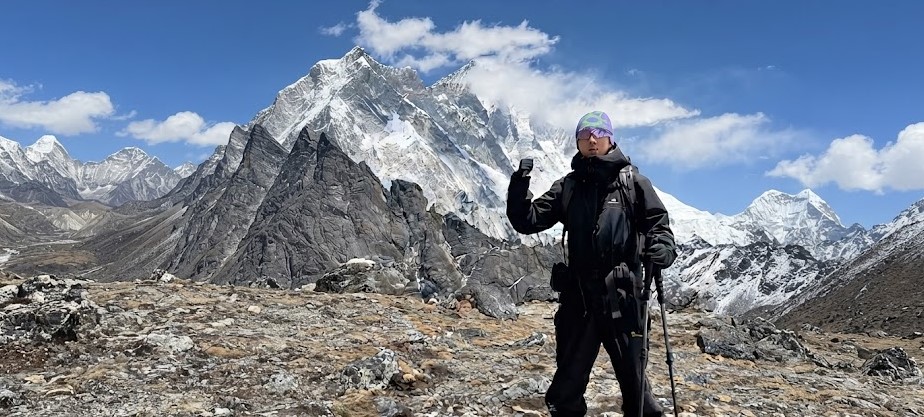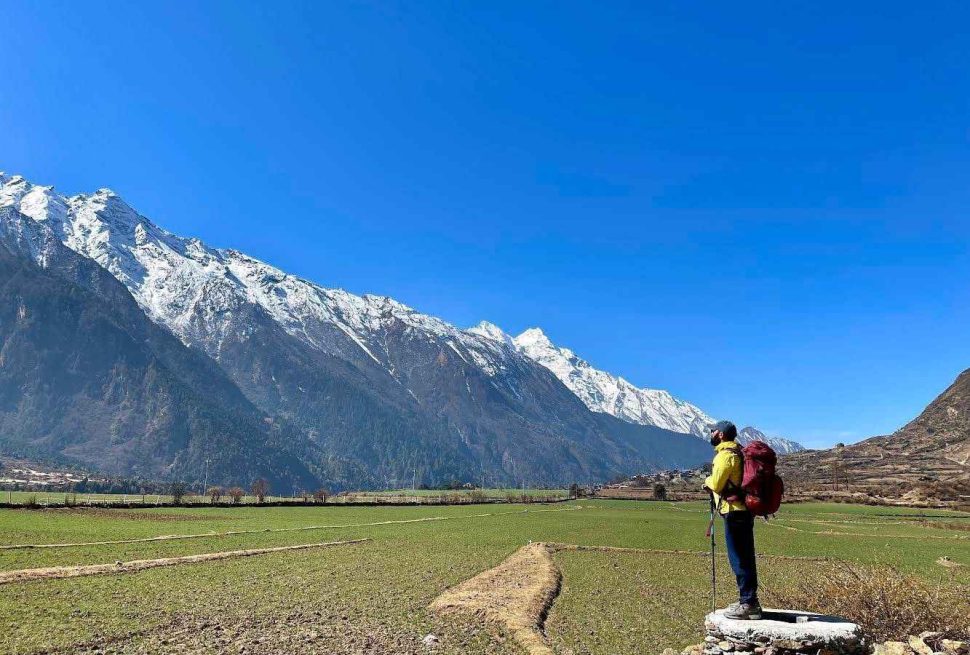
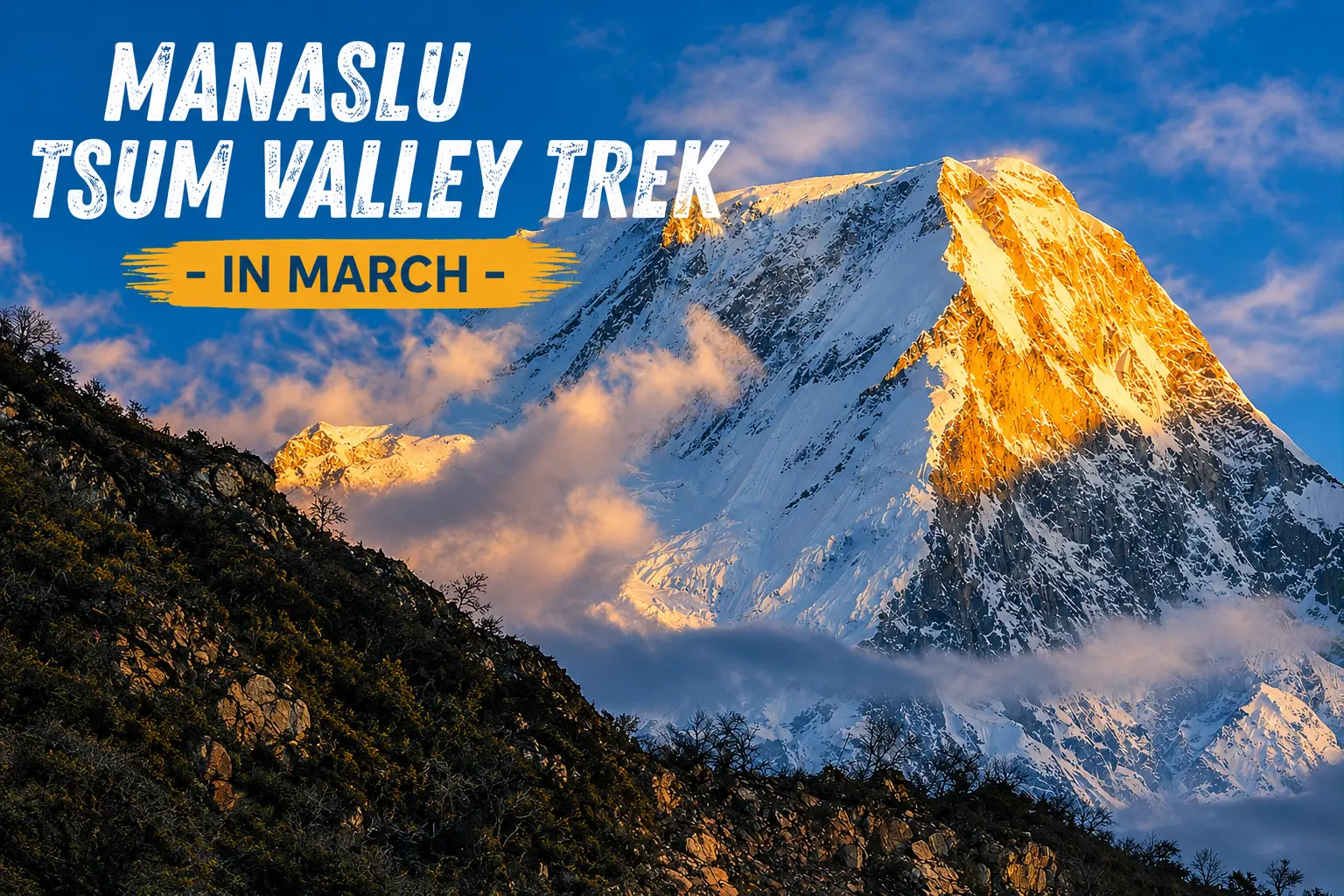
Walk into Jagat or Philim in the first week of March and you can watch the season change in real time. The willows along the Budhi Gandaki are budding, the first rhododendrons are opening below 2,500 metres, and porters who spent the winter doing other work are starting to reappear on the trail. Higher up, none of that has happened yet. Samagaun, Samdo, and the approach to Larkya La are still sitting under winter snowpack, and that split, spring in the valley, winter at altitude, is the single thing that defines trekking here in March.
For most trekkers, March is one of the better months to consider. Lower down, around Machha Khola, Jagat, and Deng, days are mild and the first rhododendrons start flowering below 2,500 metres. Higher up, Samagaun, Samdo, and the approach to Larkya La still carry meaningful snow from the winter months, especially in the first half of March. By the second half of the month, snowpack at the pass is usually softening and more parties are crossing successfully, though conditions still swing year to year and early March crossings should not be assumed easy. If you want a shoulder season trek with thinner crowds than April, are comfortable with some genuine winter gear still in your pack, and can build a flexible schedule around the pass, March works well. If you want the safest, most predictable Larkya La crossing with the least cold weather gear, April or May give you a wider margin.
If your dates land on 2 March 2026, you will be in the hills for Holi, the festival of colour, celebrated a day later in the Terai. It is mostly a Kathmandu and lower-valley event rather than a high-altitude one, so do not expect coloured powder at Samdo, but if your itinerary starts with a night or two in Kathmandu before the drive to Machha Khola, it is worth building in time to see it.
Manaslu Tsum Valley Trek in March at a glance
| Factor | March conditions |
|---|---|
| Overall feasibility | Recommended with caution, particularly early in the month |
| Larkya La (5,106 m) | Increasingly passable as the month progresses, but still weather-dependent and occasionally closed by fresh snow |
| Daytime temperature, lower valley (700-1,900 m) | 15-22°C |
| Daytime temperature, Samagaun/Samdo (3,500-3,900 m) | 2-8°C |
| Night temperature, above 4,000 m | -15°C to -22°C, milder toward month end |
| Rainfall/snowfall | Occasional snow showers at altitude, dry lower down, snow flurries possible right up to Larkya La until late March |
| Trail crowding | Low, rising toward moderate in the final week |
| Teahouse availability | More lodges reopening through the month above Samagaun |
| Permit cost tier | Dec-Aug lower rate still applies |
| Best for | Trekkers comfortable with variable conditions who want fewer people on the trail than in peak spring |
Who should consider trekking in March
March suits trekkers who have done at least one high-altitude multi-day trek before, who own or can rent proper cold-weather gear, and who are not locked into a single fixed date for crossing Larkya La. It also suits photographers and travellers who specifically want the transitional look of the valley, snow still on the peaks, first blossoms low down, trails that are not yet crowded. It is a harder sell for complete first-time trekkers, anyone who cannot build 2-3 spare days into their itinerary for weather, or anyone who is only available in the first ten days of the month, when the pass is least reliable.
Reasons to choose March, and reasons to think twice
Why March works well for many trekkers
- Lower crowds than April: teahouses are rarely full, and you get more flexibility with rooms and timing.
- Transitional scenery: snow-capped peaks above, early rhododendron blooms starting in the lower valley, a visual mix you do not get in autumn.
- Milder lower valley: the Machha Khola to Deng section is comfortable for walking, without the summer heat or monsoon mud.
- Cultural timing: Tsum Valley’s monasteries are quiet and accessible, without the trail traffic of peak season.
Why some trekkers should wait for April or May instead
- Early-month pass risk: in the first half of March, Larkya La can still be under significant snow from winter storms, and crossing conditions are less predictable than in peak spring.
- More cold-weather gear needed: you are carrying a heavier kit than you would in April, which adds pack weight and cost if you need to rent items.
- Shorter daylight than late spring: useful for planning, but it does narrow your daily walking window slightly compared with April/May.
- Weather variability: a late-season storm system can still roll through and close the pass for a day or two, so schedules need buffer days.
Weather and conditions by zone in March
Lower Budhi Gandaki: Machha Khola to Deng (700-1,900 m)
This section feels like spring is already established. Daytime temperatures typically sit between 15°C and 22°C, mornings start cool but warm quickly, and rain is uncommon. Trail conditions are generally dry and stable, though after any late-winter rain the sections near riverbanks and landslide-prone stretches can be temporarily muddy.
Tsum Valley: Chumling to Mu Gompa (2,400-3,700 m)
Tsum Valley in March is cool and often strikingly clear. Daytime temperatures at Chumling and Chhokangparo range roughly 8-14°C, dropping toward freezing overnight higher up near Mu Gompa and Rachen Gompa. Snow can linger on north-facing slopes and shaded sections of trail into March, so early risers may find icy patches before the sun clears them.
Upper Manaslu: Namrung to Samagaun (2,600-3,500 m)
This stretch shows the clearest seasonal transition. Namrung and Lho are generally walkable without special gear, while the approach to Samagaun can still have patches of packed snow on shaded trail sections, particularly in early March. Daytime temperatures range roughly 5-12°C, with nights well below freezing.
Samagaun and Samdo (3,530-3,875 m)
Daytime highs here typically run 2-8°C, with clear skies common but nights consistently cold, often -10°C to -18°C. Snow cover from winter is usually still visible on the surrounding slopes through most of March, thinning as the month goes on.
Dharmasala/Larkya Base Camp (4,460 m)
This is where March still feels like winter. Daytime temperatures rarely climb above freezing, and nights regularly drop to -15°C to -20°C or colder. Wind exposure at this camp is significant, and snow accumulation from the winter months is often still present on the ground.
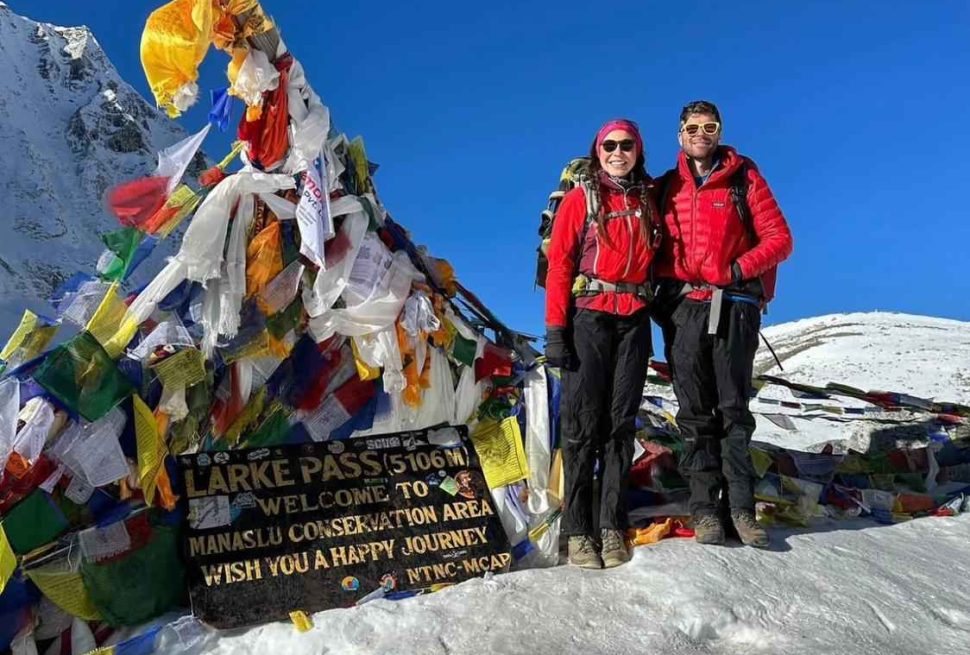
Larkya La (5,106 m)
The pass is the genuine variable in a March itinerary. Early in the month, deep winter snowpack can still make the crossing difficult or force a delay; by the second half of March, more groups report successful crossings as temperatures ease and snow begins to settle. Even so, a fresh storm can close the route for a day or more at any point in the month, and guides make the final call on the day based on conditions. Do not book a March trek assuming the pass will be open on a fixed date, build in contingency days instead.
Bhimtang and the descent to Dharapani (1,860-3,720 m)
Once over the pass, conditions improve quickly. Bhimtang can still be cold and occasionally snowy in early March, but the descent toward Tilije and Dharapani warms rapidly, and by the time you reach the Annapurna side of the route, temperatures are back into comfortable spring range.
March weather at a glance
| Zone | Altitude | Day temp | Night temp | Typical conditions |
|---|---|---|---|---|
| Machha Khola-Deng | 700-1,900 m | 15-22°C | 5-10°C | Dry, mild, occasional cloud |
| Tsum Valley | 2,400-3,700 m | 8-14°C | -2 to -8°C | Clear, cool, patchy shaded snow |
| Namrung-Lho | 2,600-3,180 m | 7-12°C | -3 to -8°C | Generally dry, some ice on shaded trail |
| Samagaun/Samdo | 3,530-3,875 m | 2-8°C | -10 to -18°C | Clear skies, thinning snow cover |
| Dharmasala | 4,460 m | -2 to 3°C | -15 to -20°C | Cold, windy, snow often present |
| Larkya La | 5,106 m | -8 to -2°C | n/a (crossed by day) | Variable, snow-dependent, improving through the month |
| Bhimtang-Dharapani | 1,860-3,720 m | 10-18°C | -2 to 5°C | Mild and improving with descent |
Rainfall, snowfall, wind and visibility in March
March is a dry month by regional standards, but not a completely rain-free or snow-free one. Precipitation at low altitude is minimal and usually short-lived if it occurs. At altitude, snowfall is more likely, especially in the first half of the month, and an unlucky weather window can bring a day or two of snow around Samagaun, Dharmasala or the pass itself. Wind is generally moderate in the lower valley and picks up noticeably above 4,000 metres, particularly at Dharmasala and on the approach to Larkya La, where cold wind chill is often a bigger factor than the ambient temperature suggests. Visibility is typically good to excellent through the month, with clear mountain views common, though a passing storm system can reduce visibility to near zero at altitude for a day.
Daylight hours in March
Daylight in March runs from roughly 6:00 am to 6:15 pm at the start of the month, extending to around 6:00 am to 6:30 pm by month end, giving approximately 12-12.5 hours of usable light. This is a meaningful improvement over January and February, and it gives more margin for a long summit-style push over Larkya La without racing the sunset, though early starts (well before dawn) remain standard practice on pass-crossing day regardless of the season.
A typical day’s weather pattern in March
Mornings are typically the clearest and calmest part of the day, particularly at higher elevations, which is why guides schedule the Larkya La crossing to start in the very early morning. Cloud tends to build through the late morning and early afternoon, especially around the high peaks, and can bring brief snow showers at altitude by mid-afternoon. Evenings usually clear again but temperatures fall quickly once the sun drops behind the ridgelines, so arriving at your teahouse before mid-afternoon is a sensible target throughout the trek.
Trail conditions in March
Below Namrung, trails are generally dry, clear and easy to follow, with only occasional muddy patches near streams. Between Namrung and Samagaun, and especially between Samagaun and Dharmasala, expect intermittent packed snow and ice on shaded sections, particularly in the first half of the month, where microspikes or similar traction aids are useful rather than optional extras. The final approach to Larkya La and the descent to Bhimtang are the most demanding sections, with snow depth varying significantly by week and by year. Guides adjust routes and pacing daily based on current snow conditions.
Road access and transport in March
Road access from Kathmandu (or Arughat/Soti Khola as the trailhead) is generally reliable in March, without the monsoon-season landslide risk that affects the June-September window. Some sections of the rougher jeep track can still be affected by residual winter damage or minor rockfall, so a same-day contingency of a few extra hours is worth planning for, but major road closures are uncommon this time of year.
Teahouses, rooms and food in March
More teahouses are open in March than in January or February, particularly from mid-month onward as lodge owners reopen ahead of the spring season. Below Samagaun, availability is generally good with no need for advance booking. Above Samagaun, including Samdo and Dharmasala, fewer lodges operate than in peak autumn, so groups are typically smaller and rooms are easier to secure, though heating and hot water may be limited or charged separately. Food menus follow the standard teahouse pattern (dal bhat, noodles, soups, basic breakfast items), with better variety at lower elevations and a simpler, more limited menu the higher you climb.
Water, charging and connectivity in March
Bottled and treated water are both available along the route; a filter or purification tablets remain the most reliable and environmentally sensible option, especially above Samagaun where boiled water can be in short supply. Charging is available in most teahouses for a fee, more reliably at lower elevations; above Samagaun, solar charging can be inconsistent on overcast days, so a power bank is a sensible backup. Mobile connectivity (NTC/local SIM) is patchy above Namrung and generally unavailable at Dharmasala and the pass itself.
How busy is the trail in March
March is a low-to-moderate crowd month. Early in the month, trail traffic is light, closer to winter levels. By the last week of March, numbers begin building toward the April peak, and teahouses in popular villages like Samagaun start filling up on the busier days. If your priority is a quiet trail, aim for the first three weeks of the month rather than the final week.
Permits and costs for March
March falls within the December-August lower permit rate tier. The Manaslu Restricted Area Permit (RAP) costs USD 75 for the first 7 days plus USD 10 per extra day. The Tsum Valley RAP costs USD 30 for the first 7 days plus USD 7 per extra day. Manaslu Conservation Area Permit (MCAP) and Annapurna Conservation Area Permit (ACAP) are each NPR 3,000 (foreigner rate), and a one-time local municipality fee of NPR 1,000 is paid on the trail to the Chum Nubri Rural Municipality. Full current details, including checkpoint locations, are on our Manaslu trekking permits guide.
Restricted area rules
The Manaslu and Tsum Valley areas remain restricted, meaning independent trekking is not permitted and all permits must be arranged through a registered trekking agency. Permits are checked at Jagat, Philim, Namrung and Samagaun for the main Manaslu route, and at Lokpa, Chumling and Chekampar for Tsum Valley, with an additional ACAP check around Dharapani. As of the 22 March 2026 rule change, the Department of Immigration removed the old minimum-two-trekkers requirement for restricted areas; one trekker travelling with one licensed guide now meets the legal requirement. If you have seen older content stating a minimum group size of two, that rule no longer applies.
Guide and porter requirements
A licensed guide from a registered agency is mandatory for both the Manaslu Restricted Area and Tsum Valley, regardless of your experience level. Porters are optional but strongly recommended in March given the extra weight of cold-weather gear; many trekkers pair one porter between two people to manage costs while still reducing pack weight for the Larkya La crossing day.
Suggested itinerary for the Manaslu Tsum Valley Trek in March
| Day | Route | Altitude |
|---|---|---|
| 1 | Kathmandu to Machha Khola | 870 m |
| 2 | Machha Khola to Jagat | 1,340 m |
| 3 | Jagat to Lokpa | 2,240 m |
| 4 | Lokpa to Chumling (Tsum Valley) | 2,386 m |
| 5 | Chumling to Chhokangparo | 3,010 m |
| 6 | Chhokangparo to Mu Gompa | 3,700 m |
| 7 | Mu Gompa exploration and acclimatisation | 3,700 m |
| 8 | Mu Gompa to Chhokangparo, descend to Gumba Lungdang or Rachen Gompa | 3,200 m |
| 9 | Descend to Lokpa, continue to Deng | 1,860 m |
| 10 | Deng to Namrung | 2,630 m |
| 11 | Namrung to Lho | 3,180 m |
| 12 | Lho to Samagaun | 3,530 m |
| 13 | Samagaun acclimatisation, side trip to Manaslu Base Camp or Birendra Lake | 3,530 m |
| 14 | Samagaun to Samdo | 3,875 m |
| 15 | Samdo to Dharmasala | 4,460 m |
| 16 | Dharmasala over Larkya La to Bhimtang | 3,720 m |
| 17 | Bhimtang to Tilije/Dharapani | 1,860 m |
| 18 | Dharapani to Kathmandu via Besisahar | 1,400 m |
This is a representative 18-day framework; most agencies build in at least one extra buffer day around the Larkya La crossing for March departures specifically, given the higher weather variability compared with April.
Acclimatisation in March
The itinerary above already includes two dedicated acclimatisation points, at Mu Gompa and Samagaun, both of which sit at or near key altitude thresholds before pushing higher. Given the added cold stress in March, staying well hydrated, eating enough calories, and resisting the urge to skip rest days even if you feel strong are all worth taking seriously. Altitude sickness risk is not lower just because it’s spring rather than the busier autumn season.
Contingency planning and buffer days
Because Larkya La conditions in March are the most variable of the spring months, build at least one, ideally two, spare days into your schedule around Dharmasala and the pass itself. Most reputable itineraries already price this in; if yours does not, ask your operator directly how weather delays at the pass are handled and whether extra nights are included or charged separately.
What to pack for March
| Category | March-specific notes |
|---|---|
| Insulation | Down jacket rated to at least -15°C still needed for Dharmasala and the pass |
| Legwear | Insulated trekking trousers or thermal layers under shell pants above Samagaun |
| Footwear | Insulated, waterproof boots; microspikes recommended for icy sections, especially early month |
| Sleep system | Four-season sleeping bag (-20°C comfort rating) still recommended |
| Sun protection | Increasingly important as days lengthen and snow glare increases |
| Rain gear | Lightweight shell useful lower down, though rain is uncommon |
Clothing and layering system for March
- Base layer: two sets of merino wool or synthetic thermal tops and bottoms.
- Mid layer: fleece or light insulated jacket for the lower and middle sections of the trek.
- Insulated outer layer: a down jacket rated to around -15°C, essential from Samagaun upward.
- Trekking trousers: a warm, wind-resistant pair for daily walking, plus thermal leggings for cold mornings and the pass day.
- Hardshell layer: a windproof, water-resistant jacket and trousers for the pass crossing and any snow showers.
Footwear for March conditions
- Boots: insulated, waterproof trekking or light mountaineering boots, broken in well before the trip.
- Traction: microspikes or similar, especially useful on icy shaded sections between Namrung and Samagaun, and on the pass approach.
- Socks: a mix of liner socks and thick wool trekking socks, with spares for the pass day.
- Gaiters: recommended for the Dharmasala to Bhimtang section where snow depth can vary.
Rain and wet-weather protection
- Waterproof jacket: a lightweight shell, more for occasional snow showers than sustained rain in March.
- Pack cover or dry bags: useful precaution even though rainfall is limited this month.
Snow and ice equipment for March
- Trekking poles: essential for stability on snow and ice, particularly on the pass descent.
- Sunglasses or glacier goggles: important for snow glare near Dharmasala and the pass.
- Gloves: a liner pair plus a heavier insulated outer pair for the pass crossing.
- Buff or balaclava: for wind protection on exposed sections above 4,000 metres.
Sleep system and personal items
- Sleeping bag: four-season, rated to around -20°C comfort.
- Sleeping bag liner: adds warmth and hygiene, cheap insurance on cold nights.
- Hot water bottle: a small rubber bottle to warm your sleeping bag at high camps is a popular low-cost addition.
Documents, money and extras
- Cash in Nepali rupees: carry enough for the full trek, as ATMs disappear beyond the lower villages.
- Permit documents and passport copies: your guide typically manages the permits, but carry your original passport and photos.
- Basic first aid and personal medication: including any altitude sickness medication discussed with your doctor in advance.
Health and altitude considerations
Altitude sickness risk on this route is a function of elevation gain and pace, not the calendar month, so the same precautions apply in March as at any other time of year: ascend gradually, use the built-in acclimatisation days, stay hydrated, and communicate any symptoms to your guide early. For a detailed look at what happens if illness occurs on route and how evacuation is handled, see our guide on what happens if you get sick on the Manaslu Circuit Trek.
Safety risks specific to March
The main March-specific risk is variable snow condition at and around Larkya La, particularly earlier in the month, which can mean anything from a straightforward crossing to a delayed or postponed one depending on recent snowfall. Cold exposure at Dharmasala and above remains a real factor even as the rest of the region warms. Trail icing between Namrung and Samagaun on shaded sections is a slip hazard worth respecting. None of these risks are unusual for the route in March, they are simply worth planning for rather than assuming away.
Travel insurance
Comprehensive travel insurance that explicitly covers trekking up to at least 6,000 metres and includes helicopter evacuation is essential for this route in any month, and March is no exception given the altitude and remoteness involved. Confirm your policy covers the specific altitude of Larkya La (5,106 m) before booking.
Is March right for beginners, experienced trekkers or solo trekkers
First-time high-altitude trekkers
March is workable for a first-timer, but only with a good guide, a flexible schedule, and realistic expectations about cold-weather gear and pacing. If it is your first multi-day trek at altitude, April is a gentler introduction.
Experienced trekkers
This is where March shines. Experienced trekkers who want fewer crowds than April and don’t mind carrying extra cold-weather kit will likely enjoy March more than the busier spring peak.
Solo trekkers
Since the 22 March 2026 rule change, one trekker with one licensed guide satisfies the restricted-area requirement, so solo trekkers can now join in March without needing to find a second trekker. See our solo trekking rule update for details.
Guides and porters: what to expect in March
Guides operating in March are typically among the more experienced staff on the roster, given the added judgment calls needed around Larkya La conditions early in the month. Expect close daily communication about the pass-day plan, and trust their call if they suggest an extra acclimatisation or weather day.
Photography in March
March rewards photographers with a different look than the other seasons: snow-dusted peaks against the first green growth lower down, clear skies for most of the month, and far fewer people in your shots than April. Golden hour light on Manaslu and the surrounding peaks is particularly striking from Samagaun and Larkya Base Camp.
Festivals and cultural events in March
Depending on the lunar calendar, some years see local Tsum Valley festivals or monastery events fall in March; timing shifts year to year, so check current dates with your operator if a specific cultural event is a priority. For a general overview, see our guide to major festivals in the Manaslu region.
Advantages and disadvantages of trekking in March
| Advantages | Disadvantages |
|---|---|
| Lower crowds than April and May | Early-month Larkya La crossing less predictable |
| Transitional scenery: snow above, blossoms below | Heavier cold-weather kit needed than in late spring |
| Easier teahouse availability than peak season | Shorter daylight than April/May, though improving through the month |
| Mild, comfortable lower valley walking | Occasional storm systems can force schedule changes |
| Reasonable permit costs (Dec-Aug tier) | Icy trail sections between Namrung and Samagaun require care |
Extra costs to budget for
Beyond permits and the standard trek package cost, budget for cold-weather gear rental if you do not own it (down jacket, sleeping bag, microspikes), a buffer night or two at teahouses in case of weather delay around the pass, hot showers and device charging (typically NPR 200-500 per use), and tips for your guide and porter, which are customary though not obligatory. Bottled or boiled water above Samagaun can also add a small daily cost compared with treating your own.
How March compares to February and April
February is colder and quieter than March, with a less reliable Larkya La crossing and heavier gear demands throughout. See our Manaslu Tsum Valley Trek in February guide for details. April, by contrast, is the more reliable of the two neighbouring months for the pass crossing, with warmer temperatures and less cold-weather gear needed, though at the cost of significantly higher trail traffic. If your priority is minimising risk around the pass, lean toward April; if your priority is minimising crowds while accepting some added winter gear and schedule flexibility, March is the better fit. Full details are in our Manaslu Tsum Valley Trek in April guide.
March month-by-month comparison table
| Month | Feasibility | Larkya La | Crowd level |
|---|---|---|---|
| February | Possible, high-risk pass crossing | Frequently snowbound | Very low |
| March | Recommended with caution | Increasingly passable through the month | Low, rising late month |
| April | Recommended, one of the best months | Normally passable with standard gear | Moderate to high |
Alternatives to consider if March doesn’t work for you
If your dates only allow the first half of March and you want to minimise pass-crossing uncertainty, consider shifting to a Tsum Valley-only itinerary that does not cross Larkya La, such as our Manaslu Tsum Valley destination options, or pushing your dates into April. If cold-weather gear cost or availability is the blocker, renting locally in Kathmandu is usually straightforward and cheaper than buying.
Final recommendation: should you trek in March
March is a good choice for trekkers who want a quieter trail than April, don’t mind carrying real cold-weather gear, and can stay flexible around the Larkya La crossing, especially in the first half of the month. It is not the easiest or most predictable month on this route, but for the right trekker it offers a rewarding middle ground between winter’s solitude and spring’s crowds. If that sounds like you, explore our 19-Day Manaslu Circuit with Tsum Valley Trek or the 23-Day Tsum Valley and Manaslu Circuit Trek, or get in touch via our contact to talk through a March itinerary with our team. For the full seasonal picture across all twelve months, see our Best Time to Go guide.
How the Rhododendron Bloom Moves Up the Valley in March
One thing that is genuinely worth planning around in March, if photography or scenery is a priority, is watching the rhododendron bloom climb the valley as the month goes on. It does not happen everywhere at once.
In the first week of March, flowering is mostly limited to the lower forest below about 1,800 metres, around Machha Khola, Khorlabesi, and Tatopani. By mid-March, the bloom line has usually pushed up past 2,000 metres into the forest sections around Jagat and Philim, and the first colour starts appearing on the lower slopes near Deng. By late March, flowering reaches into the 2,400 to 2,800 metre range around Ghap and lower Namrung, though the higher forest above Lho and toward Samagaun typically does not bloom until April.
This matters for trip planning in two ways. If rhododendrons are a genuine priority, a late March departure gives you a better chance of catching bloom across more of the route than an early March one. If you are more focused on a Larkya La crossing with the least snow risk, that same late March timing also gives the pass more time to shed winter snowpack, so the two priorities line up reasonably well this particular month.
A Guide’s View: Early March Versus Late March Departures
We get asked constantly whether to book the first week of March or the last, and the honest answer depends on what you are optimising for.
Early March departures see the thinnest crowds of the entire spring season. You will likely have Tsum Valley’s monasteries close to yourself, and lower teahouses are quiet enough that room availability is never a concern. The trade-off is that Larkya La crossings in the first two weeks of March carry real uncertainty. Our guides check pass conditions directly with contacts in Samdo before committing a group to the crossing attempt, and in a meaningful minority of early March departures, the plan shifts to an extended stay in Tsum Valley with the Circuit crossing dropped or postponed rather than forced.
Late March departures trade some of that solitude for a meaningfully higher success rate on the pass. By the last week of the month, snowpack has usually softened enough that crossings become closer to routine, weather permitting, and this is also when the rhododendron bloom is furthest up the valley. The trail is busier than early March, though still nowhere near April’s numbers.
If we are advising a client with a fixed departure date and no flexibility to postpone, we lean toward the second half of March specifically because it gives the Larkya La crossing a meaningfully better chance of going ahead as planned. If your dates are flexible and quiet trails matter more to you than a guaranteed circuit completion, early March has its own real appeal, provided you go in accepting that the full loop is not guaranteed.
Frequently asked questions
Is Larkya La open in March?
Usually, though not guaranteed. Early March crossings can be delayed by winter snowpack; by late March, more groups cross successfully as conditions ease. Build in buffer days regardless.
Is March too cold for the Manaslu Tsum Valley Trek?
No, but it is cold at altitude, particularly at Dharmasala and the pass, where night temperatures can drop to -20°C. Proper gear makes it manageable.
Do I need crampons in March?
Full crampons are not typically necessary; microspikes are usually sufficient for the icy sections between Namrung and Samagaun and near the pass.
How busy is the trail in March compared to April?
Noticeably quieter, especially in the first three weeks. Numbers pick up toward the very end of the month as the April peak approaches.
What permits do I need for March?
Manaslu RAP, Tsum Valley RAP, MCAP, ACAP and a local municipality fee, all at the December-August lower rate tier. See our permits guide for current figures.
Can I trek solo in March?
Yes. Since the 22 March 2026 rule change, one trekker with one licensed guide meets the restricted-area requirement.
Is a down jacket necessary in March?
Yes, a jacket rated to around -15°C is recommended from Samagaun upward, and essential at Dharmasala and the pass.
What is the weather like in Tsum Valley in March?
Cool and generally clear, with daytime temperatures around 8-14°C at Chumling and Chhokangparo, dropping toward freezing overnight at Mu Gompa.
Are teahouses open in March?
Yes, and more open through the month than in January or February, particularly from mid-March as lodges reopen ahead of spring.
How many days does the trek take in March?
A typical itinerary runs 17-19 days including acclimatisation and a buffer day for the pass, similar to other months but sometimes with an extra contingency day built in for March specifically.
Is altitude sickness more likely in March?
Not inherently more likely than other months, it depends on pace and acclimatisation, not the calendar.
What is the best week in March to trek?
The final two weeks of the month generally offer the best balance of improving pass conditions and still-manageable crowd levels.
Do I need trekking poles in March?
Yes, they are strongly recommended for stability on snow and ice, particularly around the pass.
Is travel insurance required?
Yes, comprehensive insurance covering trekking to at least 6,000 metres with helicopter evacuation is essential.
How cold does it get at Larkya La in March?
Daytime crossing temperatures typically range from -8°C to -2°C, with significant wind chill on exposed sections.
Can beginners do this trek in March?
It is possible with a good guide and flexible schedule, but April offers an easier introduction for genuine first-timers.
Is March better than October for this trek?
They offer different trade-offs: October has more stable weather and clearer views but far higher crowds; March offers a quieter trail with more variable, colder conditions at altitude.
What should I do if the pass is closed when I arrive at Dharmasala?
Your guide will wait for a weather window using your buffer days; in rare cases of extended closure, the itinerary can be adjusted with your operator’s support.
The 19-Day Manaslu Circuit with Tsum Valley Trek is one of Nepal’s most rewarding long-distance Himalayan journeys, combining remote valleys, ancient…