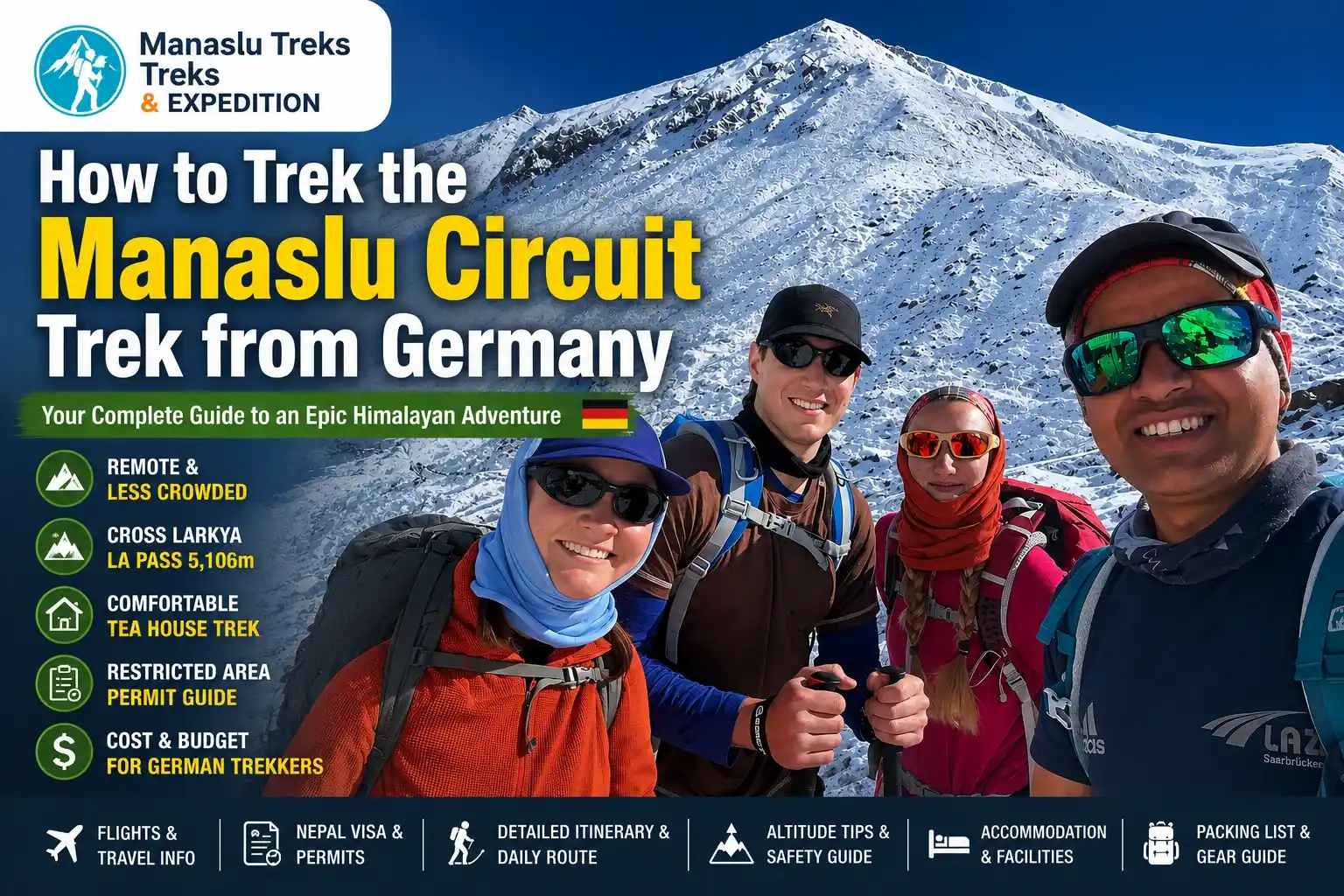
The Manaslu Circuit Trek from Germany is becoming increasingly popular among German trekkers searching for a remote and authentic Himalayan trekking experience in Nepal. Compared to the crowded Everest Base Camp route, the Manaslu Circuit Trek Nepal offers quieter trails, traditional Tibetan villages, dramatic mountain scenery, and a more adventurous trekking atmosphere. Our manaslu trek company provides fully customised itineraries with no advance deposit required.
The Manaslu Circuit Trek is one of Nepal’s best remote tea house treks, combining glacier valleys, suspension bridges, high mountain passes, and the spectacular crossing of Larkya La Pass at 5,106 meters. Because the Manaslu region is protected by restricted area permit regulations, visitor numbers remain much lower than Everest and Annapurna, which makes the trek especially attractive for experienced hikers from Germany.
This complete Manaslu Circuit Trek Nepal guide explains everything German trekkers need to know before traveling from Germany to Nepal, including international flights, Nepal visa information, Manaslu Treks permits, trekking difficulty, altitude preparation, accommodation, internet access, transportation logistics, and realistic Manaslu trek cost from Germany.
Manaslu Treks and Expedition, we organise the Manaslu Circuit Trek year-round for international trekkers, including a growing number of German-speaking visitors from Germany, Austria, and Switzerland. This guide reflects what we actually tell our clients before they book, not a generalised overview pulled from outdated sources.
Planning the Manaslu Circuit Trek and need help with permits, route, or itinerary?
WhatsApp us Email usWhy German Trekkers Choose the Manaslu Circuit Trek from Germany
German trekkers who have already done the Everest Base Camp or Annapurna Circuit often begin looking for something less crowded and more culturally authentic on their second or third Nepal trip. The Manaslu Circuit consistently comes up as the answer.
The trail circles Mount Manaslu, the world’s eighth-highest peak at 8,163 metres, through the Gorkha district of Nepal. The entire section between Jagat and Dharapani is a government-designated restricted area, which means permit requirements actively cap the number of visitors. The villages in the upper valley, particularly Samagaon, Samdo, and Lho, belong to the Nubri community, a Tibetan Buddhist culture with its own language, architecture, and traditions. The monasteries here, including Ribung Gompa at Samagaon and Lho Monastery with its direct view of Manaslu’s west face, are genuinely ancient and actively in use.
For German trekkers, the practical appeal is also significant. The Manaslu Circuit does not require any domestic flights. The drive from Kathmandu to the trailhead at Machha Khola takes about 9 to 10 hours by private jeep. The trek itself runs for 12 to 16 days, depending on the itinerary. With two weeks of annual leave in Germany, a well-planned trip of 20 to 22 total travel days, including flights and Kathmandu days, is entirely realistic.
Step One: Flights from Germany to Kathmandu
There are no direct flights from Germany to Kathmandu. All routes require at least one connecting stop. The main departure airports in Germany for this route are Frankfurt (FRA) and Munich (MUC). Berlin (BER), Düsseldorf (DUS), and Hamburg (HAM) are also options with onward connections, though Frankfurt and Munich have the strongest range of connecting services to Kathmandu.
Common connecting routes from Germany to Kathmandu:
Turkish Airlines operates one of the most frequently used routes, connecting Frankfurt and Munich to Kathmandu via Istanbul. The total travel time is typically around 11 to 13 hours. Turkish Airlines has a strong track record on this route and is a popular choice among German trekkers heading to Nepal.
Qatar Airways connects Frankfurt and Munich to Kathmandu via Doha. Travel time is comparable to the Turkish Airlines route and the connection at Hamad International Airport is generally smooth.
Etihad Airways connects Munich to Kathmandu via Abu Dhabi. From September 2026, Etihad is increasing the Munich to Abu Dhabi service to three daily flights, which improves onward connection options.
Emirates connects Frankfurt and Munich to Kathmandu via Dubai. This is another well used option with reliable onward connections.
Air Arabia connects Munich to Sharjah with onward connections to Kathmandu. This can be a more budget friendly option but requires attention to layover times and luggage allowances.
Flight costs from Germany to Kathmandu:
Round trip economy fares from Frankfurt to Kathmandu typically range from around EUR 500 to EUR 900 for travel during the main trekking seasons of autumn (October and November) and spring (March to May). Booking three to four months ahead of your departure generally gives the best combination of availability and price. Autumn departures in September and October tend to be more expensive than spring departures in March and April because demand from trekking groups peaks in autumn.
For German trekkers planning an October departure, which is the most popular month for the Manaslu Circuit, booking flights by June or July is advisable. Seats on the most convenient connecting flights from Frankfurt or Munich to Kathmandu fill up during peak season, particularly on Turkish Airlines and Qatar Airways.
Flight duration:
From Frankfurt, the total journey to Kathmandu including the connecting stop is typically between 11 and 14 hours depending on the airline and layover duration. From Munich, times are similar. Most itineraries arrive at Tribhuvan International Airport in Kathmandu in the evening or late night, so planning your first night in Kathmandu before any permit processing or briefing is the standard approach.
Planning the Manaslu Circuit Trek and need help with permits, route, or itinerary?
WhatsApp us Email usStep Two: Nepal Visa for German Citizens
German citizens are eligible for a Nepal tourist visa on arrival at Tribhuvan International Airport in Kathmandu. You do not need to apply in advance or visit a Nepalese embassy in Germany before travel.
Visa options and fees (2026):
The 15 day visa costs USD 25 per person. The 30 day visa costs USD 50 per person. The 90 day visa costs USD 125 per person.
For most German trekkers planning the Manaslu Circuit, the 30 day visa is the right choice. A 14 day Manaslu Circuit Trek plus two or three days in Kathmandu before and after adds up to around 17 to 20 days total in Nepal. The 30 day visa gives you adequate buffer for any delays due to weather, road conditions, or permit processing, and costs only USD 25 more than the 15 day option. That extra buffer matters more than the cost difference.
What to bring for the visa on arrival:
A passport with at least six months validity beyond your entry date and at least one blank page for the visa stamp. Two passport sized photographs (though the airport kiosks now have photo functionality, bringing printed photos saves time). Visa fee in USD cash or Euros. The airport has currency exchange before the immigration counters.
Online pre arrival form:
Nepal’s Department of Immigration operates the NepaliPort system, which allows you to fill in your visa application form before departure from Germany. Completing this online and printing the barcode confirmation significantly reduces your time at the visa counter in Kathmandu, particularly useful if you arrive during a busy period such as early October when multiple trekking groups are arriving simultaneously.
Passport validity reminder:
Your German passport must have at least six months of validity remaining on the date you enter Nepal. Check this before booking flights. German passports renewed in Germany are typically processed within three to six weeks, so if your passport is close to expiry, renew it before you confirm your Nepal trip.
Step Three: Travel Insurance Requirements
Travel insurance is mandatory for the Manaslu Circuit Trek, not just recommended. Since March 2026, the Restricted Area Permit for the Manaslu region will not be issued unless your travel insurance policy explicitly covers helicopter evacuation up to 6,000 metres.
For German trekkers, this is an important detail because standard European travel insurance policies often cover emergency evacuation but may not specifically state 6,000 metres altitude. When purchasing travel insurance in Germany for a Himalayan trek, verify that the policy:
Covers emergency helicopter evacuation and rescue at high altitude (minimum 6,000 metres stated explicitly in the policy). Covers medical treatment including hospitalisation in Nepal. Covers trip cancellation and curtailment. Has a minimum coverage value of USD 100,000 for emergency medical and evacuation combined.
German travel insurers that offer specific trekking or adventure travel extensions include Allianz, ERGO, and specialist providers such as Europäische Reiseversicherung. When purchasing, specify that the trek reaches altitudes above 5,000 metres and that helicopter evacuation cover at that altitude is required. Carry both a printed and digital copy of your insurance policy. Your trekking company will ask to see proof of insurance before your permits are processed.
Step Four: Manaslu Circuit Trek Permits from Germany
You cannot obtain the permits for the Manaslu Circuit Trek in Germany or online before arriving in Nepal. All permits must be processed through a Nepal government registered trekking agency in Kathmandu after your arrival.
This is a legal requirement, not just a preference. The Restricted Area Permit (RAP) for the Manaslu region is issued by Nepal’s Department of Immigration and the application must be submitted by a registered agency on your behalf, using your original passport with your Nepal visa already stamped.
What this means practically for German trekkers:
You need to arrive in Kathmandu at least one full working day before your trek begins. If your trek departs on a Thursday, you should arrive in Kathmandu no later than Tuesday evening to allow Wednesday for permit processing. Permits are typically issued within a few hours if all documents are complete, but immigration offices are closed on Saturdays and Sundays, so plan around these days.
Permits required for the Manaslu Circuit Trek:
The Manaslu Restricted Area Permit (MRAP) covers the section between Jagat and Dharapani. Costs for autumn season (September to November): USD 100 per person for the first 7 days, then USD 15 per person per additional day. Off season (December to August): USD 75 per person for the first 7 days, then USD 10 per person per additional day.
The Manaslu Conservation Area Permit (MCAP) is required from Philim village onward and costs approximately NPR 3,000 (around USD 23) for non SAARC nationals.
The Annapurna Conservation Area Permit (ACAP) is required if your route exits via Dharapani, which is the standard Manaslu Circuit finish. It costs approximately NPR 3,000 (around USD 23) for non SAARC nationals.
The Chumnubri Rural Municipality Permit is a small local fee collected along the trail, typically NPR 1,000.
TIMS cards are no longer required for the Manaslu Circuit Trek. The permit system now uses QR coded permits that are scanned at checkpoints including Jagat, Philim, Deng, and Samdo.
Documents your trekking company needs from you:
A copy of your passport (the photo page and the page with your Nepal visa). Two passport sized photographs. A copy of your travel insurance policy showing helicopter evacuation cover. Your trekking itinerary (which the agency prepares for you).
Manaslu Treks and Expedition handles all permit processing on your behalf. We collect your documents before you arrive and process everything on your first full working day in Kathmandu so that no time is wasted.
Step Five: Planning Your Manaslu Circuit Trek Itinerary
The standard Manaslu Circuit Trek itinerary runs for 14 days and is the format used by Manaslu Treks and Expedition. For German trekkers with limited annual leave, this format is the most practical option. The full itinerary with day by day details is covered separately in our dedicated route guide. Below is the essential structure.
Day 1: Drive from Kathmandu to Machha Khola (930m). This is a full day of driving, approximately 9 to 10 hours by private jeep. The road is good until Arughat, then becomes rough and narrow along the Budhi Gandaki River gorge.
Days 2 to 4: Trek through the Budhi Gandaki gorge from Machha Khola through Jagat (1,340m), Deng (1,860m), and on to Namrung (2,630m). This lower section of the circuit follows a dramatic river gorge with vertical cliffs, suspension bridges, waterfalls, and the first Buddhist mani walls and prayer flags appearing as you move north.
Days 5 and 6: Trek from Namrung through Lho (3,180m) to Samagaon (3,520m). The upper Nubri Valley opens here and the first clear views of Mount Manaslu appear from Lho village. Samagaon is the largest settlement in the upper valley and the cultural heart of the trek.
Day 7: Acclimatisation day at Samagaon with an optional day hike to Manaslu Base Camp (4,800m) or Birendra Lake (3,450m). This day is essential and should not be skipped.
Days 8 and 9: Trek from Samagaon to Samdo (3,875m) and then to Dharamsala or Larkya Phedi (4,460m). These are short days designed to allow the body to adjust to the altitude before the pass crossing.
Day 10: Cross the Larkya La Pass (5,160m) and descend to Bhimthang (3,720m). This is the longest and hardest day of the trek, typically 9 to 11 hours of walking starting before dawn.
Days 11 and 12: Descend from Bhimthang through Tilche (2,300m) to Dharapani (1,860m) and drive back to Kathmandu or Besisahar.
For German trekkers who want to combine the Manaslu Circuit with the Tsum Valley, the Tsum Valley and Manaslu Circuit route adds approximately 6 to 8 days and branches off from the main circuit near Lokpa.
Step Six: Getting to the Trailhead from Kathmandu
There are no domestic flights to the Manaslu region. All transport to the trailhead at Machha Khola is by road. This is one of the practical differences between the Manaslu Circuit and the Everest region, where most trekkers fly to Lukla.
Private jeep from Kathmandu to Machha Khola:
A private jeep is the recommended option for German trekkers doing the Manaslu Circuit. The drive takes approximately 9 to 10 hours. The road follows the Prithvi Highway west along the Trishuli River before turning north at Arughat and continuing along the Budhi Gandaki River to Machha Khola. From Arughat onward the road is unpaved, narrow, and dusty in the dry season or muddy after rain. A private jeep is considerably more comfortable than a public bus on this section and allows for flexible rest stops.
The cost of a private jeep from Kathmandu to Machha Khola is approximately USD 180 to 200 per vehicle. Most trekking packages, including those offered by Manaslu Treks and Expedition, include this transport as part of the package.
Return transport:
At the end of the trek, the return drive from Dharapani (or Besisahar) to Kathmandu is arranged in advance by the trekking agency. This drive takes approximately 6 to 8 hours.
Step Seven: Kathmandu Before and After the Trek
German trekkers typically spend two nights in Kathmandu before the trek and one night after. The pre trek days are used for permit processing, a pre trek briefing with the guide, gear checks, and any final equipment purchases.
Accommodation in Kathmandu:
The Thamel neighbourhood in central Kathmandu is where most trekkers stay. It has a wide range of guesthouses and hotels from budget to mid range, along with gear rental shops, pharmacies, currency exchange counters, and Nepali and international restaurants. Three star hotels in Thamel cost between USD 30 and 80 per night for a double room with breakfast included.
Gear and equipment in Kathmandu:
If you are travelling from Germany with hand luggage only or want to avoid checking equipment, Thamel has gear rental and purchase shops where you can find most trekking equipment at reasonable prices. Quality varies. Trekking poles, sleeping bags, down jackets, and rain gear are all available to rent or buy. If you bring your own gear from Germany, the quality is generally more reliable, particularly for layering clothing and footwear.
Currency in Kathmandu:
The Nepali Rupee (NPR) is the local currency. There are ATMs throughout Thamel that accept international cards. Bring some EUR or USD cash as a backup because ATM availability becomes limited after Arughat on the trek route, and there are no ATMs anywhere in the Manaslu restricted area. Carry enough Nepali Rupees for the entire trek before leaving Kathmandu.
Planning the Manaslu Circuit Trek and need help with permits, route, or itinerary?
WhatsApp us Email usStep Eight: What to Pack for the Manaslu Circuit Trek from Germany
Packing for a Himalayan trek from Germany requires thinking about the full range of conditions you will encounter, from the warm subtropical forests of the lower gorge at 930 metres to the snow and ice conditions at the Larkya La Pass at 5,160 metres.
Essential clothing layers:
Moisture wicking base layers for walking. Mid layer fleece for evenings and rest days. Down jacket (at least 600 fill power) for high altitude sections and cold nights. Waterproof and windproof outer shell jacket. Trekking trousers, lightweight for lower sections and warm insulated for high altitude. Warm hat, gloves, and buff or neck warmer.
Footwear:
Sturdy, waterproof trekking boots that have been properly broken in before the trip. Do not buy new boots for the Manaslu Circuit. Blisters at altitude in a remote location are a serious problem. Light camp shoes or sandals for teahouse evenings.
Technical equipment:
A good quality trekking headlamp with fresh batteries and spare batteries. This is non negotiable for the pre dawn Larkya La crossing. Trekking poles, which are very useful on steep descents and essential on snow sections near the pass. Gaiters, which keep snow and debris out of your boots on the pass section. Crampons are generally not required for autumn trekking but may be needed for November or spring crossings depending on conditions.
Health and safety:
Personal first aid kit. Diamox (acetazolamide) for altitude sickness prevention and treatment. Consult your doctor in Germany before the trip and get a prescription. Sunscreen with a minimum SPF 50, essential at high altitude where UV radiation increases significantly. Lip balm with sun protection. Oral rehydration salts. A pulse oximeter to monitor your own oxygen saturation, particularly useful above 4,000 metres.
Documents:
Original passport. Copies of all permits (carried separately from the originals). Printed copy of your travel insurance policy including the helicopter evacuation clause. Emergency contact list including your trekking agency’s contact details.
Step Nine: Altitude and Acclimatisation for German Trekkers
Most German trekkers arrive in Kathmandu at around 1,400 metres altitude. If you have spent the past months at sea level in Germany, the transition to 5,160 metres at the Larkya La Pass will be noticeable regardless of your fitness level.
Altitude sickness facts:
Acute Mountain Sickness (AMS) can affect anyone, regardless of age, fitness, or previous Himalayan experience. The primary cause is ascending too quickly and not giving the body time to produce more red blood cells and adapt to reduced oxygen levels. The Manaslu Circuit itinerary is specifically designed with acclimatisation built in, particularly the rest day at Samagaon (3,520m) before ascending to Samdo and Dharamsala.
The warning signs of AMS include a persistent headache that does not respond to paracetamol, nausea, loss of appetite, fatigue beyond what the day’s effort warrants, dizziness, and shortness of breath at rest. If any of these symptoms appear, the correct response is to stop ascending and rest at the current altitude. If symptoms worsen over 24 hours, descend immediately.
Diamox for German trekkers:
Diamox (acetazolamide) is available by prescription in Germany (Acetazolamid or Diamox brand). It is commonly prescribed to prevent and treat AMS. The standard preventative dose is 125mg twice daily, beginning one to two days before ascending above 3,000 metres. Side effects include increased urination and tingling in the fingers and toes. Consult your GP or a travel medicine specialist in Germany before the trip to discuss whether Diamox is appropriate for you and to get a prescription.
Altitude acclimatisation strategy on the Manaslu Circuit:
The 14 day itinerary builds adequate acclimatisation with gradual altitude gains in the lower sections, a rest day at Samagaon with a day hike to 4,800 metres, short stages from Samagaon to Samdo and then to Dharamsala, and an early start on the Larkya La crossing day to allow descent to Bhimthang before potential afternoon weather changes.
Do not attempt to shorten the itinerary to save time by skipping the Samagaon rest day. The altitude jump between Samagaon (3,520m) and the Larkya La (5,160m) is significant, and the acclimatisation day directly reduces your risk of developing serious altitude sickness on the pass.
Step Ten: Permits, Guides, and Group Rules
German trekkers sometimes ask whether they can do the Manaslu Circuit without a guide. The answer is no. The restricted area regulations require all trekkers to be accompanied by a licensed government approved guide from a registered trekking agency at all times in the restricted section between Jagat and Dharapani.
The March 2026 rule change by Nepal’s Department of Immigration now allows solo German trekkers to obtain the Restricted Area Permit individually, without needing a second foreign trekker named on the same permit. This is a change from the previous requirement for a minimum of two foreign trekkers. However, the licensed guide requirement was not changed and remains strictly enforced at all checkpoints.
In practice, German solo trekkers who book through Manaslu Treks and Expedition are assigned a dedicated licensed guide who accompanies them throughout the restricted area. Trekkers who want a porter in addition to the guide can add this to their package.
Total Budget Planning for German Trekkers
Understanding the full cost of the Manaslu Circuit Trek from Germany helps you plan your trip realistically. Costs below are approximate for 2026 and are quoted in USD for international costs and EUR for Germany based costs.
Flights from Germany to Kathmandu and back: EUR 500 to EUR 900 for economy round trip from Frankfurt or Munich, depending on airline and booking timing.
Nepal visa on arrival (30 days): USD 50.
Travel insurance (adventure trekking, helicopter evacuation included): EUR 80 to EUR 200 depending on provider and coverage level.
Trekking package (14 day Manaslu Circuit with guide, permits, transport, teahouse accommodation, and three meals per day): USD 1,000 to USD 1,400 per person for a private booking. Group bookings are typically lower.
Kathmandu hotel (3 nights before and after at a Thamel guesthouse): USD 30 to 80 per night, so approximately USD 120 to 240 total.
Personal spending in Kathmandu and on the trail (charging fees, hot showers, extra drinks, tips, gear purchases): Approximately USD 200 to 400 for the full trip.
Approximate total trip cost per person from Germany: EUR 2,000 to EUR 3,200 depending on flight cost, accommodation choices, and personal spending habits. For a two person booking, costs per person at the lower end of this range are realistic with careful planning.
Safety and Emergency Procedures for German Trekkers
The Manaslu restricted area is genuinely remote. Above Samagaon, the nearest road is several hours of walking away and helicopter evacuation is the only realistic option for medical emergencies.
Travel registration:
German citizens can register their trip with the German Foreign Office (Auswärtiges Amt) through the ELEFAND (Elektronische Erfassung von Deutschen im Ausland) registration system. This is not mandatory but is recommended for trekking in remote areas. If a natural disaster, serious injury, or emergency occurs, the German embassy in Kathmandu can assist more effectively if they know you are in the country.
The German Embassy in Kathmandu is located in Gyaneshwor and can be reached on +977 1 4412786. Save this number in your phone before you leave Germany.
Emergency evacuation:
Your travel insurance must cover helicopter evacuation. In the event of a medical emergency on the trail, your guide from Manaslu Treks and Expedition will contact our Kathmandu office, which coordinates with helicopter evacuation services. The most commonly used services for Manaslu evacuations are based in Kathmandu and can typically reach the upper valley within two to three hours of a confirmed request.
Communication on the trail:
Mobile network coverage on the Manaslu Circuit has improved significantly in recent years. NTC SIM cards now work reliably on most sections of the trek, with 4G service available in many villages, including Samagaon and Samdo. In most places along the route, trekkers can use mobile data for WhatsApp, Viber, and basic internet access. The main area where the internet and mobile signal become unavailable is around Dharamsala (Larkya Phedi) and during the crossing of the Larkya La Pass. A local NTC SIM card can easily be purchased in Kathmandu, especially in Thamel, for around USD 3 to 5. Some teahouses also offer WiFi for an additional charge, although the mobile network is often more reliable than lodge WiFi on the Manaslu trek.
Best Time to Do the Manaslu Circuit Trek from Germany
Autumn (September to November):
October is the most popular month for German trekkers on the Manaslu Circuit. The monsoon ends in late September, skies clear rapidly, and October brings the clearest views, most stable weather, and best trail conditions. The temperature is comfortable for walking at lower altitudes and cold but manageable at higher sections. By late November the Larkya La begins accumulating snow and crossing conditions become more demanding.
If you are booking from Germany, October availability with good guides and teahouse accommodation fills up quickly. Contacting Manaslu Treks and Expedition by June at the latest for an October departure is practical advice.
Spring (March to May):
Spring is the second best season. Rhododendron forests bloom from late March through April, covering the lower trail sections in striking colour. The days are warm and clear in the mornings though cloud build up in the afternoons increases through May. Late March through April is the best window within this season.
Monsoon and winter:
The monsoon season from June through August and deep winter from December through February are not recommended for the majority of German trekkers. If you have extensive Himalayan experience and want a completely solitary experience, a shoulder season booking in late November or early March can work with the right preparation.
Why Book with Manaslu Treks and Expedition
German trekkers planning the Manaslu Circuit from Germany need a trekking company that handles every logistical detail reliably, communicates clearly in English, processes permits correctly, and employs guides who genuinely know the Manaslu region.
Manaslu Treks and Expedition specialises exclusively in the Manaslu region and Tsum Valley. Our knowledge of the route, the checkpoints, the teahouse network, and the communities along the trail comes from years of regular work in this specific area rather than from a general Nepal trekking catalogue.
We communicate with German clients via email and WhatsApp before departure and provide a detailed pre trip briefing that covers everything from permit documents to packing advice, altitude preparation, and what to expect at each stage of the route. All permits are processed through official government channels and clients receive copies of every permit before the trek begins.
Our guides hold Nepal Tourism Board licences and have led the Manaslu Circuit multiple times across all seasons. They carry first aid kits, pulse oximeters, and emergency contact procedures. They speak English clearly and have experience working with European trekkers including German speaking clients.
If you are planning the Manaslu Circuit Trek from Germany and want clear, honest advice before you book, reach out to us directly at Manaslu Treks and Expedition. We will give you a realistic picture of what the trek involves, what the total cost will be, and what you need to prepare before you leave Germany.
Planning the Manaslu Circuit Trek and need help with permits, route, or itinerary?
WhatsApp us Email us