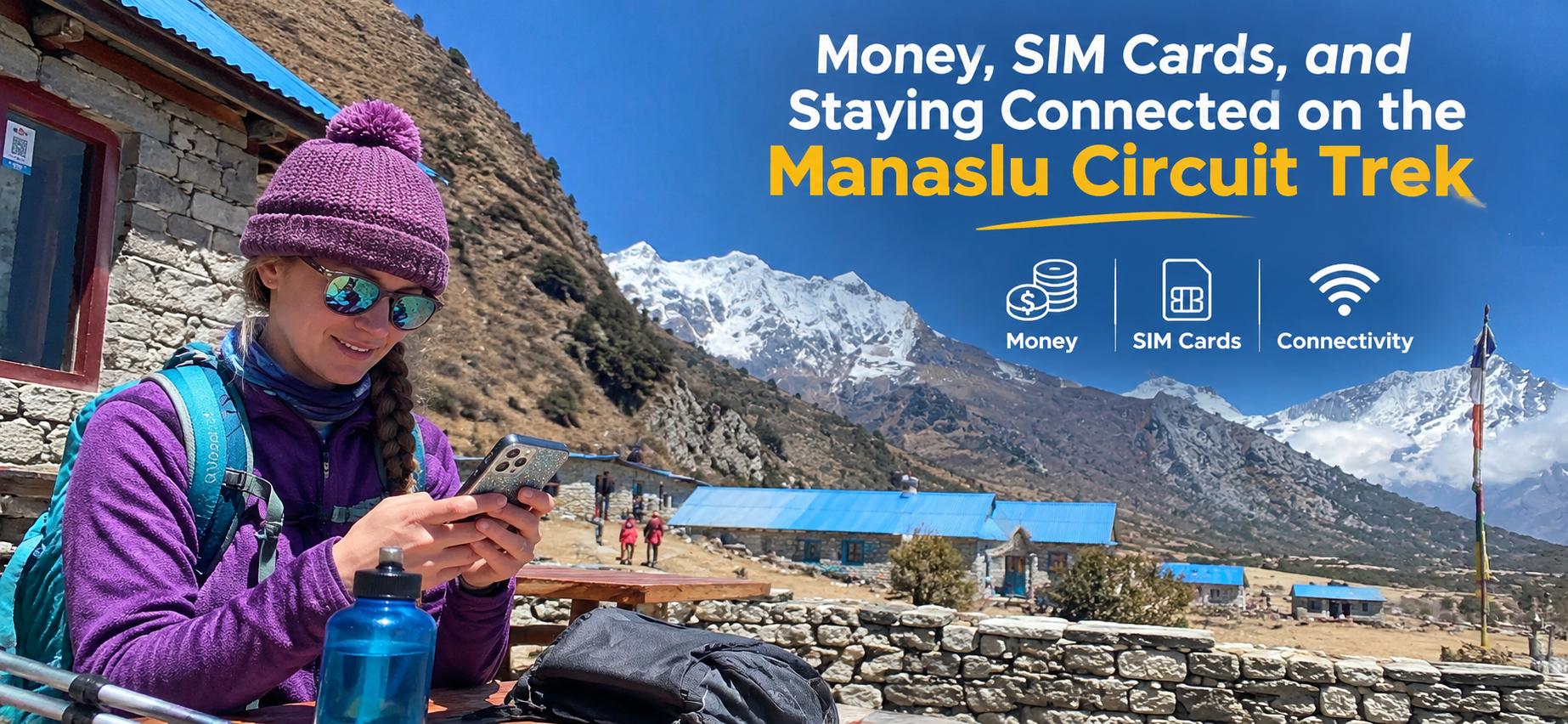
Why Money and Connectivity Deserve Their Own Guide on This Route
Most of what gets written about the Manaslu Circuit Trek covers permits, altitude, teahouses and what to pack. All of that matters, but it skips over two questions that trip up a surprising number of trekkers in the first three days: how much physical cash should I be carrying, and will my phone actually work out here. On the main Manaslu Circuit Trek route these are not minor logistics. They are the difference between a relaxed trek and a stressful one, because once you leave the lowland bazaars behind the valley simply does not offer the backup options you might be used to from other parts of Nepal.
We get asked about this constantly, usually a few days before departure, and usually in a slightly panicked tone. Someone has just read a forum post claiming there is an ATM in a random village, or a blog claiming WiFi is available in most teahouses, and they want to know if that is actually true. The honest answer, most of the time, is that nobody can tell you with full certainty, because conditions on this particular route change faster than the articles written about it. What we can do is lay out what is verified, what is widely reported but not independently confirmed, and what is simply marketing copy repeated from one trekking company site to another without anyone checking it on the ground. This article tries to do that honestly, denomination by denomination and village by village, rather than repeating the usual reassuring lines.
The Honest Answer on ATMs: Where Cash Access Actually Ends
Here is the short version, and we would rather give it to you plainly than bury it under caveats: once you leave the Kathmandu area and the drive toward Arughat and Soti Khola, you should assume there is no working ATM for the rest of the Manaslu Circuit Trek. Not a slow one, not an occasional one, none. Everything you need in rupees has to be in your pocket or your guide’s pocket before you get on the jeep or bus out of the city.
The last machine you can actually count on
Kathmandu is the last place with a dense, reliable network of ATMs that accept foreign cards without drama. Pokhara also has plenty if your itinerary routes you through there, though most Manaslu treks start and end closer to Kathmandu or Gorkha. Several trekking company guides, cross checked against each other, agree on this point even where they disagree on details elsewhere: withdraw everything you think you will need before you leave the city, because the restricted area beyond Soti Khola is effectively a cash free zone in the sense that there is no cash dispensing machine, not that cash is not used, it absolutely is, constantly, for every meal and every room.
What about Arughat
This is where sources genuinely disagree, and we think it is worth saying so rather than pretending there is a clean answer. Some guides list Arughat Bazar as the last reliable withdrawal point on the way in. Others describe the entire Manaslu route as having no functioning ATM at all once you leave the city, full stop, and specifically advise against counting on anything in Arughat. We were not able to independently confirm, through a current, verifiable source, that a machine in Arughat reliably works for international cards, dispenses NPR notes consistently, or is even stocked with cash on a given day. Small town ATMs in rural Nepal have a habit of running dry during festival periods or simply sitting offline for weeks at a time with nobody in a hurry to fix them. Even if a machine physically exists in Arughat, treating it as your contingency plan is a bet we would not recommend making. If you want a rule you can actually rely on, it is this one: Kathmandu is your last guaranteed ATM. Anything past that is a maybe at best, and a maybe is not something you want standing between you and dinner in Samagaon.
Why this matters more here than on Everest or Annapurna
On the Everest Base Camp trek, Namche Bazaar has ATMs that, while not perfectly reliable, give you a real fallback partway through the trek. On the Annapurna Circuit, Besisahar and even Chame have banking access, so a miscalculation early on can often be corrected later. Manaslu does not offer that safety net. This is a restricted area trek, permit controlled, with a noticeably smaller number of teahouses and a thinner support infrastructure than the two more developed circuits. If you run short of cash in Samagaon or Dharamsala, there is no branch to walk into and no machine to try. Your options narrow to borrowing from another trekker, which is awkward and not something to plan around, or your guide fronting money if your arrangement allows for it, which puts your trip in someone else’s hands in a way you would rather avoid. Budget conservatively here. It is one of the more practical pieces of advice buried inside the Manaslu trekking permit guide and the accommodation guide for the Manaslu Circuit Trek, and it deserves to be said plainly rather than left as a footnote.
Picture the actual scenario for a moment, because it helps explain why this keeps catching people out. A trekker underestimates how many extra teas, bowls of noodles and hot showers they will buy over sixteen days, assumes they can top up later the way they might on a city holiday, and by the time they reach Samagaon they are counting notes with real concern rather than casual curiosity. On Everest Base Camp, that same trekker could walk into Namche and pull more cash, imperfectly but workably. On the Annapurna Circuit, Chame or even Manang offer something similar. On Manaslu, the honest fix at that point is borrowing from a fellow trekker, asking the guide to cover costs against a later settlement, or simply cutting back on showers and extra food for the rest of the trip. None of those are disasters, but all of them are avoidable with a slightly larger cash buffer carried out of Kathmandu in the first place. Guides on this route tend to carry a working float of their own cash precisely because this situation comes up often enough to plan around, which tells you something about how common the mistake is.
There is also a quieter version of this problem worth mentioning: altitude sickness, a twisted ankle, or a weather delay at the pass can turn a sixteen day itinerary into an eighteen or nineteen day one without much warning. A buffer that looked generous on day one can look thin by day fourteen if a storm parks itself over the Larkya La for two extra nights. Build slack into your cash plan for exactly this kind of delay, not just for the trek going precisely to the printed itinerary, because precisely to the printed itinerary is the outcome least likely to actually happen in the high mountains.
How Much Nepali Cash to Actually Carry
Figures here vary by source, trip length, and whether meals and lodging are already included in a package price. We have pulled together ranges reported across several independent trekking company guides and cost breakdowns, cross checked against each other, to give you something closer to a realistic planning number than a single suspiciously round figure.
If your package already covers permits, guide, porter, meals and accommodation, your personal cash is mostly for drinks, snacks, hot showers, charging fees, WiFi, tips, and the inevitable unplanned extra night if weather closes the Larkya La. If you are organizing things more independently, or your package only covers some of those items, push your number toward the higher end of every range below.
| Trek length and style | Approximate personal cash to carry (NPR) | Notes |
|---|---|---|
| Short Manaslu trek, around 9 to 12 days, most costs prepaid | 35,000 to 55,000 | Covers drinks, snacks, showers, WiFi, charging, tips |
| Standard Manaslu Circuit, 14 to 18 days, most costs prepaid | 55,000 to 90,000 | Includes a buffer for an extra acclimatization or weather day |
| Independent or partly independent trek, meals and lodging paid as you go | 100,000 to 150,000 or more | Add the cost of every meal and bed at trail prices, which rise with altitude |
| Separate emergency reserve, any trek length | 15,000 to 25,000 | Keep this untouched unless something actually goes wrong |
A couple of honest notes on this table. First, these are approximate figures gathered from several trekking company cost guides, not a single authoritative source, and prices on the trail genuinely do rise over time as fuel, transport and food costs increase, so treat the top end of each range as more realistic the further out your trek date is. Second, almost every source we checked recommends carrying noticeably more cash on Manaslu than you would for a comparable length trek on Everest Base Camp or the Annapurna Circuit, specifically because there is no ATM to correct a shortfall partway through. A common piece of advice is to add twenty to thirty percent on top of your baseline budget purely as a cushion against running low with still a week of trail ahead of you.
Denominations that actually work on the trail
This part matters more than people expect. Teahouses and small shops in remote villages often cannot break a large note, especially early in the season before much cash has circulated through the valley. Carry a mix rather than one large stack of big bills.
- Mostly NPR 500 and NPR 1,000 notes for the bulk of your cash, since these are the standard notes for paying lodging and larger meal bills
- A healthy supply of NPR 100 notes for tea, small snacks, charging fees, and tipping porters along the way
- A few NPR 50 and smaller notes, since some teahouses genuinely cannot make change for a 1,000 note on a 150 rupee purchase
- Keep your cash split across at least two bags or pockets rather than one wallet, so a lost or stolen bag does not end your trek
- A sealed plastic bag or dry sack for your rupees, since damp conditions and sweat ruin notes faster than you would think
It is also worth setting aside, before you leave Kathmandu, a separate amount in US dollars if your permit arrangement or agency payment requires it. Restricted area permit fees for Manaslu are typically paid in US dollars through your agency rather than in cash at a checkpoint, but policies and preferred currencies do shift from season to season, so confirm the current arrangement with whoever is handling your permits rather than assuming last year’s rule still applies. This is one of those details covered more fully in the Manaslu trekking permit guide, and it is worth reading alongside this one before you finalize your cash plan.
Where and How to Exchange Money Before You Go
Kathmandu is where almost all of your currency exchange should happen, and ideally several days before you start driving toward Arughat, not the morning you leave.
Thamel counters versus the airport and hotels
The airport counters at Tribhuvan International are the most convenient option the moment you land, and they are fine for breaking off a small amount to cover a taxi and your first night, but the rates there are consistently reported as less favorable than what you will get in the city. Hotel exchange desks are similar: convenient, often slower to argue with, and rarely the best rate. The licensed exchange counters concentrated around Thamel are where most trekkers and most trekking companies actually recommend changing the bulk of your money, since competition between counters tends to push rates a little better than the airport or hotel options, and most of them are licensed by Nepal Rastra Bank, the central bank, which at least gives you some recourse if something goes wrong. Banks themselves, including the larger ones like Nabil Bank, Himalayan Bank and Standard Chartered, are another reliable option, though they keep standard weekday banking hours and are closed on Saturdays and public holidays, which can catch travelers out if they land on a weekend expecting to walk straight into a branch.
A few honest caveats on rates
We are not going to quote you a specific exchange rate here, because it moves, and a number printed in an article today is wrong within weeks. What stays true regardless of the day’s rate is this: count your money at the counter before you walk away, in front of the person who handed it to you, every single time. Short changing tourists by a note or two is not universal but it is common enough that every independent guide we checked mentions it. Stick to counters that display their license clearly rather than an unmarked table with a handwritten exchange rate sign, and be a little suspicious of anyone approaching you on the street offering a better rate than the shopfronts, since that is rarely a situation that ends in your favor. None of this is specific to Manaslu travelers, it applies to anyone changing money in Kathmandu, but it matters more here precisely because you will not get a second chance to fix a shortfall once you are in the Budi Gandaki valley.
NTC or Ncell: Which SIM Card Actually Works on the Manaslu Circuit
This is the question we get asked almost as often as the ATM one, and it deserves a careful answer rather than a confident sounding one line recommendation, because the honest picture is messier than most blog posts admit.
Nepal has two main mobile carriers relevant to trekkers: Nepal Telecom, usually called NTC, which is the state run incumbent, and Ncell, the larger private carrier. Across essentially every independent source we compared, the general pattern for mountain routes in Nepal, not just Manaslu, is the same: NTC tends to reach further into remote valleys and higher elevations, largely because of long standing rural coverage obligations and infrastructure investment, while Ncell tends to be strongest in cities and lower, more populated valley sections, and fades out faster as you climb. On the Manaslu Circuit specifically, multiple trekking company guides we checked, independently of each other, repeat this same pattern: NTC as the better choice for reach, Ncell as fine for the lower villages but unreliable from roughly Namrung upward.
What changed in 2024, and why you should not take it as a permanent fact
In August 2024, Nepal Telecom announced an upgrade of 2G service and the introduction of 4G across a specific list of villages in the Manaslu area and the broader Chumnubri Rural Municipality, including Jagat, Salleri, Sirdibas, Wihi, Prok, Namrung, Shyo, Lho and Samagaon, with Samdo, the village closest to the Tibet border, also reported to get improved mobile quality. The announcement specifically mentioned the Larke Pass conservation area and the Manang trekking area as part of the same expansion. At Lho, Samagaon and a site called Gamaladanda, the company reportedly replaced older VSAT satellite links with microwave transmission towers, which is a meaningfully different kind of upgrade from simply adding a repeater, since it is what allows 4G rather than just patchy 2G voice.
This is a real, reported infrastructure upgrade, not just a marketing claim, and it is good news if you are planning this trek now rather than five years ago. But we want to be careful here, because an official announcement that service has launched in a named village is not the same thing as a guarantee that your phone will have four bars and fast data the day you walk through that village. Telecom rollouts in rural Nepal have a well documented history of running behind schedule, working inconsistently in the first months, or depending on factors like weather, cloud cover for microwave links, and whether a tower has power on a given day. We also found reporting from the same district, Gorkha, describing a nearby settlement with zero signal from either NTC or Ncell despite being in roughly the same mountainous terrain, with locals describing walking for hours up a mountainside just to get a usable signal for anything at all. That is not the Manaslu trekking route itself, but it is a useful reminder that infrastructure in this region is uneven and depends heavily on specific tower placement, not a general blanket of coverage across the whole district. Treat the 2024 upgrade as a real improvement in the direction of better coverage, not as proof that you will have reliable signal everywhere the announcement name checked.
Village by village, as best as it can honestly be reported
The table below pulls together the overlapping parts of several independent trekking company guides to the route, cross checked against each other and against the 2024 Nepal Telecom announcement. Where sources disagreed, we have tried to represent the more cautious estimate rather than the more optimistic one, and we want to be upfront that nearly all of this information ultimately traces back to trekking companies and trip reports rather than a formal, independently audited coverage map, since neither carrier publishes a detailed public map at this level of village by village granularity for this specific valley. Expect this table to go stale faster than the rest of the article, since coverage here genuinely does expand year over year.
| Location | NTC | Ncell | Realistic expectation |
|---|---|---|---|
| Soti Khola and Machha Khola | Generally working | Generally working | Calls and basic data should work, data speed variable |
| Jagat and Deng | Working, often described as a strong spot | Working, also described as a strong spot | Both carriers usable, a relatively good stretch |
| Namrung | Usually working, upgraded in 2024 | Starting to weaken | Last point several guides describe as consistently reliable for both networks |
| Lho and Shyala | Patchy, improving where towers were upgraded | Weak, mostly 2G if anything | Expect gaps, do not count on data |
| Samagaon | Patchy to working depending on tower status | Weak to absent | Treated by several guides as the last meaningful connectivity checkpoint before the pass |
| Samdo | Limited, voice and SMS more likely than data | Minimal to none | Do not plan on data here |
| Dharamsala, also called Larkya Phedi | Rare at best | Essentially none | Assume no signal |
| Larkya La Pass itself | Little to none reported | None reported | Plan for complete silence crossing the pass |
| Bimthang descending toward the Annapurna side | Returning gradually | Returning gradually | Improves quickly once you drop in elevation |
| Dharapani and onward toward Besisahar | Reliable | Reliable | Back to normal Annapurna area coverage |
If you want the single sentence version of all of that: expect usable, if not great, coverage from Soti Khola through roughly Namrung or Lho, expect real gaps and patchy service through Samagaon and Samdo, and plan on no signal at all from Dharamsala through the pass and down to around Bimthang. That stretch without signal typically covers two to three full trekking days depending on your itinerary and pace, which is longer than the equivalent dead zone on either Everest Base Camp or the Annapurna Circuit.
Buying and registering a SIM
Buy your SIM in Kathmandu before you leave, not on the trail, since most villages along the route do not sell them and the registration process needs documentation you will not want to be sorting out at altitude. Both NTC and Ncell require your passport and a passport sized photo to register a tourist SIM, and the shop handles the registration on the spot, usually in a few minutes. Costs for the SIM itself are small, generally under 200 rupees, with data and call packages sold separately on top. Given everything above, a reasonable approach is to carry an NTC SIM as your primary, since it is the one more consistently recommended for reach into the upper valley, and keep a cheap Ncell SIM as backup for the lower sections where it sometimes outperforms NTC, particularly around Jagat and Deng. Carrying both costs very little and gives you a second option on the days when one network simply refuses to find a tower.
On data packages, published pricing from both carriers for tourist plans tends to start quite low, often somewhere around 100 rupees for a small daily data allowance, with bundled packages covering a week or two of data and some call minutes running from several hundred to around two thousand rupees depending on how much data is included. We would treat any exact figure printed here, or anywhere else, as a starting point for a conversation at the shop counter rather than a fixed price, since both carriers adjust tourist packages periodically and a figure that was accurate last season is not guaranteed to be accurate this one. Ncell has offered limited eSIM options for travelers in recent years, while NTC’s eSIM availability has been reported as more limited or inconsistent, so if an eSIM specifically matters to your trip, confirm current availability directly with the carrier or a reputable shop in Kathmandu rather than assuming either option automatically. A physical SIM remains the safer assumption to plan around for this particular trek.
WiFi in Manaslu Teahouses: What to Realistically Expect
This is the section where we think a lot of other sites get a bit too generous, repeating lines like WiFi is available in most teahouses without much evidence behind them. Based on what we could verify across several independent trekking company guides, WiFi on the Manaslu Circuit is more accurately described as present in a meaningful number of teahouses in the lower and middle sections of the valley, inconsistent in quality everywhere, and essentially absent at the highest, most exposed stops.
Villages like Soti Khola, Jagat, Namrung and Samagaon are commonly reported to have at least some teahouses offering paid WiFi, often running off the same satellite or microwave links that carry phone signal into the valley, which means when the phone network in a village is struggling, the WiFi usually is too, since they frequently share the same backhaul connection. Dharamsala and the stretch right around the Larkya La are reported by essentially every source we checked as having no WiFi at all, which lines up with the mobile coverage picture above. Bimthang, on the descent, sometimes has it again.
On cost, we want to flag something directly: the numbers reported across different sources are genuinely inconsistent, ranging from roughly 100 to 200 rupees per hour at the lower end up to figures of several hundred rupees, and in some reports a flat daily device charge rather than an hourly one. We suspect part of this spread is real, since prices do rise the higher and more remote the teahouse is, and part of it is simply that nobody has done a rigorous price survey of this specific route, so every guide is quoting whatever a particular trekking party happened to be charged on a particular trip. Treat any number you read, including the ranges in this article, as a rough starting point rather than a fixed price, confirm locally when you arrive, and expect to pay more at Samagaon and Samdo than you did at Machha Khola. Speeds are universally described as slow by mountain trekking standards, fine for a text message or a quick weather check, not something to plan a video call around, and connections tend to get more crowded and slower in the evening when every trekker in the lodge is trying to message home at once.
One more point worth saying clearly: teahouse WiFi availability in this region is exactly the kind of detail that changes from season to season as more lodges invest in satellite internet or better links get built out. What is true this season may be outdated in two years, in either direction, more lodges getting connected or an existing link falling into disrepair. Do not plan your trip around a specific claim that a specific teahouse in a specific village definitely has working WiFi. Plan around the assumption that it might, and that it is not something to rely on.
Satellite phones and VSAT as a backup at some lodges
A detail that shows up repeatedly in guides to this specific route, though it rarely gets mentioned for other Nepal treks, is that a number of teahouses along the Budi Gandaki valley keep a satellite phone or a VSAT link on site, mainly as an emergency backup for guests and staff rather than a casual communication tool. Villages such as Soti Khola, Lho and Samagaon are reported to have this kind of setup at some lodges, sometimes alongside the ordinary mobile network and sometimes as the only working option when the towers themselves are down. Using one of these, when available, is not free. Reported costs run somewhere in the range of ten to twenty US dollars for a day’s access or rental, plus a per minute charge on top, which puts it firmly in the category of something you use for a real problem, not to post a photo home. If a genuine emergency comes up in a village where the mobile network has failed, ask your guide or the lodge owner whether a satellite line is available before assuming you are completely cut off. It is not a guaranteed feature of every teahouse, and we would not plan around its existence in advance, but it is worth knowing the option sometimes exists.
Charging Phones, Cameras and Power Banks
Electricity along the Budi Gandaki valley mostly comes from small hydro installations, solar panels, or a generator in some of the larger lodges, and none of it is unlimited. Charging your devices is treated as a paid service almost everywhere on this route, not a free amenity, and that is worth building into your cash budget.
- Expect a per device charging fee, commonly reported somewhere in the range of 100 to 500 rupees, sometimes charged per hour and sometimes as a flat fee for a full charge regardless of how long it takes
- Expect the fee to climb the higher you go, since teahouses above Namrung are relying more heavily on solar and small hydro systems that cannot support many devices charging at once
- Expect charging access itself, not just the price, to become less predictable at altitude, since a run of cloudy days can leave a solar dependent lodge with very little power to spare for guests
- Camera batteries and larger devices sometimes cost more to charge than a phone, simply because they draw more power and take longer, though this is not charged uniformly everywhere
- Some lodges fold a basic charge into the cost of a room if you are also eating dinner there, which is part of the same bargaining logic that applies to room rates generally on teahouse treks
Given all of that, carrying your own power bank is one of the more genuinely useful, non glamorous pieces of gear for this specific trek, more so than on Everest Base Camp or the Annapurna Circuit simply because the charging infrastructure here is thinner and the fees add up faster over a two or three week itinerary. A power bank in the 10,000 to 20,000 milliamp hour range, charged fully in Kathmandu before you leave and topped up whenever you get a cheap or free charging opportunity lower in the valley, will save you real money and real stress higher up. A small foldable solar panel is a reasonable extra for anyone carrying a camera with a heavy battery appetite, a satellite messenger, or simply wanting a backup that does not depend on a teahouse having spare capacity that day. None of this needs to be expensive or elaborate, but it is worth packing deliberately rather than assuming you will sort it out as you go, and it is covered briefly but usefully alongside other gear choices in the Manaslu Circuit Trek packing list.
A practical habit worth building in: charge everything you own whenever you pass through a village with cheap or free power, rather than waiting until your battery is low. Lower villages like Machha Khola and Jagat tend to have more generous, cheaper charging than Samagaon or Samdo, simply because they are closer to the road head and less dependent on a single solar array feeding an entire lodge. If you are carrying a camera with a dedicated battery, bring at least one spare, since swapping a charged spare in your room costs nothing compared to paying a lodge to top up a camera battery at altitude prices. It is also worth asking the price before you plug in rather than after, since a quiet negotiation at the counter before charging begins tends to go better than a surprised look at the bill later. None of this is about being difficult with lodge owners who are, after all, running a small business on infrastructure that cost real money to install this far from a road. It is simply about knowing the economics of the valley going in, rather than discovering them one invoice at a time.
Practical Steps Before You Lose Signal
Given everything above, a sensible trekker treats connectivity on this route as a convenience when it works and not a dependency. A few concrete habits make that easier.
- Download offline maps for the entire route before you leave Kathmandu, using an app that caches map tiles locally, since you will not have data to load a map once you are past the lower villages
- Carry an actual paper map or a printed route description as a backup to your phone, since phones die, screens crack, and batteries fail at exactly the wrong moment
- Tell someone, in writing, your full day by day itinerary and expected dates before you lose reliable signal, not a vague this is roughly when I will be back
- If your budget and risk tolerance allow for it, consider a satellite messenger device as a backup communication method for the genuinely signal free stretch from Dharamsala across the Larkya La, since this is precisely the section where help being reachable matters most and mobile coverage is least available
- Agree a check in rhythm with your guide or agency, so that someone back in Kathmandu has a realistic expectation of when you should next be heard from, rather than assuming daily contact that the terrain simply will not allow
- Keep a physical copy of emergency contacts, insurance details and your agency’s number written on paper, not only saved in a phone that might run out of battery at the worst time
None of this is about assuming the worst. Most Manaslu treks go through without any real incident, and the lack of signal for a few days is, for a lot of people, one of the genuinely nice parts of the trip rather than a problem to solve. The point is simply not to be caught off guard by it, and not to build a plan that quietly assumes a phone signal that will not actually be there when you need it.
Pulling It Together
If you take away one thing from all of this, make it the cash point: there is no ATM once you are properly into the Budi Gandaki valley, sources disagree even on whether Arughat is a safe bet, so withdraw everything you need in Kathmandu and carry a sensible buffer on top of your estimated daily spending. On connectivity, carry an NTC SIM as your main option given its generally wider reach, keep a cheap Ncell SIM as a backup for the lower villages, and go in expecting a real, multi day stretch with no signal at all around Samdo, Dharamsala and the Larkya La itself. Treat every specific WiFi or charging price you read, including the ones in this article, as a reasonable estimate rather than a guarantee, since this is a route where things genuinely do change year to year as more infrastructure gets built into the valley.
What we have tried to do here is separate what is reasonably well supported, like the broad pattern of NTC reaching further than Ncell, or the simple fact that there is no functioning ATM past the lowland bazaars, from what is really just one blog’s guess dressed up as a fact, like a precise WiFi price per hour in a village few writers have actually visited recently. Read this alongside the Manaslu trekking permit guide, the accommodation guide for the Manaslu Circuit Trek and the Manaslu Circuit Trek packing list before you go, carry more cash than feels strictly necessary, and plan your communication with family and friends around the honest assumption that for a few days in the middle of this trek, you simply will not be reachable. That is not a flaw in the trek. For a lot of us, it is one of the better reasons to do it.
Related Manaslu Guides
For more on specific parts of the route, Tsum Valley Trek: A Village by Village Guide walks through every stop from Lokpa to Mu Gompa, and the Manaslu trekking permit guide and accommodation guide for the Manaslu Circuit Trek cover the paperwork and lodging side of the same trip. Trekkers looking for a genuinely remote extension once their phone signal disappears for good might also want to read The Rupina La Pass.