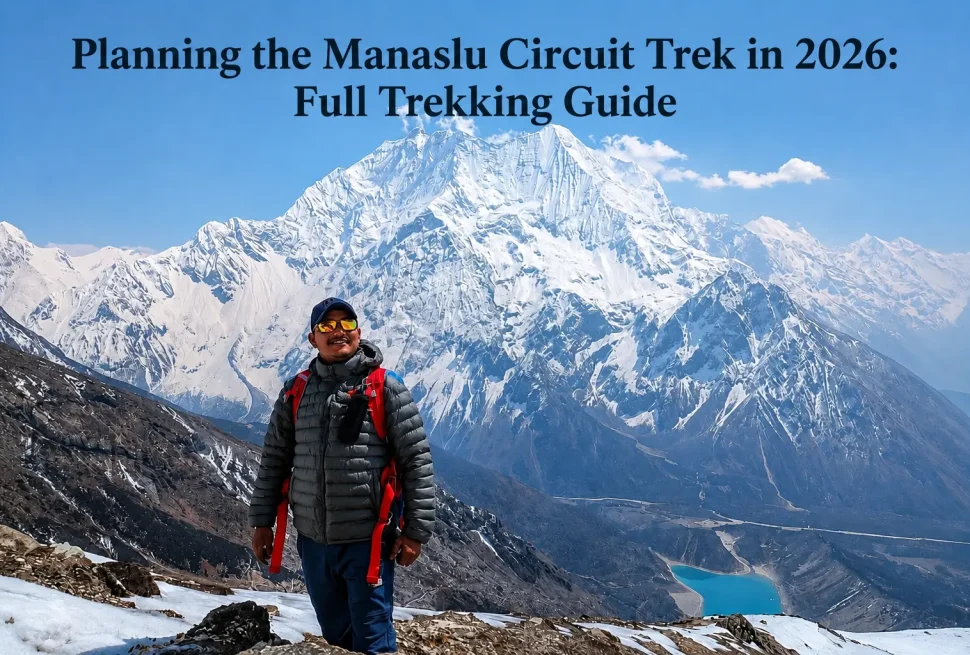
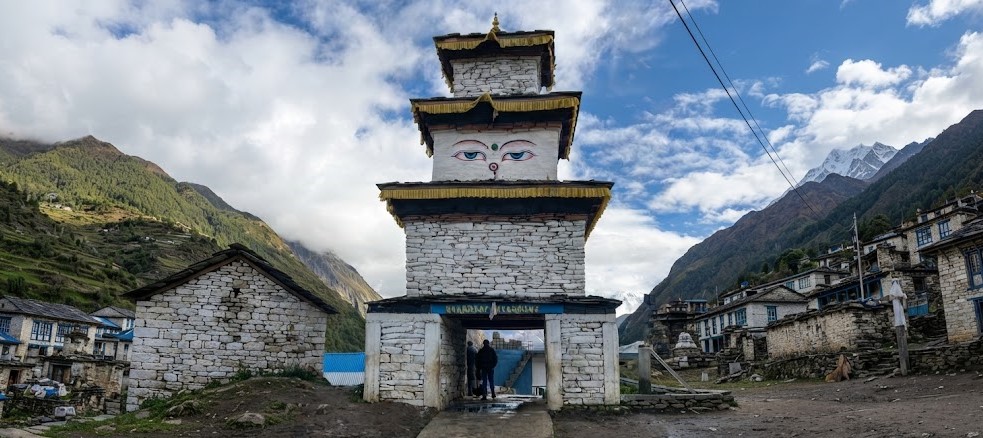
Lho is the village where the Manaslu Circuit reveals its full ambition. At 3,180 meters on the left bank of the Budhi Gandaki, it sits at the edge of the rhododendron forest that has accompanied the circuit from the lower valley and opens onto a Tibetan Buddhist cultural landscape of extraordinary completeness: the Ribung Gompa monastery commanding the hillside above the village, the white walls and prayer-flag-covered rooftops of a community that has maintained its way of life across centuries, and the first clear view of Manaslu itself — 8,163 meters of mountain rising above the valley to the north. For trekkers doing the Manaslu Circuit Trek, the sight of Manaslu from Lho is often described as the moment the trek becomes real: the summit that has given the route its name is suddenly visible in its full scale, closer than expected and more impressive than the imagination had prepared for.
This guide covers everything a trekker needs to know about Lho: its location on the circuit, the approach from Namrung, what the village offers in terms of accommodation and food, the Ribung Gompa and its significance, the mountain views and their best vantage points, the wildlife of the surrounding forest, and the trail that continues toward Shyala, Samagaun, and the high passes above.
Lho Village: Location and Basic Facts
Lho village sits at 3,180 meters in Gorkha District, on the left bank of the Budhi Gandaki in the Nubri cultural zone of the upper valley. It is a substantial settlement with a permanent population and a fully developed teahouse infrastructure for the Manaslu Circuit trekking season. The village is positioned where the valley widens enough to offer expansive views of the high peaks above, making it one of the most visually dramatic overnight stops on the circuit.
| Detail | Information |
|---|---|
| Elevation | 3,180 meters (10,433 feet) |
| District | Gorkha District, Gandaki Province |
| Cultural zone | Nubri Tibetan Buddhist |
| Key religious site | Ribung Gompa (monastery above the village) |
| Mountain views | Manaslu (8,163m), Himalchuli (7,893m), Ngadi Chuli (7,871m) |
| Teahouses | 4 to 6 operating during the trekking season |
| Permit checkpoint | Yes — additional check here before upper circuit |
| Days from Namrung | 1 day (3 to 4 hours walking) |
| Days from Shyala | 1 day (2 to 2.5 hours walking) |
| Forest character | High temperate; rhododendron and blue pine dominant |
The 9 Days Manaslu Circuit Trek, also known as the Short Manaslu Circuit Trek, is designed for trekkers who want…
Lho is also the last village before the trail enters the highest and most strictly managed section of the restricted area, and permits are checked at a checkpoint here before trekkers continue toward Shyala and Samagaun. Above Lho, the altitude gain accelerates, and the terrain becomes more open and exposed, with the forested gorge character of the lower valley giving way completely to the alpine landscape of the upper circuit.
The Trail from Namrung to Lho
The walk from Namrung to Lho is one of the shorter days on the Manaslu Circuit, covering approximately eight to ten kilometers with around 550 meters of net altitude gain and taking most trekkers three to four hours. The relative brevity of the day makes it one of the most enjoyable sections of the circuit: there is time to walk slowly, pay attention to the forest and the views, visit the villages of Sho and Lihi on the route, and arrive at Lho in the early afternoon with enough time to explore the Ribung Gompa and the viewpoints above the village before dark.
| Section | Distance | Altitude Change | Time | Notes |
|---|---|---|---|---|
| Namrung to Lihi | ~3 km | +150m | 1 hour | Mixed forest; open views beginning to appear |
| Lihi to Sho | ~3 km | +200m | 1 hour | Sho has a significant gompa, worth a stop |
| Sho to Lho | ~3 km | +200m | 1 hour | Forest path; Lho visible on its terrace with Manaslu behind |
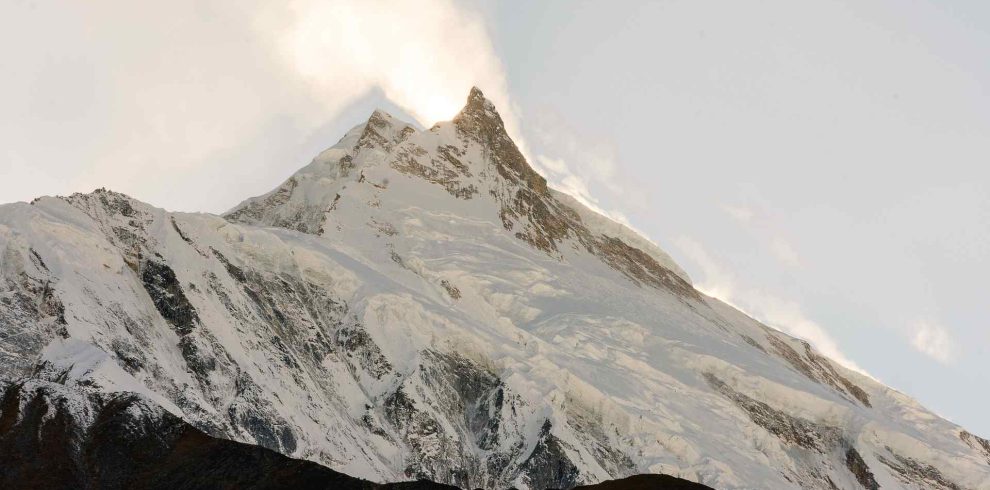
The section from Sho to Lho is one of the most visually anticipated moments on the circuit. As the trail climbs the final section of forest and rounds the last shoulder before Lho’s terrace, Manaslu comes into full view for the first time. The mountain fills the northern end of the valley with a presence that is physically overwhelming at close range: 8,163 meters of ice, rock, and glaciated ridges rising from a valley floor that is only 3,180 meters below the summit. The scale of this view, the relationship between where you are standing and the top of the mountain, communicates something about Himalayan altitude that no photograph or description can fully convey.
The First View of Manaslu
The view of Manaslu from Lho is the circuit’s defining visual moment in its lower section. Before Lho, Manaslu has been an abstraction: the name of the mountain, the reason for the route, the peak described in guidebooks and trip reports. At Lho, it becomes real. The mountain is close enough to see individual features: the steep rock and ice faces of the upper massif, the snow plumes that stream from the summit ridge in strong wind, the glaciers that descend from the upper faces to the valley below. The view is not as intimate as the view from Samagaun above, where Manaslu fills the sky above the village, but it is the first view, and first views of an 8,000-meter peak carry a particular impact.
| Peak | Height | Visibility from Lho | Direction | Notes |
|---|---|---|---|---|
| Manaslu | 8,163m | Excellent from Lho and above | North | First full view on the circuit; summit and upper massif clear |
| Manaslu North | 7,157m | Visible alongside the main summit | North | Part of the Manaslu massif |
| Himalchuli | 7,893m | Good views from Lho | Northeast | Dramatic multiple summits |
| Ngadi Chuli (Peak 29) | 7,871m | Visible from Lho | Northeast | One of the less often climbed 7,000m peaks |
| Ganesh Himal | 7,422m | Good views to the southeast | Southeast | Already visible from Namrung; better defined from Lho |
The best views from Lho are from the terrace above the upper part of the village and from the Ribung Gompa above. The monastery position was chosen, among other considerations, for its commanding view of the surrounding landscape, and the views from the gompa terrace extend from Manaslu in the north to the Ganesh Himal group in the southeast, encompassing the full panorama of the upper Budhi Gandaki valley. In the early morning, when the peaks are lit by direct sun while the valley is still in shadow, and in the late afternoon, when the light turns golden on the upper faces, the views from the gompa are genuinely extraordinary.
Ribung Gompa: The Monastery Above Lho
The Ribung Gompa is the most significant religious site on the Manaslu Circuit between the road-end and Samagaun, and one of the most important monasteries in the Nubri region. It sits on a promontory above Lho, reached by a twenty-to thirty-minute walk from the village, and commands views in three directions over the valley. The gompa belongs to the Nyingma school of Tibetan Buddhism, the oldest of the four main schools of Tibetan Buddhist practice, and maintains the doctrinal and ritual traditions of that school in its daily ceremonies and its calendar of religious events.
Architecture and Interior
The Ribung Gompa’s main assembly hall (dukhang) is the architectural centerpiece of the complex. The interior is decorated in the traditional Tibetan Buddhist manner: thangkas (religious paintings on cloth) hang from the ceiling and walls, depicting the Buddha, Bodhisattvas, protective deities, and mandalas in the complex iconographic style of the Nyingma tradition. The altar at the front of the hall holds butter lamps, offering bowls, and representations of central deities. Rows of cushioned seats face the altar for monks to sit during ceremonies. The walls carry painted murals that in older gompas represent centuries of artistic work, though many Nubri gompas were damaged during political upheavals of the twentieth century and were subsequently restored.
The exterior of the Ribung Gompa features whitewashed walls and deep red trim, characteristic of traditional Tibetan religious architecture. The gompa compound includes the main hall, monks’ residential quarters, storage buildings, and a courtyard where religious ceremonies and masked dances (cham) are performed during festival seasons. The sound of the monastery at prayer, the deep drums, the oboes, the conch shells, and the chanting of the monks, can be heard from the path below on mornings when ceremonies are in progress.
Visiting the Gompa
Trekkers are welcome to visit the Ribung Gompa during daylight hours if ceremonies are not in session. The walk up from Lho takes twenty to thirty minutes on a clear path that passes through the upper part of the village before climbing to the monastery terrace. The visit involves removing shoes at the entrance to the main hall, moving clockwise through the interior, and observing a respectful silence in the presence of religious objects and practicing monks. Photography is subject to the permission of whoever is present at the time of the visit.
A donation to the monastery’s maintenance fund is appropriate when visiting. The Ribung Gompa, like many monasteries in the Nubri region, supports its religious and community functions partly through donations from trekkers and pilgrims. The monks present may offer blessing cords (lungta) or invite visitors to observe a brief ceremony. These interactions, conducted respectfully on both sides, are among the most authentic cultural exchanges available to trekkers on the Manaslu Circuit.
Nubri Culture at Lho
Lho is a fully Nubri village and one of the most culturally complete communities on the Manaslu Circuit. The Nubri people’s Tibetan Buddhist identity is expressed in every aspect of the village: its architecture, its religious structures, its daily rhythms, its agricultural calendar, and the language and dress of its inhabitants. Trekkers who arrive at Lho after the gorge section below experience what can feel like a transport to a different culture entirely, one that has maintained its distinctiveness through centuries of relative isolation in this high Himalayan valley.
Religious Life
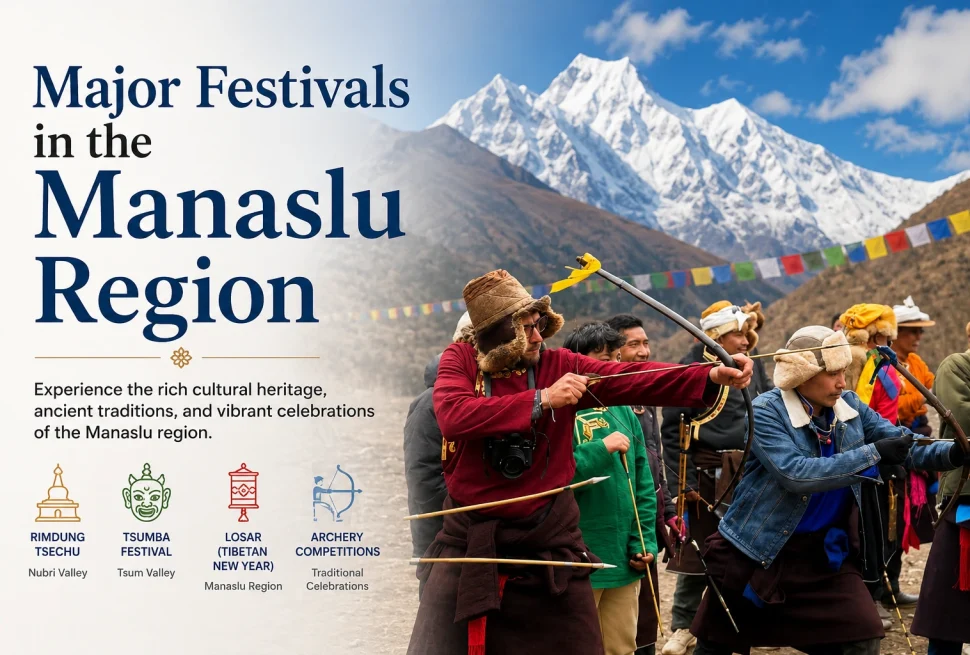
The religious life of Lho is organized around the Buddhist calendar, with festivals, ceremonies, and communal observances that mark the turning points of the year. The Ribung Gompa is the center of this life, with resident monks conducting daily ceremonies and presiding over the rites of passage and seasonal observances of the community. Trekkers who arrive during a festival period may witness masked dances, religious processions, or extended ceremonies that give the village a dramatically heightened atmosphere. The timing of these events varies by year according to the Tibetan lunar calendar, and a trekking agency with local knowledge can advise if any significant ceremonies coincide with your planned visit dates.
Traditional Dress and Material Culture
Older residents of Lho, particularly women, may be seen in traditional Nubri dress: a long wool dress (chuba) worn with an apron of striped wool. The chuba is practical clothing for the cold and the physical work of agriculture and animal care, and its continued use in the village reflects the persistence of traditional material culture in a community that has not been fully absorbed into the globalizing economy. The teahouse environment has brought more exposure to modern dress styles, particularly among younger community members, but the traditional garments are still common enough that their presence gives the village a visual distinctiveness that the more commercially developed trekking areas of Nepal have largely lost.
Accommodation in Lho
Lho has four to six teahouses operating during the main trekking seasons. The accommodation is broadly similar to that at Namrung below: basic twin-sharing rooms with foam mattresses and blankets, shared bathrooms, and a common room with a wood or yak-dung stove that is the social center of the teahouse in the evenings. At 3,180 meters, the nights are cold in all trekking seasons and a proper sleeping bag is essential.
| Facility | Availability at Lho | Notes |
|---|---|---|
| Room type | Twin-sharing, basic | Foam mattress, pillow, blankets; always supplement with sleeping bag |
| Hot shower | Some teahouses (solar or wood-heated water) | Charged extra; not always available; quality varies |
| Electricity | Solar power, limited | Charging possible during daylight and shortly after dark |
| Wi-Fi | Available at some teahouses (satellite) | Limited speed; messaging workable; streaming not practical |
| Phone signal | Ncell coverage present; NT very variable | This is among the last reliable signal points before Samagaun |
| Room cost | NPR 300 to 600 per person | Often subsidized if eating at the teahouse |
| Common area | Wood or yak-dung stove heating | Main warm space in the evening; social hub |
Lho is one of the better overnight stops on the Manaslu Circuit in terms of the overall experience it provides. The views from the village and the proximity of the Ribung Gompa give trekkers who arrive in the early afternoon an afternoon’s worth of worthwhile activity beyond simply resting. The teahouse common rooms are generally well-run and the food is good. A rest day at Lho, taken before ascending to Shyala and Samagaun, is an excellent acclimatization strategy and gives time for a full gompa visit, a walk on the ridges above the village, and an unhurried exploration of the community.
Food in Lho
The food at Lho is characteristic of the upper Nubri valley teahouse menu. Dal bhat remains consistently available and is the best nutritional value. Thukpa, the Tibetan noodle soup, is excellent here and is the local comfort food that the community itself turns to in cold weather. Tibetan bread is a reliable breakfast and snack option. Butter tea is available and is the traditional accompaniment to any discussion with the teahouse family about the weather, the trail above, or the state of the pass.
| Food Category | Items Available | Price Range |
|---|---|---|
| Main meals | Dal bhat, thukpa, fried rice, vegetable curry, noodles | NPR 500 to 750 |
| Tibetan dishes | Tibetan bread, tsampa porridge, butter tea, yak cheese dishes | NPR 200 to 500 |
| Breakfast | Porridge, eggs, Tibetan bread, pancakes, boiled potatoes | NPR 250 to 500 |
| Soups | Garlic soup, vegetable soup, tomato soup, thukpa | NPR 200 to 400 |
| Snacks | Biscuits, chocolate, dried fruit, packaged nuts | NPR 100 to 400 |
| Hot drinks | Milk tea, ginger tea, butter tea, lemon tea, instant coffee | NPR 100 to 200 |
| Water | Boiled water, mineral water | NPR 100 to 250 per liter |
Yak cheese begins to appear on some menus at Lho and becomes more common above. Produced from the milk of the yak herds that graze the high pastures above the village, the cheese has a strong flavor and a firm texture that reflects the traditional methods of its production. It is often served with Tibetan bread or incorporated into cooked dishes. Trekkers who have been eating the standard teahouse menu since the road-end will find yak cheese a welcome addition to the available variety.
Forest and Wildlife Around Lho
The forest around Lho is high temperate in character, dominated by rhododendron, blue pine, fir, and oak. This forest type is among the most biodiverse in the Himalayan zone, supporting a community of wildlife that includes some of the region’s most spectacular species. The treeline, where the forest gives way to open alpine terrain, begins just above Lho at around 3,500 meters, making the village the last major forested overnight stop before the treeline village of Shyala and the open alpine terrain of Samagaun above.
| Species | Type | Habitat Around Lho | Observation Likelihood |
|---|---|---|---|
| Himalayan monal pheasant | Bird | Forest understory and open slopes | Excellent — this is prime monal habitat |
| Blood pheasant | Bird | Rhododendron and mixed forest | Good — often seen in small flocks |
| Satyr tragopan | Bird | Dense understory of high forest | Uncommon but present; spectacular male |
| Himalayan griffon | Bird | Thermal soaring above the valley | Very common |
| Lammergeier | Bird | Soaring above ridges | Regular; the wedge-shaped tail distinguishes it |
| Himalayan tahr | Mammal | Rocky slopes above the treeline above Lho | Good — herds visible on early morning slopes |
| Red panda | Mammal | Bamboo zones in forest around Lho | Rare; habitat present and confirmed in area |
| Musk deer | Mammal | Dense forest at this altitude | Uncommon; mostly nocturnal |
| Snow leopard | Mammal | Rocky ridges above the treeline | Extremely rare; habitat begins here |
Lho and the forest between Lho and Shyala above are among the best sections of the entire Manaslu Circuit for wildlife observation. The combination of forest cover, altitude, and the protected status of the Manaslu Conservation Area creates conditions where wildlife populations are relatively intact. The Himalayan monal pheasant is regularly seen in the forest sections of the Lho-to-Shyala trail, and Himalayan tahr become visible on the rocky slopes above the treeline as the trail climbs above the forest. Early morning walkers who depart Lho before sunrise have the best chance of encountering wildlife before the main trekking traffic of the day begins.
Weather at Lho Through the Seasons
At 3,180 meters, Lho has a noticeably cooler and more variable climate than the villages below. Cold at night is a constant in all trekking seasons: even in May and September, the temperature drops to near or below zero after dark. The monsoon months bring heavy rainfall and cloud that obscures the mountain views entirely and makes the forest trails muddy and sometimes hazardous. Autumn and spring are the reliable trekking seasons, with October giving the best combination of clear skies, dry trails, and cold but manageable temperatures.
| Season | Months | Daytime Temp | Nighttime Temp | Conditions | Trekking Suitability |
|---|---|---|---|---|---|
| Spring | March to May | 5°C to 14°C | -3°C to 4°C | Rhododendrons in full bloom below and around Lho in April; some cloud; good visibility | Excellent; April best for flowers and views |
| Monsoon | June to September | 8°C to 15°C | 2°C to 8°C | Heavy rain most days; views of Manaslu entirely obscured; trails muddy | Not recommended |
| Autumn | October to November | 2°C to 12°C | -7°C to 0°C | Best clarity and views; dry trail; cold nights especially from mid-November | Excellent; peak season |
| Winter | December to February | -5°C to 5°C | -12°C to -5°C | Very cold; possible snow on trail; upper circuit closed | Not recommended |
The rhododendron bloom at Lho and on the approach from Namrung is one of the most celebrated natural events on the lower Manaslu Circuit. In April, the forest between Lho and Shyala above, and between Lho and Namrung below, comes into full bloom. The tree rhododendrons at this altitude, some of them with trunks as thick as a person’s torso and canopies that reach ten meters above the trail, bloom in pink, red, and white flowers that cover every branch simultaneously. Walking through this bloom with Manaslu visible above is a defining experience of the spring circuit that the clearer skies and better mountain views of autumn cannot replicate.
Altitude and Acclimatization at Lho
At 3,180 meters, Lho is firmly in the altitude range where acclimatization becomes important for most trekkers. The body at this elevation is working measurably harder to supply oxygen to its tissues, and the effects of this, mild headache, reduced appetite, disrupted sleep, are experienced by many trekkers for the first time at or around Lho. These effects are not the same as altitude sickness: they are the normal physiological response to a reduced oxygen partial pressure and typically resolve within one to two days as the body produces more red blood cells to compensate.
A rest day at Lho is one of the most commonly recommended acclimatization strategies for the Manaslu Circuit. The short walking day from Namrung means that trekkers arrive at Lho in good time and with energy to spare. An extra day at Lho, used for a visit to the Ribung Gompa, a walk on the ridges above the village, and rest, provides a day of acclimatization at 3,180 meters that significantly improves the body’s readiness for the rapid altitude gain to Samagaun (3,530m), Samdo (3,875m), and Dharmasala (4,460m) in the days above.
Trail from Lho to Shyala and Samagaun
Above Lho, the circuit enters the treeline transition zone and then the fully open alpine terrain of the upper valley. The trail from Lho to Shyala climbs through the high forest, passing through the rhododendron and blue pine zone before the trees thin and the open landscape of the upper circuit begins. Shyala is the treeline village at 3,500 meters where the forest ends and the mountain views become comprehensive and unobstructed. Samagaun, the primary acclimatization village, is three to four hours beyond Shyala at 3,530 meters.
| Section | Distance | Altitude Change | Time | Notes |
|---|---|---|---|---|
| Lho to Shyala | ~5 km | +320m | 2 to 2.5 hours | High forest; treeline transition; Manaslu views improve steadily |
| Shyala to Samagaun | ~6 km | +30m (nearly flat) | 2 to 3 hours | Open alpine valley; yak pastures; Manaslu dominant in view |
The walk from Lho to Shyala through the high forest is one of the most beautiful sections of the entire Manaslu Circuit, particularly in April when the rhododendrons are in bloom. The forest at this altitude includes some of the largest and oldest rhododendron trees on the circuit, their gnarled trunks covered in mosses and lichens, their canopies full of flowers in the spring. The trail climbs steadily through this forest until the trees begin to thin and the first completely open views of Manaslu appear above the remaining forest cover.

Are you interested in mountain photography and videography and looking for a quieter Himalayan route with more time at key…
Frequently Asked Questions About Lho
What is the elevation of Lho village?
Lho village sits at 3,180 meters (10,433 feet) above sea level on the left bank of the Budhi Gandaki in Gorkha District. It is approximately 550 meters above Namrung below and 320 meters below Shyala above, and it marks the last major settlement before the trail enters the treeline transition zone. At this altitude, altitude effects are noticeable for many trekkers, and acclimatization becomes an important consideration for the days above.
What is the Ribung Gompa and is it worth visiting?
The Ribung Gompa is a Nyingma school Tibetan Buddhist monastery on the hillside above Lho village. It is the most significant religious site on the Manaslu Circuit between the road-end and Samagaun and is genuinely worth visiting. The walk up from the village takes twenty to thirty minutes. The monastery has an active monastic community and a traditional Tibetan Buddhist interior with thankas, altar decorations, and murals. The terrace outside the main hall has outstanding views of Manaslu and the surrounding peaks. Trekkers should remove shoes before entering, move clockwise, behave respectfully, and consider a donation to the monastery’s maintenance fund.
Can you see Manaslu from Lho?
Yes. Lho is the first village on the Manaslu Circuit where Manaslu (8,163m) is clearly visible without obstruction from forest or intervening ridges. The view from Lho shows the upper massif of Manaslu including the summit, the hanging glaciers of the upper faces, and the long ridgelines of the mountain. The view from the Ribung Gompa above the village is even better, extending to a full panorama that includes Himalchuli, Ngadi Chuli, and the Ganesh Himal group to the south. For many trekkers, the first sight of Manaslu from Lho is one of the most memorable moments of the entire circuit.
Is there a good time of day to see Manaslu from Lho?
The early morning, before clouds begin to build in the valley, provides the clearest views. In October and November, the post-monsoon air is exceptionally clear, and early morning views in these months can extend across the full mountain panorama with extraordinary definition. Sunrise from the Ribung Gompa or the slopes above Lho, when the first light touches the summit and upper ridges of Manaslu while the valley below is still in shadow, is one of the great visual experiences available on the circuit. Trekkers who are staying a night at Lho should set an alarm and make the walk to the gompa or above it for sunrise.
Should I take a rest day at Lho?
A rest day at Lho is recommended for trekkers who are experiencing any altitude symptoms, who have a conservative acclimatization schedule, or who want to make the most of the Ribung Gompa and the views without the pressure of a full walking day. The short day from Namrung means that even without a rest day, there is time at Lho to visit the gompa and explore the village in the afternoon. A rest day is most valuable for trekkers who felt the altitude at Namrung or who want to give their bodies an extra day at 3,180 meters before the more rapid ascent above Lho. The days from Lho to Samagaun, Samdo, and Dharmasala involve significant altitude gain, and arriving at each one in good acclimatized condition makes the upper circuit safer and more enjoyable.
What is special about the forest between Lho and Shyala?
The forest between Lho and Shyala is one of the finest examples of high temperate Himalayan forest accessible to trekkers on a standard circuit. It is dominated by large tree rhododendrons, some with trunk diameters of thirty to fifty centimeters, blue pine, and fir. In April, the rhododendron bloom transforms the forest into a spectacular display of pink, red, and white flowers. The forest is also excellent habitat for the Himalayan monal pheasant, Nepal’s national bird, which is commonly seen in this section. The trail through this forest, climbing from 3,180 meters toward the treeline at 3,500 meters, is one of the most beautiful single sections of trail on the entire Manaslu Circuit in any season.
How many teahouses are at Lho?
Lho typically has four to six teahouses operating during the main trekking seasons. This is fewer than Namrung below, reflecting Lho’s position as a slightly less established overnight stop on some standard itineraries. The teahouses at Lho are adequate in standard and offer the full range of food and accommodation services expected on the Manaslu Circuit. Advance arrangements through your trekking agency are advisable, particularly if you plan a rest day at Lho, to ensure that accommodation and meals are available for the extra day.
The Gateway to the High Mountains
Lho occupies a position on the Manaslu Circuit that combines cultural completeness with natural grandeur in a way that few villages anywhere in Nepal can match. The Ribung Gompa above and the view of Manaslu to the north together give the village an atmosphere that is simultaneously ancient and overwhelming: the monastery on its hilltop has been there for centuries, organized around a religious and community life that predates the trekking industry by generations, and the mountain behind it has been there for geological ages before that.
Trekkers who arrive at Lho after the days in the gorge below experience a genuine transition. The enclosed world of the canyon, with its narrow sky and constant river noise, gives way to an open landscape where the sky is broad, the peaks are visible, and the cultural landscape is one of the most complete expressions of Tibetan Buddhist mountain community life accessible to any traveler anywhere. The days above Lho will bring higher altitude, bigger views, and the specific challenges of the Larke La crossing. But Lho itself, with its monastery, its mountain views, its forest, and its community, is not merely a transit point. It is a destination in its own right and one of the places where the Manaslu Circuit justifies the effort required to reach it.
If you are planning a Manaslu Circuit Trek and want guidance on how to structure your time at Lho, how to incorporate the Ribung Gompa visit, when to take an acclimatization rest day, or what the conditions above Lho will look like at different times of year, contact us at Manaslu Treks. We have guided trekkers through Lho and the upper circuit across many seasons and can help you plan a route that makes the most of everything this remarkable village and the journey above it offers.
The Manaslu Circuit Trek is a spectacular journey around Mount Manaslu (8,163 m), the eighth-highest mountain in the world. Located…