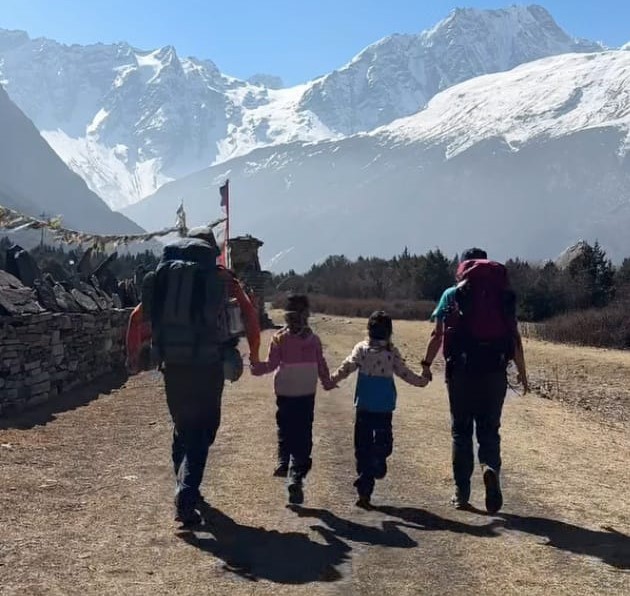
We get this question almost every planning season, usually from a parent who has already fallen in love with the idea of the Manaslu Circuit Trek and is now wondering if their child can actually come along. The short answer is yes. The honest answer is a little longer than that, because “yes” comes with real conditions: the right age, months of preparation, the right itinerary, and parents who are willing to slow down and let the trip be about the child’s pace, not their own.
Below, we go through exactly what matters — what the research actually says about children and altitude, why we tell most families that around 10 years old is the sweet spot for this particular route, and what genuine preparation looks like in practice, not just in theory.
The Short Answer: Yes, With the Right Preparation
Children can trek the Manaslu Circuit safely and enjoy it. That’s not a marketing line — it’s backed by how the body actually responds to altitude and by what we’ve seen on the trail over multiple seasons. But “yes” isn’t unconditional. It depends on:
- The child’s age, and just as importantly, their individual stamina, temperament, and comfort with physical discomfort
- How much preparation the family does in the months before departure, not the days before
- Whether the itinerary is actually built around a child’s pace, rather than a standard adult schedule with a kid squeezed into it
- Whether the parents are honestly willing to turn back or slow down if the child needs it, rather than pushing to stay on schedule
Get those four things right, and the Manaslu Circuit becomes a genuinely doable, memorable family trip. Skip them, and you’re setting a child up for a miserable two weeks, regardless of age.
There’s No Legal Age Limit — But That Doesn’t Mean Any Age Works
A lot of parents assume there must be an official minimum age for a restricted area like Manaslu, given how seriously the permit system treats guide requirements and group size. In practice:
- The Manaslu Restricted Area Permit (MRAP), along with the Manaslu Conservation Area Permit (MCAP) and Annapurna Conservation Area Permit (ACAP) required after Larkya La, apply the same way regardless of a trekker’s age
- There’s no separate children’s permit, no minimum age written into the regulations, and no special paperwork required simply because a trekker is a minor
- The requirement for a licensed guide, and a minimum of two people on the permit, is unaffected by whether one of those two people is a child
So legally, a family of two — one parent and one child — meets the requirement just as any two adult trekkers would. The absence of a legal age limit, though, is not the same as a recommendation that any age is appropriate. That’s a judgment call that falls entirely on the family and the trekking agency, which is exactly why the next section matters more than the permit rules do.
Why We Tell Families That Age 10 and Up Is the Real Sweet Spot
Ask five different trekking agencies what age they recommend for the Manaslu Circuit and you’ll get answers ranging from 6 to 14. Our honest recommendation, based on what actually goes wrong (and right) on this specific route, is that 10 years old is where things genuinely start working well for most children. Here’s why that number, specifically:
- By around age 10, most children have the leg strength, balance, and coordination to handle multiple hours of uneven trail, suspension bridges, and steep sections without needing to be carried or constantly assisted
- They can typically sustain attention and motivation across a full trekking day, rather than losing interest or patience after an hour
- They can clearly describe how they’re feeling — a headache, nausea, dizziness, fatigue — which matters enormously for catching altitude symptoms early, something we cover in detail below
- They can understand and follow safety instructions on exposed or technical sections, rather than needing constant physical supervision
- Emotionally, a 10-year-old can generally handle multiple days of discomfort, cold, and basic teahouse living without it becoming a daily crisis
None of this means 8 or 9-year-olds absolutely cannot do it, or that every 10-year-old is automatically ready. It means that as a general threshold, the physical and communication skills a child needs for a route like this one tend to be reliably in place by around age 10, in a way they often aren’t a few years earlier.
What Actually Changes at Age 10 — It’s Not Biology
Here’s the detail that surprises a lot of parents: children are not more biologically vulnerable to altitude sickness than adults. The CDC’s own travel health guidance is direct about this, stating that children are just as susceptible to altitude illness as adults, no more and no less. So if age 10 isn’t about biology, what is it about?
- It’s about communication — an 8-year-old and a 14-year-old have the same underlying risk of acute mountain sickness, but the 14-year-old can say “I have a headache and I feel sick” clearly and immediately, while a younger child might just become quiet, clingy, or fussy without explaining why
- It’s about physical endurance — younger children tire faster over multi-hour days, and fatigue on this particular trek compounds daily rather than resetting overnight
- It’s about psychological stamina — the ability to accept “we still have three more hours to walk” without it becoming an emotional battle, which matters over a 12 to 18 day trek
- It’s about proportional risk if something does go wrong — in a remote, restricted region with no road access, a child who can walk out under their own power in an emergency is a very different situation than one who cannot
So age 10 isn’t a magic biological threshold. It’s the point where the practical, real-world factors — not lung physiology — tend to line up in a child’s favor.
Are Kids Actually More at Risk of Altitude Sickness Than Adults?
This is worth stating plainly because it’s one of the most common misconceptions parents bring to us: no, children are not inherently more prone to acute mountain sickness than adults. Per CDC travel health guidance, susceptibility is essentially equal across age groups, with the modest exception that adults over 50 have slightly lower risk than younger people. A healthy child ascending gradually faces roughly the same odds of developing AMS as a healthy adult doing the same ascent at the same pace.
What is genuinely different is how symptoms show up, and how easily they get missed — which is the actual issue worth worrying about, not some special vulnerability in a child’s body.
Why Spotting Altitude Sickness Is Harder in Younger Children
This is the real safety issue with young children at altitude, and it has nothing to do with their bodies handling oxygen differently. It has to do with communication:
- Younger or preverbal children often can’t describe a headache, nausea, or dizziness the way an older child or adult can
- Instead, early altitude sickness in young children tends to show up as irritability, unusual fussiness, loss of appetite, clinginess, or changes in sleep and activity levels — signs that are easy to mistake for tiredness, a bad mood, or simple homesickness
- By the time those vague signs are recognized as something more, a mild case of AMS can have progressed further than it would in an adult who reported symptoms immediately
- Older children, particularly from around age 10, are far more likely to say directly “my head hurts” or “I feel weird,” giving guides and parents a much earlier, clearer signal
If you want a full breakdown of what normal altitude discomfort looks like versus genuine warning signs — useful for parents and adults alike — our Normal Trekking Symptoms at High Altitude guide covers this in detail, and it’s worth reading together with an older child before departure so they know what to expect and what to report.
How the Manaslu Circuit Compares to “Easier” Family Treks in Nepal
Not every trek in Nepal carries the same demands, and it matters that the Manaslu Circuit sits toward the harder end of the spectrum, not the easier one. For context:
- Shorter, lower-altitude routes like Ghorepani-Poon Hill top out around 3,210 metres and can be completed in 4 to 6 days, making them a much gentler introduction to trekking for younger children
- The Everest View Trek stays relatively short and reaches a comparable but shorter high point, without the multi-week commitment
- The Manaslu Circuit, by contrast, runs 12 to 18 days, climbs to 5,106 metres at Larkya La, and passes through a genuinely remote restricted area with limited infrastructure and no road access for evacuation
This is exactly why we frame the age question the way we do. A 7 or 8-year-old might do beautifully on a short, low-altitude family trek and still not be ready for the length, altitude, and remoteness of Manaslu specifically. If you’re comparing options for a family trip, our Manaslu Trek Difficulty: A Realistic Assessment lays out exactly what makes this route more demanding than some of the shorter alternatives.
The Physical Demands Kids Will Actually Face
It helps to be specific about what a day on this trek actually involves, since vague reassurance doesn’t prepare anyone:
- Daily walking of 5 to 8 hours, with some sections stretching longer, particularly around the Larkya La crossing
- A cumulative elevation gain from around 700 metres at the trailhead to 5,106 metres at the pass
- Steep, uneven terrain, multiple suspension bridge crossings, and sections exposed to landslide risk
- Cold nights, with temperatures dropping well below freezing at higher elevations, especially outside of peak season
- Basic teahouse accommodation with shared bathrooms, thin walls, and limited heating
None of this is meant to discourage a family trip — it’s meant to set realistic expectations so that preparation actually matches what’s coming, rather than being based on how the trek looks in photos.
Preparing Your Child Months Before the Trek, Not Days Before
The single biggest predictor of how well a child handles this trek isn’t age on its own — it’s preparation. Families who start early tend to have a dramatically better experience than those who show up hoping for the best:
- Begin with shorter, easy walks two to three months before departure, gradually building up to multi-hour hikes on varied, hilly terrain
- Include at least a few hikes with a loaded daypack, so your child gets used to walking with some weight on their back, even if a porter will carry the bulk of the gear
- Practice multiple consecutive days of activity where possible, since the cumulative fatigue of trekking day after day is different from a single strenuous hike
- Talk openly with your child about what teahouse life is like — shared rooms, squat toilets, cold mornings — so none of it comes as an unpleasant surprise on day one
- Involve your child in the planning itself, from picking out their own gear to learning a few basic facts about the region, so they arrive genuinely invested rather than just along for the ride
Gear and Packing Considerations Specific to Kids
A child’s gear list isn’t just a smaller version of an adult’s. A few things matter more for younger trekkers specifically:
- Properly broken-in, well-fitting hiking boots — blisters and foot pain end trips faster for kids than almost anything else, since children are often less likely to mention discomfort until it’s already a problem
- A sleeping bag genuinely rated for sub-zero temperatures, since children lose body heat faster than adults and are more vulnerable to poor sleep from being cold
- Proper layering systems sized for a child’s body, not adult gear cinched down to fit
- Sun protection is non-negotiable — UV exposure is significantly stronger at altitude, and children’s skin burns faster than adults’ does
- A comfortable, correctly sized daypack for the child to carry their own snacks, water, and a favorite small item, even if the main duffel goes with a porter
Our general Manaslu Circuit Trek Packing List is a solid starting point, adjusted down in size and warmth rating for a child’s specific needs.
Building an Itinerary That Actually Works for a Family
This is where a lot of otherwise well-prepared families go wrong: they book a standard adult itinerary and simply bring their child along on the same schedule. A family itinerary should look different:
- Choose a longer overall itinerary, closer to 16 to 18 days rather than a compressed 10 to 12 day version, so daily distances and elevation gain are gentler
- Add extra acclimatization days beyond what a standard adult group would take, particularly around Samagaon and before the Larkya La crossing
- Split unusually long days, such as the stretch from Dharamsala over the pass to Bimthang, into more manageable segments where the route allows
- Book as a private family trip rather than joining a fixed group departure, so pace and rest days can flex around your child’s needs rather than a group schedule
- Build in slack days near the start of the trip in case altitude, weather, or simple fatigue requires an unplanned pause
For a sense of where these adjustments fit into the standard route, our Manaslu Circuit Trek Itinerary: 10 to 22 Day Route Guide shows the full range of pacing options available, from fast to considerably more relaxed.
Thinking about bringing your child on the Manaslu Circuit Trek? We can help design a family-paced itinerary that fits your child’s age and experience.
WhatsApp us Email usMedical Preparation: Doctors, Insurance, and Medication
This part isn’t optional, and it’s where a lot of family planning falls short:
- Take your child for a check-up with a pediatrician or travel medicine doctor before booking, specifically to rule out underlying heart or lung conditions that could complicate altitude exposure
- Ask your doctor directly about acetazolamide (Diamox) for children — it isn’t officially approved for children under 12 in most guidelines, but is sometimes prescribed off-label by travel doctors for pediatric patients on faster ascent schedules, dosed carefully by body weight
- Purchase comprehensive travel insurance that explicitly covers high-altitude trekking and helicopter evacuation for your child, and confirm the policy’s age terms before you buy it, since some policies have different pediatric clauses
- Pack a basic family first-aid kit that includes children’s-dose pain relief, oral rehydration salts, and any prescribed medication, clearly labeled
- Make sure your guide knows your child’s full medical history in advance, not just on the trail if something comes up
Choosing the Right Season for a Family Trip
Season matters more for families than for solo adult trekkers, mostly because children handle extreme cold and unpredictable weather less comfortably:
- Spring (March to May) and autumn (September to November) offer the most stable weather and the most moderate temperatures, and are the seasons we recommend for almost every family booking
- Winter brings significantly colder nights and a higher chance of snow closing sections of the trail, particularly around Larkya La, which adds both discomfort and risk for younger trekkers
- Monsoon season adds slippery trails, leeches, and poor visibility, none of which make for an enjoyable first high-altitude experience for a child
- If you have flexibility, aim for the earlier or later weeks of spring or autumn, when trails are quieter and teahouses less crowded, which makes managing a tired or overwhelmed child considerably easier
Small Things That Make a Big Difference on the Trail
Beyond the big logistical decisions, a handful of small habits genuinely change how a child experiences this trek:
- Pack a steady supply of familiar snacks — appetite loss at altitude affects children too, and having food they actually want to eat matters more than nutritional perfection
- Bring simple entertainment for evenings in teahouses — cards, a small journal, a book — since long, dark evenings with nothing to do can wear a child down faster than the walking itself
- Set a pace based on the slowest, most tired member of the group, every single day, rather than pushing to match what an adult-only group would do
- Celebrate small milestones along the way, not just the summit of Larkya La, to keep motivation up over a long trip
- Let your child know clearly, and mean it, that turning back or slowing down is always an option and never a failure
A Family We Guided That Got This Right
A few seasons ago we guided a family with an 11-year-old on a 17-day version of the circuit, deliberately stretched out with extra rest days built into the schedule. The parents told us upfront that they didn’t care about the itinerary length, only that their daughter finish the trip wanting to go trekking again. We slowed the pace on the approach days, let her set the walking speed on the harder afternoons, and gave her small jobs along the way, like helping the guide check trail markers, which kept her engaged rather than just enduring the walk. She crossed Larkya La on a clear, calm morning, tired but genuinely proud of herself, and the family came back the following year for a second trek in a different region.
None of that happened by luck. It happened because the itinerary was built for her from the start, not adjusted from an adult version at the last minute. That’s the difference preparation actually makes.
Signs Your Child Needs to Stop, Rest, or Descend
Because younger children can’t always describe symptoms directly, parents and guides need to actively watch for indirect signs rather than waiting to be told:
- Unusual quietness, clinginess, or irritability that doesn’t match their normal personality
- A noticeable drop in appetite beyond the mild loss that’s common at altitude for everyone
- Complaints of headache or stomach ache that persist rather than passing with rest and water
- Unusual fatigue that doesn’t improve after a night’s sleep
- Any vomiting, confusion, or difficulty walking normally, which should be treated the same way in a child as in an adult — as a reason to stop ascending and descend if it doesn’t resolve quickly
The response to any of these is the same as it would be for an adult: stop, rest, reassess, and descend if things don’t improve. With children, the bar for “let’s not risk it” should be set lower, not higher, given how much harder early symptoms are to read.
Questions Worth Asking Your Trekking Agency Before Booking With Kids
Not every agency is set up to handle a family trip well, regardless of how they market themselves. Before booking, ask directly:
- Has this guide specifically led trips with children before, and how did those trips go?
- Does the guide carry a pulse oximeter and check oxygen saturation for the whole group, including children, on a regular schedule?
- Is the itinerary genuinely built around a family pace, or is it the standard adult itinerary with extra rest days tacked on?
- What is the agency’s actual plan if your child needs to descend early — is there a system in place, or is it improvised on the spot?
- Can the agency provide an additional porter specifically to help with a child’s gear or, if needed, assist a tired child on tough sections?
Making It a Genuinely Good Experience, Not Just a Survivable One
It’s worth saying plainly: the goal isn’t to get a child to the finish line while gritting their teeth the whole way. Kids who come away loving trekking tend to have parents who prioritized enjoyment alongside safety — pointing out wildlife, letting them chat with porters and other trekkers, stopping for photos, and treating the trip as a shared adventure rather than an endurance test. Our Highlights of Manaslu Circuit Trek page is a good one to go through with your child before the trip, so they know what they’re walking toward and get genuinely excited about it.
Frequently Asked Questions About Kids on the Manaslu Circuit
Is there an official minimum age for the Manaslu Circuit Trek?
No. There’s no legal minimum age or special permit requirement based on age. The recommendation of around 10 years old is a practical guideline based on physical and communication readiness, not a legal restriction.
Can a 7 or 8-year-old do this trek?
Some can, particularly very active, experienced young hikers with highly attentive parents and a significantly relaxed itinerary. As a general rule, though, we recommend waiting until closer to age 10 for this specific route, given its length, altitude, and remoteness.
Are children more likely to get altitude sickness than adults?
No. Research and travel health guidance indicate children are equally, not more, susceptible to acute mountain sickness compared to adults. The real challenge is that younger children often can’t describe symptoms as clearly, which can delay recognition.
Should my child take Diamox preventatively?
This should be decided with a pediatrician or travel medicine doctor, not on your own. It isn’t officially approved for children under 12 in most guidelines, though doctors sometimes prescribe it off-label for specific situations.
What’s the biggest mistake parents make when bringing kids on this trek?
Using a standard adult itinerary instead of building a genuinely slower, more flexible one. The trek itself isn’t necessarily wrong for kids — an itinerary designed for adults, with a child simply added to it, usually is.
The Bottom Line
Children can absolutely trek the Manaslu Circuit, and many have done it happily and safely. The deciding factors aren’t legal rules, since none exist, and they’re not really about a child’s body handling altitude differently, since the research says it doesn’t. They come down to whether a child has the endurance, communication skills, and temperament this specific route demands — which, for most children, tends to line up reliably from around age 10 onward — and whether the adults around them are willing to build a trip genuinely shaped around a child’s pace rather than an adult’s.
If you’re planning a family trip to Manaslu, get in touch and we’ll help you put together an itinerary, guide team, and preparation plan built specifically around your child’s age and experience, not a generic template.