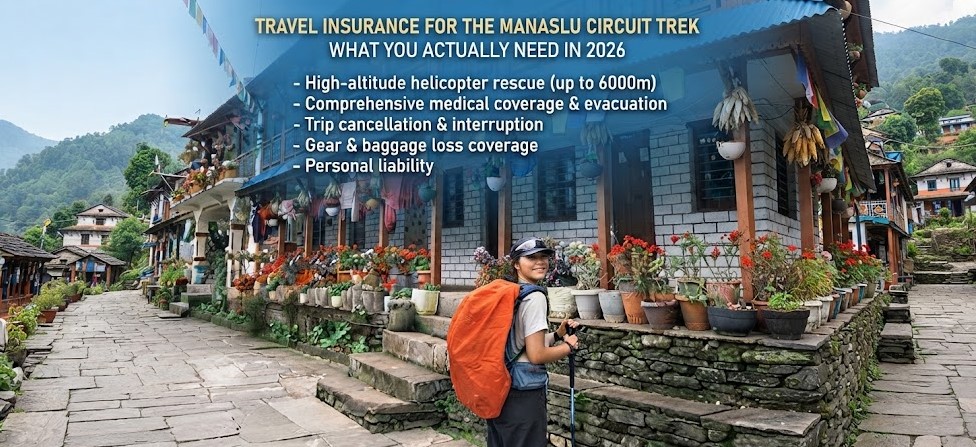
If you are asking what kind of travel insurance you actually need for the Manaslu Circuit Trek, here is the short answer before we get into the long version. You need a policy that names trekking up to at least 6,000 meters as a covered activity, that carries emergency helicopter evacuation coverage of at least USD 5,500, and that also includes medical treatment abroad, trip cancellation or interruption, and loss of baggage or gear. Those first two items are not optional extras for this particular trek. The Larkya La pass sits at 5,106 meters, and a huge share of general travel policies sold online quietly exclude any trekking above 3,000 or 4,000 meters as a hazardous activity, which means a policy that looks perfectly normal on the surface can leave you with nothing if you actually need a rescue at altitude. At Manaslu Treks and Expedition we ask every client to show us proof of insurance, meaning the policy number and the insurer’s emergency contact details, before we let them start walking. This guide explains why, in plain language, from someone who has sent groups around this circuit for years and has had to make the emergency call to an insurer more than once.
Why Standard Travel Insurance Often Fails Trekkers in Nepal
Most travel insurance sold through banks, credit cards, airlines, or general comparison sites is built for a completely different kind of trip. It is written with a beach holiday, a city break, or a standard package tour in mind. Somewhere in the policy wording, almost always in the activities or exclusions section, there is a line about “hazardous activities” or “mountaineering and trekking above a certain altitude” being excluded unless you pay for an add on or upgrade. The altitude threshold varies by insurer, but 3,000 meters and 4,000 meters are the two numbers that show up most often as automatic cutoffs.
The problem is that almost the entire Manaslu Circuit Trek route sits above 3,000 meters once you get past the first few days from Soti Khola. Samagaon sits around 3,530 meters, Samdo around 3,875 meters, and the final push over Larkya La climbs to 5,106 meters before dropping down toward Bhimtang and Dharapani. A policy that stops covering you at 3,000 or 4,000 meters is, in practical terms, a policy that only covers the easiest and least risky third of your trek. If something goes wrong on the harder, higher, more remote sections, which is exactly where things are more likely to go wrong, you would be paying out of pocket for a rescue that could run into the thousands of dollars.
I have met trekkers on this route who bought a policy in a hurry the week before flying, assumed “travel insurance” meant they were covered for whatever they ended up doing, and never opened the policy document to check. Most of the time nothing happens and they get lucky. Occasionally someone gets altitude sickness near Samdo or Dharamsala and needs a helicopter out, and that is when they discover, mid emergency, that their policy will not pay. That is the situation this whole guide is trying to help you avoid.
The Altitude Coverage Requirement Explained
When we say your policy needs to cover trekking up to at least 6,000 meters, we are not picking that number arbitrarily. Larkya La itself is 5,106 meters, but weather delays, acclimatization side trips, and the general unpredictability of mountain travel mean you want a real margin above the highest point you will actually stand on. A policy rated for 6,000 meters gives you that margin and also happens to be the threshold that most reputable insurers use for general Himalayan trekking, since it comfortably covers not just Manaslu but also Everest Base Camp, Annapurna Circuit, and similar routes.
The number to watch for in the policy document is usually described as the maximum altitude for “trekking,” “hiking,” or “walking” activities, as distinct from “mountaineering,” “climbing,” or activities that involve ropes, crampons, or technical glacier travel. The Manaslu Circuit Trek is a trekking route, not a climb. You are walking on a maintained trail with teahouses, not roped up on a glacier. That distinction matters because insurers price and classify these two categories very differently, and mountaineering cover is usually far more expensive and sometimes requires proof of technical experience. You do not need a mountaineering policy for Manaslu. You need a trekking policy with its altitude ceiling set at 6,000 meters or higher.
One detail that catches people out is that some insurers list activities by name rather than by altitude band, and Manaslu specifically may not appear on a generic list that only mentions Everest Base Camp or Annapurna. If your intended insurer’s website does not mention Manaslu by name, do not assume you are excluded. Look instead for a general altitude figure attached to trekking or hiking, and if you cannot find one, contact the insurer directly and ask them in writing whether trekking up to 5,200 meters in Nepal, specifically crossing a mountain pass, is covered under your plan. Keep that written confirmation. If our guide team ever needs to coordinate a rescue on your behalf, having that confirmation on hand speeds everything up.
The Helicopter Evacuation Coverage Requirement Explained
This is the single most important number in this whole article: USD 5,500. That is the minimum emergency helicopter evacuation coverage we require every one of our trekkers to carry before joining a Manaslu Circuit Trek departure. A real helicopter rescue from a high point in the Manaslu region, flown from somewhere near Samdo, Dharamsala, or the Larkya La area down to Kathmandu or a hospital in Pokara, can genuinely cost this much or more once you add up the flight time, the remoteness of the pickup location, and the weather conditions the pilot has to work around.
Helicopter rescue pricing in Nepal is not standardized in the way a taxi fare is. It depends on the aircraft used, the distance and altitude of the pickup, whether the flight is a dedicated charter or a shared load, and which company operates it. Figures reported for high altitude rescues in Nepal in recent years have ranged from around three or four thousand US dollars for a shorter, lower flight up to well over ten thousand dollars for a longer flight from a very remote or very high pickup point in poor weather. Setting your minimum required coverage at USD 5,500 gives you a realistic buffer against the lower to middle end of that range, and any policy worth buying for this trek should offer considerably more than that as a ceiling, since the real number you get billed can vary a lot depending on the day.
A word of caution here, because it matters and because it has been in the news. In 2026 an investigation exposed a large scale insurance fraud scheme in Nepal in which some hospitals, helicopter operators, and a small number of trekking companies coordinated to manufacture unnecessary rescues and inflate billing, in some reported cases even making trekkers artificially unwell to justify a helicopter evacuation and then billing multiple insurers for what was actually one shared flight. This is not a reason to skip insurance. It is the opposite. It is a reason to work only with a trekking company and a rescue coordination process you trust, to insist on real documentation for any evacuation, and to buy your policy from a recognized insurer rather than an unknown local broker who happens to have a convenient relationship with a particular helicopter company. We coordinate evacuations directly with licensed operators and hospitals we know, and we keep our own records of every flight, precisely because this kind of fraud has been a real problem in the industry and we do not want any of our clients caught up in it, whether as a victim of a manufactured emergency or simply as someone whose legitimate claim gets extra scrutiny because of what other operators have done.
How Helicopter Rescue Actually Works Logistically in the Manaslu Region
It helps to understand what actually happens on the ground, because the process is less like calling an ambulance and more like coordinating a small military operation. When a trekker develops a serious problem, usually acute mountain sickness, a bad fall, or a medical condition that cannot wait for a multi day walk out, our guide on the trek contacts our office in Kathmandu by satellite phone or whatever connectivity is available at that point on the route. Mobile signal is patchy to nonexistent for long stretches of this trek once you are past Samagaon, which is one more reason a satellite device carried by the guide team matters.
Our office then contacts the insurer’s emergency assistance line, or in some cases a helicopter operator directly, to confirm two things before a flight is dispatched: that the situation genuinely requires air evacuation rather than a lower altitude walk down or a mule evacuation, and that payment is guaranteed, either as a direct insurer guarantee of payment or, less commonly, a credit card guarantee from the trekker. This confirmation step is where insurance coverage stops being a document in your bag and starts being the thing that determines whether a helicopter actually takes off. Insurers with efficient, responsive emergency assistance lines can authorize a flight within an hour or two in good conditions. Insurers without a proper 24 hour assistance number, or ones that require lengthy paperwork before authorizing payment, can cost you hours that matter when someone is deteriorating at altitude.
Weather is the other major variable. Helicopters in this region cannot fly in poor visibility or high wind, and the high passes and valleys around Manaslu can close in fast, particularly in the afternoon. A rescue that gets authorized by an insurer in the morning may still not happen until the following day if cloud sits over the landing zone. This is part of why we build acclimatization days and a conservative pace into every itinerary in the first place, described in more detail on our difficulty assessment, since prevention through proper acclimatization matters more than any insurance policy ever will. Insurance is what protects you when prevention was not enough, not a substitute for a sensible pace.
Once a helicopter does reach the pickup point, usually a clearing near a village or a flat section of trail the guide has identified in advance, the patient is flown either directly to Kathmandu or to a closer hospital in Pokara depending on the severity and the weather along the route. From there, the insurer’s assistance team typically takes over coordination of hospital admission, further treatment, and if needed a medically escorted flight home. All of this depends entirely on the insurer having agreed in advance, through your policy, that this exact scenario is covered.
What Else a Good Policy Should Include: Medical, Cancellation, and Gear
Altitude coverage and helicopter evacuation are the two items we consider non negotiable for this specific trek, but they are not the only things a sensible policy should cover. Medical treatment coverage pays for hospital care once you are off the mountain, whether that means a few nights in Kathmandu for observation after a mild case of altitude sickness or a longer stay for something more serious. Look for a medical treatment limit in the tens of thousands of dollars at minimum, since hospital care in Kathmandu is reasonably priced by international standards but a medically escorted flight home, if one becomes necessary, is not.
Trip cancellation and interruption coverage matters more than most first time trekkers expect. Flights to Kathmandu get delayed by weather, and the short mountain flights or long drives that connect to the trek start point can be disrupted by landslides, strikes, or seasonal road conditions, particularly during and just after the monsoon. If you have to cancel before departure due to illness, a family emergency, or a missed connection, cancellation cover is what gets you your prepaid trek costs back rather than losing them outright. It is worth checking whether your policy’s cancellation section actually applies to trekking specifically, since some cheaper policies sell cancellation cover only for flights and accommodation and quietly exclude prepaid tour or trekking costs.
Loss of baggage or gear coverage is the least dramatic of the group but genuinely useful on a trek like this one, where you are carrying or checking specialized cold weather gear, a good sleeping bag, and trekking boots that are not easy to replace on short notice in a mountain village. Airlines lose bags, porters occasionally have loads shift or get damaged in bad weather, and a policy with a reasonable gear or baggage limit means a lost duffel does not turn into an unplanned shopping trip in Kathmandu the day before you fly to the trailhead. None of this replaces the two core requirements above. Think of medical, cancellation, and gear cover as the rest of a complete policy, with altitude and evacuation cover as the parts that are specific and essential to a trek that crosses a 5,106 meter pass.
How to Read a Policy to Check It Actually Covers High Altitude Trekking
Insurance documents are written by lawyers for other lawyers, and most people, understandably, skim the summary page and buy. For this trek, that habit is exactly what gets people into trouble. Here is the practical way to actually check a policy before you buy it or before you fly.
Start with the activities or sports section, sometimes called an activities list or activity pack. Search the document, using the find function if it is a PDF, for the words “trekking,” “hiking,” and “altitude.” You are looking for a specific number attached to one of those words, ideally 6,000 meters or higher for the trekking or hiking category. If the only altitude figure you can find is attached to “mountaineering” or “climbing” rather than trekking, that number does not apply to you and you need to keep looking or ask the insurer directly.
Next, search for “evacuation,” “medical evacuation,” or “emergency transportation” and find the dollar or currency figure attached to it. This is usually listed separately from the general medical treatment limit, and it is the figure that should be at least USD 5,500, ideally well above it. If the policy only states a combined medical and evacuation limit rather than a dedicated evacuation figure, read the fine print on how that combined limit gets split in practice, since a shared limit can be exhausted faster than it looks.
Then check the exclusions section specifically for anything about “restricted areas,” “special permit areas,” or similar wording, since the Manaslu region is a restricted area requiring a special permit, distinct from more heavily trafficked routes like Annapurna or Everest Base Camp that do not require the same permit. A small number of policies exclude activities in areas requiring a special government permit, so this is worth a direct check, and if it is unclear, again, contact the insurer and get a written answer rather than guessing. Our general FAQ and cost covers the permit side of this trek in more detail if you want the full picture of what makes Manaslu a restricted area route.
Finally, note the insurer’s emergency assistance contact number and confirm it is a genuine 24 hour line, not just an email address or a claims department that operates during office hours in a different time zone. A policy that technically covers evacuation but has no fast way to authorize it in an actual emergency is far less useful than it looks on paper.
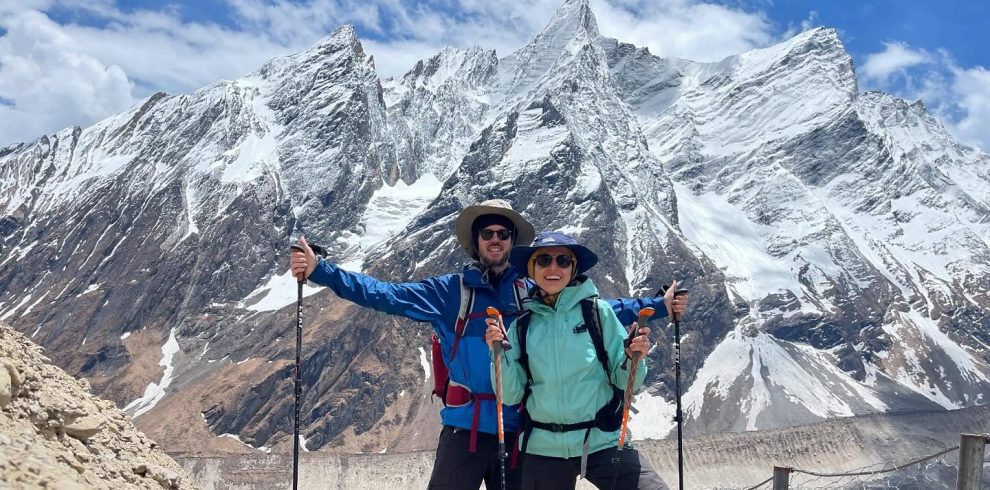
The 11-Day Manaslu Circuit Trek offers a quiet and scenic journey around Mount Manaslu (8,163m) – Nepal’s eighth-highest peak. With…
Insurance Providers Commonly Used by Nepal Trekkers
We do not sell insurance and we do not endorse any single provider, since the right policy depends on your nationality, age, health history, and where you are traveling from. What we can tell you is which names come up most often among trekkers who pass through our office each season, based on what people show us as proof of insurance. Treat the table below as a starting point for your own research, not a recommendation, and always confirm current pricing, exclusions, and altitude limits directly with the insurer before buying, since policy terms and prices change and what a trekker tells us in the field is not the same as an official policy document.
| Provider (examples, not endorsements) | Commonly used by | General suitability notes based on trekker feedback |
|---|---|---|
| World Nomads | Trekkers from the US, Australia, Canada, UK, and elsewhere buying online | Widely used and easy to buy online; some plans state coverage for trekking up to around 6,000 meters, but confirm which plan tier includes the evacuation limit you need, since base tiers sometimes require an upgrade for full evacuation cover |
| True Traveller | UK and EU based trekkers | Popular among British trekkers on Himalayan routes; check the specific altitude band and evacuation limit on the plan you select, as options vary |
| Global Rescue | Trekkers who want dedicated evacuation and security membership rather than standard travel insurance | Known specifically for evacuation and rescue coordination services rather than being a full travel insurance replacement; some trekkers pair it with a separate medical and cancellation policy |
| IMG (International Medical Group) and similar US focused insurers | US based trekkers wanting medical and evacuation cover for international travel | Offers adventure travel add ons in some plans; confirm the trekking altitude cap applies to your specific route |
| Local or regional insurers and comparison sites | Trekkers buying through a domestic insurance market in their home country | Coverage quality varies widely; always verify the altitude and evacuation figures directly rather than trusting a general “adventure travel” label |
Notice that not one of these entries is a blanket recommendation. Every single one comes with the same instruction: confirm the actual numbers on the actual plan you are about to buy. A provider’s general reputation for adventure travel does not guarantee that the specific plan tier you select, at the price you are paying, includes a 6,000 meter trekking allowance and a USD 5,500 or higher evacuation limit. Read the plan document, not just the marketing page.
Checklist: What a Suitable Policy Should Include
Use this table as a quick reference while you are comparing quotes, whether you are sitting with three browser tabs open or on the phone with an insurance agent.
| Coverage item | Minimum we recommend for Manaslu | Why it matters on this specific trek |
|---|---|---|
| Altitude limit for trekking or hiking | 6,000 meters or higher | Larkya La sits at 5,106 meters; you want margin above the highest point of the route |
| Emergency helicopter evacuation | USD 5,500 or higher | A real rescue from the Manaslu region can cost this much or more depending on distance, weather, and aircraft |
| Medical treatment abroad | Tens of thousands of dollars, check the specific figure | Covers hospital care in Kathmandu or Pokara after evacuation |
| Trip cancellation or interruption | Covers prepaid trekking costs, not just flights | Protects you against weather delays, strikes, and personal emergencies before or during the trip |
| Baggage and gear loss | Enough to replace boots, a sleeping bag, and cold weather layers | Airlines and porters occasionally lose or damage gear on remote routes |
| 24 hour emergency assistance line | A genuine round the clock number, tested if possible | Speed of authorization affects how quickly a helicopter can be dispatched |
| Restricted area or special permit exclusion check | Confirm no exclusion applies to permit controlled regions | Manaslu is a restricted area requiring a special trekking permit |
What Documents to Bring and How We Verify Your Coverage
Before any of our groups leaves Kathmandu for the Manaslu Circuit Trek, we ask every trekker for three specific pieces of information: the name of the insurer, the policy number, and the insurer’s emergency or assistance contact number, ideally with a printed or saved digital copy of the policy document itself. We check this against what the policy actually states about altitude and evacuation limits, not just that a policy exists, since a certificate that only proves you paid for some kind of travel insurance does not tell us whether that insurance would actually pay for a helicopter above 5,000 meters.
We recommend carrying both a printed copy and a digital copy saved somewhere accessible without internet access, such as a photo on your phone, since connectivity along the route is limited and you do not want to be searching for a PDF attachment in an email inbox at the exact moment your guide needs your policy number to call for a helicopter. Our guides also carry a note of each trekker’s insurance details in their own field kit as a backup, precisely so that information is available even if a trekker’s own phone is lost, damaged, or out of battery during an emergency.
If you book with us, this verification happens as part of our standard pre departure checklist, alongside permit paperwork and gear checks, and we are always glad to look over your policy details in advance and flag anything that looks like it might not meet the altitude or evacuation requirement, well before you are standing at the trailhead in Soti Khola with no easy way to fix it. You can find our full booking and planning details on the Manaslu Circuit Trek trip, and we are always reachable through our contact if you want a second opinion on a specific policy before you commit to it.
Common Mistakes Trekkers Make With Insurance
The single most common mistake is buying a general travel insurance policy without checking the activity and altitude section at all, assuming that because the policy mentions Nepal or mentions trekking somewhere in its marketing copy, it automatically covers trekking at any altitude. As covered above, this is very often not true, and the gap only becomes visible when someone needs a rescue and the claim gets rejected.
A close second is buying a policy with an evacuation limit that sounds reasonable on paper, something like USD 2,000 or 3,000, without realizing that a real helicopter rescue from high in the Manaslu region can exceed that figure on a bad weather day or a long distance flight, leaving the trekker responsible for the difference at the exact moment they are least able to deal with a large unexpected bill.
A third mistake is waiting until the last minute to buy insurance, sometimes literally at the airport before flying, which limits your choices to whatever is available at that moment and often pushes people toward the first policy they see rather than one that actually fits a high altitude restricted area trek. Buying insurance weeks in advance also matters for trip cancellation coverage specifically, since most cancellation benefits only apply to events that happen after the policy is purchased, so a policy bought the day before departure will not help if the reason for cancellation happened earlier.
A fourth mistake, less common but worth naming, is assuming a credit card’s built in travel insurance is sufficient. Some premium credit cards do include a degree of travel insurance, but the altitude and activity exclusions on these are often even more restrictive than a standalone policy, and the evacuation limits, when they exist at all, are frequently too low for a trek that reaches 5,106 meters. If your plan is to rely on a credit card benefit, read that specific benefit’s terms with the same scrutiny you would apply to a standalone policy, and do not assume “travel insurance” printed on a card benefits page means the same thing as a policy built for high altitude trekking.
Finally, some trekkers buy the right policy but never actually read it closely enough to know their own evacuation limit, medical limit, or emergency contact number, and end up scrambling to find that information from an email inbox during an actual emergency. Know your own numbers before you need them.
What Happens If You Need to Use It: The Claims Process in a Real Emergency
In an actual emergency on the trail, the claims process and the rescue process happen almost simultaneously rather than one after the other. Your guide contacts our office, our office contacts the insurer’s emergency assistance line, and the insurer, once satisfied that the situation is genuine and covered, issues what is usually called a guarantee of payment directly to the helicopter operator or hospital. This is the mechanism that allows a rescue to happen without the trekker or our company paying the full cost upfront out of pocket, and it is the entire reason the coverage limits discussed throughout this guide matter as concrete dollar figures rather than abstract policy language.
If for any reason the insurer cannot be reached quickly enough, or a guarantee of payment cannot be issued fast enough given the medical urgency, our company will front the immediate cost of a rescue in a genuine emergency and seek reimbursement afterward, which is one more reason accurate insurance details matter, since reimbursement depends entirely on the trekker’s policy actually covering what happened. This is not a substitute for proper coverage. It is a last resort measure for moments when speed matters more than paperwork, and it works far more smoothly when the trekker’s policy details were verified correctly before departure in the first place.
After the immediate emergency, the formal claims process looks much like any insurance claim: gathering medical reports from the treating hospital, a written account of the incident from the guide or trekking company, receipts for any costs paid directly, and the insurer’s own claim forms. Keep every receipt, no matter how small, and ask the treating hospital for a detailed written report before you leave Nepal if at all possible, since gathering this documentation after you have returned home is considerably harder. Insurers vary widely in how quickly they process claims and how much documentation they require, which is one more reason the assistance line’s responsiveness during the emergency itself is worth checking before you buy, not just the eventual claims payout process.
Cost Expectations for a Suitable Policy
Trekkers often ask us what a suitable policy should cost, and the honest answer is that it depends heavily on your nationality, age, trip length, and the specific insurer, so we will not quote a fixed figure here since doing so would almost certainly be out of date or inaccurate by the time you read this. What we can say is that a policy built for high altitude trekking with a proper evacuation limit typically costs somewhat more than a basic beach holiday travel policy for the same trip length, since the insurer is pricing in a genuinely higher risk activity and a higher potential payout.
Do not choose a policy based on price alone, and be especially cautious of a quote that looks unusually cheap compared to others for the same trip length, since a very low price is sometimes a sign that the policy either has a low altitude ceiling, a low evacuation limit, or both, rather than a sign of an unusually good deal. A slightly higher premium that actually includes the coverage described throughout this guide is worth far more than a cheaper policy that leaves you exposed at exactly the point on the trek where you are most likely to need help.
It is also worth checking whether trip length affects your quote meaningfully, since the Manaslu Circuit Trek typically runs somewhere in the range of two to three weeks including travel days in Kathmandu, and a policy quoted for a shorter trip duration than your actual itinerary will not cover the days that fall outside its stated window. Match your policy’s date range to your actual travel dates, including a buffer day or two on each end for flight delays, which are common on the mountain flights connecting to trek start and end points.
A Note on Nepal’s Fake Rescue Scandal and Why Verified Insurance Still Matters
You may have come across news coverage of a large scale fraud investigation involving fake helicopter rescues in Nepal, in which a small number of hospitals, helicopter operators, and trekking intermediaries were accused of manufacturing unnecessary evacuations and inflating billing to insurers, in some reported cases making trekkers artificially unwell to justify a rescue and then billing several insurers separately for what was actually one shared flight. This is a real and serious problem that Nepal’s tourism industry has had to confront, and it understandably makes some trekkers wonder whether buying proper insurance is worth the trouble if the whole system can be gamed.
Our view is the opposite. The fraud cases that made headlines involved a small number of bad actors deliberately arranging unnecessary emergencies, not the ordinary process of a genuine altitude sickness case or injury getting properly evacuated and treated. The way to protect yourself from this kind of scheme is not to skip insurance, it is to trek with a company that coordinates rescues directly with known, licensed operators and hospitals rather than through unclear intermediaries, and to keep your own copies of any medical reports, flight records, and communications if you are ever evacuated, so that your own claim is well documented regardless of what anyone else in the chain may or may not have done correctly. Proper insurance, verified before departure and paired with a trekking company that takes rescue coordination seriously, remains the right approach even in light of this news, not a reason to abandon it.
For a broader look at how a medical situation actually unfolds on this route, our walkthrough of what happens if you get sick on the Manaslu Circuit pairs well with the insurance advice above.
Frequently Asked Questions
Do I legally need travel insurance to trek the Manaslu Circuit Trek?
Nepal does not have a single national law requiring every foreign trekker to carry travel insurance for every trek, but the restricted area permit system for Manaslu, combined with the practical reality of trekking above 5,000 meters in a remote region, makes insurance essential in practice rather than optional. Manaslu Treks and Expedition requires proof of suitable insurance, covering the altitude and evacuation figures described in this guide, before we allow anyone to join a departure.
What altitude does my policy need to cover for this specific trek?
Your policy should state coverage for trekking or hiking up to at least 6,000 meters. Larkya La itself is 5,106 meters, but a 6,000 meter allowance gives you a sensible margin and matches what most reputable high altitude trekking policies already offer as a standard tier.
Why USD 5,500 specifically for helicopter evacuation, rather than some other number?
USD 5,500 reflects the realistic lower to middle end of what a genuine helicopter rescue from the Manaslu region can cost once you account for distance, weather, altitude of the pickup point, and aircraft type. Costs can run higher depending on the specifics of a given rescue, so we treat 5,500 as a firm minimum rather than a comfortable ceiling, and a policy offering considerably more provides better protection.
Can I buy insurance after I arrive in Nepal instead of before I leave home?
It is possible to find insurance options once you are in Kathmandu, but your choices narrow considerably, prices are often less competitive, and any trip cancellation benefit becomes largely meaningless since the trip is already underway. We strongly recommend buying a suitable policy from your home country before you travel, ideally as soon as your trek dates are confirmed.
Does my credit card’s built in travel insurance cover this trek?
Sometimes partially, but usually not adequately. Many credit card travel benefits carry altitude and activity exclusions that are stricter than a standalone policy built for trekking, and evacuation limits, when included at all, are often too low for a trek reaching 5,106 meters. Read your specific card’s benefit terms carefully rather than assuming general travel coverage applies.
What if my insurer requires proof the rescue was medically necessary?
Most reputable insurers do require this, and it is a reasonable safeguard given the fraud issues that have affected Nepal’s rescue industry in recent years. Our guides document the situation as it happens, and we coordinate directly with hospitals and helicopter operators we know, so that a legitimate emergency is backed by clear medical reporting your insurer can act on quickly.
Is Global Rescue enough on its own, or do I need a separate travel insurance policy too?
Global Rescue and similar evacuation membership services are generally focused specifically on rescue and evacuation coordination rather than functioning as a complete travel insurance replacement covering medical treatment, cancellation, and gear. Many trekkers who use a service like this pair it with a separate policy covering the other categories described in this guide. Confirm exactly what any membership includes before assuming it covers everything.
How do I actually prove my insurance to Manaslu Treks and Expedition before departure?
Send us your insurer’s name, your policy number, and the emergency assistance contact number, along with a copy of the policy document if possible, before you arrive in Kathmandu. We check this against the altitude and evacuation figures discussed throughout this guide as part of our standard pre departure process, and we would rather flag a gap in your coverage weeks before your trek than discover it during an emergency.
What should I do if I am not sure whether my existing policy is good enough?
Reach out to us directly through our contact with your policy details, or the specific plan you are considering, and we are glad to look over the altitude and evacuation figures with you before you commit to booking. It is far easier to sort out a coverage gap while you are still comparing options than after you have already paid for a policy that turns out not to fit this specific trek.
If you still have questions about insurance requirements for the Manaslu Circuit Trek, or you want a second opinion on a policy before you book, get in touch with us at Manaslu Treks and Expedition. You can call or message us on WhatsApp at +977 9869225929, email us directly at info@manaslutreks.com, or reach out through our contact. We would rather answer a dozen insurance questions before you fly than deal with an uncovered emergency at 5,000 meters, and we are glad to look over your specific trip dates, route plan, and policy details together before you commit to a departure.