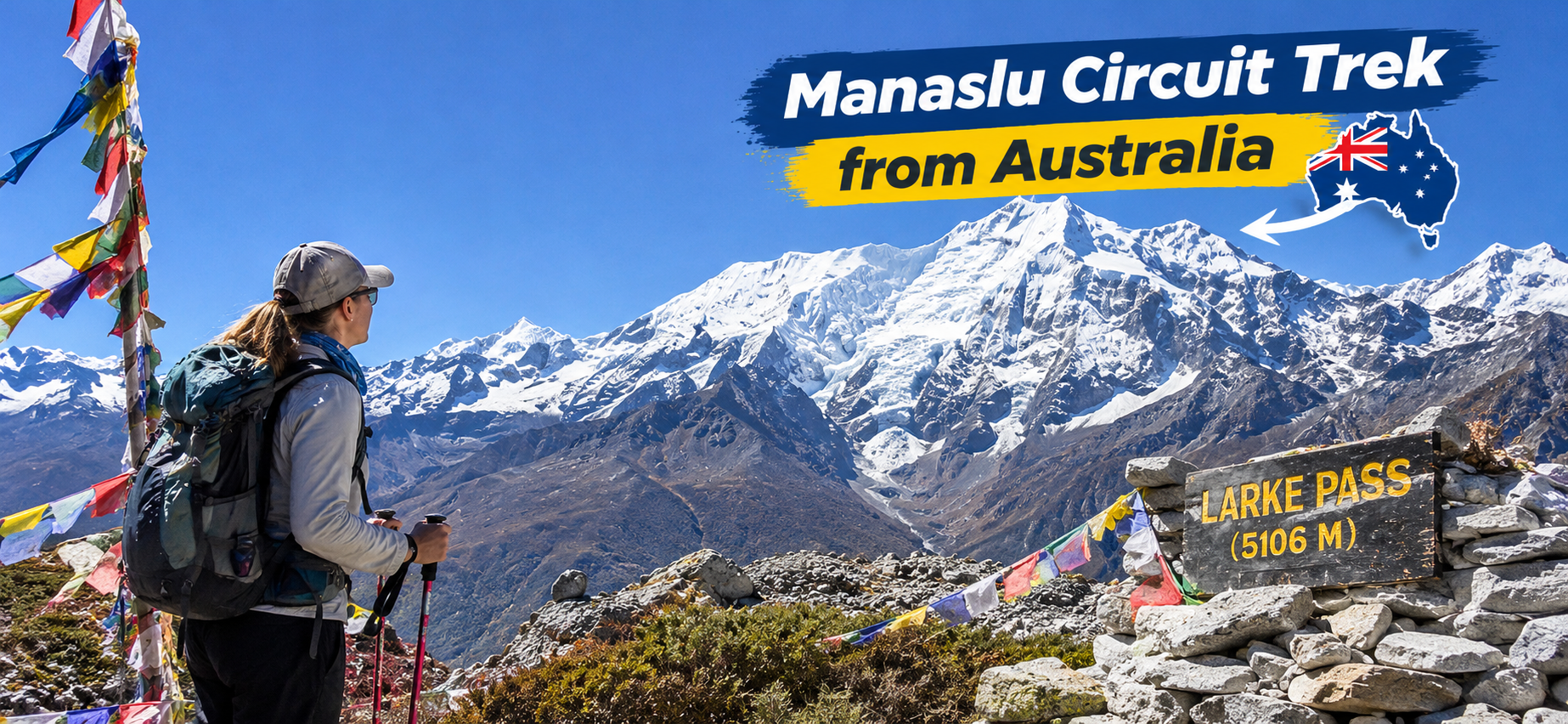
If you are reading this from Sydney, Melbourne, Brisbane, Perth, or anywhere else in Australia and wondering whether the Manaslu Circuit Trek is a realistic trip to plan, the answer is yes, and Australians tend to do very well on this particular route. I have guided a good number of Australian trekkers through this region over the years, and the pattern that shows up again and again is a strong baseline of outdoor capability: people who have done the Overland Track in Tasmania, tackled the Kokoda Track in Papua New Guinea, or spent weekends on the Larapinta Trail in the Red Centre, and who arrive with a realistic sense of what multi-day walking actually demands. What is different here is not fitness so much as scale and altitude. A week on the Overland Track tops out under 1,300 metres. Manaslu crosses a pass at 5,106 metres, sits three weeks from the nearest real hospital, and legally requires a licensed guide and a restricted area permit before you leave Kathmandu. This guide walks through everything an Australian trekker actually needs to plan this trip properly in 2027, from the long flight out of your home city to what a cold night at Dharamsala actually feels like, written the way I would explain it to someone sitting across the desk from me in our office rather than the way a generic travel site recycles the same five paragraphs.
Why Australian Trekkers Take to the Manaslu Circuit
Australia has a strong, slightly understated hiking culture. It does not have the same density of accessible high mountains that a country like Nepal or Switzerland has, but it has produced a genuinely serious cohort of long-distance walkers through tracks like the six-day Overland Track between Cradle Mountain and Lake St Clair, the gruelling Kokoda Track with its own brutal history and logistics, and the Larapinta Trail’s multi-week traverse of the West MacDonnell Ranges. None of these tracks come close to Himalayan altitude, but they all demand the same things Manaslu demands: carrying a pack for multiple consecutive days, managing fatigue that compounds rather than resets overnight, and trusting a plan you cannot fully control once you are a few days in.
I want to be upfront about where the comparison breaks down, because Kosciuszko, Australia’s highest peak, sits at 2,228 metres, and even that is reached by most visitors on a half day walk from Thredbo. Nothing in Australia prepares a trekker for what 5,000 metres plus actually feels like in the lungs, and I say this not to be alarmist but because it is the single most common blind spot I see in strong, fit Australian trekkers who assume their general hiking competence maps directly onto altitude tolerance. It does not, and the two are genuinely separate skills. What Australians do bring, more consistently than trekkers from a lot of other countries I work with, is a practical, unfussy attitude to discomfort, a willingness to carry their own gear, and an outdoor culture that takes trip planning and proper equipment seriously rather than treating a multi-week trek as an extension of a weekend day walk.
There is also a numbers story worth knowing. Nepal has historically drawn a modest but steady stream of Australian visitors each year, and most of them have gravitated toward the two most marketed routes, Everest Base Camp and the Annapurna Circuit, simply because those are the names that come up first in a web search. Manaslu barely registers yet in Australian trekking conversation, and that is precisely its appeal for anyone who has already done research on Nepal and noticed how crowded the two famous routes have become. If your goal is a Himalayan trek that still feels like a genuine expedition rather than a queue at a viewpoint, Manaslu is the more honest version of that experience right now, and it will not stay this quiet forever.
Flight Options and Travel Time from Australia to Kathmandu
There is no direct flight from any Australian city to Kathmandu, and that is simply a fact of the route network rather than something that is likely to change soon. Every option involves at least one stopover, and your total door-to-door travel time will typically run somewhere between fourteen and nineteen hours of flying, before you add layover time at the connecting airport.
From Sydney, Melbourne, and Brisbane, the most commonly used connection points are Singapore, with Singapore Airlines running a strong onward connection to Kathmandu, and Kuala Lumpur, with Malaysia Airlines offering a similar routing. Both are well-trodden corridors for Australian trekkers heading to Nepal and tend to have reasonable schedules that do not force an overnight airport stay if you book carefully. Bangkok, via Thai Airways, is another workable option, particularly if you want to break the journey with a night in Thailand on either leg. From Perth, the flight geography actually works slightly in your favour compared with the east coast, since Perth sits closer to Southeast Asian and South Asian hubs, with Singapore, Kuala Lumpur, and increasingly competitive options through Dubai or Doha on Qantas codeshare and partner airlines like Emirates and Qatar Airways.
| Departure city | Typical routing | Approximate total travel time |
|---|---|---|
| Sydney | Via Singapore or Kuala Lumpur | Roughly 14 to 17 hours including layover |
| Melbourne | Via Singapore, Kuala Lumpur, or Bangkok | Roughly 15 to 18 hours including layover |
| Brisbane | Via Singapore, with onward connections most common | Roughly 15 to 18 hours including layover |
| Perth | Via Singapore, Kuala Lumpur, Dubai, or Doha | Roughly 12 to 15 hours including layover, often the shortest routing of any Australian city |
A practical note that applies to every Australian trekker I have worked with: build at least one full buffer day into your schedule between landing in Kathmandu and starting the trek. The overland journey to the trailhead at Soti Khola or Machha Khola depends on road and weather conditions that are well outside anyone’s control, and a long-haul flight with a tight connection stacked directly against an early departure for the hills is a recipe for starting your trek exhausted at best and missing it entirely at worst if your inbound flight is delayed. Fares themselves move a great deal with season, and the cheapest months to fly tend to fall outside the Northern Hemisphere’s main holiday periods, so if your trekking dates have some flexibility, it is worth checking fares across a few different months before locking in your trip.
Nepal Visa Requirements and Process for Australian Citizens
Australian passport holders can obtain a Nepal tourist visa on arrival at Tribhuvan International Airport, and Nepal also runs an online pre-registration system that lets you complete your details in advance and print a barcode to speed up the immigration queue, which is genuinely worth doing given how busy the arrivals hall can get during peak trekking season. Tourist visas come in three standard durations, with fees historically set at around 30 US dollars for 15 days, 50 US dollars for 30 days, and 125 US dollars for 90 days, though you should confirm the current fee schedule on Nepal’s official immigration website before you travel, since visa pricing is the kind of detail governments adjust without much warning.
You will need a passport valid for at least six months beyond your travel dates, a passport-sized photo, and the visa fee in cash, with US dollars the most reliably accepted currency at the payment counter. For a trek that realistically runs two to three weeks once you add Kathmandu time on either end, most of our Australian clients choose the 30 day visa, which comfortably covers the whole trip with some buffer. Beyond the general tourist visa, Manaslu itself sits inside a restricted area and requires additional paperwork that a standard Nepal visa does not cover, specifically a Restricted Area Permit, a Manaslu Conservation Area Permit, and an Annapurna Conservation Area Permit for the section of trail that exits through that zone near Dharapani. These three are arranged through your registered trekking agency rather than at the airport, and they apply at the same rate to every nationality, Australians included, so there is no separate fee schedule to look up here beyond what any other trekker pays. Our Nepal visa guide for Manaslu trekkers goes through the full process in more detail, and the complete cost breakdown lays out exactly what each permit costs this season.
Best Time to Trek Manaslu Around Australian Holiday Patterns
The two strongest trekking windows for Manaslu are spring, roughly March through May, and autumn, roughly late September through November, and this is one area where Australian travel patterns do not line up quite as neatly as they do for some other nationalities. Australia’s big school holiday block and the most common annual leave period for workers falls around Christmas and the New Year, which lands squarely in Nepal’s winter. Winter on Manaslu is genuinely harsh, with serious snow likely at Larkya La and several teahouses above Samdo closing for the season entirely, so I would not recommend this window for a first attempt at this particular trek unless you have real high altitude winter experience and are prepared for a meaningful chance the pass is simply closed when you arrive.
The good news is that Australia’s other common leave windows line up much better. The Easter school holidays, typically falling somewhere in the March to April window depending on the year, sit right at the start of the spring trekking season, and a lot of our Australian clients build their trip around this break combined with a few extra days of annual leave either side. The September to October school holiday period overlaps nicely with the start of the best autumn trekking conditions, which is arguably the single most popular window for this trek worldwide because of its clear mountain views and generally stable weather. If your work allows flexible timing rather than being tied strictly to school terms, late September through November remains the strongest overall choice, and our detailed month-by-month itinerary planning guide breaks down conditions in more depth if you want to fine-tune your dates.
| Planning factor | Key detail for an Australian traveler |
|---|---|
| Visa | Visa on arrival or online pre-registration, standard fee tiers by 15, 30, and 90 day duration, reconfirm current fees before travel |
| Currency | Nepalese Rupee is the local currency, US dollars exchange easily in Kathmandu, Australian Dollars are not commonly exchanged outside the capital, cards work in the city but not on the trail |
| Flight routing | No direct flights, connect through Singapore, Kuala Lumpur, Bangkok, Dubai, or Doha depending on your home city |
| Best season | Spring, March to May, and autumn, late September to November, both offer reasonable overlap with Easter or September-October school holidays |
Time Zone Difference and the Long Flight Adjustment
Nepal runs on Nepal Standard Time, which is an unusual offset of five hours and forty-five minutes ahead of Coordinated Universal Time, and this produces a genuinely confusing set of gaps against Australia’s own three time zones. Sydney, Melbourne, and Brisbane run on Australian Eastern Standard Time, which sits four hours and fifteen minutes ahead of Nepal for most of the year, widening to five hours and fifteen minutes when the southern states move to daylight saving over the Australian summer, while Queensland, which does not observe daylight saving, stays at the smaller gap year-round. Perth, on Australian Western Standard Time, sits only two hours and fifteen minutes ahead of Nepal with no daylight saving adjustment at all, which makes it one of the easier adjustments of any Western country trekkers typically travel from.
In practical terms, none of these gaps are large enough to cause the kind of multi-day jet lag you would get flying to Europe or the Americas, but the long flight itself, not the time difference, is what tends to leave Australian trekkers fatigued on arrival. Combined with layover time, you are looking at sixteen to twenty hours of total travel door to door from most Australian cities, and that is real fatigue regardless of how small the actual time zone shift turns out to be. This is exactly why the buffer day in Kathmandu matters so much: it gives your body a chance to recover from the flight itself, quite separately from any time zone adjustment, before you start putting in six-hour trekking days.
Currency Exchange and Card Use for Australian Travelers
Nepal’s currency is the Nepalese Rupee, and Australian Dollars are not a currency you can reliably exchange once you are outside Kathmandu, and even within the capital you will generally get a better rate converting US dollars than Australian ones, since US currency remains the default foreign reference currency across Nepal’s exchange counters and licensed money changers. Many of our Australian clients bring a mix, converting the bulk of their trip cash to US dollars before departure or on arrival, since rates for Australian Dollars can be inconsistent and are not accepted at all once you leave the city.
Credit cards work reasonably well in Kathmandu for hotels, restaurants, and larger shops, with a small transaction fee common on Visa and Mastercard. Once you are on the trail, card acceptance disappears almost entirely. Teahouses along the Manaslu route run on cash only, and there are no functioning ATMs once you are past the lower villages near Soti Khola, so you need enough Nepalese Rupees in hand to cover your entire trek, including meals, snacks, hot showers, device charging, and WiFi where it exists, since these are typically paid for individually at each teahouse rather than bundled into your package price. Our full cost breakdown gives a realistic daily cash figure to plan around, and it climbs noticeably the higher you go, since everything above the roadhead has to be carried in by porter or mule.
Language and Communication on the Trek
English is the working language of trekking in Nepal and a requirement of the government’s own guide licensing process, so every licensed guide you trek with will speak functional to fluent English. For Australian trekkers this is genuinely one of the easier logistical hurdles of the whole trip, since there is no language barrier to plan around the way there might be for trekkers from non-English speaking countries, and the conversational style and dry humour that a lot of Australian trekkers bring to the trail tends to go down well with guides who have spent years working with English speaking clients from all over the world. Porters and teahouse owners generally have more limited English, so most of your direct day-to-day communication runs through your guide, which is one more reason the relationship with your guide matters as much as the trekking itself.
Food on the Trek: What Australian Trekkers Should Actually Expect
Teahouse food on the Manaslu Circuit is simple, filling, and built around what can realistically be carried up the trail or grown locally at lower elevations, and I want to be straightforward about this rather than oversell it. Dal bhat, a set meal of lentil soup, rice, vegetable curry, and usually a pickle or small side, is the standard trekker meal and the one I recommend eating most often, partly because it is usually the freshest option on the menu and partly because most teahouses offer unlimited refills, which genuinely matters when you are burning several thousand calories a day at altitude. Other regular menu items include fried noodles, fried rice, potato dishes in several forms, soup, and basic bread, along with instant noodles that most Australian trekkers find at least passably familiar.
What you will not find is anything resembling a classic Australian meal, and there is no real substitute for a proper barbecue or a meat pie once you are on the trail. Coffee is also worth setting expectations for early: instant coffee is common at most teahouses, but genuine espresso-style coffee, the kind most Australian trekkers drink daily at home, is rare to nonexistent above the lower villages, so anyone who treats a proper coffee as a daily non-negotiable should either pack a reliable instant alternative they actually enjoy or make peace with a few weeks of simpler options. Thamel in Kathmandu, by contrast, now has a genuinely solid cafe culture with flat whites and long blacks that would not look out of place in Melbourne, so use your buffer days in the capital to get your coffee fix before and after the trek rather than expecting it on the mountain.
Packing Considerations for Someone Traveling from Australia’s Climate
This is one area where Australian trekkers sometimes need to adjust their thinking more than trekkers from countries with a genuine cold winter. Much of Australia simply does not get the kind of sustained sub-zero cold that Manaslu’s higher villages experience most nights of the year, and a trekker whose idea of cold weather gear comes from a Melbourne winter or a weekend in the Victorian high country can genuinely underestimate what negative fifteen degrees Celsius at Dharamsala actually feels like at four in the morning before a pass crossing.
Core items worth prioritising include a proper down jacket rated well below freezing, a sleeping bag rated to at least negative fifteen degrees Celsius since teahouse rooms above 3,500 metres are not heated, thermal base layers, a windproof and waterproof outer shell, sturdy broken-in trekking boots rather than anything new out of the box, trekking poles, strong sun protection including a hat and glacier-rated sunglasses given how intense UV exposure gets at altitude, and a reliable headlamp for the early morning pass day. One genuinely convenient detail for Australian trekkers: Kathmandu is the name of a well-known Australian outdoor clothing retailer, and more than one client has pointed out the coincidence to me with a laugh, but it is also worth knowing that Thamel itself has a dense cluster of genuine and replica trekking gear shops where good quality down jackets, sleeping bags, and other cold-weather items can be rented cheaply for a trek of this length, which is often more practical than buying serious cold weather gear you may rarely use again back home in a milder Australian climate. Electrical outlets in Nepal typically use type C, D, and M configurations depending on the building, which differ from Australia’s own type I plug, so bring a proper universal adapter rather than assuming anything you own will fit directly.
Cultural Etiquette Differences Worth Knowing
Nepal’s rural trekking regions run on a slower, warmer, and more conversational social rhythm than the fairly direct, efficiency-minded style a lot of Australians are used to at home, and the trekkers I have seen adjust best are the ones who consciously slow their own pace of interaction to match rather than treating every exchange as a transaction to get through quickly. The standard greeting is “namaste,” offered with hands together at the chest, and it gets used constantly, including with strangers, teahouse owners, and porters, so using it back is a small gesture that goes a long way.
Tipping, which is a much smaller feature of everyday Australian life than it is in, say, North American service culture, is nonetheless an expected and genuinely important part of trekking in Nepal, and guides and porters rely on it as a real part of their income over a multi-week trek, so budget for it from the start rather than treating it as optional. Religious etiquette matters too, since the upper Manaslu region and Tsum Valley pass through devout Tibetan Buddhist communities. Walk around mani stones, prayer wheels, and chortens on the left side, spin prayer wheels clockwise, and always ask before photographing people, monasteries, or religious ceremonies, particularly around Samagaon and Samdo where Buddhist practice is a visible, daily part of village life. Modesty in dress matters more here than it typically does in urban or beach-culture Australia, so packing at least one layer that covers shoulders and knees is worth doing even on a trek, especially around monasteries.
Safety and the Licensed Guide Requirement on This Restricted Area Trek
Manaslu is legally classified as a restricted area by the Nepali government, which means, unlike more open routes such as Annapurna Base Camp or the standard Everest Base Camp trail, you cannot trek here independently under any circumstances. A licensed guide is a legal requirement, not a recommendation, and permits are not issued to trekkers without one. This is not bureaucracy for its own sake. The route crosses genuinely serious terrain including the Larkya La at 5,106 metres, rescue and communication infrastructure is thinner here than in more developed trekking regions, and weather at altitude can turn fast enough that local knowledge meaningfully changes safety outcomes.
For Australian trekkers specifically, who often arrive with strong general hiking fitness from genuinely demanding home tracks, the temptation can be to assume that fitness translates directly into altitude tolerance, and it simply does not. Altitude sickness affects strong hikers and weak hikers alike, and it has very little to do with how many kilometres you can cover in a day at sea level. A good guide’s real value is recognising early symptoms, pacing your acclimatisation properly, and making the call to descend when it matters, a decision that is much harder to make objectively about yourself in the moment than it is for an experienced guide watching a group from the outside. I would encourage anyone planning this trek, regardless of how fit you already are, to read our honest Manaslu trek difficulty assessment before booking, since it covers the altitude profile and physical demands without softening them. Travel insurance that explicitly covers high altitude trekking and helicopter evacuation is not optional for this trip, and our travel insurance guide explains exactly what to check for in a policy before you buy one.
Route Overview and What a Typical Day Looks Like
The standard Manaslu Circuit runs roughly two to three weeks depending on your itinerary and any side trip into the Tsum Valley, starting with a long drive to the trailhead near Soti Khola or Machha Khola, then following the Budhi Gandaki river valley upstream through villages including Jagat, Deng, Namrung, and Lho before reaching Samagaun, the main acclimatisation hub beneath Manaslu itself. From there the trail climbs to Samdo and then Dharamsala, the last camp before the pass, crosses Larkya La on a single long push day, and descends into the Marsyangdi valley on the Annapurna side toward Dharapani or Besisahar. A typical trekking day runs four to seven hours, usually starting early to make the most of clear morning weather before afternoon cloud or wind builds in. Our full Manaslu Circuit itinerary guide breaks the route down day by day with elevation profiles and village details, and it is worth studying closely alongside this article, since route knowledge and pacing matter as much as fitness for how the trek actually feels day to day.
Physical Preparation: Bridging Australian Hiking Fitness to Himalayan Altitude
If your regular routine already includes multi-day hikes on tracks like the Overland Track, sections of the Larapinta, or genuinely long day walks in places like the Blue Mountains or the Grampians, you have a solid physical foundation to build on for Manaslu. What I recommend adding in the months before departure is less about raw intensity and more about duration and cumulative fatigue: back-to-back long days on consecutive weekends to simulate the effect of a three-week trek, training hikes with a loaded pack even though a porter will likely carry your main bag, and, if you can arrange it, any exposure at all to altitude, even a single trip above 2,000 metres somewhere accessible, simply to get a sense of how your own body responds to thinner air before you are relying on that information at 4,500 metres with no easy way down.
Cardiovascular conditioning matters more than raw leg strength for this specific trek, so running, cycling, or stair climbing layered on top of your existing hiking routine will serve you well. None of this replaces proper acclimatisation on the mountain itself, which no amount of training at sea level can substitute for, but it does mean you arrive with genuine reserve capacity rather than running close to your limit from the first week.
Choosing a Trekking Agency and What to Ask Before You Book
Given the restricted area status of this trek, your choice of agency matters more here than it would for an open route. Ask directly about your guide’s specific experience on Manaslu rather than general Himalayan experience, since pacing decisions on this particular trail and knowledge of which teahouses are reliably open in your travel window come from specific route experience, not general guiding credentials. Ask how group size is handled, since a smaller group generally allows more flexible pacing around individual acclimatisation needs, which matters even more on a trip where everyone in your group is adjusting to altitude at a different rate. Ask exactly what is included in your quoted price versus what you pay for separately on the trail, since permit costs, guide and porter wages, and meals are bundled differently between operators, and comparing two quotes without checking what each one actually covers can be genuinely misleading. Our guide to common booking mistakes covers this in more depth, and our contact page is the direct route to ask us any of these questions before you commit to dates.
Practical Pre-Departure Checklist for Australian Trekkers
- Confirm your Australian passport has at least six months validity remaining and enough blank pages for entry stamps.
- Arrange your Nepal tourist visa, either through the online pre-registration system or planning for the visa on arrival process at Tribhuvan International Airport, and bring US dollars in cash for the fee along with a passport photo.
- Book your flight with a genuine buffer day on arrival in Kathmandu before your trek start date, given how much domestic connections and road transfers depend on weather.
- Confirm your trekking agency has arranged your Restricted Area Permit, Manaslu Conservation Area Permit, and Annapurna Conservation Area Permit, and confirm your licensed guide assignment ahead of arrival.
- Purchase travel insurance that explicitly covers high altitude trekking above 5,000 metres and helicopter evacuation, and check the policy actually names Nepal and the altitude you will reach.
- Pack layering for both mild lower valley conditions and genuinely cold high altitude nights, including a proper down jacket and a cold-rated sleeping bag, rather than assuming your usual Australian winter gear is enough.
- Bring broken-in trekking boots, not new ones, along with trekking poles and a headlamp for the pass crossing day.
- Bring a universal power adapter, since Nepal’s outlet types and voltage differ from Australia’s.
- Carry enough Nepalese Rupee cash for the entire trek, since cards and ATMs disappear once you leave the lower villages.
- Set aside cash for tipping your guide and porters at the end of the trek, a standard and genuinely important part of trekking culture in Nepal.
- Download an offline translation app and offline maps before you lose reliable signal outside Kathmandu.
If you are coming from elsewhere in the Asia-Pacific region and comparing notes with other trekkers, our planning guide for trekkers coming from South Korea covers many of the same visa, flight, and logistics questions from a neighbouring region’s perspective, and it is worth a look if you are travelling as part of a mixed international group.
Frequently Asked Questions
Is there a direct flight from Australia to Kathmandu?
No. Every route from every Australian city requires at least one connection, most commonly through Singapore, Kuala Lumpur, Bangkok, Dubai, or Doha, with total travel time typically running fourteen to nineteen hours depending on your departure city and layover length.
Do Australian citizens need a visa in advance for Nepal?
No advance consular visa is required. Australian passport holders can use Nepal’s visa on arrival process at the airport or complete the online pre-registration system beforehand to save time at immigration. Fees are typically offered in 15, 30, and 90 day options, and you should confirm the current schedule on Nepal’s official immigration website before travelling.
Can I use Australian Dollars in Nepal?
Not easily outside Kathmandu, and even in the capital you will generally get a better rate converting US dollars. Bring US dollars for exchange where possible, since they are the most widely accepted and easily converted foreign currency throughout Nepal.
How big is the time difference and will I get jet lagged?
Nepal sits four hours and fifteen minutes to five hours and fifteen minutes behind the eastern Australian states depending on daylight saving, and only two hours and fifteen minutes behind Perth. The time difference itself is manageable, but the length of the flight, typically sixteen to twenty hours door to door, causes more genuine fatigue than the time zone shift does, which is exactly why a buffer day in Kathmandu matters.
Will there be good coffee on the trek?
Not really. Instant coffee is common at teahouses, but genuine espresso-style coffee is rare to nonexistent above the lower villages. Kathmandu itself has a solid cafe scene, so plan to get your coffee fix in the capital before and after the trek rather than expecting it on the mountain.
Do I need previous high altitude experience to attempt Manaslu?
It helps but is not strictly required, since a licensed guide manages your acclimatisation pacing throughout the trek. What matters more is a solid baseline of multi-day hiking fitness, which trekkers with experience on tracks like the Overland Track or Larapinta often already have, combined with an honest respect for altitude illness risk, which affects fit and unfit hikers alike and has little to do with how strong your legs are.
What is the best season for an Australian trekker to attempt this trek around normal holiday timing?
Spring, March through May, overlaps reasonably well with the Easter school holiday period, and is a genuinely strong season for trekking conditions. Autumn, late September through November, is generally considered the single best overall season for clear views and stable weather, and overlaps with the September-October school holiday block if your work schedule allows that timing.
Can I trek Manaslu independently without a guide since I already hike regularly at home?
No. Manaslu is a legally restricted area, and a licensed guide along with the required permits are mandatory regardless of your personal hiking experience or fitness level. This is enforced through the permit system itself, not a suggestion, and it exists partly because rescue and communication infrastructure on this route is thinner than on more developed trekking corridors.
How does Manaslu compare in cost to doing the Overland Track or Kokoda from Australia?
Once you factor in international flights, permits, a licensed guide, porter support if you choose one, and teahouse accommodation, Manaslu is a larger financial commitment than a domestic Australian multi-day walk, simply because of the international travel and the restricted area permit system. Our full cost breakdown lays out every line item so you can budget accurately rather than guessing.
What is the single biggest mistake Australian trekkers make planning this trip?
Underestimating altitude because of genuine confidence built on strong home hiking fitness. The trekkers who do best are the ones who respect that altitude is a separate challenge from fitness entirely, build in proper acclimatisation days, and listen to their guide rather than pushing through early symptoms because they feel strong.
A Final Word Before You Book
Manaslu rewards trekkers who take it seriously without being intimidated by it, and Australian trekkers, in my experience, tend to arrive with a genuinely useful mix of outdoor capability and a practical, no-fuss attitude that serves them well here. The long flight, the visa process, the currency, the food, the coffee situation, are all manageable with a bit of planning, and none of them should be the reason you hesitate. The altitude and the mountain deserve your full attention instead. If you still have questions after reading this, whether about your specific dates, group sizes, or anything else covered here, reach out to us directly before you book anything. You can call or message us on WhatsApp at +977 9869225929, email us at info@manaslutreks.com, or use our contact page to send us your questions, and we will answer honestly, including telling you if a different trek or a different season suits your plans better than Manaslu does.