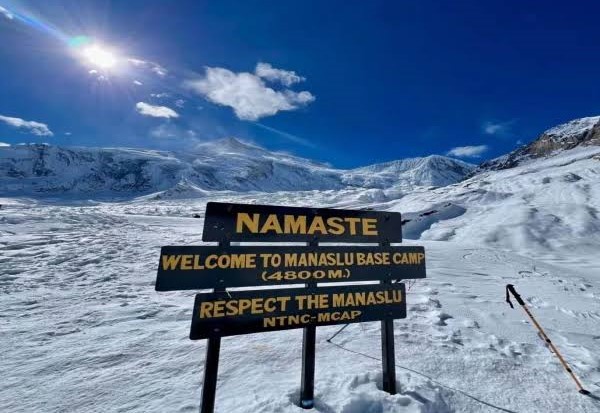
For most trekkers on the Manaslu Circuit Trek, Manaslu Base Camp is a single, unforgettable side trip out of Samagaon, a chance to stand on the moraine directly beneath the south face of the world’s eighth highest mountain before turning back for the acclimatization rest that day was really scheduled for. For a much smaller number of climbers, that same patch of ground is the starting point for a genuine 8,000 metre expedition, with tents, rope fixing teams, and weeks of rotations between camps still ahead of them. This guide covers Manaslu Base Camp from both angles: what it actually is, how trekkers get there, what an expedition looks like once it does, and the real history and danger that sit behind one of the more famous base camps in the Himalaya.
Where Manaslu Base Camp Actually Is
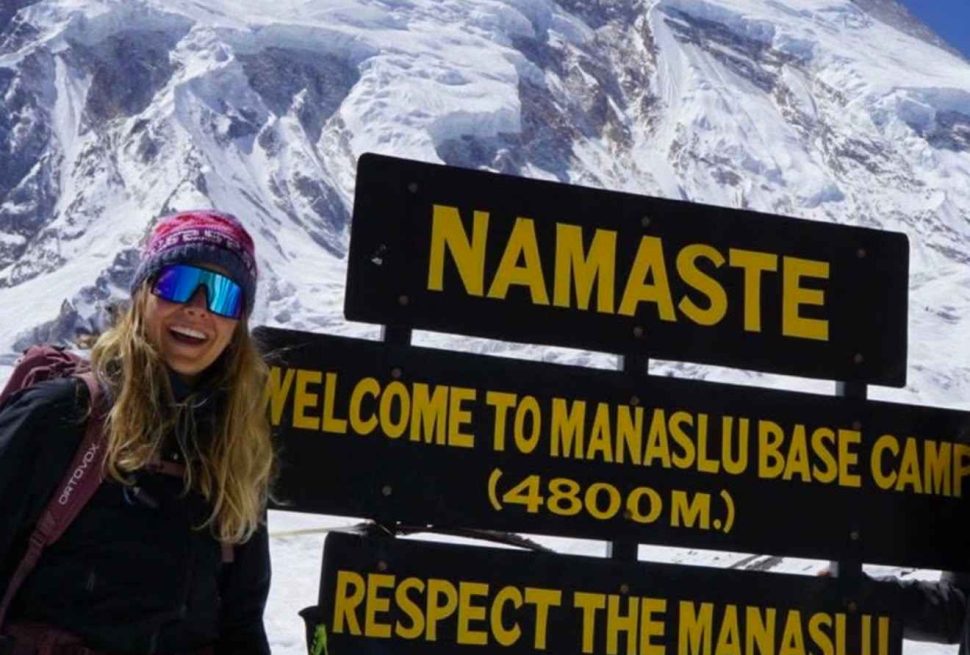
Manaslu Base Camp sits at approximately 4,800 metres, on the lateral moraine above Samagaon, the main village and rest stop on the standard Manaslu Circuit itinerary at around 3,530 metres. Mount Manaslu itself rises to 8,163 metres on the border of the Gorkha and Manang districts, roughly 64 kilometres east of Annapurna, making it the eighth highest mountain on earth. Base camp is not on the main circuit trail itself, it is a deliberate side trip that branches off from Samagaon, which is exactly why most circuit trekkers treat it as an optional, if highly recommended, addition to their rest day rather than a required stop on the way to Larkya La.
What Manaslu Base Camp Is Actually Used For
Base camp serves two genuinely different purposes, depending on who is standing on it:
- For the large majority of trekkers on the standard circuit, it is a demanding but rewarding acclimatization hike from Samagaon, done as a there and back day trip before continuing on toward Larkya La
- For climbers attempting the mountain itself, it is the actual staging ground for a multi week expedition, complete with a dining tent, communications equipment, and a rotation schedule between base camp and the higher camps on the mountain
- Both groups end up sharing the same patch of moraine at different points in the climbing season, though trekkers typically visit and leave the same day, while climbers may be based there for several weeks
The Meaning Behind the Name Manaslu
The name Manaslu comes from the Sanskrit word manasa, and is generally translated as Mountain of the Spirit or Mountain of the Soul. It is a fitting name for a peak that dominates the skyline above the Nubri valley’s Tibetan Buddhist communities, who regard the mountain and its surrounding landscape, including glacial lakes like Birendra Lake near Samagaon, as part of a spiritually significant terrain rather than simply scenery.
How to Get to Manaslu Base Camp From Samagaon
The hike itself is one of the more physically demanding day trips on the entire circuit, and it is worth knowing what you are taking on before you commit your rest day to it:
- The round trip from Samagaon typically takes six to seven hours, covering an elevation gain of roughly 1,270 metres from the village to base camp
- The trail heads north along the Budhi Gandaki river, passing through yak pastures before climbing onto the lateral moraine of the Manaslu Glacier itself
- The final stretch crosses loose rock and scree, terrain where careful, deliberate footing matters more than speed, and where a guide’s experience with this specific ground is genuinely useful
- Many trekkers pass close to Birendra Lake on the way, making it possible to combine both side trips into a single, longer outing from Samagaon if time and energy allow
What You Actually See When You Get There
The payoff for the climb is significant. From Manaslu Base Camp, the mountain fills the sky directly ahead of you, with the south face pyramid, the route most expeditions climb, clearly visible rising above the glacier. On a clear day you can also pick out Manaslu North at 7,157 metres, along with more distant peaks including Himalchuli and Ngadi Chuli further along the ridge line. It is a genuinely different perspective on Manaslu than the more distant views you get from lower on the circuit, close enough that the scale of the mountain becomes obvious in a way photographs from further away simply cannot capture.
Why This Hike Doubles as the Best Acclimatization Day on the Circuit
Beyond the views, there is a real physiological reason so many guides push their groups toward this specific side trip rather than a quieter rest day in the village:
- The climb high, sleep low principle is one of the most effective tools for acclimatization, and reaching 4,800 metres before returning to sleep at 3,530 metres in Samagaon gives your body a genuine, controlled dose of altitude stress followed by proper recovery
- This kind of deliberate, moderate exposure ahead of Larkya La tends to leave trekkers noticeably better prepared for the pass than a group that spent the day resting entirely at village elevation instead
- It also gives guides a useful, low risk opportunity to observe exactly how each trekker in a group is handling altitude, well before the much higher and more consequential day at the pass itself
For more on what normal altitude adjustment should feel like during a hike like this, versus symptoms that actually need attention, our Normal Trekking Symptoms at High Altitude guide is worth reading before you set off from Samagaon.
Manaslu Base Camp Trek vs the Full Manaslu Circuit: What Is Actually Different
It is worth being clear about a common point of confusion. Some agencies sell a standalone Manaslu Base Camp Trek, distinct from the full circuit:
- A standalone Manaslu Base Camp Trek typically runs Kathmandu to Soti Khola, up through the same villages as the circuit, out to base camp from Samagaon, and then back down the same way, without crossing Larkya La at all
- The full Manaslu Circuit Trek includes the same out and back trip to base camp as a side excursion from Samagaon, but then continues over Larkya La and down to Bimthang and Dharapani, completing the full loop
- The base camp only version is shorter and involves less overall elevation gain and risk, since it skips the pass entirely, making it a reasonable option for trekkers with less time or a preference for a lower risk itinerary
- The full circuit remains the more popular option for trekkers who want the complete experience, the pass crossing included, rather than an out and back trip focused primarily on the base camp view
Our Manaslu Circuit Trek Itinerary guide lays out the standard day by day route for the full circuit, including where the Samagaon rest day and base camp side trip typically sit.
Permits and Practical Requirements
Since Manaslu Base Camp sits inside the same restricted area as the rest of the circuit, the same permit and guide rules apply, whether you are visiting for a day or staying for weeks as part of an expedition:
- Trekkers need the Manaslu Restricted Area Permit and the Manaslu Conservation Area Permit, both of which must be arranged through a registered Nepali trekking agency rather than independently
- A licensed guide is mandatory for the base camp hike, the same as for the rest of the restricted section of the circuit
- Climbers attempting the mountain itself require a separate mountaineering permit and royalty fee paid to Nepal’s Department of Tourism, which for the autumn 2026 season stood at 3,000 US dollars per climbing permit
The Climbing History of Manaslu
Manaslu has a long and genuinely significant place in Himalayan climbing history:
- The first successful ascent came on May 9, 1956, when Toshio Imanishi and Sherpa climber Gyalzen Norbu reached the summit as part of a Japanese expedition led by Aritsune Maki, with two more team members summiting a few days later
- Urkien Tshering Sherpa became the first Nepali climber to summit Manaslu, on April 22, 1973
- In 1972, Reinhold Messner led an Austrian expedition to complete the first ascent of the mountain’s difficult south west face
- In 1974, a Japanese women’s expedition became the first all female team to summit an 8,000 metre peak anywhere in the world, and they did it on Manaslu
- The first winter ascent came in January 1984, completed by Polish climbers Maciej Berbeka and Ryszard Gajewski
The Historic Trade Route That Leads to Base Camp
The trail you actually walk to reach Samagaon, and eventually base camp, is not a route built for trekkers. It follows the Budhi Gandaki river along what was historically a salt trade path connecting the lower villages of Gorkha with Tibetan trading communities across the border. Long before anyone climbed Manaslu for sport, traders and yak caravans moved along essentially the same valley, carrying salt, grain, and other goods between very different climates and cultures separated by a single mountain range. Walking this same route today, ending at a spot where climbers now stage attempts on an 8,000 metre summit, is a genuine link between the region’s working history and its more recent identity as a trekking and mountaineering destination.
Notable Records Set on Manaslu Beyond the First Ascent
Beyond the 1956 first ascent, Manaslu has featured in several other significant moments in Himalayan climbing history:
- It was the first 8,000 metre peak successfully climbed by an Asian expedition, with the 1956 Japanese team’s success coming after two earlier Japanese attempts on the mountain had failed
- Reinhold Messner, who later became the first person to climb all fourteen of the world’s 8,000 metre peaks, added Manaslu’s difficult south west face to his record in 1972, well before he completed the full set
- The 1974 Japanese women’s expedition that became the first all female team to summit any 8,000 metre peak did so specifically on Manaslu, a genuinely significant moment for women’s high altitude mountaineering
- Manaslu has also been climbed without supplemental oxygen by a number of elite mountaineers over the decades, a considerably more demanding undertaking than the standard, oxygen supported ascents most commercial expeditions now use
Why Manaslu Has Become One of the World’s Busiest 8,000 Metre Peaks
In recent years, Manaslu has quietly become one of the most climbed 8,000 metre peaks in the world, and the reasons are fairly practical rather than mysterious. The standard route is considered relatively moderate by 8,000 metre standards, commercial guiding support on the mountain is strong, and it has developed a reputation as a sensible first 8,000 metre summit for climbers working their way up to more technical peaks. For the autumn 2026 season, Nepal’s Department of Tourism issued a record 480 climbing permits, 354 to men and 126 to women, generating roughly 1.44 million US dollars in royalty revenue at 3,000 dollars per permit. That popularity does not make the mountain safe, and it is worth being honest about that before assuming Manaslu’s reputation as a good starter 8,000er means it is a low risk undertaking.
The Real Dangers: Avalanches and Serac Fall
Manaslu’s climbing history includes some of the more serious disasters among the 8,000 metre peaks, and this is worth knowing rather than glossing over:
- On September 23, 2012, at around 4:30 in the morning, a massive serac released above Camp 3, at roughly 7,000 to 7,400 metres, triggering a slab avalanche reported to be around 300 metres wide and 1,000 metres long. It struck Camp 3 directly and hit Camp 2 with a powerful blast wave, destroying roughly 25 tents and killing 11 climbers from France, Spain, Italy, Canada, and Nepal
- Heavy snowfall in the days before the 2012 disaster, with roughly six feet of fresh snow, is generally cited as the main factor that destabilized the slope before it failed
- A separate avalanche in 2022 caused further fatalities on the mountain, a reminder that this risk has not gone away simply because Manaslu is now climbed by hundreds of people each season
- Historical climbing statistics have at times ranked Manaslu among the more dangerous 8,000 metre peaks by fatality rate, driven largely by avalanche and serac exposure on the standard route rather than pure technical difficulty
None of this affects a standard day hike to base camp from Samagaon in any direct way, since trekkers are not exposed to the higher camps where these events occurred. It matters for understanding what base camp actually represents once expedition season begins, and why the people staying there for weeks at a time are taking on a genuinely serious undertaking, however moderate the mountain’s reputation has become.
What an Actual Expedition Looks Like From Base Camp
If you visit during the climbing season, usually spring or autumn, you may see an active expedition camp set up nearby, and it is worth understanding roughly what that involves:
- Base camp, at around 4,700 to 4,800 metres, functions as the main staging area, with a dining tent, communications setup, and individual sleeping tents for the climbing team and support staff
- A rope fixing team typically establishes the climbing route up through several higher camps ahead of the main summit push, opening the route for commercial teams to follow
- Climbers cycle between base camp and Camps One and Two multiple times over several weeks as part of a structured acclimatization rotation, a slower and more deliberate version of the climb high, sleep low principle trekkers use on their single day hike
- Once the route is fixed and a stable weather window appears, usually identified well in advance by mountain forecasting services, teams move up through the higher camps for a final summit attempt
Best Time to Visit Manaslu Base Camp as a Trekker
Timing matters for both the view and the hiking conditions, and it lines up closely with the best season for the circuit as a whole. Autumn, from September to November, and spring, from March to May, offer the most stable weather and the clearest views of the south face from base camp. Our Best Time to Trek the Manaslu Circuit Trek guide covers this in more depth, including how conditions shift across the rest of the route beyond just this one side trip.
What to Pack and Prepare For
The hike to base camp does not require specialized mountaineering gear, but a few things are worth having beyond your standard daily kit:
- Sturdy, broken in boots with good ankle support and grip, since the final stretch across loose rock and scree rewards stable footing over speed
- Trekking poles, which genuinely help on both the ascent and the looser sections of the descent
- A warm layer even if the morning starts clear, since conditions on exposed moraine at 4,800 metres change quickly and wind picks up without much warning
- Enough water and snacks for a full six to seven hour round trip, since there is nowhere to buy anything once you leave Samagaon
Our full Manaslu Circuit Trek Packing List covers everything else needed for the rest of the trek beyond this specific side trip.
Want the Manaslu Base Camp side trip built properly into your Samagaon rest day? Tell us and we will plan your itinerary around it from the start.
WhatsApp us Email usA Trekker’s First Look at Manaslu Base Camp
We had a trekker a couple of seasons ago who nearly skipped the base camp hike entirely, worried that a six to seven hour round trip on a rest day would leave her too tired for Larkya La two days later. She went anyway, at our guide’s encouragement, and stopped talking almost entirely for the last twenty minutes of the climb once the south face came fully into view above the moraine. She crossed Larkya La two days later without any unusual difficulty, and told us afterward that seeing the mountain that close, rather than always from a distance further down the valley, changed how the entire second half of the trek felt to her, less like walking toward an abstract high point on a map and more like walking toward a mountain she had already stood beneath.
The Tsum Valley Extension Option
For trekkers with extra time, Manaslu Base Camp is not the only meaningful detour available from the main route. Adding five to six extra days allows a side trip into the Tsum Valley, a culturally distinct, Tibetan influenced region with its own monasteries and views toward the Ganesh Himal range, rejoining the main circuit trail again near Namrung. It is a genuinely different addition from the base camp hike, more about culture and remoteness than altitude and mountain views, but it is worth knowing about if your schedule allows for more than the standard itinerary.
Common Misconceptions About Manaslu Base Camp
- Assuming base camp is directly on the main circuit trail rather than a separate side trip requiring its own dedicated day from Samagaon
- Confusing the standalone, shorter Manaslu Base Camp Trek with the full Manaslu Circuit Trek, which are genuinely different itineraries with a different amount of time, elevation gain, and risk involved
- Assuming Manaslu’s popularity as an entry level 8,000 metre peak for climbers means the mountain itself is safe, when its climbing history includes some of the more serious avalanche disasters among the 8,000 metre peaks
- Underestimating the base camp hike itself as an easy add on to a rest day, when it is genuinely one of the more physically demanding single day outings on the entire circuit
Frequently Asked Questions About Manaslu Base Camp
How high is Manaslu Base Camp?
Manaslu Base Camp sits at approximately 4,800 metres, on the moraine above Samagaon, which itself sits at around 3,530 metres.
Do I need mountaineering experience to visit base camp as a trekker?
No. The hike from Samagaon is a demanding but non technical day trip, suitable for reasonably fit, already acclimatized trekkers with a licensed guide, and does not require any climbing skills or equipment.
Is Manaslu Base Camp part of the standard Manaslu Circuit itinerary?
It is typically offered as an optional side trip on the Samagaon rest day rather than a mandatory stop, though most guides strongly recommend it, both for the views and the acclimatization benefit.
How dangerous is climbing Manaslu compared to other 8,000 metre peaks?
Manaslu is often described as a relatively moderate 8,000 metre climb in terms of technical difficulty, but its history includes serious avalanche and serac related disasters, including 11 deaths in a single 2012 avalanche, so it should not be considered a low risk mountain despite its reputation as a common first 8,000 metre summit.
Can I visit base camp without doing the full Larkya La crossing?
Yes. A standalone Manaslu Base Camp Trek exists that reaches base camp from Samagaon and returns the same way, without crossing Larkya La, for trekkers who want the base camp experience on a shorter, lower risk itinerary.
The Bottom Line
Manaslu Base Camp is one of the more rewarding single day additions available anywhere on the Manaslu Circuit Trek, a demanding but genuinely spectacular hike from Samagaon that puts you directly beneath the south face of the world’s eighth highest mountain, while also giving your body a real acclimatization boost ahead of Larkya La. For the small number of climbers who use it as an actual expedition staging ground each season, it represents something considerably more serious, the starting point for a multi week attempt on a mountain whose history includes both remarkable firsts and genuinely tragic losses. Whichever reason brings you there, it is worth treating the hike itself with real respect, and worth knowing the fuller story of the mountain standing above you when you finally see it up close.
If you want the Manaslu Base Camp side trip properly planned into your itinerary, get in touch and we will build it into your Samagaon rest day from the start.