Is Late November or Mid December Actually a Good Idea on the Manaslu Circuit
We get this question from clients almost every year, usually by email, and it almost always comes down to the same two dates on a calendar: the last week of November, or the middle of December. Someone has already read the Manaslu Circuit Trek in November guide and the Manaslu Circuit Trek in December guide on this site, both of which are honest about their own month, and they are now stuck choosing between the tail end of one and the middle of the other, since that is the realistic pair of windows most people with flexible but not unlimited time actually end up weighing against each other. That is a narrower, more specific question than “is November or December good,” and it deserves a direct answer rather than two separate month by month breakdowns stitched together.
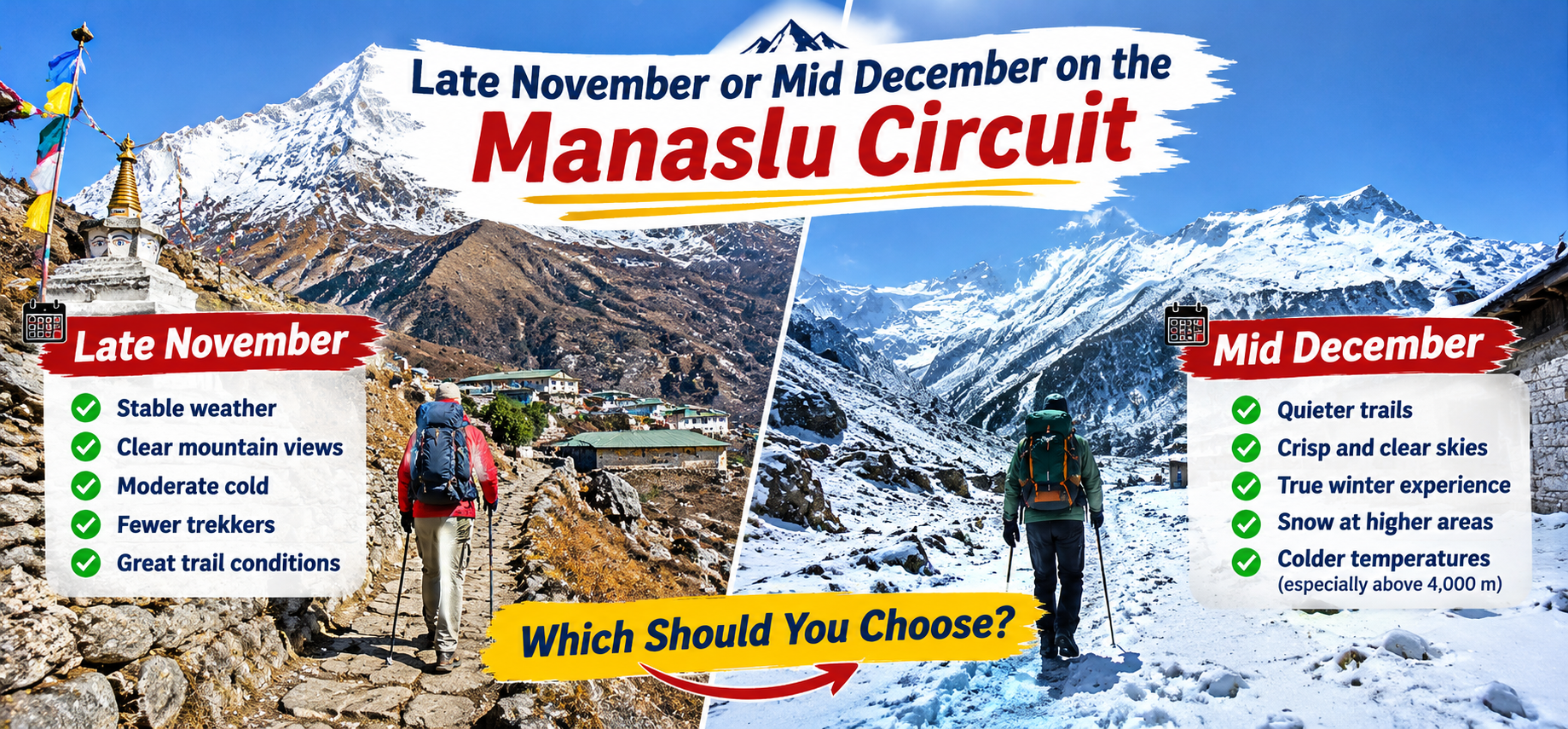
So here it is, up front. Trekking the Manaslu Circuit in the last week of November, or waiting until the middle of December, are both genuinely good ideas for an experienced, reasonably fit trekker who wants dry trails, clear mountain air, and far fewer people on the path, and who can accept real cold at altitude and a nonzero chance that Larkya La Pass asks them to wait a day or two before it lets them cross. Either window is a poor idea for someone who has never slept above four thousand meters before, who has a flight home booked for the morning after their planned pass crossing, or who simply does not do well in serious cold. The honest answer is not a simple pick between the two. It is a question of who you are and how much slack sits in your calendar, and mid December asks for more of that slack than late November does.
What follows treats late November and mid December as the two live options worth weighing against each other, with the first half of December covered only as the transition between them, because that is closer to how conditions actually behave on the ground. The trail does not know it is a new month on December first. It cools, quiets, and gets a bit less forgiving in a gradual slide that starts well before Thanksgiving in the United States and keeps going through the middle of the month. Our job here is to walk you through that slide and help you decide whether your own answer is the last week of November or the middle of December.
One Continuous Shoulder Window, Not Two Separate Months
Autumn on the Manaslu Circuit peaks in October and holds through the first half of November. That is when the main season crowds are on the trail, when most teahouses are fully staffed, and when the weather is at its most dependable. By the third week of November, that peak season momentum is fading but has not stopped. Trekkers who started their trip in early November are still finishing it, lodges are still running close to full service, and the pass is, in most years, still in good shape. Then, gradually rather than suddenly, the whole system downshifts.
Fewer new groups set out from Kathmandu or Soti Khola as November turns into December. Fewer independent trekkers show up at the permit counter in Kathmandu. Operators schedule fewer departures, partly because demand drops and partly because a smaller, later season group is harder to run profitably with full staffing at every lodge. That matters for you in two opposite ways at once. On the plus side, you get quieter trails, shorter waits for a hot meal, and a much better shot at a room to yourself at Samagaon or Samdo instead of a shared dormitory. On the minus side, there are fewer other groups on the trail who could help if something goes wrong, fewer porters and guides moving through the high villages who might know current pass conditions firsthand, and a thinner support network generally the later you go. This is the real trade of the late season window, and it only gets more pronounced as December wears on.
What Actually Changes, Week By Week
In the last week of November, you are still riding the tail end of real autumn. Days are cool but comfortable for walking below three thousand meters, nights are cold at Samdo and Dharamsala but not yet brutal, and Larkya La is usually clear or carrying only a light dusting of old snow that a guide with microspikes handles without much drama. Crowds have thinned noticeably from the October peak but have not vanished. You will still see other groups at the bigger villages.
Move into the first ten days of December and the shift becomes more obvious. Overnight temperatures at the higher camps drop further, frost forms earlier in the evening and lingers later into the morning, and the trail population keeps shrinking. This is still, in most years, a genuinely workable stretch, and it is the stretch that the Manaslu Circuit Trek in December guide on this site singles out as the more dependable half of the month.
By the middle of December, which is the second half of our real comparison here, the margin has narrowed noticeably from where it sat in late November. Cold fronts moving across the Himalaya become more frequent, and when one of them drops fresh snow on the approach to Larkya La, the trail needs more time to consolidate before it is safe to cross. Fewer groups on the mountain also means fewer boots packing down a fresh dusting, so new snow tends to sit looser and deeper for longer than it would in late November or in a busier month. This is the real cost of waiting three extra weeks: you trade a further drop in crowds and a slightly cheaper permit for a meaningfully higher chance that the pass asks you to wait a day before it lets you through.
We will say only briefly that the back half of December, after the twentieth, keeps pushing in the same direction again, with storm cycles becoming more likely still. That stretch sits outside the comparison this article is actually built around, and we mention it here mainly so you know the trend does not stop at mid December, it simply keeps going if you push later still.
Why There Is No Major Festival to Plan Around
If you have read other guides to this region, you have probably seen festival dates used as a reason to pick one month over another. We want to be upfront that this does not really apply here. The Manaslu Circuit Trek in November guide on this site covers the festivals that sometimes fall near the start of that month, and Nepal’s biggest Himalayan festivals, things like Mani Rimdu in the Everest region, generally land earlier in autumn, while Losar, the Tibetan and Sherpa new year, usually falls in February or March depending on the lunar calendar. Between late November and the end of December, the villages along the Manaslu route are simply in their quiet working season. You may still see small local observances tied to the Tibetan Buddhist calendar in Samagaon or Lho, since this is a strongly Buddhist valley, but we found no fixed, dependable festival that trekking companies can responsibly build a trip around in this specific window, and you should be skeptical of any guide that claims otherwise without naming a specific, verifiable date.
Crowds, Cold, and Closures: The Real Tradeoffs Mapped Out
It helps to break this down into the four things that actually drive the decision, because marketing copy tends to blur them together into a vague impression of “quiet and cold.” They do not move at the same rate, and they do not matter equally to every trekker.
Crowd levels fall steadily and predictably across this entire window. October is Manaslu’s busiest month, the last week of November is noticeably quieter than mid November, and by deep December the trail can feel genuinely empty, with long stretches where you see no one outside your own group. If solitude is your main reason for choosing this season, almost any point in the window delivers it, and pushing later buys you progressively more of it, though with rapidly diminishing extra benefit once you are past the first week of December.
Cold increases in a straighter line than crowds thin out. Samagaon and Samdo both see night temperatures that are already uncomfortable in late November and that keep sliding through December, commonly cited in the range of minus ten to minus eighteen degrees Celsius at those two villages by mid month, with Dharamsala, which has only basic, largely unheated shelter, running colder still. None of this is exotic extreme cold by mountaineering standards, but it is real cold to sleep through in a teahouse room with a single pane window and no insulation, and it is the kind of cold that punishes anyone who skimped on their sleeping bag rating.
Daylight shortens too, though less dramatically than some guides suggest. Around the Manaslu region’s latitude, day length drops from a little under eleven hours in late November to roughly ten and a half hours at the winter solstice in late December, a difference of only about fifteen minutes of raw daylight. The more meaningful change is not the clock, it is the terrain. In a narrow Himalayan valley with the sun sitting low on the horizon through the cold months, high ridgelines block direct light for longer stretches of the morning and evening than the sunrise and sunset times alone suggest. Villages like Samdo and Dharamsala can sit in shade for a meaningfully larger share of the day than the raw daylight numbers imply, which is part of why mornings there feel so much colder than the thermometer alone would explain. Either way, starting the pass crossing well before sunrise, which guides already do throughout the season, matters more in December simply because there is less margin if the group moves slowly.
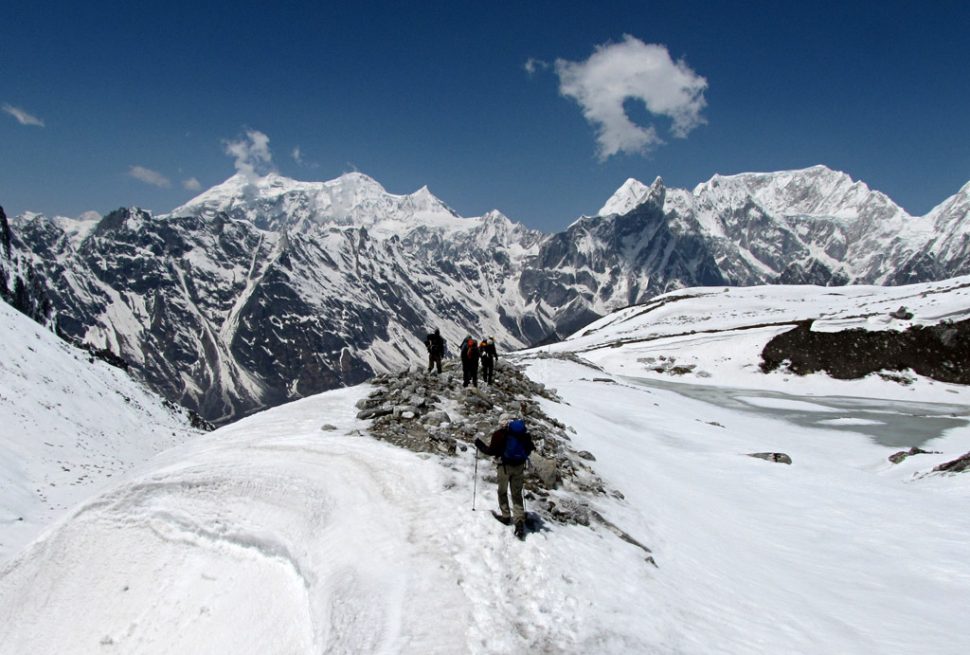
Pass risk at Larkya La is the one variable that genuinely accelerates rather than sliding at a steady rate. In recent years, heavy snowfall has closed high passes across the Manaslu, Annapurna, and Mustang regions even in early November, well before the late season window this article is about. In one widely reported case, the Trekking Agencies Association of Nepal confirmed that around four hundred trekkers and crew were held near Samdo and Dharamsala until conditions stabilized enough for the route to reopen and for that backlog to cross together. That event happened before the window this article covers even begins, which is itself worth sitting with. If a storm can shut the pass in the second half of a month usually considered safe, it can certainly shut it in December, and local operators and at least one independent trekking question and answer thread we checked agree that the odds of a multi day closure climb noticeably once you move past the middle of December. None of the sources we found could give a precise, independently measured probability for any specific date, and you should treat any guide, including this one, that states a confident percentage chance of a closure on a specific day with some skepticism. What is well supported across multiple independent sources is the direction of the trend: the risk is low but real in late November, present but usually manageable in early December, and meaningfully higher from the middle of December onward.
The table below puts the two windows this article is actually comparing side by side, the last week of November and the middle of December, with early December shown in between purely as the transition so you can see how the trend moves rather than jumping straight from one extreme to the other.
| Window | Crowd level | Larkya La pass risk | Typical cold | Daylight |
|---|---|---|---|---|
| Last week of November | Thin but present, still some groups on trail | Low, usually clear or light old snow | Cold at night above Samagaon, manageable by day | About 10 hours 45 minutes |
| Early December, days 1 to 10 (transition only) | Noticeably quiet | Low to moderate, generally still workable | Colder nights at Samdo and Dharamsala, frost lingers into morning | About 10 hours 40 minutes |
| Mid December, days 11 to 20 | Very quiet | Moderate, fresh snow takes longer to settle with fewer trekkers packing the trail | Sharp cold at high camps, Dharamsala shelter offers little insulation | About 10 hours 35 minutes |
Photography, Light, and the Argument for Going Late
One genuine, well supported reason to pick this window over peak autumn is light quality. The main monsoon ends in September, and the dust and haze that build up over the Kathmandu valley and the lower trail through the warmer months take real time to settle. By October the air is noticeably cleaner, and that improvement keeps going through November and into December, since the cold, dry air sitting over the Himalaya in winter holds very little moisture or particulate matter compared to the warmer months. Multiple independent sources we reviewed, including general Himalayan weather guidance rather than trekking marketing alone, describe winter as the clearest season for long distance mountain views in Nepal, with crisp separation between ridgelines that can look flat or hazy in a humid month. Combine that with the near total absence of other trekkers in your frame and you have a real, defensible reason for a photographer to choose December over October or even over busy November, separate from any argument about cold tolerance or crowd avoidance for their own sake. The tradeoff is the obvious one. You are shooting in serious cold, your batteries will drain faster than usual and should be kept warm against your body between uses, and you will be doing all of this with gloved hands, which is worth practicing with your actual camera before you leave home rather than discovering the problem at Larkya La.
On Teahouse Availability, We Want to Be Careful
Several trekking companies state flatly that specific villages, usually Samdo or the shelter at Dharamsala, reduce to only a couple of open lodges or close certain rooms once the cold deepens. Multiple operators describe this same general pattern independently, which gives it some real weight, and it matches the basic economics of running a stone lodge at four thousand six hundred meters for a trickle of guests instead of a full house. But we could not find an independently verified, dated record of which specific lodges close on which specific dates in a given year, and the honest truth is that this varies from year to year depending on how many bookings a lodge owner has on the books and how harsh that particular winter is shaping up to be. Treat the claim that upper village lodging thins out in December as commonly reported and broadly plausible rather than as a fixed, bookable fact. The practical response is the same either way: your guide should call ahead from Samdo before you commit to a departure for Dharamsala, and if you are trekking independently rather than with a guide, which is not legal on this restricted route in any case, you would need to confirm this yourself. A good operator treats this as routine planning, not a crisis.
Who This Window Actually Suits
This stretch of the calendar rewards a fairly specific kind of trekker. If several of the following describe you, late November or December is worth serious consideration rather than something to be talked out of.
- You have already done at least one trek above four thousand meters and know roughly how your body handles altitude and cold, so you are not learning both at once for the first time on a remote restricted route.
- You actively dislike crowded trails and busy lodges, and the idea of having a dining room mostly to yourself at Samagaon sounds appealing rather than lonely.
- You are a photographer or just someone who cares about clear mountain light, and you want the crisp, haze free visibility that typically follows the monsoon without fighting peak season trail traffic for the same shot.
- Your schedule has real flexibility built in, meaning you are not locked into a flight home the day after your planned pass crossing and can absorb a weather delay of a day or two without it turning into a missed flight or a lost vacation day you cannot recover.
- You are comfortable packing and actually wearing serious cold weather gear, and you do not mind sleeping in a heavy bag in an unheated room for a week or more.
Who Should Avoid It
On the other side, some trekkers are better served by choosing October or early November instead, even if the quieter trails sound tempting.
- First time high altitude trekkers, especially anyone who has not previously spent a night above three thousand five hundred meters, since this is not the trip to learn how your body reacts to both altitude and serious cold at the same time.
- Anyone with a rigid flight date booked for the day immediately after the pass crossing, with no buffer and no flexible or refundable ticket, since a one or two day weather hold at Larkya La is a real possibility in this window and a missed international flight is an expensive way to find that out.
- People who simply get cold easily or who have struggled with cold extremities or Raynaud type circulation issues on past trips, since the nights at Samdo and Dharamsala in this window are genuinely cold even with good gear.
- Groups that are not prepared, as a whole, to buy or rent serious cold weather equipment, including a sleeping bag rated well below freezing, real insulated layers, and microspikes, since this is not a trip where a single underprepared member in the group is a minor inconvenience, it is a safety issue for everyone.
Building Real Schedule Buffer for a Late Season Departure
If there is one piece of practical advice that matters more in this window than in any other part of the Manaslu trekking calendar, it is this: build in buffer days before you book flights, not after something goes wrong. The later into December your itinerary runs, the more seriously you should take this.
A sensible approach looks something like this. Treat your international departure date as at least two full days later than the date your itinerary says you will be back in Kathmandu, and treat that itinerary date itself as already including one contingency day near the pass crossing, not as a tight best case schedule. In practice that means booking your flight home roughly three days after your planned finish rather than the same day or the next day. If the weather cooperates, you get a relaxed extra day or two in Kathmandu for shopping, a massage, and a real shower, which is a fine way to spend a buffer. If it does not cooperate, that buffer is what keeps a weather hold at Larkya La from turning into a missed flight.
A sensible contingency plan also means knowing, before you leave Kathmandu, what the fallback actually is if the pass will not go. On the Manaslu Circuit, the realistic options if Larkya La is genuinely closed are to wait it out at Dharamsala or Samdo for conditions to improve, which is usually the right call for a day or two of bad weather, or in a longer closure to retreat and consider the Tsum Valley side trip or simply return the way you came, which is a real possibility some operators mention for extended storm cycles. Your guide and agency should be the ones managing this decision in real time with current information, but you should go in understanding that it is a live possibility in this window rather than something that will never apply to you.
Travel insurance that explicitly covers trip delay and high altitude trekking is not optional for this window, it is close to mandatory. Read the policy before you buy it, not after you need it, and check specifically whether it covers delay caused by weather at altitude rather than only delay caused by your airline.
It also helps to think about buffer in terms of supplies, not just days. A group that is carrying its own stove fuel and a couple of spare dehydrated meals is in a much better position to sit out a one or two day hold at Dharamsala than a group relying entirely on whatever a thinly stocked lodge happens to have left in late December. Mule trains that resupply the upper villages run less often once the main season crowd thins out, since there is less demand to justify the trip over the pass and back, so the shelves at Samdo and Dharamsala can run lower on basics like extra gas canisters, chocolate, or spare batteries than they would in October. None of this needs to turn into a full expedition style resupply plan. A sensible guide or agency already carries a reasonable safety margin of food and fuel on a December trip as a matter of course. But if you are the one asking the questions before you book, asking what your operator carries as contingency food and fuel for a weather hold is a far more useful question than asking whether the trip is, in the abstract, safe.
The flip side of this quieter supply chain is that porters and mule drivers who do work this part of the season tend to know the current state of the trail unusually well, simply because they are among the few people moving through it regularly. A guide who has crossed Larkya La twice already that December, rather than one who last did it in October, is a meaningfully better source of real time judgment about whether today is a crossing day. This is one more reason the later into the window you go, the more it matters that you are trekking with an experienced, locally current guide rather than treating the restricted area permit requirement as a bureaucratic formality.
Permits and Costs for the Late Season Window
This is one area where we can give you a genuinely verified answer rather than a hedge, because the Manaslu Restricted Area Permit fee structure is set by season in a way that is consistent across multiple independent permit guides we checked, and it lines up with what both of this site’s own month specific guides already state. From September through November, the restricted area permit runs at the higher peak season rate, commonly cited at around one hundred US dollars for the first seven days with an additional charge per extra day. From December through August, the same permit drops to the lower off season rate, commonly cited at around seventy five US dollars for the first seven days with a smaller additional per day charge. In other words, if you are choosing specifically between the last days of November and the first days of December, the permit fee itself genuinely shifts in your favor the moment you cross into December, which is a small but real financial argument for leaning slightly later if your decision is otherwise a close call.
The Manaslu Conservation Area Permit and the Annapurna Conservation Area Permit, both of which you also need on this route, do not appear to vary by season in any source we found, and they are a comparatively minor cost either way. Expect a modest flat fee in the range of roughly thirty US dollars each, though we would point you to the Manaslu trekking permit guide on this site or your own operator for the current exact figure rather than treating any number quoted here as the final word, since these fees are set by Nepali authorities and can change between seasons.
Beyond permits, we did not find reliable evidence that guide fees, porter fees, or standard package pricing move in any consistent seasonal pattern tied to late November versus December specifically. Some individual operators discount late season departures to fill seats on a quieter trip, and it is worth asking directly whether a December departure carries any such discount, but this is a matter of individual company pricing strategy, not an industry wide rule, so treat any specific discount you are quoted as that operator’s own offer rather than a universal fact about the season.
So Which Should You Actually Pick: Late November or Mid December
If you forced us to choose between only these two specific windows for a client, without knowing anything else about that person, we would lean toward the last week of November more often than not. It still delivers most of the solitude that draws people away from peak October crowds, the cold is real but noticeably gentler than what you meet at Samdo and Dharamsala three weeks later, and the Larkya La pass risk, while never zero in any month, sits at its most favorable point of this entire comparison. The cost is a slightly higher permit fee and a trail that is quiet rather than empty.
Mid December is the right answer for a different, narrower kind of trekker, and it is not a lesser choice, just a more demanding one. A trekker who runs warm, who already has solid high altitude experience, and who genuinely has no fixed flight pressing on them is well placed to choose the middle of December specifically to chase the emptiest trails and the clearest light of the whole late season window, accepting a somewhat higher chance of a weather hold at the pass as a fair trade for it. Anyone slightly more risk averse, or newer to this kind of cold, is usually better served staying in the last week of November, trading a bit more crowd and a marginally higher permit fee for a meaningfully lower chance of any pass drama at all. Both are defensible choices for the right person, and the honest answer genuinely depends on which of those two people you are, not on one window being objectively superior to the other.
In the end, the decision between late November and mid December on the Manaslu Circuit is less about which point is objectively better and more about matching the calendar to your own honest assessment of your cold tolerance, your altitude experience, and how much slack your travel dates can absorb if the mountain asks you to wait. Read the Manaslu Circuit Trek in November guide and the Manaslu Circuit Trek in December guide on this site for the full week by week detail on each month individually, use the Manaslu Circuit Trek packing list to make sure your gear actually matches the temperatures this window produces, and if you are still unsure which of these two specific dates suits you, talk to an operator who runs the main Manaslu Circuit Trek regularly enough in this season to tell you honestly, rather than optimistically, what the last few years at Larkya La have actually looked like in both windows.