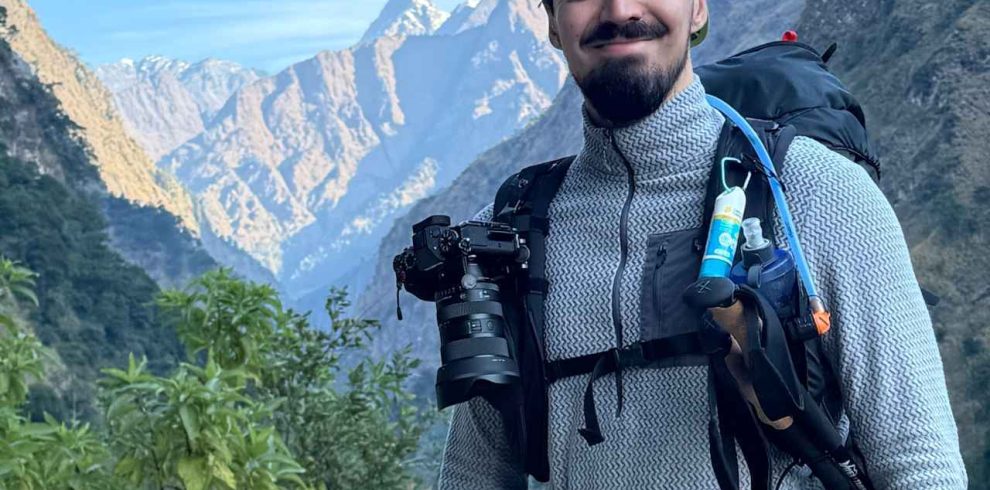
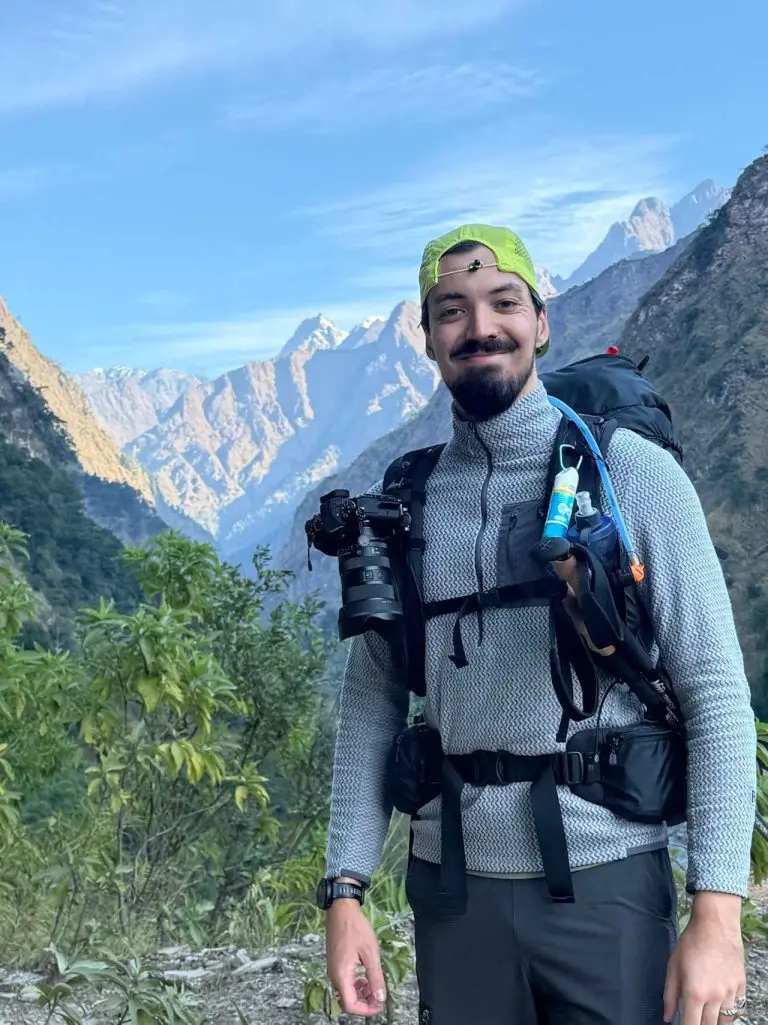
Published: June 2026 Written by: Thomas Harrison, United Kingdom Trekked: April 12 to April 24, 2026 Company: Manaslu Treks and Expedition Pvt. Ltd. Contact our manaslu trekking company to plan your trip with local experts.
My name is Thomas, and I am from Bristol, England. I have done a few hikes back home in the Lake District and Wales, but nothing in my life had prepared me for what I experienced on the Manaslu Circuit Trek in Nepal. This is my honest account of everything that happened across those 13 days, from landing in Kathmandu to crossing the Larkya La Pass at 5,106 meters and descending into the Annapurna region. If you are thinking about doing this trek, I hope this helps you understand what it actually feels like on the ground.
I chose the Manaslu Circuit after months of research. I had originally planned the Annapurna Circuit Trek, but the more I read, the more I kept coming back to Manaslu. The restricted area status meant fewer trekkers, the route felt genuinely remote, and the culture in the upper Nubri Valley sounded unlike anything else in Nepal. A guide was mandatory by law, which actually made the decision easier because I did not have to worry about planning every detail on my own.
After reading reviews and comparing companies, I booked with Manaslu Treks and Expedition Pvt. Ltd. and was assigned Kiran as my guide. That turned out to be one of the best parts of the entire trip.
Finding Manaslu Treks and Expedition
When I was searching for a company, I noticed that many agencies offering the Manaslu Circuit Trek were general tour operators based in Kathmandu with no particular connection to the region. Manaslu Treks and Expedition was different. Their guides are local to Gorkha district and the company specializes specifically in the Manaslu region. Kiran, my guide, grew up in Dhading and has completed the Manaslu Circuit more than twenty times across different seasons. That level of familiarity with the trail, the teahouse owners, the pass conditions, and the local culture is something you cannot get from a generalist operator.
Booking was straightforward. I contacted them on WhatsApp, received the full itinerary and cost breakdown the same day, and had all my permits arranged before I even arrived in Nepal. The 13 Days Manaslu Circuit Trek package was all inclusive, covering accommodation, all meals on the trail, permits, guide, porter, and transport. No surprise costs after landing, which I greatly appreciated.
Country: Nepal Duration: 13 Days Difficulty: Challenging Activity: Trekking Max. Altitude: 5,106 m / 16,752 ft Best Season: Mar–May, Sep–Nov…
Arriving in Kathmandu
I landed at Tribhuvan International Airport on April 11 and was met by a driver holding a sign with my name. Within an hour I was checked into my hotel in Thamel. Kathmandu hit me immediately. The streets are narrow and full of energy, the smell of incense mixes with street food and exhaust, and ancient temples sit beside modern shops without any sense of contradiction. It is chaotic in the best possible way.
That evening Kiran came to meet me at the hotel. He is calm, quietly confident, and immediately made me feel like everything was organized. He walked me through the full 13 day itinerary, checked my gear, confirmed we had all the permits, and answered every question I had without making me feel like I was asking too many. He gave me practical advice about pace, hydration, and what to expect at altitude. He told me to go to sleep early and save energy for the nine hour drive to Machha Khola the next morning.
I trusted him completely from that first conversation.
Day 1: Kathmandu to Machha Khola
We left Kathmandu at 6 AM in a private jeep. The first hour took us through Kathmandu’s outskirts, gradually thinning into terraced hillsides, river valleys, and small roadside villages. The road quality changed dramatically once we passed Arughat, becoming rough and narrow as we followed the Budhi Gandaki River upstream.
The drive took around nine hours. Kiran pointed out landmarks along the way and explained the geography of the Manaslu Conservation Area as we entered it. We passed through Arughat, which felt like the last proper town before the mountains truly took over. By the time we reached Machha Khola at 930 meters, I was tired from the drive and eager to start walking the next morning.
The teahouse was simple and clean. Dal Bhat for dinner, which became my meal of choice for the entire trek. Kiran told me it was the best fuel for trekking and he was right.
Day 2: Machha Khola to Jagat
The first day of actual trekking felt like stepping into a different world. The trail followed the Budhi Gandaki through a deep river gorge, with suspension bridges crossing back and forth over the rushing water. The vegetation was dense and subtropical in the lower sections, completely unlike the alpine images I had seen in photos of the Manaslu region. Kiran explained that the trail changes character dramatically as you gain altitude, and these lower gorge sections are where most people first understand why Manaslu feels more raw and less polished than other trekking routes.
We stopped at Tatopani, where natural hot springs feed into a small bathing area beside the trail. After six hours of walking, soaking my feet in the warm water for twenty minutes was genuinely wonderful.
At Jagat, we went through the first official permit checkpoint. Kiran handled everything smoothly and quickly. This is where the restricted area officially begins, and there was a real sense of crossing a threshold into something quieter and more serious.
Day 3: Jagat to Deng
The trail continued deeper into the gorge. We passed through Salleri and Sirdibas before reaching Phillim, a wide and open village where the Tsum Valley route branches off to the right. Kiran pointed it out and briefly explained the Tsum Valley, which sits above and to the north, one of the most sacred hidden valleys in the entire Himalaya.
The landscape shifted again on the approach to Deng, with pine forest replacing the subtropical vegetation of the lower gorge. Multiple river crossings punctuated the day, each one on a swinging suspension bridge that tested my confidence in a way the Lake District never had.
We arrived in Deng at 2,095 meters. I felt fine physically but Kiran reminded me to drink at least three litres of water per day and to eat well at every meal regardless of appetite, because altitude affects hunger before it affects anything else.
Day 4: Deng to Namrung
This day brought the first real views of snow peaks through gaps in the valley walls. We passed through Bihi and Ghap, both small villages with traditional Tibetan Buddhist mani walls lining the trail. Kiran stopped at each mani wall and explained the practice of always passing to the left so that the carved stones remain on your right. Small details like this, explained in the right place at the right moment, made the cultural dimension of the trek come alive in a way that reading a guidebook never could.
By the time we reached Namrung at 2,900 meters, I had my first clear view of Siringi Himal. Standing at the edge of the village looking up at a proper high Himalayan peak for the first time, I understood why people return to this region repeatedly.
Day 5: Namrung to Sama Gaon
This was the day the trek became something extraordinary.
The trail climbed steadily through forest and then opened into the wide upper valley. We passed through Lho, a beautiful Tibetan village with a large monastery on a hill above it called Ribung Gompa. Kiran had a warm relationship with the monks there from previous treks and we stopped for tea. The monastery was quiet and genuinely ancient, completely removed from any tourist circuit feel.
Then we came around a bend in the trail and Mount Manaslu appeared.
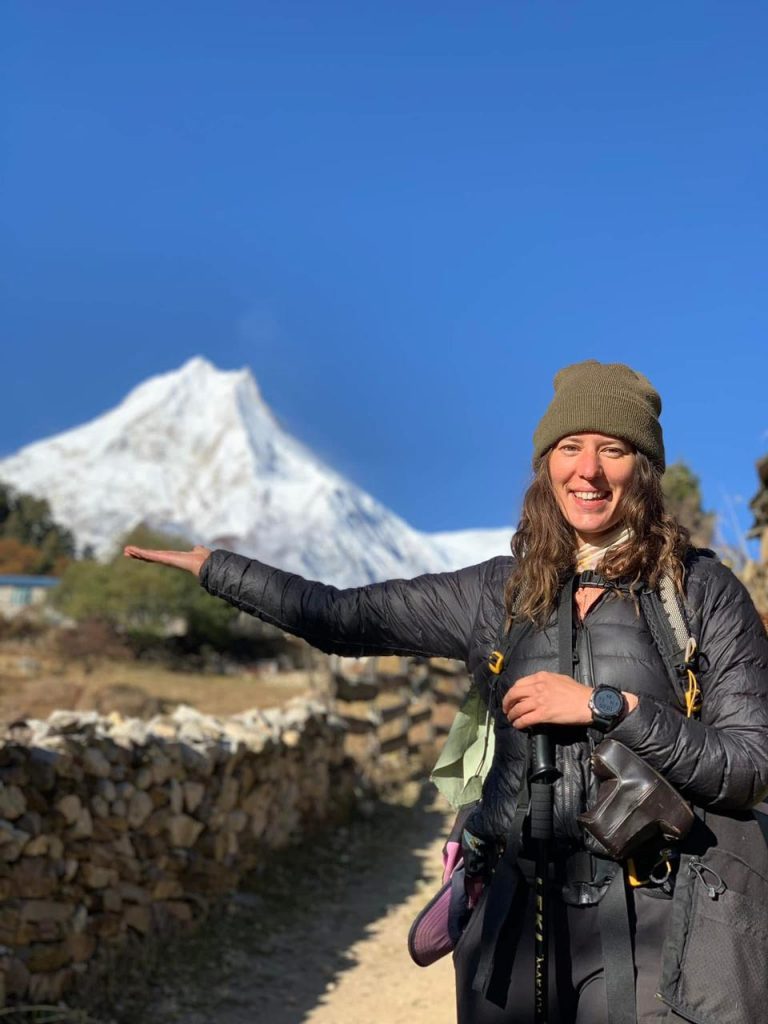
I am not sure I can describe what it feels like to see Manaslu for the first time from this angle. It rises above the valley like a wall of ice and rock, enormous and completely dominant, filling the entire upper end of your view. Kiran stopped walking when he saw my face and laughed quietly. He told me that no matter how many times he had guided this trail, that first view of Manaslu from above Lho still made him stop for a moment.
We arrived at Sama Gaon at 3,530 meters. It is a genuine Tibetan Buddhist community with monasteries, mani walls, prayer flag strings crossing between every rooftop, and villagers who maintain a way of life that has remained essentially unchanged for centuries. We stayed two nights here for acclimatization.
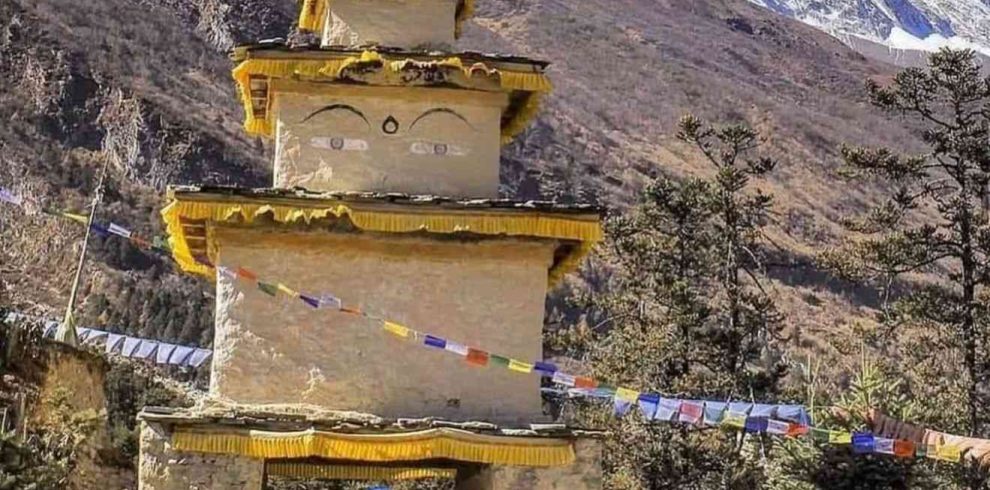
The 14-Day Manaslu Circuit Trek takes you around Mount Manaslu at 8,163 meters, the eighth-highest mountain on earth, through one of…
Acclimatization Day in Sama Gaon
Kiran gave me three options for the rest day: a walk to Birendra Lake, a hike toward Manaslu Base Camp, or a visit to Pungyen Gompa. We chose Birendra Lake in the morning and the monastery in the afternoon.
Birendra Lake sits below the Manaslu glacier and is fed by glacial melt. The water is an extraordinary shade of blue that I have never seen anywhere else. Chunks of ice floated at the far edge. Manaslu rose directly behind it. I took more photographs at that lake than at any other point on the trek.
In the afternoon we visited Pungyen Gompa, a small monastery above the village. Kiran translated some of the murals inside and explained their significance. The elderly monk who looked after the monastery brought us butter tea and seemed genuinely happy to have visitors who were interested rather than just passing through.
That evening around the dining table, Kiran told me stories from previous treks on the circuit. He had guided groups of all ages and fitness levels, solo trekkers and large expeditions, and his knowledge of how different people respond to altitude and how to manage the physical and mental challenges of the high sections was clear in every detail of how he was managing my acclimatization.
Day 6: Sama Gaon to Samdo
A short day of three to four hours, which felt like a relief after the longer days lower down. The trail crossed yak pastures and followed the valley floor toward the Tibetan border. Samdo at 3,785 meters is the last proper village before the pass, sitting directly below the ridge that separates Nepal from Tibet.
The afternoon was free and I walked along the valley above the village with Kiran. The silence up there is absolute. No wind, no running water, no sound at all from the village below. Just the mountains and the sky. It was one of the most peaceful moments I have ever experienced.
Day 7: Samdo to Dharamsala
A short ascent to Dharamsala at 4,460 meters, which is the final stop before the Larkya La Pass. Dharamsala is a collection of basic teahouses with limited facilities. There is no electricity, water comes from a nearby stream, and the toilet is an outhouse behind the building. None of that mattered.
Kiran checked the weather carefully that evening. He had a network of contacts among the other guides on the circuit and gathered information about conditions on the pass over the past 24 hours. He was satisfied with what he heard and told me we would leave at 4 AM.
I packed everything carefully that night and tried to sleep at 7 PM. The altitude made sleep difficult. I woke several times and lay in the dark listening to the wind pick up and then ease off again. Just before 4 AM, I heard Kiran moving in the corridor and that was enough to get me out of my sleeping bag.
Day 8: Larkya La Pass Day – Dharamsala to Bimthang
This is the day the Manaslu Circuit is built around.
We left at 4 AM under a sky full of stars. Kiran carried a headtorch and walked at a measured pace, checking on me every fifteen minutes. The first section crossed a moraine field in the dark, picking between rocks and ice patches. The cold was genuine, around minus ten degrees Celsius with a wind that cut through every layer.
As we gained the glacier section, the sky began to lighten behind us. Kiran pointed out the silhouettes of Cheo Himal and Himlung Himal emerging from the darkness to our right. Directly ahead, the pass was still invisible but the sky above it was turning from black to deep blue to the first orange of sunrise.
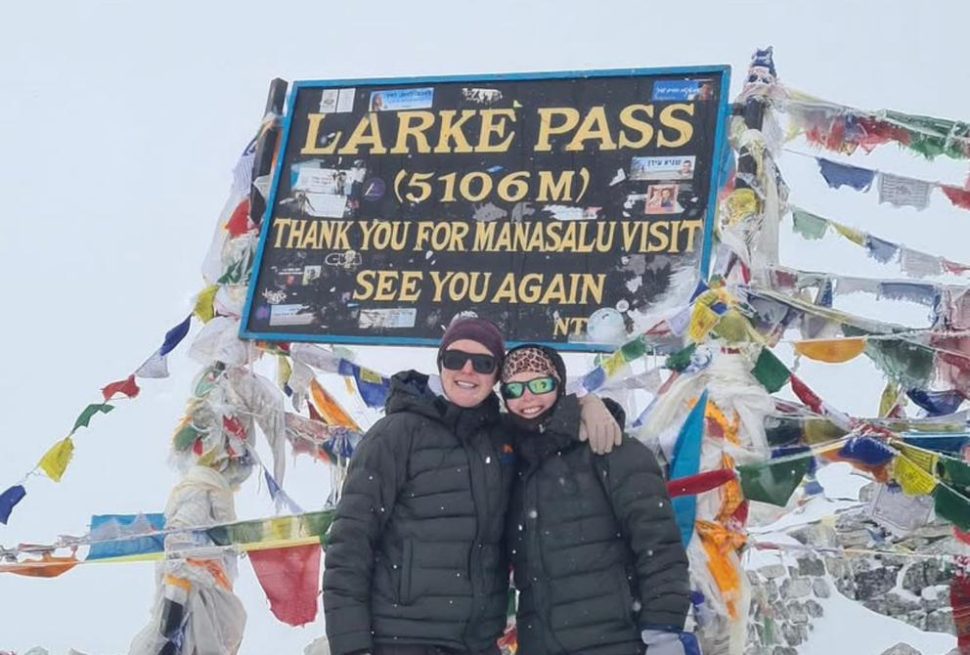
We reached the Larkya La Pass at 5,106 meters just after 7 AM.
The view from the top stopped me completely. To the north, the glacial cirque below the pass was fully lit by early morning sun. To the south and west, Annapurna II rose directly ahead, enormous and white, with the entire Annapurna massif spreading behind it. To the right, the peaks Kiran had been naming throughout the trek, Cheo Himal, Himlung, Nemjung, Gyaji Kang, and Kang Guru, formed an unbroken wall of ice. Every single peak was visible in perfect clarity. There was no cloud anywhere.
Kiran stood beside me and said nothing for a while. Then he said, in his understated way, that this was one of the clearest pass days he had seen in years. He had been hoping the weather would hold and it had held perfectly.
I put prayer flags up that I had been carrying since Sama Gaon. Kiran tied them carefully to the existing lines at the pass cairn and explained what the colors represent and which directions they face. Standing there at 5,106 meters with those flags moving in the wind and the entire Himalayan horizon around me in every direction, I felt something that I do not have a word for. It was not happiness exactly. It was bigger than that.
The descent took four hours. Long and steep through loose rock and then into alpine meadow as the altitude dropped and the air thickened noticeably. We reached Bimthang at 3,720 meters in the early afternoon, exhausted and euphoric. I ate the largest meal of the entire trek and went to sleep before dark.
Day 9: Bimthang to Tilije
The lower sections of the descent brought a different landscape again. Rhododendron forest, Gurung apple orchards, and the sound of running water everywhere after the dry silence of the high valley. Tilije at 2,300 meters felt almost tropical compared to Dharamsala. The air was thick and warm.
Kiran relaxed noticeably on this day. The technical section of the trek was behind us and the mood was lighter. We talked more freely, about his family in Dhading, about the changes he had seen in the region over his years of guiding, about which parts of the circuit he personally loved most. He said Sama Gaon and the view of Manaslu from Lho were always the moments he looked forward to most, regardless of how many times he had seen them.
Day 10: Tilije to Besisahar – Return to Kathmandu
A short final walk brought us to the road at Dharapani, where we met the jeep for the drive back to Kathmandu via Besisahar. The road dropped quickly into the Marsyangdi Valley and then wound south through the Annapurna foothills toward the Prithvi Highway.
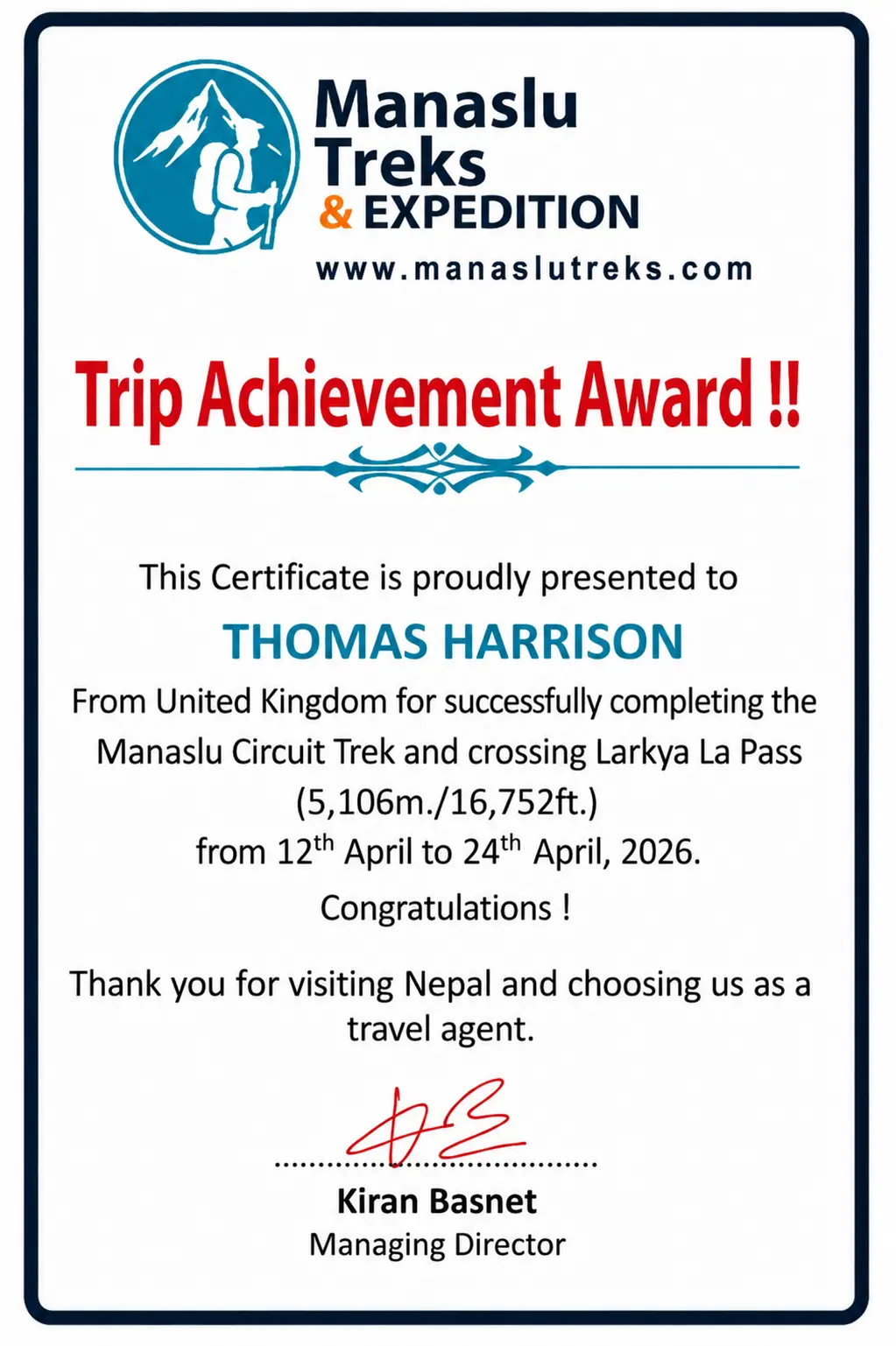
We reached Kathmandu late in the evening. Kiran had arranged a farewell dinner at a restaurant in Thamel that I would never have found on my own. We ate well and talked for a long time. He presented me with a trekking completion certificate from Manaslu Treks and Expedition.
We said goodbye outside my hotel at around 10 PM. I thanked him properly, though I am not sure any words were sufficient for what he had made possible over those 13 days.
What I Learned About the Manaslu Circuit Trek
A few honest observations for anyone considering this route.
The drive to the trailhead is long but important. Nine hours from Kathmandu to Machha Khola is tiring, but it is part of the experience and it puts the geography of the region into context in a way that flying would not.
The lower gorge sections are underrated. Most people focus on the high sections around Sama Gaon and the pass, but the Budhi Gandaki gorge in the lower days has its own drama and beauty. Do not rush through them.
The altitude on this circuit is serious. The jump from Samdo at 3,785 meters to Dharamsala at 4,460 meters followed immediately by the pass at 5,106 meters is demanding. The acclimatization day in Sama Gaon is not optional and the pace Kiran set throughout the lower days was deliberate preparation for the high section.
A mandatory guide is not a limitation. It is one of the best things about this trek. Having Kiran beside me changed the entire experience. His knowledge of the culture, the landscape, the other guides on the route, the teahouse owners, and the practical realities of the high section transformed 13 days of walking into something genuinely meaningful.
The Larkya La Pass will be the best day of your trekking life.
My Recommendation for Kiran and Manaslu Treks and Expedition
Kiran was exceptional throughout the trek. Professionally, he managed every logistical detail seamlessly, from permits to accommodation choices to pacing the itinerary with my fitness level in mind. On the trail, his judgment was consistently sound, his knowledge of the route was comprehensive, and his read of the weather conditions around the pass was critical to us having a perfect crossing day.
Personally, he made the trek genuinely enjoyable as an experience rather than just an achievement. His quiet humour, his patience with my endless questions, and the cultural knowledge he shared throughout the journey added a dimension to the trip that no guidebook could have provided.
I cannot recommend Manaslu Treks and Expedition highly enough. If you are looking for a company that genuinely knows the Manaslu region, operates with transparency, and gives you a guide who is local to the area and deeply knowledgeable about the circuit, this is the right choice.
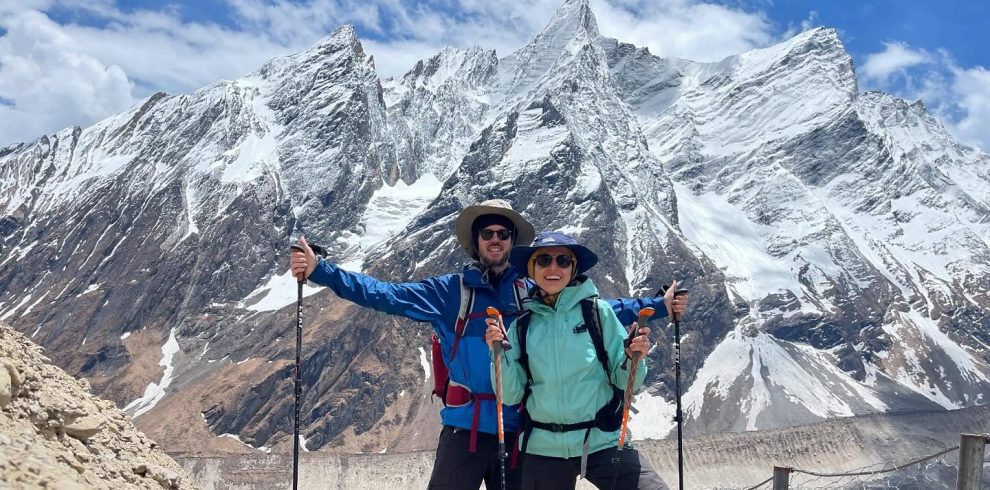
The 11-Day Manaslu Circuit Trek offers a quiet and scenic journey around Mount Manaslu (8,163m) – Nepal’s eighth-highest peak. With…
Practical Information for the Manaslu Circuit Trek
Trek Duration: 13 days from Kathmandu to Kathmandu Maximum Altitude: 5,106 meters at Larkya La Pass Best Seasons: March to May and September to November Permits Required: Manaslu Restricted Area Permit, Manaslu Conservation Area Permit (MCAP), and Annapurna Conservation Area Permit (ACAP) Guide Requirement: Mandatory by law throughout the restricted area Accommodation: Tea houses throughout the route with meals included Cost with Manaslu Treks and Expedition: From USD 1,250 per person for groups of two to five
Here is the recommendations section in clean bullet points. Copy and paste directly:
My Honest Recommendations for Anyone Planning the Manaslu Circuit Trek
Best Time to Go
- The best seasons are March to May and September to November
- I trekked in April and conditions were near perfect, clear skies, dry trail, rhododendrons blooming in the lower sections
- October is equally good if you prefer post-monsoon autumn colours and settled weather
- Avoid June to August completely, the monsoon makes the gorge trails dangerous, leeches are a real problem, and the pass carries serious risk
- December to February is possible but extreme cold at Dharamsala and on the pass, and several teahouses close in deep winter
What to Pack and Gear
- Down jacket rated to minus ten degrees or colder, the pass morning is genuinely freezing
- Waterproof outer shell for the lower gorge sections which can rain without warning
- Trekking poles, I nearly left mine behind and would have regretted it badly on the descent from Larkya La
- Broken in trekking boots, not new ones
- Gaiters for the snow approaching the pass
- Sleeping bag rated to at least minus five, teahouses above Namrung do not always provide thick blankets
- Sunscreen and glacier sunglasses, UV at 5,000 meters is far stronger than most people expect
- You do not need to carry everything yourself, a porter handles your main bag and you walk with just a daypack, Kiran arranged this as part of the package
Food and Water on the Trail
- Dal Bhat is available at every single teahouse and is the best fuel on the trail, two large servings, lentil soup, vegetable curry, rice, and pickle
- Kiran told me to always eat a full meal regardless of appetite because altitude kills hunger before it kills energy, that advice kept me going through the high section
- Other reliable options along the route are noodle soup, fried rice, Tibetan bread with honey, porridge, and thukpa
- Always drink boiled or filtered water, every teahouse provides it either free or for a small charge
- Carry a water bottle and refill at teahouses rather than buying plastic bottles
- Budget around 500 to 800 Nepali rupees per meal at teahouses, higher up the valley prices increase slightly
Altitude Sickness Warnings
- Do not rush the acclimatization day in Sama Gaon, it is not optional no matter how good you feel
- The standard symptoms to watch for are persistent headache, nausea, loss of appetite, dizziness, and difficulty sleeping
- Kiran monitored me quietly every single day without making it feel like surveillance, if your guide suggests slowing down, listen immediately
- Drink at least three litres of water per day from Namrung upward
- Diamox is available but talk to your doctor before the trek, Kiran advised me not to rely on it as a substitute for proper acclimatization
- If symptoms worsen at any point above Sama Gaon, descend immediately, no view or schedule is worth the risk
- Travel insurance with helicopter evacuation cover is mandatory, make sure yours is valid above 5,000 meters
Physical Fitness Preparation
- You do not need to be an elite athlete but you do need a solid base of cardiovascular fitness before arriving
- Kiran recommended at least two months of consistent preparation before the trek
- Walking uphill with a light pack for two to three hours, two to three times per week is the most relevant training
- Stair climbing and longer weekend hikes are both excellent preparation
- The hardest day physically is the pass crossing, eight to ten hours total with a very early start, everything before that is building toward it
Teahouse Expectations
- Teahouses on the Manaslu Circuit are better than I expected across almost the entire route
- Private rooms are available at most stops, simple but clean with a bed, pillow, and blanket
- Hot showers are available for a small extra charge up to around Samdo, above that facilities become more basic
- WiFi is available at teahouses in the lower and mid sections of the route
- Dharamsala is the exception, it is very basic with no electricity, an outdoor toilet, and minimal facilities, but honestly after everything the trek had built up to, none of that mattered at all
- Charging your devices costs extra at most teahouses above Namrung, bring a power bank
Money and Connectivity
- Carry enough Nepali rupees in cash before leaving Kathmandu, there are no ATMs on the trail after Arughat
- NTC (Nepal Telecom) SIM works perfectly throughout almost the entire circuit including the high villages of Sama Gaon and Samdo
- The only place where signal drops is around Dharamsala at 4,460 meters, which is the final teahouse before the pass
- Kiran recommended buying an NTC SIM at the airport or in Thamel before departing Kathmandu, it is inexpensive and essential for staying in contact
- Inform your bank before leaving home that you will be withdrawing cash in Nepal to avoid your card being blocked
Here it is, corrected and ready to paste:
My Training Before the Manaslu Circuit Trek
- I started preparing around two months before flying to Nepal
- Three times a week I went running, starting with 30 minute runs and building up to one hour by the final weeks
- On weekends I did longer hikes in the Brecon Beacons and the Peak District with a light daypack, usually four to six hours
- I also did stair climbing at home and in the office, Kiran later told me this was one of the best things I could have done because the Manaslu trail is relentless uphill in the first five days
- Two weeks before flying I added some light gym sessions focusing on legs and core
- Honestly I arrived in Nepal feeling prepared but the trail still humbled me on the longer days, so do not underestimate the preparation
How Much I Spent on the Manaslu Circuit Trek – Full Budget Breakdown
- Return flights from Bristol to Kathmandu: USD 800 booked about three months in advance via Dubai
- Kathmandu hotel: Manaslu Treks and Expedition arranged my accommodation in Kathmandu as part of the package, which I did not expect and was a very welcome surprise
- Company package with Manaslu Treks and Expedition: USD 1,250 per person, fully all inclusive covering permits, guide, porter, all meals on trail, accommodation, transport to and from the trailhead, and hotel in Kathmandu
- Gear shopping in Thamel: USD 150, I bought a buff, an extra fleece, trekking poles, and some woollen socks. Good quality gear is widely available in Thamel at reasonable prices
- Tips for Kiran and the porter: USD 100, Kiran never asked and never hinted, but after 13 days he absolutely deserved it and I gave it without hesitation. If your guide is good, tip generously
- Extra spending on the trail: USD 80, hot showers, device charging, a few extra snacks, and one or two cold drinks at teahouses on the warmer lower days
- Visa on arrival Nepal: USD 50 for 30 days
- Travel insurance with helicopter evacuation cover: USD 120, do not skip this, it is mandatory and genuinely essential above 5,000 meters
Total I spent: approximately USD 2,300
For 13 days trekking around the eighth highest mountain in the world with a professional local guide, all meals, all accommodation, hotel in Kathmandu, and all permits included, I consider that extraordinary value. The Manaslu Circuit Trek is not cheap to reach from the UK but once you are in Nepal the cost is very reasonable for what you get.