Yes, May is one of the two best months of the year to trek the Manaslu Circuit, the other being autumn in October and November. By May the winter snow has mostly cleared from the lower and middle sections of the trail, the rhododendron forests below Namrung are in bloom, and Larkya La is normally in one of its most stable, walkable states of the year. It is not a flawless month. The lower valley gets genuinely hot and humid, afternoon haze can dull the mountain views on some days, and if you push your dates into the very last days of May you start flirting with the early edge of monsoon. Overall though, if you want warm days, blooming forest, a good shot at clear Larkya La weather, and a trail that is not crowded to the point of queuing at teahouses, late spring is a smart choice. This guide walks through what the weather actually does at each altitude band on the route, what the pass is like this time of year, what to pack, what it costs, and where the genuine trade offs are, based on how the route actually behaves in practice rather than generic seasonal marketing.
Is May a Good Month for the Manaslu Circuit Trek? The Short Answer
May sits at the tail end of Nepal’s spring trekking season. Temperatures have been climbing steadily since March, the last of the winter snow on Larkya La has usually melted back or firmed up into manageable spring pack, and the forest sections of the trail through Sirdibas, Ghap and up toward Namrung are green and full of birdlife rather than bare and brown. Compared to October and November, May tends to have slightly less consistent visibility because of seasonal haze building ahead of the monsoon, but it also has warmer nights at altitude, which matters a lot when you are sleeping at 3,500 m or higher in a teahouse with thin walls. If you are choosing between a hot, humid lower valley walk in exchange for a genuinely comfortable high camp, and a cool clear lower valley in exchange for brutally cold nights at Samdo and Dharamsala, May leans toward the more forgiving end for anyone who suffers in the cold. Where May struggles is in the final week or two of the month, when early monsoon moisture starts pushing up from the south and cloud building becomes more frequent in the afternoons. Trekkers who book the first three weeks of May generally get the best version of this month.
Manaslu Circuit Trek Weather in May by Altitude Band
The single biggest thing to understand about weather on this trek, in any month, is that you are not walking through one climate. You start in a subtropical river valley at under 1,000 m and finish, ten days later, crossing an alpine pass above 5,100 m. In May that range is dramatic. Down at Machha Khola and Jagat you will be sweating in a t shirt by mid morning. Nine days later at Dharamsala you will be putting on every layer you own before dawn. Below is a rough, honest breakdown of what to expect at each stage, based on how the route sits and how spring generally behaves in this part of the Nepal Himalaya. Treat these as planning ranges rather than a forecast, since mountain weather can swing several degrees either way from year to year and even day to day.
- Lower valley, Machha Khola and Jagat, around 900 to 1,400 m: daytime highs commonly reach the high twenties Celsius, occasionally touching 30, with humid, sticky air. Nights stay mild, typically somewhere in the high teens.
- Mid hills, Namrung and Lho, around 2,900 to 3,200 m: daytime temperatures are pleasant for walking, often in the mid to high teens Celsius, sometimes low twenties in direct sun. Nights turn noticeably cooler, dropping to somewhere around 5 to 8 degrees.
- High villages, Samagaon and Samdo, around 3,500 to 3,860 m: daytime temperatures in May typically sit somewhere in the low teens Celsius when the sun is out, but drop fast once cloud rolls in. Nights regularly fall close to or just below freezing.
- Dharamsala and Larkya La, 4,450 m to 5,106 m: daytime temperatures near the pass hover close to freezing even in clear conditions, and can feel far colder with wind. Nights at Dharamsala commonly drop to somewhere between minus 5 and minus 15 degrees Celsius, and the early morning pass crossing, which usually starts well before sunrise, is the coldest few hours of the entire trek.
None of these numbers should be taken as guarantees. A warm spell can push temperatures higher than this for days at a time, and an unexpected cold front or a late season snowfall can just as easily drop them well below what is typical. What stays fairly consistent is the pattern: hot and humid low, comfortable in the middle forested stretch, cold at altitude, and genuinely harsh in the hours around the pass. Pack for all four conditions, not just the one you expect to spend the most time in.
Lower Valley Trail Conditions and Greenery in Late Spring
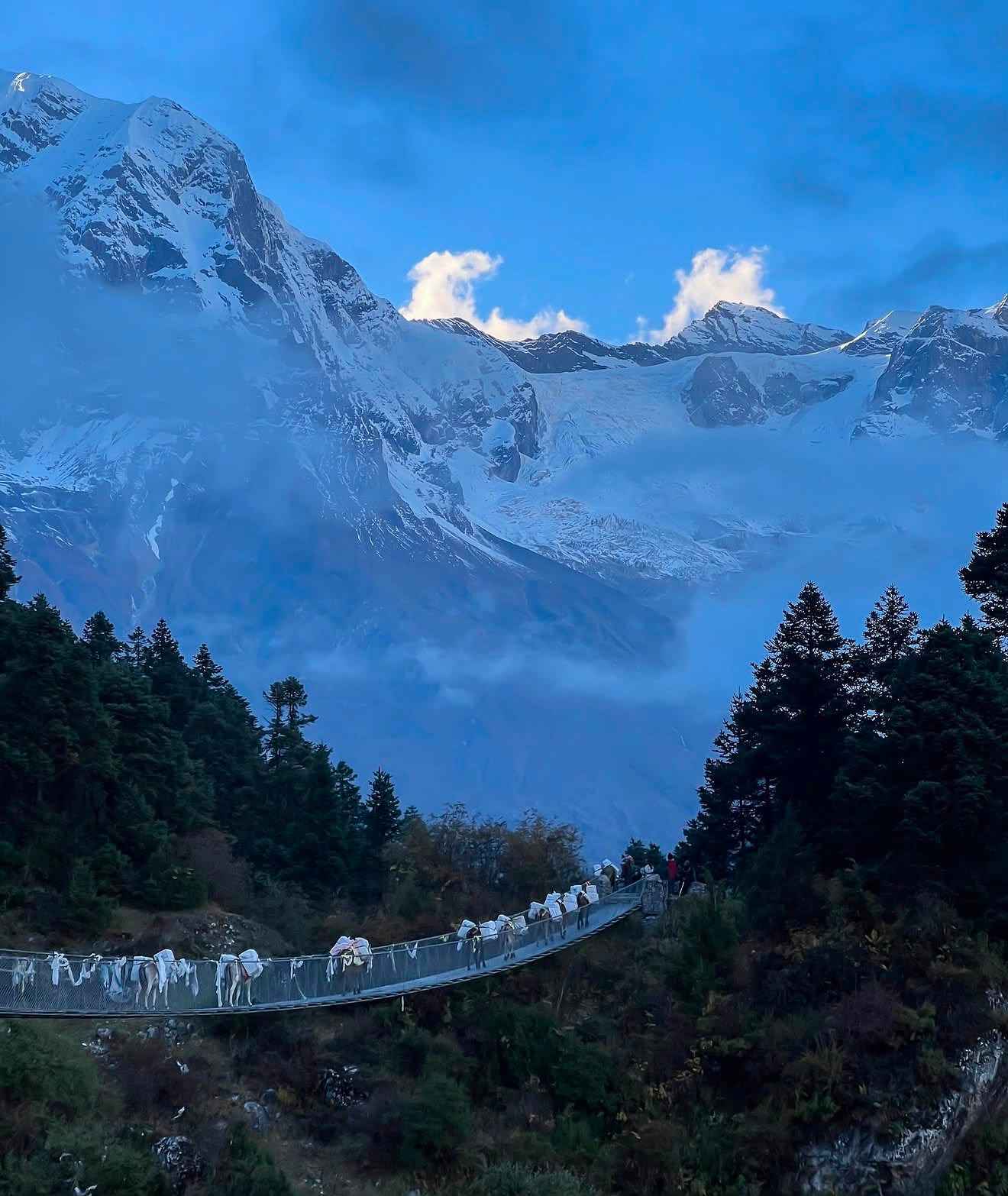
The first three or four days of the Manaslu Circuit, from Machha Khola through Jagat and up toward Deng, follow the Budhi Gandaki river through a steep, humid, subtropical gorge. By May this section is at its greenest. The terraced fields around Jagat and Philim are planted with maize and millet, the forest is thick and full of insect noise, and waterfalls along the trail are running strong from the accumulating spring melt higher up. The trade off is heat. Walking at low elevation in direct sun during May can be genuinely tiring, more from the humidity than the temperature itself, and you will sweat through layers faster than you expect. Start walking early in the morning while it is still cool, take the shaded sections of trail at an easy pace, and drink more water than you think you need. Leeches can appear in the wetter, more overgrown patches of forest in late spring, particularly after rain, so a pair of leech socks or a light application of salt or repellent around your boots and ankles is worth carrying, even if you never need it. The upside of this lower section in May, beyond the greenery, is that the river itself is dramatic, fuller and louder than in the dry winter months, and the suspension bridges crossing it make for some of the most memorable photographs of the entire trip.
Mid Hills: Namrung, Lho and the Approach to the High Country
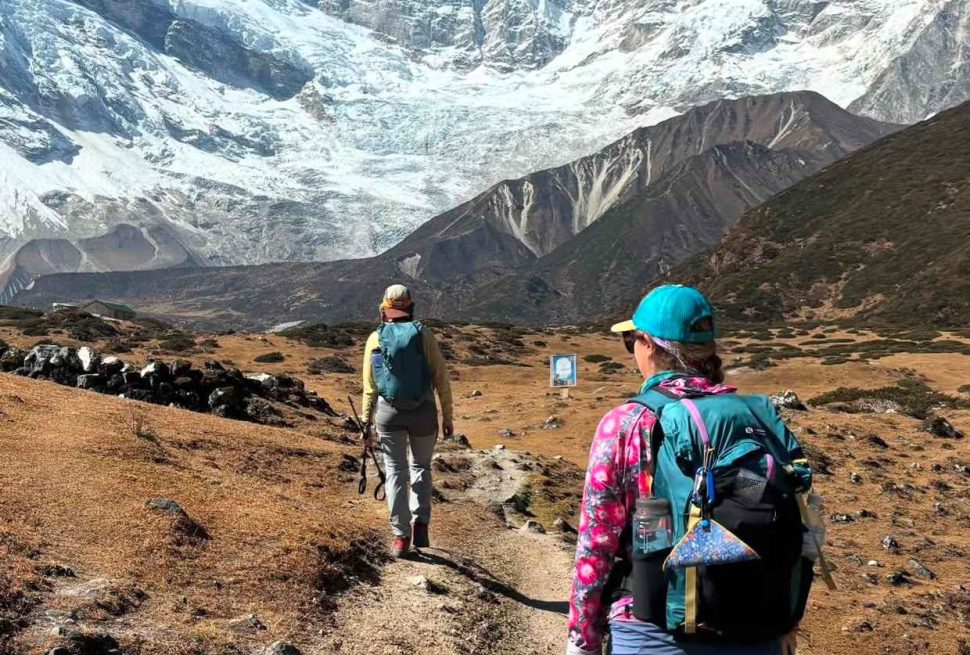
Above Deng the trail climbs into pine and rhododendron forest, and this is where May genuinely shows off. Rhododendron blooming season in this part of Nepal generally runs from March into May, and depending on elevation and the specific year, you can still catch late blooms on the higher slopes around Namrung and Lho into the first half of the month. The forest here is cooler and far more comfortable to walk through than the valley below, with dappled shade for most of the trail and none of the humidity that makes the lower gorge sticky. Namrung marks the entrance to the upper Manaslu valley, where the restricted area checkpoint sits and where your first real views of Manaslu itself and the surrounding peaks start opening up on clear days. Lho, a short stage further on, has one of the best monastery viewpoints on the whole circuit, with Manaslu framed directly behind the village gompa. This mid hill stretch is, in a lot of ways, the most pleasant walking on the entire route in May: warm enough to be comfortable, cool enough to move at a good pace, and visually rewarding as the peaks start to dominate the skyline.
High Altitude Villages: Samagaon and Samdo in May
Samagaon, at 3,500 m, is where the trek changes character. The forest thins out, stone walled fields and yak pastures take over, and the air noticeably cools even in the middle of the day. This is also the acclimatization stop on most itineraries, including the one outlined further down this page, and it is worth taking that rest day seriously. In May, Samagaon usually offers reasonably stable weather in the mornings, with cloud building through the afternoon, which is a pattern that repeats at nearly every stage from here to the pass. Plan side hikes, views of Manaslu North Face, or the walk up toward Manaslu Base Camp or Pungyen Gompa for the morning hours while the sky is still clear, and expect the peaks to disappear behind cloud by early afternoon most days. Samdo, a short stage further at 3,860 m, sits close to the Tibet border and has a starker, more open landscape than anywhere lower on the trek. Nights here in May are cold, frequently dropping close to freezing, and mornings can start with frost on the ground even though the days themselves are usually mild enough to walk comfortably in a fleece and light shell.
Dharamsala and Larkya La Pass Conditions in May
Dharamsala, sometimes marked on maps as Larke Phedi, sits at around 4,450 m and exists purely to stage the pass crossing. There is no village here, just a handful of basic lodges, and this is the coldest overnight stop on the whole route. Expect a genuinely cold night, well below freezing, and limited facilities. Most groups leave Dharamsala in the dark, often between 4 and 6 in the morning, specifically to cross Larkya La before the afternoon cloud and wind build up, which is a pattern that holds regardless of season but matters especially in the shoulder months. For Larkya La itself, May is generally regarded, along with the autumn window of October and November, as one of the two most reliable periods of the year to cross. The heavy monsoon snow and cloud of summer are absent, and the harsh, wind scoured cold of deep winter has eased. That said, spring conditions on a 5,106 m pass are never soft. Overnight snow is possible on the approach even in May, the trail across the pass itself can be icy in patches especially in early morning shadow, and wind chill at the top routinely makes the actual temperature feel far colder than the thermometer suggests. Guides on this route generally treat May as a good, workable month for the crossing, but not a casual one, and a competent, licensed guide who knows the current snow and ice conditions on the day is genuinely important here, which is also a legal requirement in this restricted area regardless of your experience level. The descent from the pass down to Bimthang, dropping over 1,400 m in a single long day, is where the eight to ten hour crossing day really tests tired knees, and this does not change by season.
Haze and Visibility Considerations in Late Spring
This is the honest downside of trekking in May, and any guide who tells you otherwise is not being straight with you. As spring progresses toward the monsoon, moisture and dust build up in the atmosphere across the middle hills of Nepal, and this often produces a hazy quality to the air, particularly in the lower and middle sections of the valley and particularly in the afternoons. Mornings are usually your clearest window for photography and for views of Manaslu, Himalchuli and Ngadi Chuli, with haze building as the day warms up. This is different from cloud cover, which can block a view entirely, haze tends to soften and flatten distant views rather than remove them completely, so you will generally still see the big peaks, just not always with the crisp, sharp definition you would get on a cold, dry October morning. If photography of the high peaks is your main priority, plan on shooting in the early morning hours at each viewpoint, and do not assume the same view will look as good three hours later. Rain, when it comes in May, is usually a short afternoon shower rather than a sustained downpour, at least until the very end of the month, but it does add to the haze the following day by increasing humidity in the valley air.
Daylight Hours on the Manaslu Circuit in May
May gives you some of the longest days of the year in Nepal, which is genuinely useful on a trek with several long walking stages. Around the middle of May, first light in this part of Nepal comes at roughly 4:45 to 5:00 in the morning, with the sun properly up shortly after, and it does not get fully dark until close to 7:00 in the evening, giving you around fourteen hours of usable daylight. This matters most on the two longest days of the itinerary, the walk into Namrung and the pass crossing day from Dharamsala to Bimthang, both of which can run eight hours or more. Long daylight gives you a buffer if the group moves slowly, if weather forces a delay, or if someone needs extra rest breaks, and it also means guides can start the pass crossing early without walking the first hour in full darkness the way you sometimes must in November or December. Even so, most groups still start the pass day before or right at sunrise, both to beat the afternoon wind on the pass and to have a comfortable margin of daylight left once you reach Bimthang.
Teahouse and Lodge Availability in May
The Manaslu Circuit is a restricted area trek, which caps the number of independent trekkers on the trail compared with somewhere like the Everest or Annapurna regions, and this holds true in May as much as any other month. Teahouses along the route, from Machha Khola through to Bimthang, are generally family run, simple, and limited in room count, often with four to eight rooms per lodge in the upper villages. May is a busier month than the winter off season but noticeably quieter than the peak autumn window of October and early November, so you are unlikely to find yourself competing hard for rooms, particularly if you are trekking with an organized group whose guide can call ahead. That said, some of the smaller settlements, especially Dharamsala before the pass, have genuinely limited capacity, and on a handful of busy nights lodges there can fill up, occasionally requiring shared rooms or dining hall floor space for the overflow. Booking through an operator who maintains relationships with specific lodges along the route, and who confirms rooms a day or two ahead by phone where there is signal, removes most of this uncertainty. Food along the route in May is the same dal bhat, noodle, and basic Western menu found across most Nepal teahouse treks, though fresh vegetables become more available again once the lower valley crops are producing, an improvement over what you would find in the depths of winter.
Road and Transport Conditions in May
Getting to and from the trailhead is part of the Manaslu experience, and it is worth setting expectations honestly. The drive from Kathmandu to the starting point at Machha Khola covers roughly 160 km but takes eight to nine hours, and the return drive from Tilije to Kathmandu covers around 210 km in eight to ten hours. These numbers reflect the state of the rural road network in this part of Nepal rather than the distance itself, the road is unpaved and rough in long stretches, and travel times can extend further after heavy rain has damaged sections of the track. In May, before the monsoon arrives in earnest, road conditions are generally at their most favorable for the year, drier and firmer than the muddy, sometimes landslide affected conditions of the summer months, and less affected by ice or snow than in the depths of winter at higher points on the route. Landslides and road damage are always a possibility on this kind of mountain road, so it is sensible to build a spare day into your schedule around the drive, particularly toward the very end of May if early rains have already started further south. Local jeeps and shared vehicles also become somewhat more available as the trekking season picks up through spring compared with the quieter winter months.
Pros and Cons of Trekking the Manaslu Circuit in May
No month is perfect for a trek that spans this much elevation and this many microclimates. Here is a straightforward look at what actually works in your favor in May, and what does not.
| Pros of May | Cons of May |
|---|---|
| Larkya La is usually in one of its two most stable windows of the year, alongside autumn | Afternoon haze can soften distant mountain views, especially in the lower and middle valley |
| Rhododendron and forest greenery is at or near its best on the Namrung to Lho stretch | Lower valley heat and humidity make the first few days of walking genuinely tiring |
| Long daylight hours, around fourteen hours, give extra buffer on long walking days | Leeches can appear in the lower forest sections after rain |
| Milder nights at altitude compared with deep winter, especially at Samagaon and Samdo | The very end of May can bring early monsoon showers and rising humidity |
| Quieter trail and easier teahouse booking than the peak autumn season | Road conditions, while better than summer, can still be affected by early rain toward month end |
| Roads to and from the trailhead are typically drier and firmer than in summer monsoon months | Dharamsala and the pass crossing remain genuinely cold regardless of season |
Day by Day Sample Itinerary for the Manaslu Circuit Trek in May
This is the actual thirteen day itinerary that Manaslu Treks and Expedition runs for the Manaslu Circuit Trek, with notes adjusted for what you can genuinely expect from the trail and weather in May. For a fuller stage by stage breakdown of the route itself, including terrain notes for each day, see the detailed Manaslu Circuit Trek route guide.
| Day | Route | Altitude | Notes for May |
|---|---|---|---|
| Day 1 | Arrival in Kathmandu | 1,300 m | Airport transfer and hotel check in. Kathmandu in May is warm, generally in the high twenties Celsius by day, with occasional short evening showers as the month goes on. |
| Day 2 | Kathmandu to Machha Khola, about 160 km, 8 to 9 hrs drive | 930 m | Long, rough drive day. Roads are generally dry and firm in May, though a spare day in the schedule is sensible in case of delays. |
| Day 3 | Machha Khola to Jagat, 11 to 12 km, 5 to 6 hrs walk | 1,410 m | Hot, humid valley walking. Start early to avoid the worst midday heat and carry more water than usual. |
| Day 4 | Jagat to Deng, 19 km, 6 to 7 hrs walk | 1,860 m | Forest is green and full of birdlife. Watch for leeches on shaded, damp stretches, particularly after rain. |
| Day 5 | Deng to Namrung, 19 km, 6 to 7 hrs walk | 2,900 m | Long day but one of the most rewarding, entering restricted area checkpoint country with first real Manaslu views on clear mornings. |
| Day 6 | Namrung to Samagaon, 17 km, 6 to 7 hrs walk | 3,500 m | Noticeably cooler air from here on. Rhododendron blooms may still be visible on higher slopes early in the month. |
| Day 7 | Acclimatization day at Samagaon, short side hike 8 to 10 km, 4 to 5 hrs | 3,500 m | Take morning views seriously, since afternoon cloud typically builds by early afternoon in May. |
| Day 8 | Samagaon to Samdo, 8 to 9 km, 3 to 4 hrs walk | 3,860 m | Short, easier day for further acclimatization. Nights start dropping close to freezing from here. |
| Day 9 | Samdo to Dharamsala, 11 to 12 km, 4 to 5 hrs walk | 4,450 m | Basic facilities, cold night ahead. Pack your warmest layers accessible for tonight and tomorrow morning. |
| Day 10 | Dharamsala over Larkya La (5,106 m) to Bimthang, 17 to 19 km, 8 to 10 hrs | Descending to about 3,700 m | Early pre dawn start. Coldest, most demanding day of the trek, but May generally offers one of the more stable weather windows of the year for this crossing. |
| Day 11 | Bimthang to Tilije, 12 to 13 km, 5 to 6 hrs walk | 2,300 m | Descending back into forest and warmer air, with views back toward Manaslu from the Bimthang side often very clear in the morning. |
| Day 12 | Tilije to Kathmandu, about 210 km, 8 to 10 hrs drive | 1,300 m | Long return drive. Roads generally firm this time of year, though always worth confirming conditions the day before. |
| Day 13 | Final departure from Kathmandu | Transfer to airport for international departure. |
If you have extra time and want to combine this route with one of the quieter side valleys in the region, our 23 day Tsum Valley and Manaslu Circuit combination trip adds the Tsum Valley loop before rejoining the main circuit, and May’s warmer, greener conditions suit that extension particularly well since Tsum sits at generally lower elevations than the main Larkya La stages.
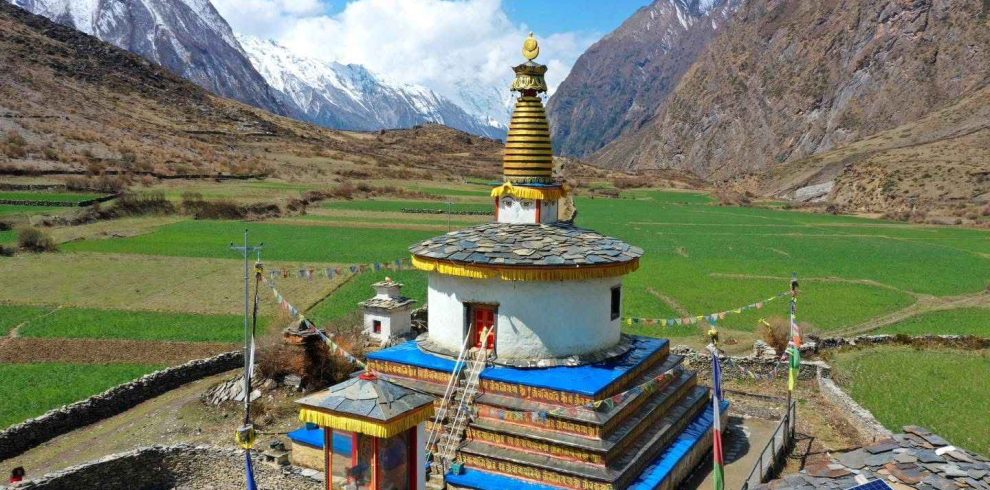
The 23-day Tsum Valley & Manaslu Circuit Trek combines breathtaking Himalayan landscapes with the preserved Tibetan Buddhist culture of a…
What to Pack for the Manaslu Circuit Trek in May
Packing for this trek in May means packing for four different climates in the space of two weeks, which trips up a lot of first time trekkers who assume “spring” means uniformly mild weather. Here is what actually earns its place in your duffel bag for a May departure.
- Lightweight, breathable trekking shirts and a sun hat for the hot, humid lower valley days around Machha Khola and Jagat.
- A mid weight fleece or softshell for the comfortable but cooling mid hill stretch through Namrung and Lho.
- A proper down jacket for the cold nights and mornings from Samagaon upward. Manaslu Treks and Expedition provides a down jacket and sleeping bag as part of the package, returned at the end of the trip, which saves you from buying gear you may only use once.
- A warm sleeping bag rated for well below freezing, since even in May the nights at Dharamsala and Samdo drop close to or below zero.
- A windproof, waterproof outer shell for the pass crossing, where wind chill matters as much as the actual temperature, and for the possibility of a short afternoon shower lower down.
- Good broken in trekking boots with solid ankle support, plus gaiters if you have them, useful for both muddy lower trail sections and any lingering icy patches near the pass.
- Light gloves and a warm hat for the pass crossing morning, along with sunglasses rated for high altitude glare, since May sun at 5,000 m is intense even through haze.
- A basic personal first aid kit with blister care, any personal medication, and, if you are prone to altitude symptoms, medication your doctor has approved in advance, discussed with your guide.
- A reusable water bottle or bladder and a means of water purification, since bottled water is not included in the package and is best avoided anyway for environmental reasons in a fragile mountain area.
- Insect repellent for the lower valley forest sections, where mosquitoes and leeches are more active in the warm, humid conditions of late spring.
- A trekking pole or two, genuinely useful on the steep, sometimes loose descent from Larkya La down to Bimthang.
For a more detailed look at how demanding this trek is day to day, including what kind of fitness and prior experience helps, see our full Manaslu Circuit Trek difficulty assessment.
Permits and Costs for the Manaslu Circuit Trek in May
The Manaslu region is a restricted area, which means permits here work differently from more open trekking areas like Everest or Annapurna, and a licensed guide is a legal requirement regardless of group size or experience. May falls into the cheaper off season permit bracket for the Manaslu Restricted Area Permit, which runs from December through August, before the pricier September through November peak season bracket kicks in. As of recent seasons the fee structure has generally run at roughly USD 75 for the first seven days of the permit period, with an additional charge of around USD 10 per extra day beyond that in this off season window, though these figures are periodically revised by the Nepal government and should always be reconfirmed close to your departure date. Alongside the restricted area permit you will also need the Manaslu Conservation Area Permit, generally around USD 30, and the Annapurna Conservation Area Permit, also generally around USD 30, since the route crosses into Annapurna Conservation Area territory on the far side of Larkya La near Bimthang. There is also a local Chumnubri Rural Municipality fee of roughly USD 10, payable in cash Nepali rupees at a checkpoint, usually at Jagat. All of this is handled for you as part of a booked package, but it is worth understanding what you are actually paying for.
| Permit | Approximate Cost | Notes |
|---|---|---|
| Manaslu Restricted Area Permit (May, off season bracket) | Around USD 75 for first 7 days, plus about USD 10 per extra day | Priced by season, cheaper December to August, pricier September to November. Confirm current rate before departure. |
| Manaslu Conservation Area Permit | Around USD 30 | Covers the conservation area on the approach and upper valley. |
| Annapurna Conservation Area Permit | Around USD 30 | Required since the route exits through Annapurna Conservation Area near Bimthang and Tilije. |
| Chumnubri Rural Municipality local fee | Around USD 10 | Cash Nepali rupees, usually paid at a checkpoint at Jagat. |
On top of permits, the package price itself depends on group size. Manaslu Treks and Expedition’s current rates per person are approximately USD 1,350 for a solo traveler, USD 1,250 for a group of two to five, USD 1,200 for a group of six to eight, and USD 1,150 for a group of nine to ten, though these should always be confirmed at the time of booking since rates are subject to change. The package includes airport pickup and drop off, two nights in a Kathmandu hotel with breakfast, teahouse lodging throughout the trek, transport to and from the trailhead, all permits including the restricted area permit, conservation area permits, TIMS, and local government fees, a licensed English speaking guide, porter service at one porter per two trekkers up to 20 kg each, guide and porter wages, meals including three meals a day on the trek plus morning tea or coffee, insurance, a sleeping bag and down jacket for the duration of the trip, a trekking map, a completion certificate, a first aid kit, government taxes, and a farewell dinner in Kathmandu at the end. Not included are your international airfare, Nepal entry visa, personal travel and evacuation insurance, personal expenses such as laundry, phone and wifi charges, bottled water and other beverages, alcohol and snacks, and any extra food beyond what the package covers. For a fuller breakdown of costs and permit questions, our Manaslu Circuit Trek cost and permit FAQ covers this in more depth.
Who Should Trek the Manaslu Circuit in May
May suits a fairly specific kind of trekker well. If you run cold at night and dread the idea of a minus fifteen degree evening at altitude, the milder nights of late spring compared with peak winter or even late autumn are a genuine advantage. If you want to see the region green and blooming rather than dry and brown, and you are not overly precious about getting a perfectly crisp, haze free photograph of every peak on every single day, May delivers a version of the trek that autumn simply cannot match in terms of forest color and river flow. It also suits people who want a slightly quieter trail and easier lodge bookings than the busiest weeks of October, without dropping all the way down to the genuinely cold, quiet winter months when snow can complicate the pass crossing considerably. Where May suits people less well: if pin sharp mountain photography is your top priority and you are willing to trade warmer nights for it, autumn generally gives more consistently clear conditions. If you are especially heat sensitive, the first three or four days of hot, humid valley walking in May can be a genuine slog, more so than in the cooler months. And if your schedule is flexible only at the very end of May, be aware you are pushing into the early edge of monsoon risk, with a higher chance of afternoon rain, muddier trail sections lower down, and a slightly greater chance of road delays on the drive in and out. For a broader look at how May compares with the other trekking seasons on this route, our seasonal comparison guide for the best time to trek Manaslu and Tsum Valley lays out the full year month by month.
Frequently Asked Questions About the Manaslu Circuit Trek in May
Is Larkya La passable in May?
Yes, in the great majority of years Larkya La is passable and in reasonably good condition throughout May, and along with the October to November autumn window it is generally regarded as one of the two most reliable months to cross it. The heavy winter snow accumulation has usually melted back or firmed into manageable spring pack by this point, and the harsh, wind driven cold of deep winter has eased. That said, this is still a 5,106 m pass, and conditions can vary year to year. A late season snowfall is always possible, icy patches can persist in shaded sections of the trail even in good years, and a licensed guide who checks current conditions before the crossing day is genuinely important, not a formality. Groups typically cross before midday to avoid the wind and cloud that build in the afternoon, a pattern that holds in May as it does in every other month.
How cold does it get at night on the Manaslu Circuit in May?
It depends heavily on where you are on the route. Down in the lower valley around Machha Khola and Jagat, nights in May stay mild, typically in the high teens Celsius. By the time you reach Namrung and Lho in the mid hills, nights cool into roughly the 5 to 8 degree range. At Samagaon and Samdo, in the 3,500 to 3,860 m range, nights regularly approach or dip just below freezing. And at Dharamsala, just below the pass at 4,450 m, expect a genuinely cold night, commonly somewhere between minus 5 and minus 15 degrees Celsius. This is why packing layers for the full range of the trek, not just the conditions at the start, matters so much.
Does it rain a lot on the Manaslu Circuit in May?
Early and mid May generally sees relatively little rain, with the odd short afternoon shower being the most common pattern, particularly in the lower valley. As the month goes on, especially into its final week or so, the chance of rain increases as the region edges toward the monsoon, which typically arrives in earnest in Nepal sometime in June. If you want to minimize your rain risk within May, booking your trek for the first three weeks of the month rather than the last few days is the more conservative choice.
Will I get clear views of Manaslu in May?
Most days, yes, at least in the morning. The more common issue in May is not cloud blocking the view entirely, but a hazy quality to the air, especially in the lower and middle valley, which softens rather than removes distant views. This haze tends to build through the day, so mornings are consistently your best window for clear photographs of Manaslu, Himalchuli and the surrounding peaks. Higher up, around Samagaon, Samdo and the approach to the pass, the air is thinner and generally clearer, and many trekkers find their best, sharpest mountain views actually come in this upper section rather than lower down.
Is May too hot for trekking in the lower Manaslu valley?
It is warm and, more importantly, humid, and this genuinely surprises some first time trekkers who expect the whole trek to feel like a mountain holiday from day one. The first three to four days of the route, through Machha Khola, Jagat and Deng, sit at relatively low elevation in a subtropical river gorge, and daytime temperatures here in May commonly reach the high twenties Celsius with sticky, humid air. It is not dangerous heat, but it does mean walking is more tiring than the modest elevation gain on those days would suggest. Starting early in the morning, pacing yourself, and drinking plenty of water make a real difference here.
How busy is the Manaslu Circuit Trek in May compared to autumn?
May is a genuinely popular month, but it is quieter than the peak autumn window of October and early November, which remains the single busiest period on this route. Because the Manaslu region is a restricted area with a cap on independent trekker numbers, the trail never feels crowded the way parts of the Everest or Annapurna regions can during peak season, but teahouse rooms, particularly at smaller stops like Dharamsala, can still fill up on busy nights. Booking through an operator who confirms rooms ahead of time removes most of the uncertainty around this.
Do I need a guide for the Manaslu Circuit Trek?
Yes, and this is not optional. The Manaslu region is legally classified as a restricted area, and Nepal’s government requires every trekker on this route, regardless of experience level or group size, to be accompanied by a licensed guide. This rule holds in every season, including May. It is worth noting this is a genuine safety benefit as much as a bureaucratic requirement, since a guide who works this route regularly will know current trail and pass conditions, checkpoint procedures, and altitude warning signs far better than a first time visitor could on their own.
What should I pack differently for a May trek compared to autumn or winter?
The main difference is emphasis rather than a completely different kit list. For May, lean toward lighter, more breathable clothing for the lower valley days, since the heat and humidity there are more of a factor than in cooler months, and bring insect repellent for the leech and mosquito prone forest sections. You still need the same serious cold weather gear for Samagaon upward and for the pass crossing, since nights and early mornings at altitude remain cold regardless of season. The one thing you can generally scale back on compared with a winter trek is the absolute heaviest cold weather gear for the lower and middle sections of the route, since May nights there are considerably milder than in December or January.
Ready to Book Your Manaslu Circuit Trek in May
May is a genuinely good window for this trek, warm greenery lower down, a comfortable middle stretch through Namrung and Lho, and generally one of the more stable years for the Larkya La crossing, with the honest trade offs of lower valley heat and some late spring haze. If the dates and conditions described here suit your plans, Manaslu Treks and Expedition, based in Thamel, Kathmandu, can put together a departure around your schedule with a licensed guide who knows this route firsthand in every season. Get in touch by phone or WhatsApp at +977 9869225929, by email at info@manaslutreks.com, or through our contact to ask questions or check availability, and take a look at the full Manaslu Circuit Trek package details for the complete itinerary, inclusions and current pricing before you book.