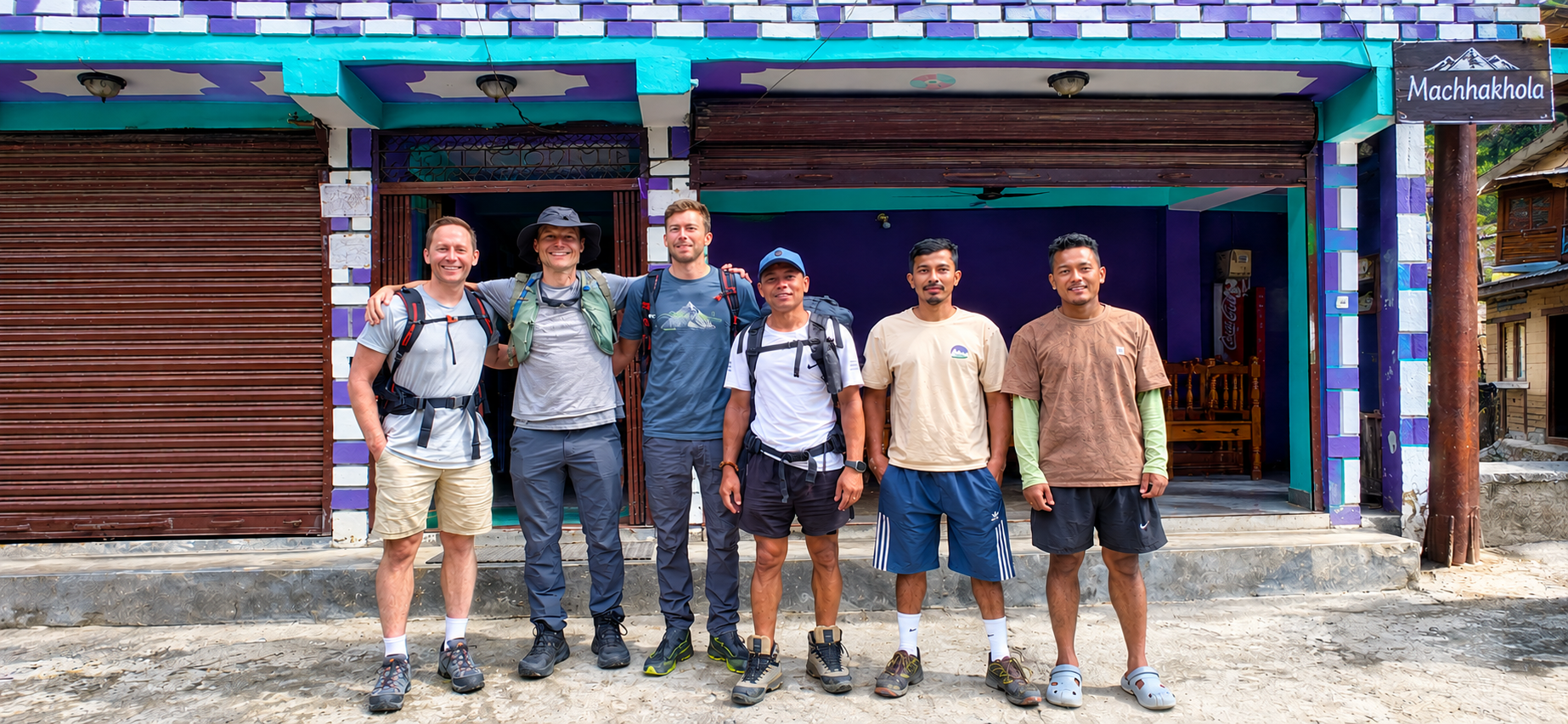
Machhakhola is a small riverside village in Gorkha District, Nepal, that sits at the point where the jeep road from Kathmandu ends and the walking trail of the Manaslu Circuit Trek begins. The name translates directly from Nepali as “Fish River,” after the Machha Khola stream that joins the Budhi Gandaki River near the village. Almost every trekker who does the Manaslu Circuit passes through here, either as their first overnight stop or as the place where they get off the jeep and start walking.
The village sits at approximately 869 meters above sea level. This low elevation means the climate is warm and subtropical, very different from the high cold valleys you encounter further up the Budhi Gandaki. Paddy fields, banana trees, and subtropical forest surround the village, and the heat during spring and summer can feel intense after the long jeep drive from Kathmandu. The Budhi Gandaki River runs through the valley with force here, cutting between steep green walls, and the sound of the river is constant.
Machhakhola itself is not a large settlement. It is a cluster of teahouses, small shops, and family homes along the riverbank, all oriented toward serving the trekking traffic that passes through. But its position at the trailhead of one of Nepal’s most significant restricted trekking routes gives it an outsized importance in any Manaslu itinerary. This guide covers everything you need to know about Machhakhola: how to reach it, what to do there, where to stay, what to eat, the trail onward, and what makes this small village the right place to begin a serious trek.
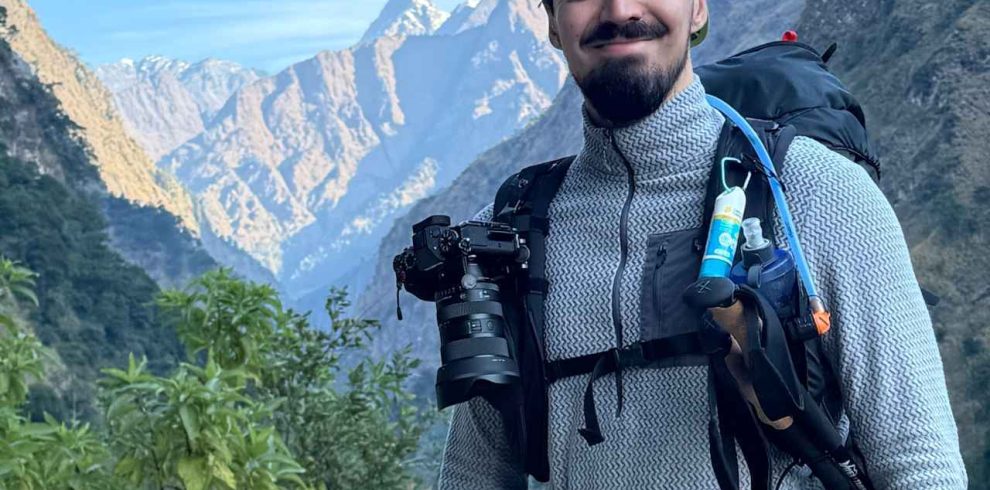
The Manaslu Circuit Trek is a spectacular journey around Mount Manaslu (8,163 m), the eighth-highest mountain in the world. Located…
Where Is Machhakhola Located
Machhakhola lies in the southern part of Gorkha District, in Gandaki Province of Nepal. It is part of the Budhi Gandaki Rural Municipality. The village sits along the eastern bank of the Budhi Gandaki River in a valley that runs roughly north to south at this point, before the river bends and the trail turns into increasingly narrow gorge terrain to the north.
Gorkha District is historically significant in Nepal. It is the birthplace of Prithvi Narayan Shah, the king who unified the many small kingdoms and principalities of Nepal into a single nation in the eighteenth century. The district capital, Gorkha Bazaar, lies southeast of Machhakhola and contains the historic Gorkha Durbar palace complex on a hilltop ridge above the town. Trekkers driving to Machhakhola pass through or near Gorkha and can stop there to visit the palace before continuing to the trailhead.
| Detail | Information |
|---|---|
| Elevation | 869 meters (2,851 feet) |
| District | Gorkha District |
| Province | Gandaki Province |
| River | Budhi Gandaki |
| Distance from Kathmandu | Approximately 160 kilometers by road |
| Drive time from Kathmandu | 8 to 10 hours depending on road conditions |
| Climate type | Subtropical, warm and humid |
| Village below on trek | Soti Khola (700m) |
| Village above on trek | Jagat (1,340m) |
| Trek route | Manaslu Circuit Trek |
The Machha Khola stream, which gives the village its name, joins the Budhi Gandaki just below the village. The main suspension bridge at Machhakhola crosses the Budhi Gandaki and is one of the first significant bridge crossings on the Manaslu Circuit route. Standing on this bridge and looking upstream into the gorge gives you an early preview of the terrain that defines the Manaslu valley: steep walls, dense vegetation, and a powerful river carved deep into the hills over millions of years.
How to Get to Machhakhola from Kathmandu
Getting to Machhakhola requires either a private jeep or a public bus from Kathmandu. There is no airport, no railway, and no shortcut. The road distance from Kathmandu to Machhakhola is approximately 160 kilometers but the journey typically takes 8 to 10 hours because the road passes through mountain terrain with many curves, occasional single-lane sections, and periodic road damage from monsoon rains and landslides.
The main road route goes from Kathmandu toward Prithvi Highway, then turns north through Arughat Bazaar or via Gorkha Bazaar, before continuing up the Budhi Gandaki valley to the road end at Machhakhola. Some itineraries have trekkers start from Soti Khola, which is slightly further down the valley at around 700 meters, making the first walking day into Machhakhola itself. Other itineraries drive all the way to Machhakhola and start walking from there. Both approaches are common.
Private Jeep from Kathmandu
A private jeep hired through your trekking agency is the most comfortable and flexible option. A 4WD jeep can carry four to six passengers plus gear and costs between NPR 12,000 and NPR 20,000 for the full trip depending on the season and negotiation. The advantage of a private vehicle is that it can stop for breaks, adjust timing for road conditions, and does not require you to wait at bus stations or share space with other passengers and cargo.
The last section of the road from Arughat Bazaar to Machhakhola follows the Budhi Gandaki valley and is rough in places. After heavy monsoon rain, this section can have washouts, fallen rocks, and temporary closures. Checking current road conditions before departure is sensible, particularly if you are traveling between July and October.
Public Bus from Kathmandu
Public buses from Kathmandu to Arughat Bazaar run from various bus parks in Kathmandu, with the most common departure point being Gongabu Bus Park (also called New Bus Park) in northern Kathmandu. From Arughat, you can take a local jeep or continue on foot to Machhakhola. The public bus option is significantly cheaper (roughly NPR 400 to NPR 600 one way to Arughat) but the journey takes longer, the seats are crowded, and luggage space is limited.
| Transport Option | Cost (approximate) | Duration | Comfort Level | Best For |
|---|---|---|---|---|
| Private jeep (Kathmandu to Machhakhola) | NPR 12,000 to 20,000 total | 8 to 10 hours | Good | Groups, organized trekking tours |
| Public bus (Kathmandu to Arughat) | NPR 400 to 600 per person | 7 to 8 hours | Basic | Budget-conscious solo trekkers |
| Local jeep (Arughat to Machhakhola) | NPR 300 to 500 per person | 1.5 to 2 hours | Basic | Connecting after public bus |
Most organized trekking groups use private jeeps arranged by their agency in Kathmandu. This ensures a predictable departure time and removes the stress of navigating bus parks and local connections with a full trekking pack. If you are trekking with Manaslu Treks, ground transport to the trailhead is included in the package arrangements, so you simply board the vehicle at the agreed time in Kathmandu and the logistics are handled.
The People of Machhakhola
Machhakhola and the surrounding villages in this lower section of the Budhi Gandaki valley are home primarily to Gurung and Magar communities. Both groups are indigenous Nepali ethnic communities from the hill regions of central and western Nepal, known historically for their service in the British and Indian Gurkha regiments and for their farming and livestock traditions.
The Gurung people have their own language and cultural traditions that are distinct from those of the Brahmin and Chhetri communities that predominate in many lowland areas of Nepal. Their festivals, music, and religious practices draw from a blend of Buddhist and animist traditions specific to the hill communities of the Gandaki region. In the villages around Machhakhola, many older residents still speak Gurung as their primary language, with Nepali serving as the language of commerce and interaction with outsiders.
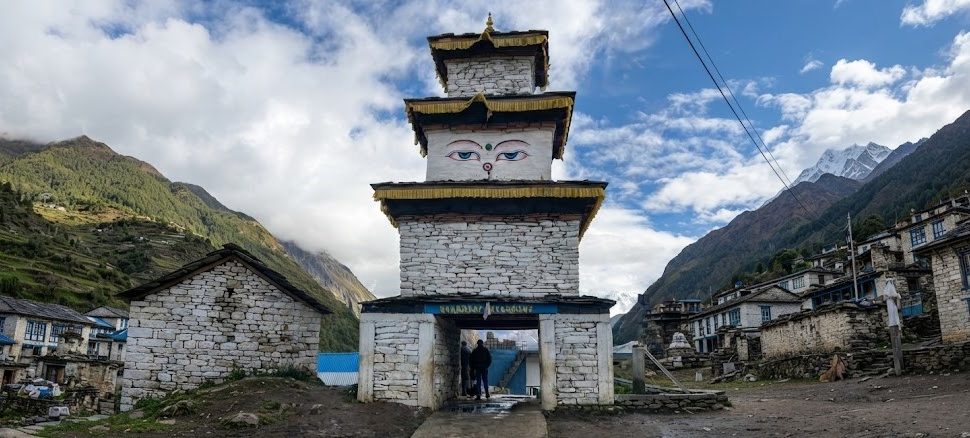
As the trail climbs higher into the Budhi Gandaki valley beyond Jagat, the population transitions toward communities with stronger Tibetan Buddhist influences. The villages of Deng, Namrung, Lho, and eventually Samagaun are home to Tibetan and Nubri communities. Machhakhola represents the meeting point between these two cultural spheres, and both Hindu and Buddhist religious structures appear in and around the village.
The main livelihood in Machhakhola today combines traditional farming with trekking tourism services. Paddy rice is grown in the terraced fields around the village during the monsoon season. Maize and millet grow at slightly higher elevations on the surrounding slopes. Livestock including goats and buffalo are common. The teahouses and small shops that serve trekkers provide a secondary income that has become increasingly important as the Manaslu Circuit has grown in popularity since it opened to foreign trekkers in 1992.
Where to Stay in Machhakhola
Accommodation in Machhakhola is basic compared to what you find in more developed trekking destinations like Namche Bazaar on the Everest route or Ghorepani on the Annapurna trail. The teahouses here are simple family-run guesthouses with small rooms, shared bathrooms, and basic amenities. This is entirely appropriate for the first night of a trek that will see you walking for two weeks through increasingly remote terrain.
Most teahouses in Machhakhola offer twin or double rooms with foam mattresses, pillows, and blankets. The rooms are small but adequate for one night. Shared bathrooms with squat toilets are standard, though some teahouses have upgraded to Western-style toilets. Hot showers may be available at some teahouses for a small extra charge, typically between NPR 200 and NPR 400, running through a simple solar heating system. In the warm subtropical climate of Machhakhola, a hot shower is less essential than it will be at higher altitudes, but many trekkers appreciate it after a long day of driving.
| Accommodation Feature | Typical Standard at Machhakhola |
|---|---|
| Room type | Twin rooms with foam mattresses, some double rooms available |
| Bathroom | Shared, mostly squat toilets, some Western |
| Hot shower | Available at some teahouses (NPR 200 to 400 extra) |
| Electricity | Available at most teahouses, grid connection at this altitude |
| Phone signal | Ncell and Nepal Telecom coverage generally available |
| Wi-Fi | Some teahouses offer it, reliability varies |
| Price per room | NPR 200 to 500 per person per night |
Unlike many villages higher on the Manaslu Circuit, Machhakhola benefits from grid electricity rather than relying entirely on solar panels or micro-hydropower. This means device charging is straightforward and reliable at this stage of the trek. Take advantage of this: charge all your devices fully in Machhakhola, because electricity becomes less reliable as you gain altitude.
Trekking agencies that book accommodation on the Manaslu Circuit typically reserve rooms in Machhakhola teahouses as part of the package. If you are trekking with your own group under an agency arrangement, your guide will handle the check-in process. Independent trekkers arriving without reservations in peak season (October and November) should arrive early enough to secure a room, as the limited number of beds can fill when multiple groups arrive on the same evening.
Food in Machhakhola: What to Expect
The food available in Machhakhola teahouses is straightforward Nepali mountain cuisine, which is exactly what you need at the start of a long trek. The staple is dal bhat: a large plate of boiled rice accompanied by lentil soup, seasonal vegetables, spicy pickle, and sometimes a small amount of meat or egg. Dal bhat is filling, nutritious, and genuinely good here at lower elevation where vegetables are fresh from the surrounding fields and the cooking quality tends to be higher than at altitude.
Breakfast items typically include fried eggs with bread or chapati, porridge, muesli with milk, or Tibetan bread with butter and jam. Noodle soup, fried rice, and vegetable curries are common lunch options. Tea, coffee, and hot chocolate are available at most teahouses. Given the subtropical climate, cold drinks are also available and welcome.
| Food Category | Common Items | Typical Price |
|---|---|---|
| Main meals | Dal bhat (unlimited refills), fried rice, noodle soup, vegetable curry | NPR 300 to 500 |
| Breakfast | Eggs (fried, boiled, scrambled), porridge, Tibetan bread, muesli | NPR 200 to 400 |
| Snacks | Biscuits, chocolate, instant noodles, spring rolls | NPR 100 to 250 |
| Hot drinks | Milk tea, black tea, ginger tea, coffee, hot chocolate | NPR 80 to 150 |
| Cold drinks | Soft drinks, mineral water | NPR 80 to 150 |
The food prices in Machhakhola are among the lowest on the entire Manaslu Circuit. As you gain elevation toward villages like Namrung, Samagaun, and Samdo, supply costs increase because everything must be carried in by porter, and prices rise accordingly. Eating well and at reasonable cost in the lower villages is a sensible strategy. Fuel up on dal bhat in Machhakhola, as the unlimited refill policy at most teahouses means you can eat a genuinely large meal for a fixed price.
Fresh produce is available in Machhakhola at a standard that drops off as you go higher. Vegetables grown in the surrounding fields end up on your plate the same day, which produces noticeably better quality food than the preserved and stored ingredients used at higher altitude villages. Some teahouses in Machhakhola even cook with fresh chicken or buffalo meat, though trekkers are generally advised to transition to vegetarian options above 3,000 meters for food safety reasons.
Things to Do in Machhakhola
Machhakhola is primarily a transit point rather than a destination in itself, but there are a few worthwhile things to do here beyond settling into your teahouse. If you arrive in the late afternoon after a long jeep drive, an evening walk along the river is a pleasant way to stretch your legs. If you arrive early enough, or if you have time due to a rest day or delayed schedule, the following activities are available.
Walk Along the Budhi Gandaki River
The most accessible activity in Machhakhola is simply walking along the riverbank. The Budhi Gandaki here is a substantial river, running clear green-blue in dry season and brown and churning during and after monsoon rains. The riverbanks near the village have flat sections where villagers wash clothes, and the suspension bridge crossing is itself a worthwhile walk for views up and down the gorge. The river walk requires no preparation and takes as little or as much time as you have available.
Visit Tatopani Hot Springs
Tatopani, which means “hot water” in Nepali, refers to a natural hot spring location along the Manaslu Circuit trail between Machhakhola and Jagat. The exact location of the hot spring varies by source, but most accounts place it roughly one to two hours of walking upstream from Machhakhola. The hot springs bubble up at the river’s edge and have been used for bathing and relaxation by locals and trekkers for generations.
A soak in a natural hot spring at the start of a two-week trek is an appealing prospect, and some trekkers build in an extra half-day at Machhakhola specifically for this purpose. The water temperature is warm enough for bathing but not scalding. You need to bring your own soap and towel, as there are no facilities at the natural spring itself. Some itineraries include the hot spring visit as part of the first morning of walking before reaching Jagat for the night.
Explore the Village and Surrounding Fields
A walk through the village and the terraced fields above it gives you a good introduction to the agricultural life of the Budhi Gandaki valley. In monsoon season, the paddy terraces are brilliant green and the surrounding hills are alive with vegetation. In winter and spring, the same terraces are dry and brown, and the hills visible above the village show their steeper, rockier faces. Either way, the contrast between the cultivated valley floor and the wild steep hills above is striking.
Interacting with local residents in Machhakhola is easy because the village has been hosting trekkers for decades and the residents are accustomed to foreign visitors. Children often approach trekkers with curiosity and sometimes with requests for candy or pens, which is a common dynamic in tourist-frequented villages throughout Nepal. Carrying small gifts is a personal decision, but handing out candy can create expectations that other trekkers then have to navigate.
Check and Restock Supplies
Machhakhola has small shops that sell trekking supplies, snacks, and basic medications at significantly lower prices than you will find at higher altitude villages. If you realize you have forgotten something in Kathmandu, or want to add to your snack supply before the trail gets more remote, Machhakhola is your last reliable opportunity to do so at reasonable cost. Specific items worth checking include spare batteries, snack foods (chocolate, nuts, dried fruit, biscuits), blister treatment supplies, and any personal medications you may have left behind.
The selection of goods in Machhakhola shops is limited compared to what you would find in Kathmandu or even Gorkha Bazaar, but the basics are available. Prices are lower here than at any other point on the Manaslu Circuit, so buying extra snacks here rather than waiting until Namrung or Samagaun saves money.
What to Pack for the Trek Starting from Machhakhola
Because Machhakhola is a warm, low-altitude village, the packing requirements here are not about cold-weather gear. The challenge is carrying appropriate gear for the full range of conditions you will encounter on the Manaslu Circuit, which goes from the subtropical heat of Machhakhola all the way to the high-altitude cold of Larke La Pass at 5,106 meters. Everything you carry from Machhakhola must earn its weight across that full range.
| Category | Essential Items | Notes |
|---|---|---|
| Clothing (low altitude, days 1 to 3) | Lightweight trekking shirt, trekking pants or shorts, light rain jacket | Heat and humidity on lower trail |
| Clothing (high altitude, days 4 to 14) | Down jacket, fleece, thermal base layers, warm hat, gloves, neck gaiter | Essential above 3,000m |
| Footwear | Waterproof trekking boots (broken in), camp sandals | Same boots carry you from Machhakhola to Larke La Pass |
| Sleeping | Sleeping bag rated to at least -10°C | Teahouses provide blankets but a personal bag is essential above 4,000m |
| Rain protection | Waterproof pack cover, dry bags for electronics | Lower trail gets rain throughout monsoon; upper trail gets snow in winter |
| Navigation | Offline maps on phone, headlamp with spare batteries | Charge fully in Machhakhola |
| Health | Personal first aid kit, altitude medication, water purification | No pharmacy above Arughat |
| Documents | All permits, passport, emergency cash in Nepali rupees | No ATM on the route after Arughat |
| Electronics | Power bank, all cables, camera | Charge everything in Machhakhola where grid power is reliable |
The key packing principle for a trek starting at Machhakhola is to travel light enough on the lower warm trail that you are not exhausted by the heat and humidity, but to have every piece of cold-weather gear you need for the high sections. If you are trekking with a porter, that balance is easier to achieve. If you are carrying your own pack, ruthlessly eliminate anything you cannot justify carrying for two weeks to 5,000 meters.
The Trail from Machhakhola: What Comes Next
Leaving Machhakhola on the first morning of proper trekking, you cross the suspension bridge over the Budhi Gandaki and begin the northward push into the gorge. The trail from Machhakhola to Jagat is one of the most dramatic sections of the lower Manaslu Circuit, following the river through tight gorge sections with steep walls on both sides, crossing side streams on narrow bridges, and navigating sections of trail cut directly into cliff faces.
The walk to Jagat from Machhakhola takes approximately 6 to 7 hours and gains about 470 meters in elevation. The trail is not particularly steep, but the rough terrain, the heat at these lower elevations, and the occasional landslide-prone sections require attention. The path passes through several small villages and settlements along the way, including Khorlabeshi and Tatopani (where the hot springs are located).
| Stage | From | To | Distance | Elevation Change | Walking Time |
|---|---|---|---|---|---|
| Day 1 | Machhakhola (869m) | Jagat (1,340m) | ~14 km | +471m | 6 to 7 hours |
| Day 2 | Jagat (1,340m) | Deng (1,860m) | ~12 km | +520m | 5 to 6 hours |
| Day 3 | Deng (1,860m) | Namrung (2,630m) | ~14 km | +770m | 6 to 7 hours |
| Day 4 | Namrung (2,630m) | Lho (3,180m) | ~9 km | +550m | 5 to 6 hours |
| Day 5 | Lho (3,180m) | Samagaun (3,530m) | ~8 km | +350m | 3 to 4 hours |
The section of trail immediately after Machhakhola is often described by trekkers as the most physically demanding part of the lower circuit. The gorge narrows significantly north of the village, and the path requires crossing and recrossing the river on suspension bridges, climbing over rock outcroppings, and walking narrow ledge paths above the river. Trekking poles are extremely useful on this section.
Despite the demanding terrain, the natural scenery on the trail north of Machhakhola is exceptional. The gorge walls rise hundreds of meters on both sides, draped in dense forest at lower elevations. Waterfalls drop from the cliffs above, some falling directly across the trail in wet season. Bird life is rich in this subtropical zone: you can see colorful birds including various pheasants, barbets, and sunbirds that disappear as you gain altitude. The trail gradually transitions from subtropical forest to temperate forest as you approach Jagat and beyond.
Permits and Regulations for the Manaslu Circuit Starting at Machhakhola
Machhakhola is outside the Manaslu Restricted Area, which officially begins at Jagat, one day’s walk north. However, you must have all your permits arranged before you arrive in Machhakhola, as they are checked at permit checkpoints starting from Jagat and at several subsequent villages along the route.
The Manaslu Circuit requires three core permits: the Manaslu Restricted Area Permit (RAP), the Manaslu Conservation Area Permit (MCAP), and the Annapurna Conservation Area Permit (ACAP). The ACAP is required because the standard circuit exits through the Annapurna Conservation Area via Dharapani. Additionally, a TIMS (Trekkers’ Information Management System) card was historically required, though permit rules for the Manaslu region are periodically updated by the Nepal government.
| Permit | Where Required | Cost (per person) | Where to Get It |
|---|---|---|---|
| Manaslu Restricted Area Permit (Sep to Nov) | Jagat checkpoint onward | USD 100 for first 7 days, USD 15 per extra day | Kathmandu, Department of Immigration |
| Manaslu Restricted Area Permit (Dec to Aug) | Jagat checkpoint onward | USD 75 for first 7 days, USD 10 per extra day | Kathmandu, Department of Immigration |
| Manaslu Conservation Area Permit (MCAP) | Throughout Manaslu Conservation Area | NPR 3,000 (approximately USD 22) | Agency or conservation office |
| Annapurna Conservation Area Permit (ACAP) | Required for Dharapani exit | NPR 3,000 (approximately USD 22) | Agency or conservation office |
A licensed guide is mandatory for the Manaslu Circuit. This rule applies to all trekkers regardless of experience level or solo versus group status. The guide requirement is enforced at permit checkpoints along the route. Trekkers attempting the circuit without a guide are turned back and can face fines. All permits and guide arrangements must be made through a registered trekking agency before leaving Kathmandu.
If you are trekking with an established agency, all permit paperwork is handled for you in advance. Your guide carries copies of the permits and presents them at checkpoints. As the trekker, you need to carry your original passport as the permits are issued in your name and the checkpoint officials may want to verify your identity against the permit documents.
Weather and Best Time to Visit Machhakhola
Machhakhola at 869 meters experiences a subtropical climate that is warm year-round and significantly hotter than the mid-mountain or high-altitude sections of the trek. Understanding the weather at Machhakhola specifically matters because the conditions here, particularly rain on the lower trail, can affect trail safety regardless of how good the weather is higher up on the circuit.
| Season | Months | Temperature at Machhakhola | Conditions | Trekking Suitability |
|---|---|---|---|---|
| Spring | March to May | 20°C to 35°C daytime | Warm, rhododendrons blooming at higher elevations, some afternoon cloud | Excellent |
| Monsoon | June to September | 22°C to 32°C daytime | Heavy rain, leeches on trail, landslide risk, lush green scenery | Possible but challenging and wet |
| Autumn | October to November | 15°C to 28°C daytime | Clear and dry, cool nights, best overall conditions | Excellent (peak season) |
| Winter | December to February | 8°C to 18°C daytime | Cool to cold, dry, clear skies, fewer trekkers | Good at low altitude, challenging at high sections |
Autumn: Clear Skies and Ideal Conditions
October and November are the most popular months to begin the Manaslu Circuit from Machhakhola, and for good reason. The monsoon has ended, leaving the vegetation washed clean and the skies clearer than at any other time of year. The temperature at Machhakhola in October is pleasantly warm without being oppressive, and the higher sections of the circuit have excellent mountain views and stable weather. Nights in Machhakhola during October and November are cool enough for comfortable sleeping, rarely dropping below 10°C.
Spring: Flowers and Green Scenery
March to May brings warming temperatures to Machhakhola and spectacular rhododendron blooms on the slopes above the lower valley. Spring is the second main trekking season for the Manaslu Circuit. The days are long, the light is good, and the higher sections of the circuit benefit from the same reasonable weather as autumn. The downside of late spring, particularly May, is that pre-monsoon cloud activity can build quickly in the afternoons, reducing visibility at higher altitudes.
Monsoon: The Challenge Season
The monsoon months of June through September bring heavy rain to the Budhi Gandaki valley. The trail between Machhakhola and Jagat passes through landslide-prone terrain and can become genuinely dangerous after sustained heavy rain. Leeches are abundant on the lower trail sections during monsoon. The rivers swell and bridge crossings become more serious undertakings. Despite all of this, some trekkers specifically choose the monsoon season for the empty trails and the intense green of the valley in full bloom. It is not recommended for inexperienced trekkers or those with tight schedules.
Machhakhola in the Context of the Full Manaslu Circuit
Machhakhola is the starting point, but it is worth understanding its place within the full arc of the Manaslu Circuit to appreciate why the choices you make here matter for the rest of the trek. The circuit covers approximately 177 kilometers of trail, climbing from the subtropical Budhi Gandaki valley to the high-altitude desert terrain near Larke La Pass, and descending into the Annapurna foothills before reaching the road at Besisahar or Dharapani.
| Circuit Section | Key Villages | Altitude Range | Days | Character |
|---|---|---|---|---|
| Lower valley (approach) | Machhakhola, Jagat, Deng | 869m to 1,860m | Days 1 to 3 | Subtropical gorge, challenging trail, hot and humid |
| Mid valley | Namrung, Lho | 1,860m to 3,180m | Days 4 to 5 | Temperate forest, altitude begins to matter |
| High section (acclimatization) | Samagaun, Samdo | 3,530m to 3,860m | Days 6 to 8 | High alpine, rest days essential, dramatic mountain views |
| Pass crossing | Dharamsala, Larke La Pass, Bhimtang | 3,860m to 5,106m | Days 9 to 10 | Most demanding day, summit views, long descent |
| Descent (Annapurna side) | Tilje, Thonje, Dharapani, Besisahar | 3,590m to 760m | Days 11 to 14 | Rapid descent, road access returns |
The decisions you make at Machhakhola set the tone for the entire trek. Starting well-rested after a good sleep, eating a solid breakfast before leaving, and setting a comfortable pace on the first walking day all contribute to how you will feel in the higher sections two weeks later. Trekkers who push too hard in the lower sections often arrive at Samagaun and the acclimatization stages already fatigued, which reduces their ability to handle the altitude effectively.
Machhakhola is also where the reality of the trek becomes concrete. The jeep drive from Kathmandu is over. The permits are already in hand. The guide is introducing themselves and explaining the route. The pack is on your back. All the planning and preparation is complete, and the actual work of walking begins here. For many trekkers, stepping off the jeep in Machhakhola and crossing the suspension bridge into the gorge is one of the clearest transitions of their trekking life.
Comparing Machhakhola with Other Manaslu Circuit Starting Points
Some Manaslu Circuit itineraries start the walking from Soti Khola rather than Machhakhola. Soti Khola sits at approximately 700 meters, about one walking day below Machhakhola. Starting from Soti Khola adds a day to the trek and gives trekkers a longer warm-up period on lower-altitude trail before reaching the gorge sections. It also gives another night of adjustment before the permitting area begins at Jagat.
| Starting Point | Elevation | Advantages | Disadvantages | Best For |
|---|---|---|---|---|
| Soti Khola | 700m | Longer warm-up, more time at low altitude, one extra walking day | Adds a day to the trek, less infrastructure than Machhakhola | Trekkers with extra time, those wanting a longer walk-in |
| Machhakhola | 869m | Better teahouses and facilities, slightly shorter trek, clear trailhead | Slightly less acclimatization time on lower trail | Most organized tours, standard 14-day itinerary |
| Arughat Bazaar | 563m | Available by road, market town | Adds 2 days of walking to reach Jagat | Trekkers wanting maximum lower valley experience |
Most 14-day and 13-day Manaslu Circuit itineraries start from Machhakhola as the practical trailhead. The jeep road reaches here reliably (road conditions permitting), the teahouses are better than at Soti Khola, and the walking from Machhakhola to Jagat is a full and satisfying first day without being excessive. Shorter itineraries of 10 to 12 days sometimes start directly from Jagat, with trekkers taking a jeep that far when the road allows, cutting out the lower gorge section entirely. This is possible but means missing some of the most dramatic lower-valley scenery on the route.
Frequently Asked Questions About Machhakhola
What is the elevation of Machhakhola?
Machhakhola sits at approximately 869 meters above sea level, which is about 2,851 feet. This is a low elevation by Himalayan trekking standards, and the warm subtropical climate here is very different from the cold high-altitude conditions you experience in villages like Samagaun, Samdo, or near Larke La Pass. Altitude sickness is not a concern at Machhakhola, but the heat and humidity on the lower trail can cause significant fluid loss through sweating, making hydration more important than many trekkers expect.
How long does it take to reach Machhakhola from Kathmandu?
The drive from Kathmandu to Machhakhola takes 8 to 10 hours by private jeep under normal road conditions. The road is approximately 160 kilometers but the mountain terrain means the speed is slow for much of the journey, particularly on the narrower sections near Arughat and on the final stretch of the Budhi Gandaki valley approach. During monsoon season or after heavy rain, landslides or road damage can add several hours to the journey or occasionally make sections impassable for a day or two. Most trekking agencies plan for an early morning departure from Kathmandu to arrive at Machhakhola in late afternoon with enough time for a meal and sleep before the first walking day.
Is there an ATM in Machhakhola?
No. Machhakhola does not have an ATM. The nearest reliable ATMs are in Gorkha Bazaar or Arughat Bazaar, both of which are passed on the road from Kathmandu. You must carry all the cash you need for the entire Manaslu Circuit trek from Kathmandu. Calculate your expected expenses carefully: lodge accommodation for 14 nights, all meals, hot showers, device charging, Wi-Fi where available, permit checkpoints (these are pre-paid), tips for your guide and porter, and an emergency fund for unexpected costs. All transactions on the Manaslu Circuit are cash only in Nepali rupees.
Can I get a sim card or mobile data in Machhakhola?
Mobile phone signal from both Ncell and Nepal Telecom networks is generally available in Machhakhola, and 4G data is accessible in some parts of the village. Machhakhola is at low enough elevation and close enough to the populated valley system that cell coverage is reasonable. Signal becomes progressively less reliable as you gain altitude, with significant dead zones on parts of the upper trail. If you need to make calls or use data, do so in Machhakhola or Jagat, where coverage is relatively better than higher on the circuit.
What is the name Machhakhola mean?
The name comes directly from Nepali. “Machha” means fish, and “khola” means river or stream. The village is named after the Machha Khola stream that flows into the Budhi Gandaki River near the settlement. Fish River is an apt name: the Budhi Gandaki and its tributaries in this lower section support fish populations, and locals have fished these waters for generations. As you gain elevation on the circuit, the rivers become too cold and fast for fish to thrive, and the Machha Khola name remains a marker of the subtropical, river-rich character of the trek’s beginning.
What ethnic communities live in Machhakhola?
The main communities in Machhakhola are Gurung and Magar, both of whom are indigenous hill peoples of the Gandaki region. Some Brahmin and Chhetri families also live in the village and surrounding area. The mix of ethnic communities in Machhakhola reflects the broader diversity of the lower Budhi Gandaki valley, which has served as a trade and migration corridor between the Tibetan plateau to the north and the Gangetic plains to the south for centuries. The cultural character of the village is distinctly different from the Tibetan Buddhist communities you encounter at Namrung, Lho, and Samagaun higher on the circuit.
Do I need a guide to trek from Machhakhola?
Yes. The Manaslu Circuit is a restricted trekking area and a licensed guide hired through a registered Nepali trekking agency is mandatory. This requirement applies from the moment you start the trek at Machhakhola and continues through the entire circuit. Permit checkpoints at Jagat and subsequent villages verify that you are traveling with a guide. Trekkers found without a guide are turned back and can face fines. This rule is enforced and is not a formality.
Is Machhakhola suitable for trekkers with no previous Nepal experience?
Yes, Machhakhola itself is easy to manage for any trekker. The village is accessible by road, has teahouses with basic facilities, and sits at low altitude. The challenge begins on the walking day from Machhakhola to Jagat, which passes through gorge terrain that requires attention but is not technically difficult. First-time Nepal trekkers who are physically fit and have the right gear can complete the Manaslu Circuit starting from Machhakhola, provided they are trekking with a licensed guide and follow a proper acclimatization schedule in the higher sections.
What is the trail like between Machhakhola and Jagat?
The trail from Machhakhola to Jagat is one of the most dramatic sections of the lower Manaslu Circuit. After crossing the suspension bridge at Machhakhola, the path enters a tight gorge where the Budhi Gandaki has cut deeply into the rock. The trail alternates between riverside sections close to the water and higher ledge paths above the gorge. There are multiple suspension bridge crossings, some narrow and some significantly wider. Sections of the trail are carved directly into cliff faces. The path passes through several small settlements and the Tatopani hot spring area. The walking takes 6 to 7 hours at a moderate pace, with a total elevation gain of approximately 470 meters.
Why Machhakhola Matters Beyond Being a Starting Point
It is tempting to see Machhakhola as simply a point of departure, a place where the vehicle stops and the walking starts. But the village deserves more attention than that. It represents the beginning of a genuine transition: from road to trail, from familiar to remote, from the pace of a vehicle to the pace of human feet. The Budhi Gandaki valley that opens up beyond the suspension bridge at Machhakhola contains two weeks of extraordinary walking, and the village is the last recognizable link to the ordinary world before that journey takes over.
Trekkers who spend their first evening in Machhakhola well, eating a good meal, sleeping properly, talking to their guide about what lies ahead, and approaching the first morning without rushing, tend to have better experiences on the full circuit than those who rush through the starting point as if the real trek does not begin until higher altitude. The Manaslu Circuit starts here, in this riverside village of fish and farmland, with the sound of the Budhi Gandaki as the constant backdrop.
If you are planning a Manaslu Circuit Trek and want accurate information about what to expect from Machhakhola onward, including permits, transport, accommodation, and itinerary options, contact us at Manaslu Treks. We have guided groups through this valley for years and can help you plan a trek that starts well at Machhakhola and stays strong all the way to Larke La Pass and beyond.