Mid April usually brings Nepali New Year, Bikram Sambat, landing on 13 or 14 April depending on the year, and if you are passing through Kathmandu around then, you will see it everywhere: family gatherings, sweets shops doing brisk business, and a general lift in mood that has nothing to do with the trekking season. It is a small thing to plan around, but it sets the tone for what April generally is on this route: warm, alive, and considerably busier than the quiet winter months that came before it.
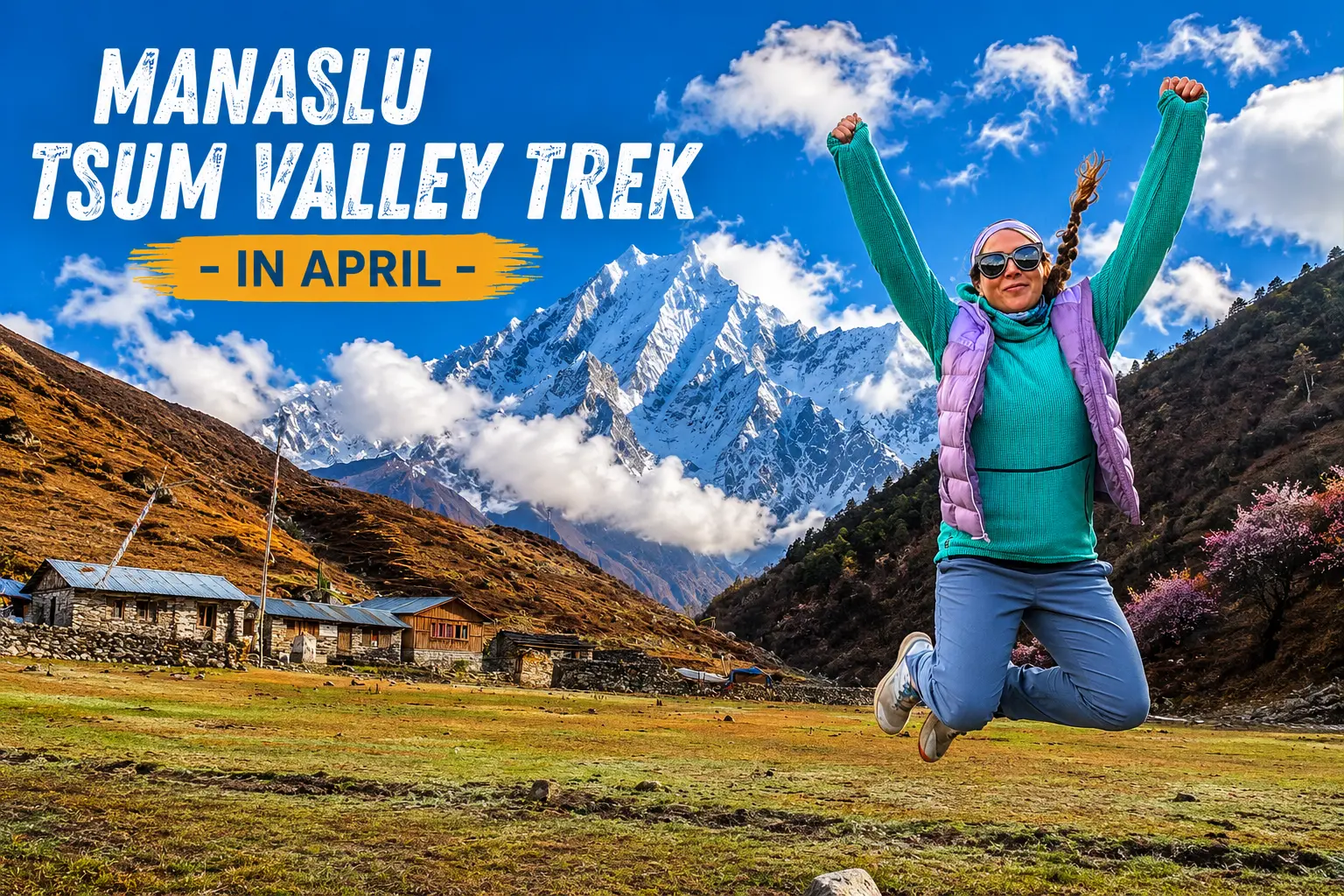
April is widely considered one of the two best months of the year for the Manaslu Tsum Valley Trek, alongside October. Rhododendron forests below 3,000 metres are in full bloom, daytime temperatures across most of the trail are comfortable, and Larkya La is normally passable with standard trekking gear rather than the heavier winter kit needed in January through March. The trade-off is crowding: April is the peak of spring season, so teahouses fill up and the trail is noticeably busier than March, particularly in the second half of the month. If you want warm, reliable conditions and do not mind sharing the trail with more people, April is an easy recommendation. If solitude matters more to you than certainty, March or November may suit you better.
Manaslu Tsum Valley Trek in April at a glance
| Factor | April conditions |
|---|---|
| Overall feasibility | Recommended, one of the best two months of the year |
| Larkya La (5,106 m) | Normally passable with standard trekking gear |
| Daytime temperature, lower valley (700-1,900 m) | 20-27°C |
| Daytime temperature, Samagaun/Samdo (3,500-3,900 m) | 8-14°C |
| Night temperature, above 4,000 m | -8°C to -15°C |
| Rainfall/snowfall | Rare, occasional afternoon cloud build-up, brief showers possible late month |
| Trail crowding | Moderate to high, busiest in the second half of the month |
| Teahouse availability | Good, though advance booking helps for popular villages |
| Permit cost tier | Dec-Aug lower rate still applies |
| Best for | Trekkers who want the most reliable pass crossing and classic rhododendron scenery |
Who should consider trekking in April
April suits almost every type of trekker: first-timers who want the most predictable conditions, experienced trekkers who want a reliable Larkya La crossing without extreme cold-weather gear, and photographers chasing the rhododendron bloom. It is a slightly harder sell only for people who specifically want a quiet trail, since April is one of the two busiest months on this route alongside October.
Reasons to choose April, and reasons to think twice
Why April works well for most trekkers
- Rhododendron bloom: forests between roughly 2,000 and 3,000 metres are at their most colourful, a highlight many trekkers plan their trip around.
- Reliable pass conditions: Larkya La is normally passable with standard gear, without the winter-level uncertainty of January through March.
- Comfortable temperatures throughout: warm in the lower valley, mild at mid-altitude, and cold but manageable at the pass.
- Long daylight hours: more time to walk and less pressure on the daily schedule than winter months.
Why some trekkers should consider March or October instead
- Crowding: April is peak season, so teahouses can fill up and the trail feels busier, especially around Samagaun.
- Booking pressure: popular teahouses may need advance notice during the second half of the month.
- Haze building toward May: visibility is generally excellent early and mid-April but can start to soften toward the very end of the month as pre-monsoon haze builds.
Weather and conditions by zone in April
Lower Budhi Gandaki: Machha Khola to Deng (700-1,900 m)
Warm and pleasant, with daytime temperatures typically 20-27°C. This section can feel hot by early afternoon, so an early start is worth it both for comfort and for photography light.
Tsum Valley: Chumling to Mu Gompa (2,400-3,700 m)
Comfortable trekking weather throughout, with daytime temperatures around 14-20°C at Chumling and Chhokangparo, cooling toward Mu Gompa. Rhododendron forests lower in the valley are typically at their best in mid-to-late April.
Upper Manaslu: Namrung to Samagaun (2,600-3,500 m)
Mild and clear for most of April, with daytime temperatures around 12-18°C. This is one of the most scenic stretches during rhododendron season, with forest cover giving way to alpine terrain as you approach Samagaun.
Samagaun and Samdo (3,530-3,875 m)
Daytime highs typically run 8-14°C, with clear mountain views common. Nights are cold, generally -5°C to -12°C, but far more manageable than the winter months.
Dharmasala/Larkya Base Camp (4,460 m)
Daytime temperatures hover around freezing to 5°C, with nights dropping to roughly -10°C to -15°C. Wind remains a factor at this exposed camp, though less severe than in winter.
Larkya La (5,106 m)
This is normally the most reliable month for the crossing. Snow cover is typically stable and well-trodden by this point in the season, and most groups cross without major difficulty in standard trekking gear plus the usual cold-weather essentials. That said, mountain weather can still turn quickly at this altitude, and guides always make the final call on crossing day based on current conditions.
Bhimtang and the descent to Dharapani (1,860-3,720 m)
Pleasant and increasingly warm as you descend, with blooming rhododendrons again visible on the Annapurna side of the route.
April weather at a glance
| Zone | Altitude | Day temp | Night temp | Typical conditions |
|---|---|---|---|---|
| Machha Khola-Deng | 700-1,900 m | 20-27°C | 10-15°C | Warm, dry, clear |
| Tsum Valley | 2,400-3,700 m | 14-20°C | 2-8°C | Mild, rhododendrons blooming lower down |
| Namrung-Lho | 2,600-3,180 m | 12-18°C | 0-5°C | Clear, comfortable walking weather |
| Samagaun/Samdo | 3,530-3,875 m | 8-14°C | -5 to -12°C | Clear skies, stable conditions |
| Dharmasala | 4,460 m | 0-5°C | -10 to -15°C | Cold, windy, generally stable |
| Larkya La | 5,106 m | -5 to 0°C | n/a (crossed by day) | Normally passable, standard gear sufficient |
| Bhimtang-Dharapani | 1,860-3,720 m | 15-22°C | 2-8°C | Warm and pleasant |
Rainfall, snowfall, wind and visibility in April
April is one of the driest and clearest months on the route. Rainfall is uncommon, though a brief afternoon shower is possible, particularly toward the end of the month as the season transitions toward May. Snowfall at altitude is rare by this point, with existing snowpack around Dharmasala and the pass typically stable and well-consolidated. Wind is generally moderate, picking up above 4,000 metres as usual. Visibility is typically excellent through most of the month, among the best of the year, though a slight haze can build in the final week of April.
Daylight hours in April
Daylight runs from roughly 5:45 am to 6:45 pm, giving around 13 hours of usable light, among the longest windows of the trekking calendar. This gives comfortable margins for longer walking days, including the Larkya La crossing.
A typical day’s weather pattern in April
Mornings are clear and cool, ideal for walking and photography. Cloud can build over the high peaks by early afternoon, occasionally bringing brief showers in the lower valley later in the month, though this rarely disrupts the day’s plan. Evenings are generally clear again, with pleasant temperatures at lower elevations and a rapid cool-down at altitude once the sun sets.
Trail conditions in April
Trail conditions throughout the route are generally excellent in April: dry, clear and well-trodden given the volume of spring traffic. Snow and ice are largely confined to the highest sections around Dharmasala and the pass itself, where the trail is typically well-packed by other trekking groups. Traction aids are still worth carrying but are used less often than in the earlier spring months.
Road access and transport in April
Road access is reliable in April, ahead of the monsoon-season disruption that begins around June. This is generally one of the most straightforward months for the drive to and from the trailhead.
Teahouses, rooms and food in April
Nearly all teahouses along the route are open and operating in April, including at Samdo and Dharmasala. Given the higher trekker numbers, rooms in popular villages like Samagaun can fill up on busy days, so booking ahead through your agency is worthwhile, particularly for departures in the second half of the month. Food variety is generally at its best this time of year, with fresh supplies more readily available than in winter.
Water, charging and connectivity in April
Water, charging and mobile connectivity follow the same general pattern as other months: reliable lower down, progressively less consistent above Samagaun. With more trekkers on the trail, charging points and hot showers may have short waits at busier lodges during peak periods.
How busy is the trail in April
April is one of the two busiest months of the year on this route, alongside October. Expect a lively, sociable trail atmosphere with trekkers from many countries, particularly from mid-April onward. If you specifically want solitude, this is not the ideal month, but if you enjoy a busier trekking community atmosphere, it is a genuine advantage.
Permits and costs for April
April falls within the December-August lower permit rate tier. The Manaslu Restricted Area Permit (RAP) costs USD 75 for the first 7 days plus USD 10 per extra day. The Tsum Valley RAP costs USD 30 for the first 7 days plus USD 7 per extra day. MCAP and ACAP are each NPR 3,000 (foreigner rate), plus the one-time NPR 1,000 local municipality fee. See our Manaslu trekking permits guide for full current details.
Restricted area rules
The Manaslu and Tsum Valley areas remain restricted, requiring all permits to be arranged through a registered trekking agency. Checkpoints are at Jagat, Philim, Namrung and Samagaun for the main route, and Lokpa, Chumling and Chekampar for Tsum Valley, plus an ACAP check near Dharapani. As of the 22 March 2026 rule change, the old minimum-two-trekkers requirement no longer applies; one trekker with one licensed guide is sufficient.
Guide and porter requirements
A licensed guide from a registered agency is mandatory for both areas. Porters are optional but popular in April given the busier trail and generally social group dynamics; many trekkers still choose to share a porter between two people.
Suggested itinerary for the Manaslu Tsum Valley Trek in April
| Day | Route | Altitude |
|---|---|---|
| 1 | Kathmandu to Machha Khola | 870 m |
| 2 | Machha Khola to Jagat | 1,340 m |
| 3 | Jagat to Lokpa | 2,240 m |
| 4 | Lokpa to Chumling (Tsum Valley) | 2,386 m |
| 5 | Chumling to Chhokangparo | 3,010 m |
| 6 | Chhokangparo to Mu Gompa | 3,700 m |
| 7 | Mu Gompa exploration and acclimatisation | 3,700 m |
| 8 | Mu Gompa to Chhokangparo, descend to Gumba Lungdang or Rachen Gompa | 3,200 m |
| 9 | Descend to Lokpa, continue to Deng | 1,860 m |
| 10 | Deng to Namrung | 2,630 m |
| 11 | Namrung to Lho | 3,180 m |
| 12 | Lho to Samagaun | 3,530 m |
| 13 | Samagaun acclimatisation, side trip to Manaslu Base Camp or Birendra Lake | 3,530 m |
| 14 | Samagaun to Samdo | 3,875 m |
| 15 | Samdo to Dharmasala | 4,460 m |
| 16 | Dharmasala over Larkya La to Bhimtang | 3,720 m |
| 17 | Bhimtang to Tilije/Dharapani | 1,860 m |
| 18 | Dharapani to Kathmandu via Besisahar | 1,400 m |
Acclimatisation in April
The itinerary’s two acclimatisation days, at Mu Gompa and Samagaun, remain just as important in April as in any other month. Warmer temperatures do not reduce altitude sickness risk, so pace and hydration discipline still matter.
Contingency planning and buffer days
April generally needs less contingency buffer than the winter or early spring months, since Larkya La conditions are more predictable. Most itineraries still include at least one spare day as standard practice for any high-altitude trek.
What to pack for April
| Category | April-specific notes |
|---|---|
| Insulation | Mid-weight down jacket sufficient for Dharmasala and the pass |
| Legwear | Standard trekking trousers, with thermal layer for the pass day only |
| Footwear | Sturdy waterproof trekking boots; microspikes optional but worth carrying |
| Sleep system | Three-season sleeping bag usually sufficient, four-season for extra comfort |
| Sun protection | High priority: strong sun at altitude and reflected light off any remaining snow |
| Rain gear | Light shell recommended for occasional late-month showers |
Clothing and layering system for April
- Base layer: lightweight moisture-wicking tops and bottoms for the warmer lower sections.
- Mid layer: a fleece or light insulated layer for mornings and evenings at altitude.
- Insulated outer layer: a mid-weight down jacket for Dharmasala and the pass crossing.
- Trekking trousers: breathable, quick-drying trousers for daily walking, plus thermal leggings for pass day.
- Hardshell layer: a light windproof jacket for the pass and any afternoon showers.
Footwear for April conditions
- Boots: waterproof trekking boots, well broken in.
- Traction: microspikes are optional this month but worth packing as insurance for the pass.
- Socks: a mix of lightweight and midweight trekking socks.
- Gaiters: useful but not essential given generally stable snow conditions.
Sun and glare protection
- Sunglasses or glacier goggles: important near Dharmasala and the pass where snow glare remains strong.
- Sunscreen and lip balm with SPF: UV exposure is high at altitude, even on cool days.
- Wide-brimmed hat or cap: useful for the warm lower valley sections.
Snow and cold-weather items for the pass day
- Trekking poles: recommended for stability on any remaining snow or loose scree.
- Gloves: a liner pair plus a warmer outer pair for the early morning pass crossing.
- Buff or light balaclava: useful for wind protection above 4,000 metres.
Documents, money and extras
- Cash in Nepali rupees: carry enough for the full trek since ATMs disappear beyond the lower villages.
- Permit documents and passport copies: carry your original passport and photos even though your guide manages the permits.
- Basic first aid and personal medication: including any altitude sickness medication discussed with your doctor.
Health and altitude considerations
Altitude sickness risk depends on pace and acclimatisation, not the season, so the same precautions apply in April: ascend gradually, use the built-in rest days, stay hydrated, and tell your guide about any symptoms early. See our guide on what happens if you get sick on the Manaslu Circuit Trek for more detail.
Safety risks specific to April
April’s main risks are the ordinary ones for this route rather than anything season-specific: altitude, trail exposure at the pass, and the general remoteness of the region. Crowding can occasionally lead to bottlenecks on narrow trail sections or busy teahouses, worth factoring into your daily pacing.
Travel insurance
Comprehensive travel insurance covering trekking to at least 6,000 metres, with helicopter evacuation included, is essential for this route in any month, April included.
Is April right for beginners, experienced trekkers or solo trekkers
First-time high-altitude trekkers
April is the best month for a first-time high-altitude trekker on this route, given the reliable pass conditions and comfortable temperatures throughout.
Experienced trekkers
Experienced trekkers will still enjoy April, though those who have done the route before in a quieter month may find the crowds a notable change.
Solo trekkers
Since the 22 March 2026 rule change, one trekker with one licensed guide meets the restricted-area requirement, and April’s busier trail also means more opportunities to meet other trekkers along the way. See our solo trekking rule update for details.
Guides and porters: what to expect in April
Guides are in high demand during April, so booking early is worth doing if you want your preferred operator and team. Expect a confident, well-practised pass-crossing routine given how often groups cross successfully this time of year.
Photography in April
April is the best month of the year for photography on this route: blooming rhododendron forests, clear mountain views, and good light for most of the month. Popular photo points include the forested sections between Namrung and Lho, and the peaks visible from Samagaun and Larkya Base Camp.
Festivals and cultural events in April
Nepali New Year typically falls in mid-April, and some local cultural events may coincide with your trek depending on the year. Check current dates with your operator, and see our guide to major festivals in the Manaslu region for a general overview.
Advantages and disadvantages of trekking in April
| Advantages | Disadvantages |
|---|---|
| Rhododendron bloom and excellent scenery | Busiest trail conditions of the spring season |
| Reliable Larkya La crossing with standard gear | Teahouse rooms can fill up, especially late month |
| Comfortable temperatures across all zones | Guides and porters in high demand, book early |
| Long daylight hours for flexible daily pacing | Slight pre-monsoon haze possible in the final week |
| Good food and lodge variety | Less solitude than March or November |
Extra costs to budget for
Budget for standard trek package costs and permits, plus tips for guides and porters (customary though not obligatory), hot showers and charging fees (typically NPR 200-500 per use), and consider booking teahouses or a slightly higher-tier operator package in advance given April’s popularity, which can carry a modest premium over quieter months.
How April compares to March and May
March is quieter but comes with more variable, colder conditions at altitude and a less predictable pass crossing, particularly early in the month. See our Manaslu Tsum Valley Trek in March guide. May offers similar reliability to April with slightly warmer temperatures, but pre-monsoon haze and storm risk build toward the end of the month. Full details are in our Manaslu Tsum Valley Trek in May guide. If you want the single most reliable month with the best scenery and don’t mind crowds, April is hard to beat.
April month-by-month comparison table
| Month | Feasibility | Larkya La | Crowd level |
|---|---|---|---|
| March | Recommended with caution | Increasingly passable through the month | Low, rising late month |
| April | Recommended, one of the best months | Normally passable with standard gear | Moderate to high |
| May | Recommended, narrowing window | Normally passable, watch pre-monsoon storms | Moderate |
Alternatives to consider if April doesn’t work for you
If April’s crowds are a concern but you still want reliable pass conditions, consider late March or early May as a compromise, or shift to October for the equivalent autumn peak with different scenery. For a Tsum Valley-only option without the Larkya La crossing, see our Manaslu Tsum Valley destination.
Final recommendation: should you trek in April
April is one of the two most reliable, most scenic months of the year for the Manaslu Tsum Valley Trek, and a strong choice for most trekkers, particularly first-timers and anyone prioritising a dependable Larkya La crossing. The only real trade-off is crowding, which is a fair price for the conditions on offer. Explore our 19-Day Manaslu Circuit with Tsum Valley Trek or the 23-Day Tsum Valley and Manaslu Circuit Trek, or reach out via our contact to plan your April departure. For the complete seasonal picture, see our Best Time to Go guide.
April Versus October: Choosing Between the Two Best Months
Trekkers planning far enough ahead to choose between April and October often ask us directly which one to pick, and the honest answer is that they reward slightly different priorities rather than one being objectively better.
April’s advantage is the rhododendron forest. Below 3,000 metres, especially through the Ghap to Lho section and lower Tsum Valley, the forest is genuinely spectacular in a way October simply cannot match, since October has no flowering to offer. April also runs slightly warmer at altitude than October, which matters if cold is your main concern, and daylight hours are longer, giving more flexibility on long trekking days.
October’s advantage is visibility and trail firmness. Post monsoon air is usually clearer than pre monsoon air, so distant peaks, Manaslu itself, Himlung Himal, and the wider range visible from Larkya La, tend to stand out more sharply in October than in April, when pre monsoon haze can soften the horizon by mid to late month. October’s trail is also fully dry, having had a full monsoon to settle, while April’s lower sections can still carry some residual dampness from spring rain showers.
On crowding, the two months are comparable, both are genuinely busy by this route’s standards, though October is usually the single busiest month of the year on the wider Manaslu Circuit, with April a close second. If we had to generalise: choose April if flowering forest and warmer nights matter most to you, choose October if the clearest possible mountain photography is the priority. Either choice puts you in one of the two best windows of the year, and neither is a compromise.
Booking Timeline and Teahouse Availability in April
Because April is peak season, booking timeline matters more here than in quieter months. For the second half of April specifically, when both weather and bloom conditions are usually at their best, we recommend confirming your trip at least six to eight weeks ahead if you want a private departure with full control over your itinerary, and even earlier, ten to twelve weeks, if you are hoping to join one of our fixed group departures during this window.
Teahouse capacity along the route is limited by the nature of the villages themselves, small settlements that were never built to accommodate large volumes of trekkers, and in peak April weeks, popular stops like Sama Gaon and Dharmasala can fill up on short notice. Guides operating in this region communicate directly with lodge owners to hold rooms ahead of a group’s arrival, which is one of the more understated reasons a licensed, well connected guide matters more in April than it does in, say, January, when availability is never really in question.
If your schedule is flexible, the first ten days of April offer a reasonable middle ground: bloom is already well underway at lower elevations, crowds are lighter than the back half of the month, and booking pressure on teahouses is correspondingly lower.
Where the Rhododendron Forest Is Best in April
April is peak bloom across nearly the entire lower and middle section of the route, but a few stretches stand out specifically for trekkers prioritising the forest itself over the high mountain scenery.
The section between Ghap and Namrung, roughly 2,000 to 2,900 metres, is consistently the most photographed rhododendron stretch on the route, with dense forest crowding both sides of the trail in shades ranging from deep red through pink to white depending on elevation and species. Lower Tsum Valley, particularly around Lokpa and Chumling, offers a similar density of bloom with the added advantage of far fewer trekkers than the main Circuit trail, since most Circuit-only itineraries do not enter Tsum Valley at all.
By contrast, the forest around Lho and up toward Shyala thins out as elevation increases, and above roughly 3,000 metres you are back into open, rocky, high-altitude terrain where rhododendron gives way to juniper scrub and bare ground. If forest photography is your main goal, plan extra time in the Ghap to Namrung and lower Tsum Valley sections specifically, rather than assuming the bloom continues all the way to Samagaun.
Wildlife and Birdlife in April
Spring is one of the more rewarding times to notice wildlife on this route, and April sits close to the peak of it. Along the lower Budhi Gandaki forest sections, langur monkeys are commonly spotted moving through the canopy, and birdlife is genuinely active, with sunbirds, minivets, and various species of pheasant, including occasional sightings of the Himalayan monal, Nepal’s national bird, in the forested middle sections of the trail. Higher up, above the tree line near Samagaun and Samdo, keep an eye on the ridgelines for blue sheep, and, less commonly, the tracks or distant silhouette of a snow leopard’s usual prey rather than the animal itself, which remains rarely seen even by guides who have worked this route for years.
None of this is guaranteed on any single trek, wildlife sightings never are, but April’s combination of active breeding season birdlife and animals moving to take advantage of fresh spring growth makes it one of the better months on the route for this kind of observation, alongside the quieter months of the pre-monsoon window.
Field Notes: A Guide’s Perspective on April Departures
One thing that shows up consistently across our April departures, and that does not always come through in a weather table, is how much the mood on the trail shifts compared to winter or monsoon trips. Groups moving through Ghap and Namrung in full bloom tend to walk slower than scheduled, not because the trail is harder, but because people keep stopping for photos, and a good guide builds that into the day’s pacing rather than fighting it.
The other thing worth knowing: April afternoons can bring brief, sharp showers at lower and middle elevations, usually clearing within an hour, part of the pre-monsoon build-up rather than a sign of bad weather setting in. Trekkers who have not been told to expect this sometimes assume the trip is going wrong when a short burst of rain hits around Jagat or Deng in the early afternoon. It is normal for this specific month, and mornings are reliably the clearer, more settled part of an April day, which is part of why we schedule the more exposed, view-dependent sections of any given day’s walk for the morning wherever the itinerary allows it.
What Changes About Cost and Logistics in Peak April
Permit fees themselves do not change with season, the Manaslu Restricted Area Permit, Manaslu Conservation Area Permit, and Annapurna Conservation Area Permit are priced the same in April as any other month, full details are on our Manaslu trekking permit guide. What does change in peak April is everything around the permits: guide and porter availability tightens as more groups are on the trail simultaneously, and flights and jeep transport between Kathmandu and the trailhead see more demand, which occasionally pushes prices on shared transport up slightly compared to quieter months.
For trekkers booking a private trip rather than joining a group departure, this matters less directly, but it is still worth locking in guide and porter allocation early in peak season rather than assuming availability will still be open a few weeks out. We hold guide assignments for confirmed April bookings specifically because our better guides, the ones with the most seasons of experience on this exact route, tend to be booked first for the year’s two busiest months.
How April Compares Inside Tsum Valley Specifically
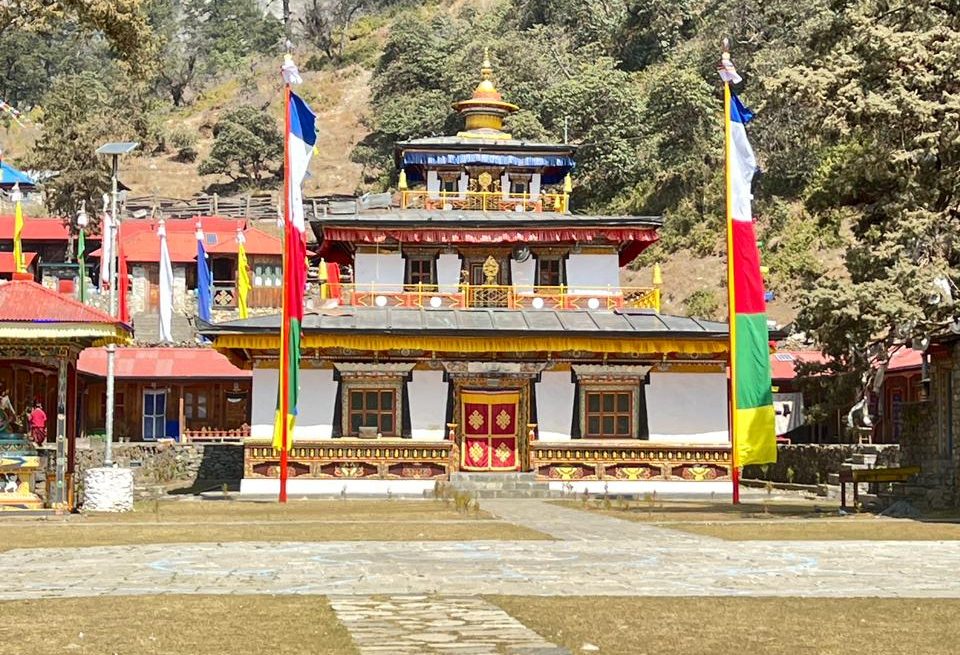
Most of what gets written about April on this route focuses on the Manaslu Circuit side, Larkya La, Samagaun, the pass crossing, but Tsum Valley itself has its own April character worth a separate mention. Because Tsum is a side valley rather than a through route, trekkers who add it to their itinerary tend to find it noticeably quieter than the main Circuit trail even during peak season, since Circuit-only groups never enter it at all. Mu Gompa and Rachen Gompa, the valley’s two most significant monasteries, are both comfortably reachable in April without snow concerns, and the rhododendron forest through lower Tsum, around Lokpa and Chumling, is every bit as dense as the main trail’s best sections. If crowding is a real concern for you in peak season, building extra days into Tsum Valley rather than rushing straight through to the Circuit side is one of the more effective ways to keep an April trek feeling personal rather than crowded.
Insurance and Booking Timeline for a Peak-April Trek
Comprehensive travel insurance covering trekking above 5,000 meters and emergency helicopter evacuation is essential for an April booking, given Larkya La’s 5,106-meter elevation, the same standard we hold for every month on this route. Given the peak-season guide and porter demand discussed earlier, we recommend confirming an April booking at least four to five weeks ahead, longer than the two-to-three-week window that suffices for quieter months, to secure the specific guides with the most seasons of experience on this route rather than settling for whoever happens to be available closer to your departure date. Trekkers who book early also have more flexibility to shift their exact dates by a few days if that year’s rhododendron bloom or weather pattern is running slightly ahead of or behind the typical calendar, a small adjustment that can meaningfully improve the trip.
Frequently asked questions
Is April the best month for the Manaslu Tsum Valley Trek?
It is one of the two best months, along with October, thanks to reliable Larkya La conditions and rhododendron season.
Is Larkya La reliably open in April?
Normally yes, this is one of the most dependable months for the crossing, though guides still assess conditions daily.
How crowded is the trail in April?
Moderate to high, among the busiest months of the year, especially from mid-April onward.
Do I need to book teahouses in advance in April?
It helps, particularly for the second half of the month; your guide or agency typically handles this.
What permits do I need for April?
Manaslu RAP, Tsum Valley RAP, MCAP, ACAP and a local municipality fee, at the December-August lower rate tier.
Can I trek solo in April?
Yes, since the 22 March 2026 rule change, one trekker with one licensed guide meets the restricted-area requirement.
Is April too crowded to enjoy?
Not usually; most trekkers find the atmosphere sociable rather than overwhelming, though it is a real change from quieter months.
What is the weather like in Tsum Valley in April?
Mild and pleasant, generally 14-20°C at Chumling and Chhokangparo, with rhododendrons in bloom lower in the valley.
Do I need a down jacket in April?
Yes, a mid-weight down jacket is recommended for Dharmasala and the pass, though lighter than the winter-rated gear needed in January through March.
How many days does the trek take in April?
A typical itinerary runs 17-19 days including acclimatisation and a buffer day.
Is altitude sickness more likely in April?
No more likely than in other months; it depends on pace and acclimatisation, not the calendar.
Is April better than October?
Both are excellent, reliable months. April offers rhododendron blooms and spring scenery; October offers the clearest post-monsoon mountain views. Crowd levels are comparably high in both.
Do I need trekking poles in April?
Yes, recommended for stability, particularly on the pass crossing.
Is travel insurance required?
Yes, comprehensive insurance covering trekking to at least 6,000 metres with helicopter evacuation is essential.
How cold does it get at Larkya La in April?
Daytime crossing temperatures typically range from -5°C to 0°C, with wind chill a factor on exposed sections.
Is April a good month for photography?
Yes, the best month of the year given the rhododendron bloom combined with clear mountain views.
Should I book my guide and porter early for April?
Yes, this is one of the busiest months, so booking a few months ahead is sensible if you have a specific team preference.
The 19-Day Manaslu Circuit with Tsum Valley Trek is one of Nepal’s most rewarding long-distance Himalayan journeys, combining remote valleys, ancient…