The Monasteries of Tsum Valley
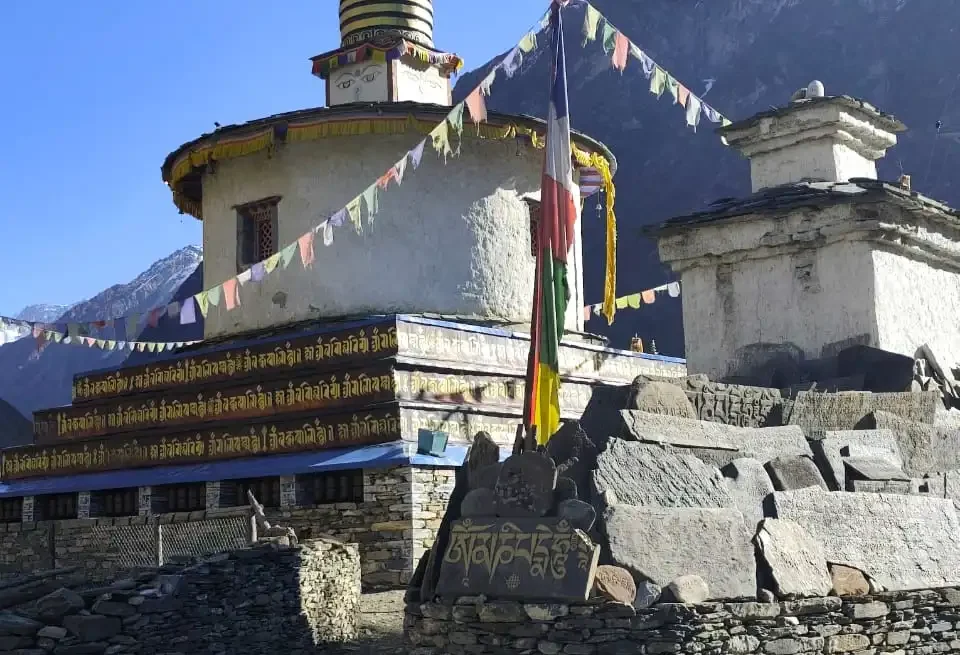
Tsum Valley is home to a cluster of monasteries and nunneries that anchor both its religious calendar and its social structure. Mu Gompa, sitting near 3700 meters close to the Tibetan border, is the most remote and among the most visited, established in the late nineteenth century and often treated as the turnaround point for shorter treks into the valley.
| Monastery | Elevation | Type | Notes |
|---|---|---|---|
| Mu Gompa | Around 3700 meters | Monastery | Founded late nineteenth century, closest to the Tibetan border, common turnaround point for shorter treks |
| Rachen Gompa | Roughly 3240 meters | Nunnery | Founded early twentieth century, one of the larger resident female monastic communities in the Himalaya |
| Serang Gompa (Nubri Monastery) | Around 3050 meters | Monastery | Local tradition holds it was founded more than 500 years ago |
| Longdan Gompa | Around 3200 meters | Nunnery | Rounds out the valley’s cluster of main religious sites |
Together these institutions are not simply tourist stops. They remain functioning centers of worship, education, and community decision making, and many of the festivals described later in this guide are hosted at one or another of these monasteries on a rotating basis. Visiting monks and nuns at these sites follow daily prayer schedules built around chanting, ritual instruments such as long horns and hand drums, and the maintenance of butter lamps that burn continuously in the main prayer halls. Many of these monasteries also maintain small resident communities of monks or nuns who study Buddhist philosophy and ritual practice for years at a time, following a curriculum passed down through the same Nyingma and Kagyu lineages that shape religious life across the valley.
Rachen Gompa in particular has drawn attention from outside researchers and visitors for the scale of its resident nunnery, which has at various points housed well over a hundred nuns, making it one of the larger female monastic communities in this part of the Himalaya. Its prayer halls are decorated with detailed murals depicting Buddhist deities and protective figures, painted and repainted by generations of resident artists using traditional mineral pigments.
Shyagya: The Valley That Outlawed Killing
Perhaps the single most distinctive feature of Tsum Valley’s culture is Shyagya, a formal vow of non violence adopted by the community and rooted in Buddhist philosophy. According to local history, Upper Tsum’s residents formally declared the area a non violence zone in 1920, under the guidance of a religious teacher remembered as Mahaguru Dukpa Lama Serap Dorje, establishing a set of obligatory restrictions that remain observed today.
Under Shyagya, residents are bound by rules that prohibit the following:
- Setting forest fires
- Hunting wild animals
- Setting animal traps
- Harvesting wild honey through methods that harm bee colonies
- Killing insects
- Selling livestock for slaughter outside the valley
This declaration has been formally reaffirmed by the community on multiple occasions over the following decades, including gatherings held in 1939, 1965, 1970, 1972, and 1998. Lower Tsum adopted a comparable commitment later, in 2012, an event that was accompanied by the voluntary surrender of 58 illegal firearms held by valley residents. Few communities anywhere in the Himalaya have codified conservation ethics this explicitly, and fewer still have maintained the practice across an entire century.
Festivals That Still Shape the Yearly Calendar
Religious festivals remain the organizing rhythm of life in Tsum Valley, and several of them offer visitors a rare chance to see the valley’s culture in its most active form. None of these festivals were created with tourism in mind, and their timing shifts according to the Tibetan lunar calendar, so travelers hoping to witness one should plan an itinerary with a guide who can confirm dates for the relevant year.
- Losar, the Tibetan New Year, is the largest festival, typically celebrated over roughly 15 days in January or February with family gatherings, monastery rituals, and community feasting.
- Saka Dawa, observed in the fourth Tibetan lunar month, usually falling in May or June, marks the birth, enlightenment, and death of the Buddha and is treated as the most religiously significant date on the calendar, with heightened prayer activity and merit making across the valley’s monasteries.
- Faning, held in August, centers on traditional and nutritious local foods and is tied to the agricultural calendar and harvest preparation.
- Nara is a masked dance festival performed on a rotating basis by different monasteries in the valley, drawing on Tibetan Buddhist cham dance traditions in which monks wear elaborate costumes and masks to enact stories of protective deities.
- Dhachyang, held around November or December, is a horse festival connected to community welfare and social cohesion.
Village Life, Farming, and an Unusual Marriage Tradition
Daily life in Tsum Valley still runs largely on subsistence agriculture and livestock herding, shaped by an environment where little else is possible at this altitude. Villagers cultivate barley, potatoes, maize, and buckwheat on terraced fields, and keep yaks, dzo, and sheep for wool, dairy, and transport. Limited cross border trade with Tibet continues in some communities, alongside a growing but still modest income from trekking tourism, which has become an important supplementary source of income since the valley opened in 2008.
One tradition that continues to draw outside interest is fraternal polyandry, in which brothers within a family jointly marry a single wife. This custom, historically found across parts of the Tibetan plateau and Himalayan borderlands, developed as a practical response to limited arable land, since it kept family landholdings from being repeatedly divided across generations of sons. It persists in some Tsum Valley households today, though its prevalence has declined as younger residents pursue education and work outside the valley. Visitors should treat this, like all aspects of Tsumba domestic life, as a subject for respectful curiosity rather than casual comment.
Wildlife and the Manaslu Conservation Area
Tsum Valley falls entirely within the Manaslu Conservation Area, a protected zone established in 1998 that covers roughly 1663 square kilometers in total, within which the Tsum territory itself accounts for an estimated 54417 hectares. Elevations across the conservation area span from around 1600 meters up to 6705 meters at the Manaslu summit, supporting an unusually wide range of habitats within a relatively compact area.
Surveys of the region have recorded close to 2000 plant species, including around 50 with recognized medicinal uses, alongside roughly 110 bird species and 33 mammal species. Wildlife that trekkers may encounter or hear about locally includes the snow leopard, Himalayan tahr, blue sheep, and musk deer, all of which benefit from the Shyagya hunting prohibitions described earlier. In effect, Tsum Valley’s religious conservation ethic and its formal conservation area status reinforce one another, and researchers studying the region frequently point to this overlap as one of the more successful examples of community led conservation in the Himalaya.
Self Governance: Ghenchen, Syara, and Lama
Even as modern state institutions such as the Conservation Area Management Committee have taken on a larger role, Tsum Valley retains a layer of customary governance that predates them by generations:
- Ghenchen: a village leader responsible for coordinating community decisions
- Syara: a clan leader role that handles clan level matters
- Lama: provides religious guidance, attached to the local monastery
These roles operate alongside, and sometimes in tension with, more recent administrative structures, creating what researchers studying the valley describe as a hybrid governance system. Decision making in practice often involves village assemblies, the monasteries themselves, traditional medical practitioners known locally as Amchi, and modern government bodies working in parallel. Challenges facing this system include road construction projects extending further into the valley, growth in tourism infrastructure, the gradual displacement of customary authority by formal institutions, and the outward migration of younger residents, all of which have been identified as pressures on the valley’s traditional way of life in recent conservation research.
Permits and Rules for Visiting Tsum Valley
Because Tsum Valley is classified as a restricted area, independent trekking without a guide is not permitted. Every foreign visitor must be accompanied by a licensed trekking guide from a registered agency, a requirement that has applied to Manaslu region trekking generally since April 2023 and that predates that rule specifically for the restricted Tsum and Manaslu zones.
Three permits typically apply to a Tsum Valley itinerary. All of them must be arranged in advance through Kathmandu or Pokhara, since none can be issued at trailhead checkpoints, and agencies typically recommend finalizing paperwork one to two days before departure.
| Permit | Cost | Notes |
|---|---|---|
| Manaslu Restricted Area Permit | About 100 US dollars for the first seven days in peak season (September through November), plus 15 US dollars per extra day. About 75 US dollars for seven days plus 10 US dollars per extra day during the rest of the year. | Required for entry into the restricted Tsum and Manaslu zones |
| Manaslu Conservation Area Permit | About 3000 Nepali rupees, close to 23 US dollars | Applied year round |
| Annapurna Conservation Area Permit | Similar cost to the Manaslu Conservation Area Permit | Only needed if the route exits through the Annapurna region, for example via Dharapani on the classic circuit connection |
The Best Time to Trek Through Tsum Valley
Spring, running from March through May, and autumn, running from September through November, are widely regarded as the strongest seasons for a Tsum Valley trek, offering the most stable weather, the clearest mountain views, and the most reliable flight and road conditions for the approach. Spring adds blooming rhododendron forests lower in the valley, while autumn brings crisp, settled air following the summer monsoon along with Nepal’s major Dashain and Tihar festival season.
Winter, from December through February, is workable for experienced trekkers but brings temperatures that regularly fall well below freezing at higher elevations, along with reduced services at some higher villages. The monsoon months of June through August bring heavy rainfall, slippery trails, and a higher chance of leeches and landslides on the lower approach sections, making this the least favorable window despite quieter trails and lush scenery. A more detailed month by month breakdown, including specific temperature ranges, is available in the guide to the best time to trek Tsum Valley published separately on this site.
How Tsum Valley Connects to the Wider Manaslu Circuit
What makes Tsum Valley such a compelling addition to a Manaslu itinerary is how naturally it combines with the classic circuit route. Both begin on the same trail along the Budhi Gandaki River, meaning trekkers do not need to choose between the two experiences outright. The 19 day Manaslu Circuit with Tsum Valley Trek is built around this exact combination, adding the detour into Tsum before rejoining the main Manaslu Circuit route toward Samagaon, Samdo, and the Larkya La pass at 5106 meters.
For travelers with more time, the 23 day Tsum Valley and Manaslu Circuit Trek extends this further, allowing extra acclimatization days and a slower pace through both regions. This matters practically as well as culturally, since spending additional nights below 3600 meters in Tsum before continuing up toward Larkya La gives trekkers a real acclimatization advantage heading into the higher, more demanding sections of the Manaslu Circuit. Readers wanting the fuller detail on itinerary structure, daily walking times, and elevation profiles can also refer to the site’s complete guide to the Manaslu Tsum Valley Trek and its companion quick facts summary.
Getting to Tsum Valley: The Trail In
The journey to Tsum Valley begins the same way most Manaslu region treks do, with a long drive from Kathmandu to Soti Khola or Machha Khola along a rough mountain road that can take anywhere from seven to ten hours depending on road conditions. From there, the trail follows the Budhi Gandaki River north through a series of villages including Khorlabesi, Jagat, and Philim, climbing gradually through a landscape that shifts from subtropical forest and terraced rice fields near the road head to pine and rhododendron forest higher up.
At Lokpa, usually reached on the third or fourth day out from the road head, the route to Tsum Valley splits away from the main Manaslu Circuit trail and follows the Shiar Khola east into the valley proper. This branch trail is noticeably quieter than the main circuit route, since a smaller share of Manaslu trekkers add the Tsum detour compared with those who continue straight on toward Samagaon. Within a day or two of walking up the Shiar Khola, the landscape opens into the wider, gentler valley floor that holds villages such as Chumling and Chhokangparo, and the change in atmosphere from the steep, narrow gorge below Lokpa is immediate and noticeable.
Food, Lodges and Daily Life on the Trail
Teahouse style lodges operate throughout the main villages of Tsum Valley, though they are generally simpler and less numerous than those found on more heavily trekked routes such as the Everest or Annapurna regions. Rooms are typically basic, with shared toilets in most lodges below the higher villages and thicker walls or extra blankets recommended for the colder settlements near Mu Gompa. Meals center on the same Nepali staple of dal bhat, along with Tibetan style dishes such as thukpa noodle soup, momos, and tsampa, a roasted barley flour that has long been a dietary staple across the Tibetan plateau and remains common in Tsum Valley kitchens.
Because the valley’s economy still runs primarily on subsistence farming and herding rather than large scale tourism, the range of food and lodging options thins out considerably above Chhokangparo, and travelers should expect a simpler, more limited menu the closer they get to Mu Gompa. This is part of what makes a knowledgeable guide valuable, since planning realistic daily distances around where food and shelter are actually available matters more here than on busier trekking routes with lodges every hour or two.
Health and Altitude Considerations
Although Tsum Valley itself does not reach the extreme elevations found on the main Manaslu Circuit near Larkya La, trekkers still climb from around 700 meters at the road head to over 3700 meters at Mu Gompa, which is well within the range where altitude sickness becomes a real risk if ascent is rushed. Standard acclimatization guidelines, including limiting daily elevation gain above 3000 meters and building in rest days at key villages such as Chhokangparo, apply here just as they do on any high altitude Himalayan trek.
Because Tsum Valley is a restricted area with a mandatory licensed guide, trekkers benefit from having someone on the trail who is trained to recognize early symptoms of acute mountain sickness and to adjust the itinerary if needed. This is one of several practical reasons, alongside permit regulations, that independent trekking is not permitted here. Combining Tsum Valley with the main Manaslu Circuit, as both the 19 day and 23 day itineraries do, also has a genuine acclimatization benefit, since the extra nights spent in Tsum below 3700 meters help the body adjust gradually before the far higher demands of crossing Larkya La at 5106 meters later in the trek.
Trekking Tsum Valley With Manaslu Treks and Expedition
Manaslu Treks and Expedition operates both the 19 day and 23 day Tsum Valley itineraries with licensed local guides who grew up trekking these exact trails, many with direct family or community ties to the Manaslu and Gorkha region. That local grounding matters in a valley where etiquette, monastery access, and festival timing are not things a generic itinerary can account for from a distance.
Because Tsum Valley cannot legally be trekked without a registered guide, choosing an experienced local operator is not simply a matter of comfort but a legal requirement built into how the restricted area system works. Beyond permit handling and route planning, a guide with real familiarity with Tsum’s monasteries and villages is what turns a walk through the valley into an informed visit to a functioning cultural and religious community, rather than a walk past a series of scenic backdrops.
Closing Thoughts
Tsum Valley is not simply an extension of the Manaslu Circuit or a quieter alternative to more crowded Himalayan trails. It is a distinct cultural region with its own language, its own century old conservation ethic, its own festivals, and its own monasteries that continue to function much as they have for generations. Its late opening in 2008 preserved a way of life that has largely disappeared elsewhere in the Himalaya, and that same isolation is exactly what makes a visit here feel different from almost anywhere else in Nepal.
A trek through Tsum Valley is far more than a scenic side route on the way to Larkya La. Trekkers pass through villages still governed in part by clan leaders and lamas, past monasteries founded centuries ago, and along a valley whose own residents formally renounced violence against animals nearly a hundred years before global conservation became a widely used term. That combination of geography, history, and living religious practice is what sets Tsum Valley apart, and it is exactly what the 19 day and 23 day itineraries from Manaslu Treks and Expedition are built to share.
Tucked against the Tibetan border in the northern reaches of Gorkha District, Tsum Valley remained closed to the outside world until 2008, longer than almost any other trekking region in Nepal. That isolation is precisely why it still feels the way it does today. Where much of the Himalaya has absorbed decades of road building, lodge expansion, and steady tourist traffic, Tsum Valley has kept its own pace. Monasteries that are several centuries old still function as they always have, elderly residents still speak a dialect found nowhere else on earth, and an entire community still lives under a set of religious vows written down in the year 1920 that forbid the killing of any animal within the valley’s boundaries.
For travelers walking the 19 day Manaslu Circuit with Tsum Valley Trek or the longer 23 day Tsum Valley and Manaslu Circuit Trek, the trail itself is only half the experience. The other half is walking into a living piece of Tibetan Buddhist history that has barely changed in generations. This guide sets out what makes Tsum Valley different: where it lies, why it was sealed off for so long, who the Tsumba people are, what their faith and customs look like up close, and what a visitor should understand before setting out.
Where Tsum Valley Lies
Tsum Valley sits in the northern part of Gorkha District in Gandaki Province, wedged against the Tibet Autonomous Region of China. The valley runs roughly east to west, carved by the Shiar Khola, and is ringed by three major mountain groups: Ganesh Himal to the south, Sringi Himal to the north, and Boudha Himal along its eastern edge. Elevations in the region climb from around 1900 meters near the valley’s entrance to well over 5000 meters at the high passes and viewpoints above the main settlements, with peaks in the surrounding ranges rising past 6700 meters.
Access to Tsum Valley runs through the same Budhi Gandaki River corridor used for the wider Manaslu Circuit. Trekkers walk north from Soti Khola or Machha Khola, and instead of continuing on toward Samagaon and the Larkya La pass, they branch east at Lokpa into the separate Shiar Khola drainage that leads up into Tsum. This is what makes the combined Manaslu and Tsum itineraries, such as the 19 day and 23 day routes offered by Manaslu Treks and Expedition, so effective: a single approach trail gives access to two entirely different cultural and geographic experiences.
The valley itself is often described in two parts, Lower Tsum and Upper Tsum, a distinction that reflects both geography and the pace at which the 1920 Shyagya vow of non violence, described later in this guide, was adopted across the region. Lower Tsum includes the entry villages closer to Lokpa, while Upper Tsum holds the higher settlements of Chhokangparo, Nile, and Mu Gompa near the Tibetan border. Because the valley sits directly against this border, several of its highest points and trade routes historically connected communities in Tsum with Tibetan settlements just across the frontier, a relationship that shaped the valley’s culture and economy long before Nepal’s modern boundaries were formally administered.
What the Name Tsum Actually Means
The name Tsum is generally traced to the Tibetan word tsombo, meaning vivid or bright, though it is also connected to the older regional name Tsum Tso Chuksum, which translates roughly as thirteen provinces governed as one. That older name reflects how the valley was historically organized, as a cluster of separate settlements that functioned together under a shared administrative and religious identity rather than as thirteen independent villages.
Locally, Tsum Valley is also referred to as Kimolung, sometimes rendered as the Valley of Peace or Valley of Happiness. This is not a modern tourism slogan. It reflects centuries of the valley’s own religious self identity, tied directly to its status as one of Nepal’s most significant beyuls, a concept explained in the next section.
A Beyul: Why Padmasambhava Is Said to Have Blessed This Valley
In Tibetan Buddhist tradition, a beyul is a hidden valley set aside as a place of refuge, where practitioners can retreat from worldly conflict and pursue spiritual practice undisturbed. According to local tradition, Tsum Valley was designated as one of these hidden sanctuaries by the eighth century Buddhist master Padmasambhava, also known as Guru Rinpoche, who is credited across the Himalaya with identifying and blessing a network of 108 such beyuls.
This status is not a minor detail of local folklore. It shapes how the Tsumba people understand their own home. A beyul is meant to be protected, not exploited, and that framing underlies much of the valley’s later history, including its 1920 non violence declaration and its continued resistance to unrestricted development. Visitors who arrive expecting only mountain scenery often find that the deeper story of Tsum Valley is this religious geography, a landscape that its own residents regard as sacred ground rather than simply home.
From a Closed Kingdom to an Open Trekking Region: The History of Access
For most of its recorded history, Tsum Valley operated at the edge of formal state control, connected more closely to Tibet through trade and religious exchange than to the rest of Nepal. Its geographic isolation, wedged behind Ganesh Himal and reachable only via a demanding trail up the Budhi Gandaki and Shiar Khola, kept it largely outside the reach of both colonial era travelers and the first waves of Nepal’s post war tourism industry.
The valley remained officially closed to foreign trekkers until 2008, when the Nepali government opened it as a restricted area requiring a special permit, the same year in which formal trekking infrastructure, guide requirements, and monitoring systems were put in place. This is a comparatively recent opening. For context, nearby Annapurna had already been a major trekking destination for three decades by that point. That late opening is the single biggest reason Tsum Valley today still looks and functions the way it does, and why its monasteries, customs, and language have remained comparatively undisturbed.
The Tsumba People: Origins and Population
The indigenous inhabitants of the valley are known as the Tsumba, a Tibetan origin population numbering roughly 1800 to 4000 people depending on the source and survey year, spread across around 18 to 20 villages and roughly 500 households. The two most commonly cited population figures differ mainly because some counts include only Upper Tsum’s core villages while others include the broader Tsum Nubri rural municipality area.
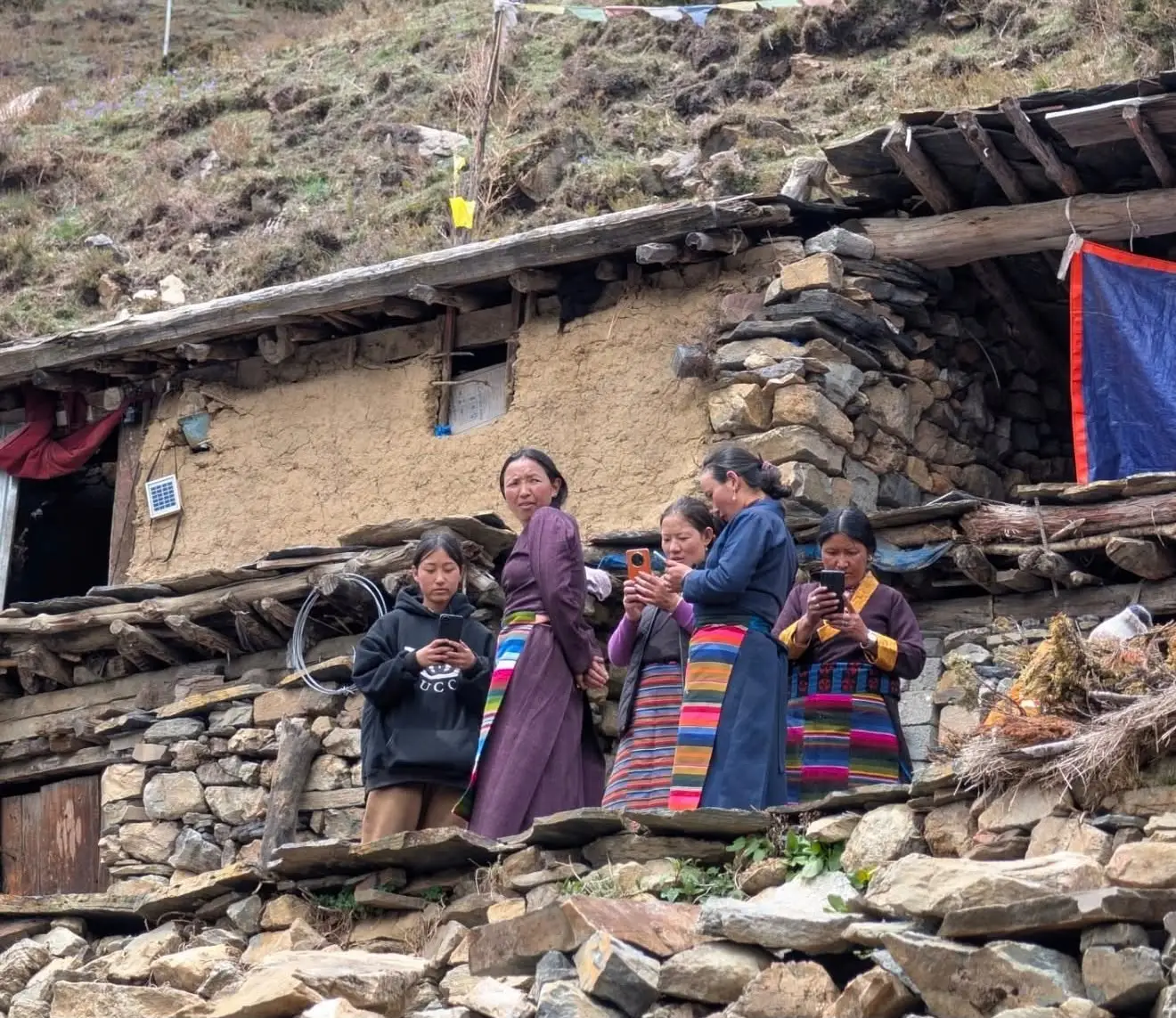
Ethnically and culturally, the Tsumba trace their roots to Tibet, and their features, dress, farming methods, and religious life all reflect that heritage more strongly than almost any other group in Nepal outside of the far northern border districts. Traditional dress still worn by older residents, particularly during festivals, includes heavy woolen chuba robes suited to the valley’s cold climate, along with jewelry and headwear that closely resembles styles found across the Tibetan plateau rather than the clothing traditions of lowland Nepal.
Major settlements include Chumling, Chhokangparo, Nile, Chhule, and Dharapani (a separate, smaller settlement from the well known Annapurna Circuit town of the same name). Each village functions somewhat independently in daily affairs but shares the same overarching religious and customary framework that defines the valley as a whole, coordinated in large part through the monasteries and clan structures described later in this guide.
Language: A Dialect Found Nowhere Else
The Tsumba speak a Tibetan derived language often identified as Tsum, or described in some linguistic surveys under the broader Kyirong Kagate grouping, with two recognized internal dialects, Tsumke and Tsumba, that show some influence from neighboring Kham related languages. This is not simply a variant of standard Tibetan or Nepali. It developed in relative isolation over centuries and remains, to a significant extent, unique to this single valley.
Because the Tsumba population is small and increasingly connected to the wider Nepali economy through migration, tourism, and education, this language sits in a genuinely precarious position. Younger residents who move to Kathmandu or abroad for work and schooling often use Nepali or English day to day, and linguists studying the region have flagged out migration as one of the central threats to the survival of Tsum’s spoken traditions, a concern echoed by local governance bodies and conservation researchers working in the valley.
Faith in Tsum Valley: Buddhism Layered Over Bon
Religious life in Tsum Valley is built on Tibetan Buddhism, primarily through the Nyingma and Kagyu schools, but it is not a simple, single strand tradition. It exists alongside older animist practices associated with Bon, the pre Buddhist belief system of the Tibetan plateau, which involves reverence for local deities, mountains, and spirits tied to the landscape itself. Rather than one replacing the other, Buddhist and Bon practices in Tsum have layered together over centuries into a single, locally distinct religious life.
This is visible in small, everyday ways as much as in major rituals: prayer flags strung across passes and rooftops, chorten shrines marking the entrances to villages, mani walls of carved stone that trekkers are expected to pass on the left, and household shrines that blend Buddhist iconography with older protective symbols. For a visitor, understanding that this is a functioning, daily religious practice, not a museum display, changes how these sights should be approached. Photographing monasteries respectfully, asking before entering active prayer halls, and following the guidance of a local guide on etiquette all matter here more than in many other trekking regions of Nepal.
Milarepa and the Cave of Piren Phu
Among the most visited sacred sites in the valley is Piren Phu, commonly known in English as Milarepa’s Cave, located in the northern part of Tsum at an elevation of roughly 3500 meters. The cave is a natural rock formation, not a constructed shrine, set into a mountainside overlooking the valley and framed by alpine forest, terraced fields, and prayer flags left by generations of pilgrims.
According to tradition, the eleventh century Tibetan yogi and poet Milarepa, who lived roughly between 1052 and 1135, spent extended periods meditating inside this cave during his wandering life across the Himalaya. Milarepa is one of the most revered figures in Tibetan Buddhism, known for achieving enlightenment within a single lifetime through intensive solitary practice, and sites associated with him are treated as major pilgrimage destinations across the Tibetan cultural world. For the Tsumba, his connection to Piren Phu adds another layer to the valley’s identity as sacred ground, reinforcing the beyul designation attributed to Padmasambhava centuries earlier.
The 19-Day Manaslu Circuit with Tsum Valley Trek is one of Nepal’s most rewarding long-distance Himalayan journeys, combining remote valleys, ancient…