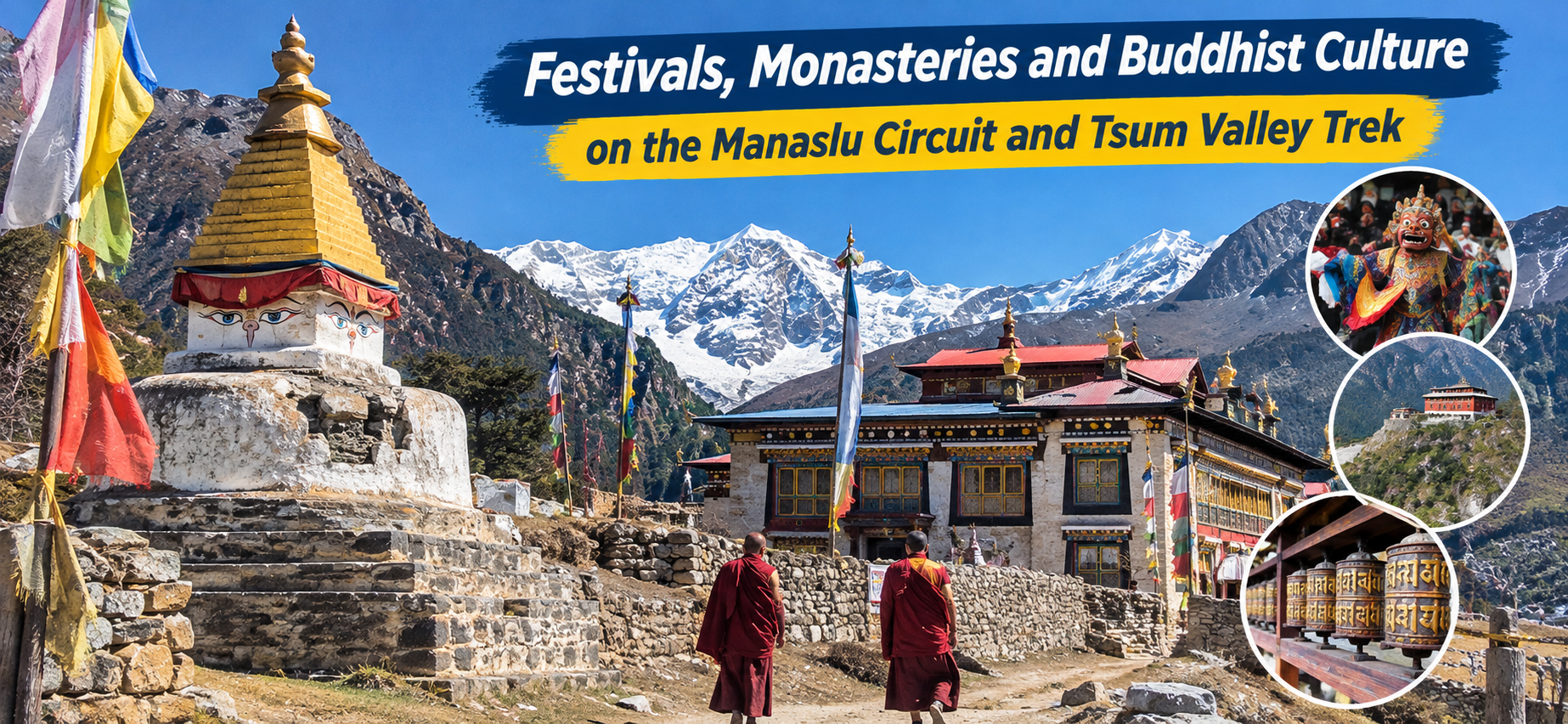
Most trekkers book the Manaslu Circuit for the mountain itself, the long climb to Larkya La, the glaciers hanging off Manaslu’s southern flank, the sheer remoteness of a trail that still sees a fraction of the traffic Everest or Annapurna get every season. What surprises almost everyone I guide through this valley is how much the human side of the trek ends up staying with them longer than the scenery does. The Budhi Gandaki valley and the Tsum Valley side trip pass through one of the most layered cultural landscapes in the Nepal Himalaya in a single trek, moving from Hindu-influenced Gurung and Magar villages in the lower gorge, through increasingly Tibetan Buddhist Nubri communities in the upper valley, and into Tsum, a culturally distinct valley that was a restricted “hidden valley” of its own well into this century. This guide is the one I wish existed when I first started bringing trekkers through here: an honest walk through the festivals you might get lucky enough to witness, the monasteries worth building time into your itinerary for, and the ethnic communities whose home you are passing through, written so you understand what you are seeing rather than just photographing it.
Why the Manaslu Region Is Culturally Different From Other Nepal Treks
Most popular trekking regions in Nepal settled into a fairly consistent single-culture identity a long time ago. The Khumbu is Sherpa country. The Annapurna Circuit’s lower stretches are Gurung and the upper stretches are Manangi, with a fairly clean transition. Manaslu is different because the trail runs the entire length of a single river valley, the Budhi Gandaki, climbing from under 1,000 metres near the trailhead to over 5,100 metres at Larkya La, and ethnic and religious identity in Nepal’s hill regions has always tracked altitude and distance from Tibet closely. You walk through three or four distinct cultural zones in the space of two weeks, which is genuinely unusual, and the Tsum Valley side trip adds a fourth, almost entirely separate culture on top of that.
The other reason this region stayed culturally distinct for so long is political. Manaslu only opened to foreign trekkers in 1991, decades after Everest and Annapurna, and Tsum Valley stayed closed until 2008. That late opening means the monasteries, festival calendars, and village social structures here developed with far less tourism influence than you will find in the Khumbu, where decades of trekking money have visibly reshaped how some festivals are staged for visitors. What you see on Manaslu and in Tsum is closer to how these communities have always practiced their faith and marked their year, not a version adjusted for an audience, and that is worth appreciating as you walk through rather than something to photograph without context.
The Lower Valley: Gurung and Magar Villages Under Hindu-Buddhist Influence
The first several days out of Soti Khola or Machha Khola pass through villages, Khorlabesi, Tatopani, Jagat, and Philim among them, that sit in a cultural transition zone. The population here is predominantly Gurung and Magar, two of Nepal’s prominent hill ethnic groups, with Hindu influence blending into the Tibetan Buddhist practice that becomes dominant further up the valley. You will see small Hindu shrines alongside Buddhist chortens in some of these villages, a mix that reflects centuries of trade, intermarriage, and cultural exchange along this ancient route between Tibet and the Nepali lowlands, since the Budhi Gandaki valley has functioned as a trade corridor for a very long time, not something that started with trekking tourism.
Tamu Lhosar, the Gurung New Year, is the major festival of this lower stretch of the trail, typically celebrated around late December or early January on the Gurung lunar calendar, though exact dates shift year to year and are worth checking against your specific travel dates if witnessing it matters to you. In villages like Jagat and Philim, Tamu Lhosar brings communal feasting, traditional Gurung dress, and dancing, and if your itinerary happens to land here during the festival you will likely be welcomed to observe, though as with any community celebration, it is courteous to ask your guide before joining in or photographing closely rather than assuming open access. Gurung identity in this region carries its own distinct history, language, and animist-influenced Buddhist practice that predates much of the more purely Tibetan Buddhist culture you will encounter higher up the valley, and treating Tamu Lhosar as simply “a Nepali festival” undersells how specifically Gurung this celebration is.
Entering Nubri: Where the Culture Turns Distinctly Tibetan
Somewhere around Deng and more firmly by Namrung, the cultural character of the trail shifts noticeably. This is the beginning of Nubri, the name given to the upper Budhi Gandaki valley and its population, who are ethnically and culturally much closer to Tibet than to the Gurung and Magar communities below. Nubri people, sometimes referred to as Bhotia in broader Nepali usage though Nubri itself is the more specific and locally preferred term, speak their own dialect related to Tibetan, practice Tibetan Buddhism as their primary faith, and maintain architecture, dress, and daily customs that would feel very at home across the border in Tibet itself. Villages like Namrung, Lho, Sama Gaun, and Samdo are the heart of Nubri culture, and this is where most of the Manaslu region’s most significant monasteries and festivals are concentrated.
Namrung itself is worth a slower look than most itineraries give it. The village sits at a natural gateway into the upper valley, marked by a traditional kani, an archway gate common at the entrance to Tibetan Buddhist villages meant to symbolically cleanse travelers of negative influences before they enter, and Namrung’s kani is one of the more elaborately painted examples on the route. Spend a few minutes here rather than walking straight through, since the painted mandalas and protector deities inside these gateways are genuinely worth seeing closely, and our day-by-day itinerary guide can help you see where natural pause points like this fit into a well-paced schedule.
Lho Village and Ribung Gompa
Lho is, in my opinion, the single best village on the entire circuit for a cultural rest morning, and I actively encourage clients to build in extra time here rather than rushing through toward Samagaon. The village is home to Ribung Gompa, also known locally as Lho Gompa, a working monastery with an active community of monks and one of the most impressive settings of any monastery on the route, with Manaslu itself visible rising directly behind the gompa’s roofline on a clear morning. This is not a museum piece; it is an active site of daily prayer and ritual, and visiting respectfully, removing hats, staying quiet during any ongoing prayer session, and always asking before photographing monks or ceremonies, matters more here than at almost any other stop on the trek.
Lho is also where, during Gyalpo Lhosar, the Tibetan New Year typically falling in February or March depending on the lunar calendar, some of the most vivid mask dance ceremonies in the region take place, often associated with the broader Sama Gompa community further up the valley but with Lho’s own monastery participating in the surrounding celebration. These mask dances, performed by monks in elaborate costume representing protector deities and figures from Buddhist cosmology, are genuinely spectacular and photographically stunning, but they are first and foremost religious ritual, not performance staged for trekkers, and the respectful approach is to watch quietly from where the community directs visitors rather than pushing for a closer vantage point.
Samagaon: The Cultural and Religious Heart of Nubri
Samagaon, sometimes written Sama Gaun, is the largest and most culturally significant village in the upper Manaslu region, and most itineraries build in at least one full acclimatisation day here, which doubles as the best cultural immersion stop on the whole trek. The village sits in a wide, relatively flat basin beneath Manaslu’s southern face, with the mountain looming close enough that it dominates the skyline from almost anywhere in the village. Samagaon’s monastery, often called Sama Gompa, is the most important religious site in the immediate area and the focal point for several of the region’s biggest festivals.
Gyalpo Lhosar celebrations centred on Samagaon typically include the most elaborate mask dances in the Nubri region, performed by resident monks in the courtyard of the main monastery, drawing villagers from across the upper valley. Saka Dawa, a deeply important date on the Tibetan Buddhist calendar commemorating the birth, enlightenment, and death of the Buddha, usually falling in May or June depending on the lunar calendar, is also marked with particular devotion in Samagaon and nearby Lho, with increased prayer activity, butter lamp offerings, and circumambulation of local chortens and mani walls. If your trek dates happen to align with either of these windows, mention it to your guide early in the planning process, since a little extra flexibility in your acclimatisation day scheduling can let you witness genuine ceremony rather than just passing through on an ordinary day.
Pungyen Gompa: A Side Trip Most Trekkers Skip
Above Samagaon, reached by a steep but manageable side trail, sits Pungyen Gompa, a smaller and more remote monastery at an elevation somewhere in the range of 3,800 to 4,000 metres, tucked into a dramatic position closer to Manaslu’s base than any other religious site on the circuit. Pungyen Gompa carries real significance in regional mountaineering history as well as religious history, since Manaslu’s name itself derives from the Sanskrit for “mountain of the spirit,” and the mountain holds deep spiritual importance to the Nubri community, who have at times viewed mountaineering expeditions on Manaslu with ambivalence given the peak’s sacred status.
This side trip is one of the most underused half-days on the entire route. Most group itineraries use the Samagaon acclimatisation day for the more commonly promoted side hike toward Manaslu Base Camp or the Birendra Tal viewpoint, both worthwhile, but Pungyen Gompa offers a genuinely quieter, more contemplative stop with a real chance of having the place almost entirely to yourself, along with some of the closest views of Manaslu’s lower glacier available anywhere on the trek. If a slower, more spiritually oriented morning appeals to you over a bigger-name viewpoint, ask your guide about routing your acclimatisation day toward Pungyen Gompa instead.
Samdo and the Higher Nubri Villages
Beyond Samagaon, Samdo is the last substantial village before the push toward Larkya La, sitting close to the Tibetan border and historically a trading post between Nubri traders and Tibetan counterparts before the border closed more tightly to informal trade. Samdo’s population is smaller than Samagaon’s but maintains its own strong Nubri identity, and the village hosts its own, smaller-scale Lhosar and Saka Dawa observances. Samdo is also where Yartung, a horse festival with roots shared across several Tibetan-influenced communities in the Nepal Himalaya, is sometimes celebrated in August, featuring horse racing and archery displays that trace back to a tradition of military and equestrian skill display, though Yartung’s prominence and exact timing varies by year and by which communities choose to mark it, so treat any specific date as provisional rather than fixed.
One festival name that surfaces in some regional accounts of the upper Manaslu area is Dumje, described in a few sources as a community and monastic purification ceremony associated with villages further down the valley around Namrung and Bihi. I want to flag this one carefully rather than overstate it: Dumje is a well-documented and significant festival in Khumbu Sherpa communities, particularly around Thame and Namche, and it is possible that accounts mentioning a Manaslu-region Dumje are describing a related but locally distinct observance, or conflating the two regions. If a local informs you of a Dumje-related ceremony happening during your trek, treat it as a genuine local event to ask your guide about respectfully, but do not plan your itinerary around an expectation of witnessing a specific version of this festival in the Manaslu region without confirming details on the ground, since written sources on this specific point are thin and sometimes contradictory.
Crossing Into Tsum Valley: A Culture Apart
If your itinerary includes the Tsum Valley extension, and I would encourage almost anyone with the extra four to seven days to spare to add it, you are entering what is genuinely a separate cultural world from Nubri, despite sharing a trailhead region and a broadly similar Tibetan Buddhist faith. Tsum Valley remained closed to outside visitors until 2008, later even than the rest of the Manaslu region, and its isolation shaped a population, the Tsumba, with their own dialect, Tsumke, distinct customs, and a particularly strong local tradition of Buddhist practice blended with elements of the pre-Buddhist Bon religion. Our dedicated village-by-village Tsum Valley guide covers the trekking logistics of this side trip in depth; this section focuses specifically on what you are seeing culturally once you are there.
Tsumba identity carries a particularly interesting historical feature worth knowing before you go: the valley has a long local tradition, rooted in Buddhist philosophy around compassion for all living beings, of prohibiting animal slaughter and hunting within the valley, an informal but deeply respected local code that predates any modern conservation designation. Walking through Tsum with this context changes how you read the valley; the strong local reverence for wildlife and the unusually intact natural environment are tied directly to this long-standing cultural practice, not simply a function of remoteness.
Mu Gompa: The Most Remote Major Monastery on the Route
Mu Gompa, sitting at roughly 3,700 metres near the head of the Tsum Valley, is the most remote significant monastery accessible on this entire trekking circuit and, for many of my clients, the single most memorable stop of the whole trip. Founded in the Nyingma school of Tibetan Buddhism, the oldest of the four major schools, Mu Gompa’s current structure dates back roughly to the 17th century, though the site’s religious significance as a place of practice likely predates the building itself by some margin, consistent with how many Himalayan monasteries grew up around sites already considered spiritually significant.
What makes Mu Gompa worth the extra trekking days is less the building itself, modest by the standards of some larger Tibetan monasteries, than its setting and atmosphere: a small, genuinely isolated community of resident monks maintaining centuries of unbroken practice in one of the most physically remote inhabited pockets of the Nepal Himalaya, with views back down the valley and toward the Tibetan border ridgeline that few trekkers anywhere in Nepal ever see. Visiting hours are informal and dependent on the resident monks’ availability, so build flexibility into your schedule here rather than a tight fixed time, and a modest donation toward the monastery’s upkeep is both customary and appreciated.
Rachen Gompa: The Valley’s Historic Nunnery
Lower in the valley, Rachen Gompa, at approximately 3,240 metres, is Tsum Valley’s most significant nunnery, home historically to a community that has numbered in the range of 200 to 300 nuns, making it one of the larger female monastic communities anywhere in this part of the Himalaya. Rachen Gompa was established in the early twentieth century, with its founding commonly dated to around 1905, and it maintains an active daily prayer and study routine that visitors are welcome to observe quietly from the courtyard or the edge of the main prayer hall, again always asking first and never during active ceremony without explicit invitation.
The presence of a monastic community this size, dedicated specifically to women’s religious practice, in a valley this remote says something meaningful about the depth of Buddhist devotion embedded in Tsumba culture, and spending unhurried time at Rachen Gompa, rather than treating it as a brief photo stop on the way to Mu Gompa further up the valley, gives a genuinely different and valuable perspective on the valley’s religious life compared to the male monastic tradition more visible elsewhere on the circuit.
Gumba Lungdang: A Nunnery on the Nubri Side
Back on the main Nubri side of the region rather than within Tsum itself, Gumba Lungdang is a nunnery set at around 3,200 metres above the lower Manaslu valley, reached via a side trail that is considerably less trafficked than the main circuit route. This is a genuinely off-the-beaten-path cultural stop even by Manaslu’s already quiet standards, maintaining an active community of Buddhist nuns and offering a different, more solitary monastic atmosphere than the larger and more visited gompas further up the main trail. Few standard itineraries include Gumba Lungdang by default, so this is a detail worth raising specifically with your trekking agency if a deeper, quieter monastic visit interests you more than ticking off the main-trail highlights.
Serang Gompa and the Kyimolung Valley
For trekkers with extra time and a genuine interest in going further off the standard route, Serang Gompa sits within the Kyimolung Valley, a side valley accessible from the Manaslu region that remains considerably less visited even than Tsum. Serang Gompa is home to a sizeable resident community, with more than a hundred monks and nuns associated with the monastery at various times, and the Kyimolung Valley itself carries its own local legends tying it to hidden valley, or beyul, traditions found throughout Tibetan Buddhist geography, referring to sacred hidden lands believed to offer refuge in times of spiritual or worldly crisis. Our dedicated guide to the Serang Gompa route covers the logistics of this genuinely remote extension in more depth, since it requires additional permit and routing considerations beyond the standard Manaslu Circuit and Tsum Valley combination.
Mani Rimdu and Late-Year Festivals Around Lho
Mani Rimdu is most widely known as a major Sherpa festival of the Khumbu region, particularly at Tengboche and Thame monasteries, typically celebrated in October or November. Versions and echoes of this festival tradition, centred on masked dances performed by monks depicting the triumph of Buddhism over earlier belief systems, appear in some Nubri monastic communities as well, with accounts pointing to observances in the Lho Gompa area during the same general autumn window. As with Dumje further up this guide, I would encourage you to treat any specific claim about Mani Rimdu being celebrated at a particular Manaslu-region monastery as something to confirm locally through your guide rather than a fixed, guaranteed date to plan a trip around, since regional festival calendars in this part of Nepal are maintained by individual monastic communities and can vary meaningfully year to year and valley to valley.
Language, Dress and Daily Life Across the Three Cultures
One detail that helps make sense of everything described above is understanding that you are crossing at least three distinct linguistic and ethnic zones on a single trek, and recognising the differences adds real texture to what you are seeing rather than it all blurring into one generic “mountain village” impression. In the lower valley, Gurung and Magar communities speak their own respective languages at home alongside Nepali, and daily dress is largely similar to what you would see in hill villages across much of central Nepal, practical cotton and synthetic layers suited to farming life, with traditional Gurung dress reserved mainly for festivals like Tamu Lhosar rather than everyday wear.
Once you are in Nubri territory from around Namrung upward, the language shifts to a dialect closely related to Tibetan, sometimes called Nubri or Kutang depending on the specific sub-valley, and you will notice everyday dress changing too, with older residents especially more likely to wear traditional Tibetan-style chuba robes, particularly in colder months, and prayer beads, or mala, carried and used throughout the day as a normal part of religious practice rather than something reserved for special occasions. Yak hair and wool products, spun and woven locally, are still a visible part of daily material culture in villages like Samagaon and Samdo, used for everything from clothing to tent material to the ropes and bags seen around most households.
In Tsum Valley, the Tsumba speak Tsumke, a language distinct enough from both Nepali and standard Tibetan dialects that it is considered its own linguistic variety by most researchers who have studied the valley, reflecting just how isolated this community remained for generations. Tsumba dress and architecture carry their own regional character as well, with flat-roofed stone houses common in the valley’s upper reaches, built for a climate and lifestyle shaped by centuries of near-total isolation from the outside world. Even small details, like the design of prayer flags, the style of carved mani stones, or the specific deities depicted in village chortens, can differ meaningfully between Nubri and Tsum, rewarding a slower, more observant pace of walking over simply covering distance.
Markets and trade patterns also reflect this layered cultural history. Villages like Samdo historically functioned as trading points with Tibetan communities across the nearby border, exchanging salt, wool, and other goods long before trekking tourism existed, and some older residents in the highest villages still recall or maintain family trading connections that predate the modern border’s tighter restrictions. Asking a guide with genuine local roots, rather than simply a licensed guide from Kathmandu, about these family and trade histories can add a dimension to your trek that no guidebook, including this one, fully captures.
How to Actually Witness These Festivals: Timing Your Trek
If experiencing one of these festivals firsthand is a real priority rather than a nice-to-have, the single most important thing to understand is that nearly every festival described in this guide follows a lunar calendar, meaning the Gregorian calendar date shifts from year to year, sometimes by several weeks. Do not book a trek based on a date you found attached to a festival name from a previous year without confirming the current year’s date specifically. Your trekking agency, especially one with staff from the Nubri or Tsum communities themselves, is your best source for confirming current-year dates close to your planned departure, and we are always happy to check this directly with contacts in Samagaon or the Tsum Valley before you finalise your dates.
It is also worth being realistic about trade-offs. Gyalpo Lhosar in February and March falls in a cooler, quieter trekking window with a real chance of snow at higher elevations, while Saka Dawa in May or June sits at the very start of the pre-monsoon season, generally a good trekking window but one where afternoon cloud builds earlier in the day. Chasing a specific festival date sometimes means accepting slightly less ideal trekking conditions than the peak spring or autumn windows covered in our month-by-month itinerary guide, and that is a genuine decision worth thinking through rather than assuming festival timing and ideal weather always align.
Respectful Conduct Around Monasteries and Ceremonies
A few practical points of etiquette apply consistently across every monastery and ceremony described in this guide, and I cover them here together rather than repeating them at each site. Always walk clockwise around mani walls, chortens, and monastery buildings, keeping these structures to your right as you pass, which is the correct direction of circumambulation in Tibetan Buddhist practice. Remove your hat and lower your voice when entering a prayer hall, and never point your feet directly toward a shrine, statue, or seated monk if you sit down inside one. Photography inside prayer halls is often restricted, sometimes entirely and sometimes only during active ceremony, so always ask your guide or a visible monastery attendant before raising a camera, and accept a no without pressing the point.
Modesty in dress matters more around religious sites here than it does on the open trail; covering shoulders and knees when visiting a gompa is a sign of basic respect that local communities notice and appreciate, even if no one explicitly enforces it. A small donation left in the offering box at any monastery you visit, even a modest one, is a meaningful gesture of respect for communities that maintain these sites with very limited outside funding, and it is one of the more concrete ways a trekker can give something back to the places that make this trek so distinctive.
The Living Communities Behind the Culture
It is worth closing on a point I try to make to every client before we start this trek: the Gurung and Magar villages of the lower valley, the Nubri communities of Namrung through Samdo, and the Tsumba of Tsum Valley are not living museum exhibits maintained for trekkers. These are working communities, farming barley and potatoes at extreme altitude, raising yak and dzo, and practicing a faith that predates organised trekking tourism in this region by centuries. The festivals, monasteries, and customs in this guide are offered so you can understand and appreciate what you are walking through with real context, not so you can check boxes on a cultural checklist. The best compliment I can pay any trekking group I guide through here is that they left having learned something real about Nubri or Tsumba life, not just having collected photographs of it.
Frequently Asked Questions
What is the best time to trek Manaslu if I want to see a festival?
Gyalpo Lhosar, the Tibetan New Year, usually falling in February or March, and Saka Dawa, usually in May or June, are the two festivals most likely to coincide with an active trekking window and offer the richest ceremonial experience, particularly around Samagaon and Lho. Confirm current-year dates with your trekking agency before booking, since both follow a lunar calendar that shifts annually.
Can trekkers visit monasteries along the Manaslu Circuit?
Yes, generally, though always with courtesy and ideally with your guide’s introduction. Ribung Gompa in Lho and Sama Gompa in Samagaon are both accustomed to respectful visitors. More remote sites like Mu Gompa and Rachen Gompa in Tsum Valley welcome visitors as well, with informal visiting hours dependent on the resident monks or nuns.
Is the Tsum Valley culturally different from the rest of the Manaslu region?
Yes, meaningfully so. The Tsumba people of Tsum Valley have their own dialect, Tsumke, their own strong local tradition against animal slaughter within the valley, and a distinct blend of Buddhist and Bon religious practice, separate from the Nubri identity of villages like Samagaon and Lho on the main circuit.
What should I know before photographing people or ceremonies in these villages?
Always ask first, whether photographing individuals, monks, or an active ceremony. Many prayer halls restrict photography entirely, and even outdoor festival photography should be approached with a request rather than an assumption of open access, since these are genuine religious and community events, not staged performances.
Are there nunneries as well as monasteries on this trek?
Yes. Rachen Gompa in Tsum Valley is a historically significant nunnery with a community that has numbered in the hundreds, and Gumba Lungdang on the Nubri side is a smaller, quieter nunnery reached via a less-trafficked side trail. Both offer a valuable, less commonly highlighted perspective on the region’s religious life.
Is it true that hunting is banned in Tsum Valley?
There is a long-standing local tradition in Tsum Valley, rooted in Buddhist philosophy, against animal slaughter and hunting within the valley, maintained informally by the Tsumba community for generations. It reflects deep cultural and religious values specific to this valley rather than a modern conservation rule imposed from outside.
How much extra time should I budget to properly experience the cultural side of this trek?
Beyond the standard circuit itinerary, I would recommend at minimum one unhurried day in Lho or Samagaon rather than treating either as a pure overnight stop, and the full four-to-seven-day Tsum Valley extension if monastic culture genuinely interests you. Rushing through Lho, Samagaon, or Tsum Valley to save a day is, in my experience, one of the more common regrets trekkers report after the fact.
A Final Word Before You Book
The Manaslu Circuit and Tsum Valley together offer one of the richest single-trek cultural experiences anywhere in the Nepal Himalaya, moving through Gurung and Magar villages, deep into Tibetan Buddhist Nubri culture, and into the genuinely distinct world of the Tsumba people, all within a trek that most visitors still book purely for the mountain scenery. I would encourage you to build enough time into your itinerary to actually experience this rather than walk past it, and to approach every monastery, festival, and village with the same respect you would want shown toward your own community’s sacred spaces and celebrations. If you have questions about timing your trek around a specific festival, adding Tsum Valley, Gumba Lungdang, or the Serang Gompa extension, or anything else covered here, reach out to us directly. You can call or message us on WhatsApp at +977 9869225929, email us at info@manaslutreks.com, or use our contact page, and we will help you build an itinerary that does justice to both the mountain and the people who call this valley home.