Pokhara After Manaslu Circuit Trek: The Complete Guide
Almost every trekker who books the Manaslu Circuit Trek assumes the trip ends the same way it started, with a long drive back to Kathmandu. That assumption is not wrong exactly; it is just incomplete. Once you cross Larkya La and walk down through Bimthang to Tilije and Dharapani, the road at your feet does not only lead back the way you came. It also leads to Pokhara, and for a large number of our guests, that turns out to be the better choice. This guide explains exactly why, exactly how, and exactly what it costs, using the real distances, real road conditions and real prices we work with every week as a company that runs this route.
We are Manaslu Treks and Expedition, based in Kathmandu and operating under our parent company, Next Trip Nepal Treks and Expedition. We have been walking guests out of the Manaslu restricted area for years, and the question of Pokhara versus Kathmandu comes up on almost every departure at some point between Samagaon and Dharapani. This article is written to answer it properly, with numbers you can actually plan around rather than vague reassurance.
Why Consider Pokhara Instead of Kathmandu After the Manaslu Circuit
The honest starting point is that neither city is wrong. Plenty of trekkers finish this route and are perfectly happy driving straight back to Kathmandu for a shower, a real bed and a flight home two days later. But a genuine set of practical reasons pushes a lot of people toward Pokhara instead, and they are worth laying out plainly rather than as a sales pitch.
It Is Simply a Shorter, Easier Journey
This is the single biggest factor and the one most trekkers do not realize until someone tells them. From Tilije or Dharapani, the road to Kathmandu runs roughly 220 kilometers and takes 8 to 10 hours or more depending on traffic and road conditions once you reach the Prithvi Highway. The road to Pokhara covers a shorter total distance and, more importantly, spends far less time on the rough, unpaved mountain section, since Pokhara sits closer to where that rough section ends at Besisahar. On a normal day, reaching Pokhara from Tilije or Dharapani takes around 6 to 7 hours door-to-door, compared with 8 to 10+ hours to Kathmandu. After 12 or 13 days of walking, including the long push over a 5,106 meter pass, that difference in seat time matters more than it sounds on paper.
Recovery Is Genuinely Easier in Pokhara
Kathmandu is a working capital city, loud, crowded and thick with traffic and dust, especially around Thamel where most trekkers stay. Pokhara is calmer. It sits on the edge of Phewa Lake with the Annapurna range and Machapuchare visible from the lakeside on a clear morning, and the pace of the town simply suits a body that has just spent two weeks at altitude. Guests consistently tell us they sleep better their first night in Pokhara than they did their first night back in Kathmandu.
The Mountain Views Do Not Just Stop
One underrated detail is that Pokhara gives you a completely different, and arguably better, view of the Annapurna massif than anything you saw during the trek itself, since Manaslu and Pokhara sit on opposite sides of the Marsyangdi valley system. Waking up to Machapuchare’s fishtail summit reflected in Phewa Lake is a genuinely good way to close out a Himalayan trip, and it is not something you get by driving straight back into Kathmandu’s haze.
It Is the Natural Gateway to a Second Trek
A meaningful share of our Manaslu guests ahavenot finished trekking wby the timethey reach Dharapani. Pokhara is the starting point for the Annapurna Base Camp trek, the Ghorepani Poon Hill trek ,and the Mardi Himal trek, all of which are shorter, lower-altitude routes that pair naturally with Manaslu if you have an extra week. Routing through Pokhara instead of Kathmandu means you are already positioned for that second trip rather than backtracking across the country to start it.
Getting Back to Kathmandu Later Is Easy and Fast
This is the detail that removes most people’s hesitation. Pokhara has its own busy domestic airport with frequent flights to Kathmandu, roughly 25 to 30 minutes in the air compared with 6 to 7 hours by road. So choosing Pokhara now does not mean giving up a Kathmandu departure later. It usually means doing that leg rested, by air, on your own schedule, instead of exhausted, by road, on the same day you crossed a mountain pass.
Where the Trek Actually Ends: Tilije and Dharapani Explained
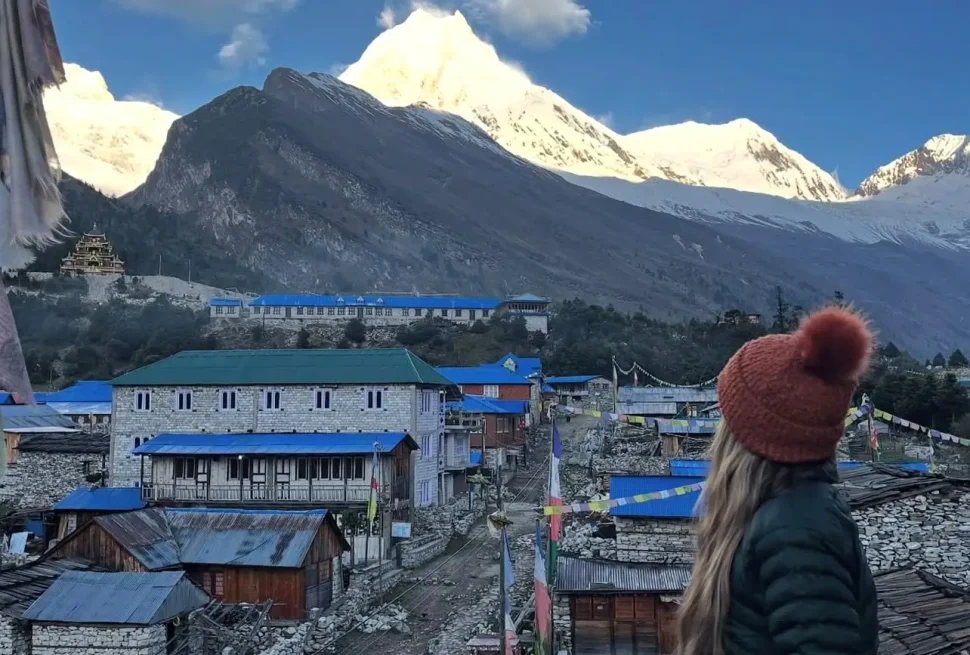
To understand the transport options properly, it helps to know exactly where you are standing when you make this decision. After crossing Larkya La at 5,106 meters, the standard route descends to Bimthang at roughly 3,720 meters, then continues down through changing forest and farmland to Tilije at roughly 2,300 meters, a walk of about 15 to 18 kilometers and 5 to 7 hours from Bimthang. Tilije sits just above Dharapani, which is at roughly 1,860 meters and marks the point where the Manaslu route rejoins the Annapurna Circuit trail in the Marsyangdi valley.
Both villages sit on the same jeep road, and this is the practical detail that matters most: for our private groups traveling with our own vehicle, pickup starts directly at Tilije rather than requiring an extra walk down to Dharapani first. That saves a genuinely tiring final hour or so on a day when most people are already running on empty. If you are arranging transport independently rather than through an agency, vehicles are available from either village, and the difference in cost and timing between starting at Tilije versus Dharapani is minor.
Tilije is a small Gurung and Manangi settlement with a handful of teahouses, a couple of small shops selling snacks and bottled water, and a jeep stand that has grown busier as the Manaslu Circuit has become more popular. There is no need to rush through it if your group needs a short break before the drive, a cup of tea and a rest for twenty minutes before four to seven hours on a bumpy road makes a real difference. Dharapani is slightly larger, since it also serves Annapurna Circuit trekkers coming from Manang, so it has a wider choice of teahouses, a small health post, and mobile network coverage that is more reliable than anything you will have had since well before Samagaon. Either village works fine as a starting point, and neither requires an overnight stay unless your group prefers to break the journey rather than driving straight through the same day you finish trekking.
A Realistic Day by Day Timeline From Bimthang to Pokhara
Numbers on a map are useful, but seeing how this actually fits into the final days of a Manaslu Circuit itinerary makes it easier to plan around. A typical finish looks something like this. Day one after crossing Larkya La, most groups walk down to Bimthang and spend the night there, tired but past the hardest single day of the entire trek. Day two continues down through forest and farmland to Tilije or Dharapani, a walk of five to seven hours depending on pace and how the group is feeling, arriving in the early to mid afternoon. This is the point where the transport decision actually happens, not weeks earlier at a desk in Kathmandu.
If a private or sharing jeep is already arranged, it is entirely possible to continue the same afternoon, reaching Besisahar by early evening and Pokhara by roughly dinner time, turning what would otherwise be a rest day into the final push of the trip. Most guests, understandably, prefer not to do that after thirteen or fourteen days on the trail, and choose instead to spend one more night at a teahouse in Tilije or Dharapani, leaving fresh the next morning for the six to seven hour drive to Pokhara. Either approach works. The road itself does not change, only how tired you choose to be when you get in the vehicle.
For groups combining the Manaslu Circuit with a second trek out of Pokhara, this timeline also matters for planning permits and porters for the next trip, since the Annapurna Conservation Area permit required for routes like Annapurna Base Camp or Mardi Himal can be arranged in Pokhara itself with a day’s notice, meaning a guest can realistically finish Manaslu, rest one full day in Pokhara, and start a second trek within forty eight hours if the schedule allows for it.
The Route From Tilije or Dharapani to Pokhara
The journey to Pokhara happens in two genuinely different stages, and understanding both is the key to planning this leg properly rather than being surprised by it.
The first stage runs from Tilije or Dharapani down the Marsyangdi valley to Besisahar, covering roughly 35 to 40 kilometers on a mostly unpaved mountain road that was built for the Annapurna Circuit road network and has since been extended and roughened by seasonal rain and heavy vehicle traffic. Expect 3 to 5 hours for this stretch depending on the season and how recently the road has been graded. It passes through villages most Annapurna Circuit trekkers will recognize, including Tal, Chamje, Jagat, Syange, Ngadi and Bhulbhule, before reaching Besisahar itself.
The second stage is a completely different kind of driving. Besisahar sits at the point where this rough mountain road meets the paved Prithvi Highway, and from there it is roughly 108 kilometers to Pokhara, a smooth, sealed road that normally takes about 2 hours. This is the same highway used by every tourist bus running between Kathmandu and Pokhara, so the road quality and traffic pattern are well established and generally reliable outside of monsoon landslide season.
| Leg | Approximate distance | Approximate time | Road surface |
|---|---|---|---|
| Tilije or Dharapani to Besisahar | 35 to 40 km | 3 to 5 hours | Unpaved mountain road, rough in places |
| Besisahar to Pokhara | 108 km | Approximately 2 hours | Paved highway (Prithvi Highway via Dumre) |
| Total, Tilije or Dharapani to Pokhara | Roughly 145 to 150 km | Roughly 6 to 7 hours | Mixed, unpaved then paved |
For comparison, the drive from the same starting point to Kathmandu covers roughly 220 kilometers and takes 8 to 10 hours or more, since the paved portion of that route runs from Besisahar through Dumre and on toward Kathmandu, a considerably longer stretch of highway than the short hop to Pokhara. Both routes share the identical rough first stage down to Besisahar. The difference is entirely in what happens after that, and it consistently favors Pokhara on time alone.
Your Transport Options Explained
There are three practical ways to make this journey, and they suit different budgets, group sizes and tolerance for logistics. We arrange all three for our guests, and independent trekkers finishing without an agency can arrange the same options locally at Tilije, Dharapani or Besisahar.
Private Jeep, Direct From Tilije or Dharapani to Pokhara
This is the option most of our guests choose, and for good reason. A private jeep booked to run the entire distance in one continuous trip costs approximately 300 US dollars for the vehicle, not per person, and typically seats up to 6 or 7 passengers along with your bags. There is no change of vehicle at Besisahar, no waiting around for a connecting bus, and the driver can stop when you actually want to stop rather than on someone else’s schedule. For a family, a group of friends, or anyone simply worn out from the trek and unwilling to deal with a transfer, this is the most comfortable and most predictable option, and the total travel time runs close to the 6 to 7 hour range described above.
Sharing Jeep, Arranged Through to Pokhara
If you are traveling solo or as a pair and do not need the whole vehicle, a shared jeep arranged directly through to Pokhara costs approximately 60 US dollars per person. This is not the same as flagging down a random local jeep at the roadside, it is a seat booked in a vehicle that runs the complete route without stopping at Besisahar for you to find your own onward transport. The tradeoff compared with a private jeep is that departure timing depends on the other passengers booked for the same vehicle, so there is slightly less flexibility, but the cost per person is a fraction of hiring the whole jeep yourself.
Local Jeep Plus Public Bus, the Independent Budget Route
The cheapest way to make this journey is to do it in two separate stages arranged on your own, and plenty of independent trekkers do exactly this. The first stage is a local shared jeep from Tilije or Dharapani to Besisahar, which typically costs somewhere around 20 to 25 US dollars per person and takes 3 to 5 hours on the rough section described above. At Besisahar, you get off, find the bus stand, and board a public bus to Pokhara, which costs approximately NPR 2,000, roughly 15 to 20 US dollars, and takes about 2 hours on the paved highway.
Total cost for this route usually lands somewhere between 35 and 45 US dollars per person, noticeably cheaper than either jeep option, but it comes with a real tradeoff: you have to physically change vehicles at Besisahar, which means carrying your own bags across the bus stand, waiting for the next available bus if one is not departing immediately, and accepting a public bus’s fixed schedule rather than door to door service. For a confident independent traveler with light luggage and no particular time pressure, this is a perfectly workable option. For anyone who has just finished a genuinely demanding trek and would rather not manage a mid journey transfer, it is worth the extra cost to book a through jeep instead.
| Option | Cost | Approximate time | Best for |
|---|---|---|---|
| Private jeep, direct to Pokhara | Approximately USD 300 for the vehicle | 6 to 7 hours | Families, small groups, anyone wanting door to door comfort with no transfer |
| Sharing jeep, arranged direct to Pokhara | Approximately USD 60 per person | 6 to 7 hours | Solo travelers or pairs who still want a single continuous ride |
| Local jeep to Besisahar, then public bus to Pokhara | Approximately USD 35 to 45 per person total | 6 to 8 hours including the transfer | Budget conscious independent trekkers comfortable managing their own connection |
What Is Actually Included in the Price
The 300 US dollar private jeep figure and the 60 US dollar per person sharing jeep figure both cover the vehicle, driver and fuel for the full route from Tilije or Dharapani to Pokhara. They do not automatically include a tip for the driver, which is appreciated but not mandatory, and most guests give somewhere in the range of 500 to 1,000 Nepali rupees per vehicle for a six to seven hour drive, more if the driver has gone out of his way to help with heavy bags or an early departure. Bottled water and snacks along the way are also on you, though every stop along the Besisahar to Pokhara stretch has small shops where this is easy to sort out.
One thing worth knowing if you are pricing this yourself rather than booking through a guide: jeep rates on this route can rise during the monsoon months, roughly June through August, when the unpaved section between Tilije or Dharapani and Besisahar takes longer and is harder on vehicles, and again briefly during the busiest weeks of the September to November peak season when demand outstrips available jeeps. The figures in this guide reflect typical pricing outside those spikes, and a small seasonal premium of perhaps ten to twenty percent is reasonable to expect if you are traveling during either window.
Why Most Guests Let Their Guide Handle This Rather Than Arranging It Alone
Nothing about this route requires an agency. Independent trekkers do it every season, on foot to the jeep stand and onto whatever vehicle has an open seat. But there is a real, practical reason most of our guests choose to let their guide handle it instead. A guide who has run this route dozens of times knows which drivers are reliable, can negotiate a fair price on the spot rather than paying whatever a roadside driver quotes a visibly tired foreign trekker, and can adjust the plan in real time if the group is moving slower than expected or someone needs an extra rest day at Tilije before continuing. It also means one less decision to make at the exact moment you have the least energy to make it, which, after thirteen or more days on the trail, is worth more to most people than the small amount of money saved by arranging everything independently.
How We Arrange This for Our Guests
Because a licensed guide travels with every group on the Manaslu Circuit, this is not a decision you have to lock in months before departure. It is entirely normal for guests to decide during the trek itself, often somewhere between Bimthang and Dharapani once they have a clearer sense of how they are feeling and what the rest of the group wants to do. Your guide simply relays the plan to our office, and the vehicle is arranged to meet you at Tilije or Dharapani on the appropriate day.
One detail that surprises a lot of first time guests: if you left a duffel bag or extra luggage at your Kathmandu hotel before starting the trek, since you only need trekking gear on the mountain, you do not need to go back to Kathmandu to collect it. We transfer that bag directly to your Pokhara hotel, so it is waiting for you when you arrive, no detour required. This single detail is often what actually removes the last hesitation people have about skipping Kathmandu altogether.
If you already know before you fly to Nepal that you would like to end the trek in Pokhara rather than Kathmandu, telling us at the booking stage makes the logistics even smoother, but it genuinely is not required. This route runs often enough that we can typically arrange a vehicle with only a day or two of notice during the trekking season.
What to Expect Once You Reach Pokhara
Both jeep options and the public bus route drop you in or near Lakeside, Pokhara’s main tourist area along the eastern shore of Phewa Lake, where the great majority of hotels, restaurants and trekking shops are concentrated. If you have a hotel booking waiting, this is a short taxi ride or sometimes a direct drop off if you have arranged transport through us.
The first day is worth planning as a genuine rest day rather than a sightseeing day. Hot showers, real beds, laundry service, and food that is not dal bhat for the first time in two weeks tend to be the actual priorities, and Pokhara’s Lakeside area is set up well for exactly that. Once you have had a proper night’s sleep, the town has plenty to offer for a second or third day: boating on Phewa Lake, the World Peace Pagoda on the ridge above the lake with a genuinely excellent Annapurna panorama, the International Mountain Museum if you want context on the peaks you just walked among, and paragliding if your legs have recovered enough to enjoy a very different kind of adrenaline than the one you got crossing Larkya La.
A few additional spots are worth knowing about if you end up with more than a single rest day. Sarangkot, a hilltop above the city, is the classic spot for a sunrise view of the Annapurna range and Machapuchare together, reachable by a short taxi ride before dawn. Davis Falls and the adjoining Gupteshwor Mahadev cave are an easy half day outing close to Lakeside if you want something low effort. The Old Bazaar area on the northern edge of town has a slower, more local feel than Lakeside, with the Bindhabasini Temple as its centerpiece, and is worth an hour or two if you want a break from the tourist strip. None of this requires much planning, since Lakeside hotels and travel desks can arrange any of it with a few hours’ notice.
From Pokhara Back to Kathmandu, or Onward
Most trekkers eventually need to reach Kathmandu, either for an international flight home or simply because that is where their trip started. From Pokhara, this is straightforward. Domestic flights run frequently throughout the day, take roughly 25 to 30 minutes, and are the most time efficient option if your schedule allows for it. A tourist bus is the budget alternative, taking about 6 to 7 hours on the same Prithvi Highway, comfortable enough for most travelers and considerably cheaper than flying.
If your trip is not over, Pokhara is also the departure point for several other well known treks. The Annapurna Base Camp trek, the Ghorepani Poon Hill trek and the Mardi Himal trek all start within a short drive of Lakeside, and combining one of these shorter routes with the Manaslu Circuit is a common choice among guests who have the extra week to spare and want a genuinely different landscape after two weeks in a restricted area.
Practical Things to Know Before You Decide
A few details are worth keeping in mind regardless of which option you choose. The unpaved section between Tilije or Dharapani and Besisahar is noticeably affected by weather. During and shortly after the monsoon months, roughly June through August, this stretch can be slower and occasionally disrupted by landslides or washed out sections, so building in a little schedule flexibility during that window is sensible. Outside of monsoon season, the road is generally reliable, if still bumpy.
Booking ahead matters more in peak trekking months, September through November and March through May, when demand for jeeps out of the Manaslu region is highest. A private jeep is usually easier to arrange on short notice than a shared jeep, simply because it does not depend on other passengers’ plans lining up with yours.
Pack a small daypack with what you actually want for the ride itself, water, snacks, a layer for the cooler morning start, and let the rest of your luggage travel loaded on the jeep roof or in the back as usual. After Larkya La, most people are running on very little reserve energy, so treating this transport day as part of the trek rather than an afterthought, with a reasonable departure time and realistic expectations about how tired you will be, makes the whole experience noticeably better.
Permit checkpoints along this stretch are the same ones you would pass through regardless of your final destination, since the road from Dharapani to Besisahar sits within the Annapurna Conservation Area, the zone your Manaslu route exits through. Keep your permits accessible until you are safely past Besisahar rather than packing them away at the bottom of your duffel bag.
Seasonal Notes for the Drive
Spring, March through May, and autumn, September through November, are the most reliable months for this drive, with generally dry conditions on the unpaved section and steady demand for jeeps, which is exactly why booking a day or two ahead helps most during those windows. Winter, December through February, brings cold mornings and occasional light snow at higher points near Dharapani, but the road itself is rarely blocked and the drive is usually straightforward, if cold before the sun is fully up. Monsoon, June through August, is the one period where genuine delays are possible, since heavy rain can trigger short term landslides or force a slower pace on the unpaved stretch, so travelers on a tight flight connection in Kathmandu or Pokhara during those months should build at least half a day of buffer into their plans.
Frequently Asked Questions
Can I go directly to Pokhara after finishing the Manaslu Circuit Trek?
Yes. Once you reach Tilije or Dharapani, a jeep or bus route to Pokhara is available in exactly the same way as the route back to Kathmandu, and for many trekkers it is the faster and more comfortable choice.
How far is Pokhara from Dharapani or Tilije?
The total distance is roughly 145 to 150 kilometers, made up of about 35 to 40 kilometers on unpaved mountain road down to Besisahar, then about 108 kilometers on the paved Prithvi Highway from Besisahar to Pokhara.
How long does the journey to Pokhara take?
Around 6 to 7 hours in total under normal conditions, compared with 8 to 10 hours or more for the equivalent journey to Kathmandu.
Is it faster to go to Pokhara or Kathmandu after the trek?
Pokhara is faster. Both routes share the same rough first stage down to Besisahar, but the paved stretch from Besisahar to Pokhara is considerably shorter than the paved stretch from Besisahar to Kathmandu.
What does a private jeep to Pokhara cost?
Approximately 300 US dollars for the vehicle, typically seating up to 6 or 7 passengers with luggage, covering the entire route from Tilije or Dharapani directly to Pokhara without a change of vehicle.
What does a shared jeep to Pokhara cost?
Approximately 60 US dollars per person when arranged as a through booking direct to Pokhara, a considerable saving over hiring a private vehicle if you are traveling alone or as a pair.
Can I take a public bus to Pokhara instead?
Yes, though it involves two separate stages. A local jeep from Tilije or Dharapani to Besisahar costs roughly 20 to 25 US dollars per person, and a public bus from Besisahar to Pokhara costs approximately NPR 2,000, roughly 15 to 20 US dollars, for a combined total of about 35 to 45 US dollars per person.
Do I need to decide before booking my Manaslu Circuit Trek whether I want to end in Pokhara?
No. Since a licensed guide accompanies every group throughout the trek, this decision is commonly made during the trek itself, and transport is arranged accordingly with only a day or two of notice in most cases.
What happens to luggage I left in Kathmandu if I end the trek in Pokhara?
We transfer any bags left at your Kathmandu hotel directly to your Pokhara hotel, so there is no need to travel back to Kathmandu to collect them before continuing your trip.
Is the road from Dharapani to Besisahar safe?
It is a normal, if rough, mountain road used daily by local and tourist vehicles alike. It is slower and occasionally affected by landslides during and just after the monsoon months, but it is a well established route with regular traffic outside that window.
Can I fly from Pokhara back to Kathmandu instead of driving?
Yes. Pokhara has its own domestic airport with frequent flights to Kathmandu, taking roughly 25 to 30 minutes, a fast and comfortable alternative to the 6 to 7 hour road journey.
What is there to do in Pokhara after finishing the Manaslu Circuit?
Beyond simple rest and recovery, popular options include boating on Phewa Lake, the World Peace Pagoda for Annapurna views, the International Mountain Museum, and paragliding once you have recovered from the trek itself.
Does going to Pokhara mean I skip Kathmandu entirely?
Not necessarily. Most trekkers still return to Kathmandu eventually, whether for an international flight or simply to close out their trip, but they do so afterward by air or bus from Pokhara, rested, rather than immediately after crossing Larkya La by a long road journey the same day.
Is Pokhara a good starting point for another trek after Manaslu?
Yes. The Annapurna Base Camp trek, the Ghorepani Poon Hill trek and the Mardi Himal trek all begin within a short drive of Pokhara, making it a natural next stop for trekkers with extra time who want to combine two routes in one trip.
Which option should I choose if I am traveling alone?
A sharing jeep booked through directly to Pokhara at approximately 60 US dollars offers a good balance of comfort and cost for a solo traveler, avoiding both the higher cost of a private vehicle and the transfer hassle of the independent bus route through Besisahar.
Does the jeep price change between seasons?
Slightly. Rates can rise by roughly ten to twenty percent during the monsoon months, when the unpaved section is slower and harder on vehicles, and during the busiest weeks of peak season when demand for jeeps is highest. Outside those windows, the prices in this guide are a reliable baseline.
Can I combine this route with another trek instead of ending my trip in Pokhara?
Yes, and it is a common choice. Pokhara is the starting point for the Annapurna Base Camp trek, the Ghorepani Poon Hill trek and the Mardi Himal trek, and permits for those routes can be arranged in Pokhara itself, so it is realistic to finish Manaslu, rest a day, and start a second trek within forty eight hours.
Is there mobile network coverage along the route to Pokhara?
Coverage improves steadily as you descend. It is limited or absent for stretches near Tilije and Dharapani, becomes more reliable by Besisahar, and is consistent for the entire paved stretch from Besisahar to Pokhara.
Should I tip the driver on this route?
It is appreciated but not mandatory. Most guests give somewhere around 500 to 1,000 Nepali rupees per vehicle for the full drive, more if the driver has been especially helpful with luggage or timing.
Final Thoughts
Finishing the Manaslu Circuit at Tilije or Dharapani is not the end of your options, it is a genuine fork in the road. Kathmandu is the familiar choice, but Pokhara is shorter, calmer, and puts you in a better position for a second trek or a rested flight home later. Whether you choose a private jeep, a shared jeep, or the independent bus route through Besisahar, the route is well established, the costs are predictable, and your guide can help arrange it on the spot, even if you only decide once you are standing in Bimthang looking at the trail ahead. If you are still planning your trip, our full Manaslu Circuit Trek guide covers the itinerary in detail, our transportation guide compares every vehicle option on the route into the mountains, and our Private Manaslu Circuit Trek has current pricing and departure dates. You can also read what past guests have said on our Manaslu trek reviews, and check our registered company documents directly if you want to verify who you would be booking with.