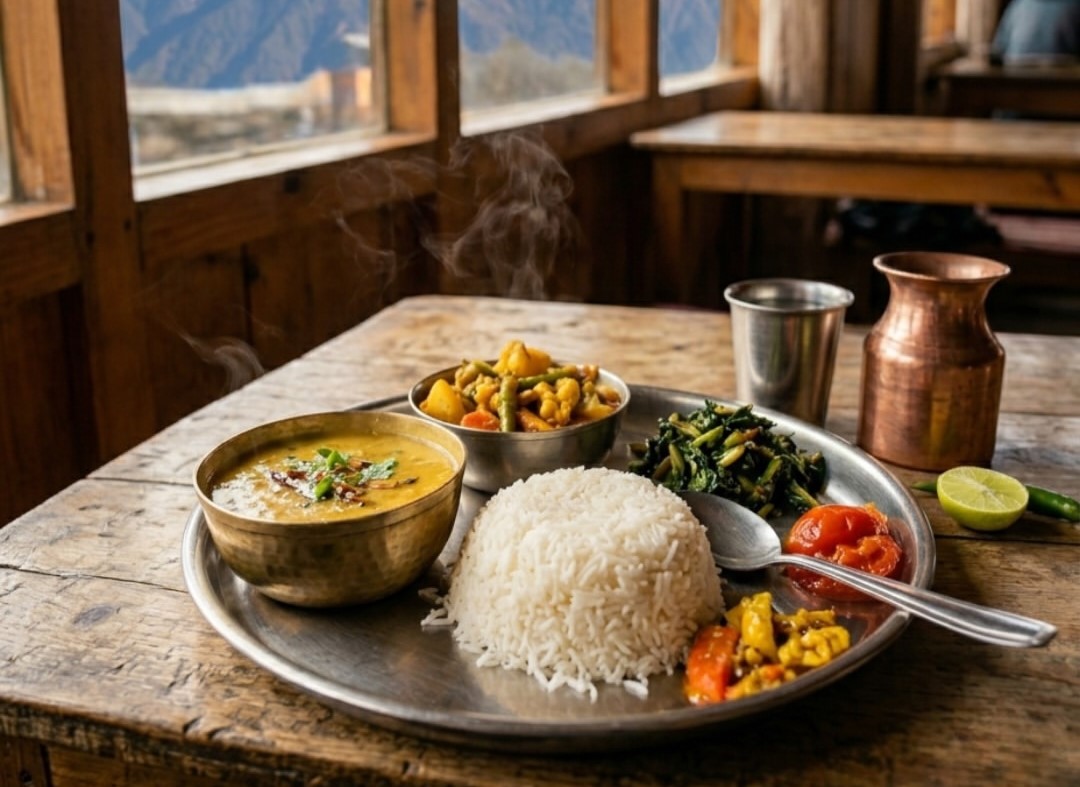
If you’ve never trekked in Nepal before, “dal bhat” is one of the first phrases you’ll hear repeated by guides, porters, and other trekkers on the Manaslu Circuit Trek — usually followed by a grin and some version of “dal bhat power, 24 hour!” It sounds like a joke the first time you hear it. By day five on the trail, most trekkers understand exactly why it isn’t.
This guide explains what dal bhat actually is, what’s on the plate, why it’s the backbone of every teahouse menu on this route, and — since it’s rarely a single fixed dish — the different types of dal bhat you’ll actually be offered as you move from the lower Budhi Gandaki valley up into Samagaon and toward Larkya La. We’ve pulled this together from how dal bhat is served across Nepal generally and from food guides specific to the Manaslu region, cross-checked against each other rather than taken from a single source.
What Is Dal Bhat, Exactly
Dal bhat is Nepal’s national meal, eaten by most Nepali households twice a day, and it is also the default meal on almost every trekking menu in the country. The name itself is simple: “dal” means lentil soup, and “bhat” means boiled rice. Together, served as a full plate with a handful of other small components, “dal bhat” refers to the entire meal, not just the two headline ingredients.
It isn’t a single fixed recipe. What arrives on your plate changes slightly from teahouse to teahouse and from valley to valley, shaped by what’s locally available, who’s cooking, and increasingly, by altitude. What stays constant is the basic structure: rice, lentil soup, a vegetable curry, and something pickled or spiced on the side.
Across Nepal, different regions have their own take on the format. In the Annapurna region, Thakali dal bhat from the Mustang area is often served as several small bowls of different curries rather than one combined plate, and is widely considered one of the more refined versions of the dish. In the Everest region, Sherpa households tend to serve a slightly thicker dal alongside a potato-heavy vegetable side, suited to colder temperatures. On the Manaslu Circuit, the style you’ll encounter sits closer to the everyday household version found across the mid-hills of Nepal, built around whatever the teahouse can reliably grow, store, or carry in, rather than a single named regional style.
What’s Actually on the Plate
A standard dal bhat set on the Manaslu Circuit Trek typically includes:
- Bhat — steamed white rice, usually the largest portion on the plate and the main source of carbohydrate for the day’s walking
- Dal — a thin lentil soup, usually yellow or a mix of lentils, seasoned with turmeric, cumin, garlic, and ginger, poured over or served alongside the rice
- Tarkari — a vegetable curry that changes with the season and the altitude, commonly potato, cauliflower, spinach, or seasonal greens
- Achar — a spicy pickle or chutney, often made from radish, tomato, or whatever vegetable is on hand that week, meant to be eaten in small amounts alongside the rest of the plate
- Saag — sautéed greens, frequently spinach or mustard greens, added as a side in many teahouses
- Papad — a thin, crisp lentil or rice wafer, served in some teahouses as an extra crunch alongside the main plate
In the lower villages before the restricted area begins, you may also be offered a small side of curd (dahi), used almost like a mild dessert or digestive at the end of the meal. Higher up, dairy becomes less consistent, so don’t expect it as a given at every stop.
Why Dal Bhat Is Called “Trekking Fuel”
The slogan “dal bhat power, 24 hour” isn’t just a T-shirt joke sold to tourists in Thamel, it’s a genuinely accurate description of why this meal works so well for multi-week trekking:
- A full plate typically provides somewhere around 700 to 1,000 calories before refills, and considerably more once you factor in a second helping of rice or dal, which most trekkers end up taking
- Rice and lentils together form a complete protein when eaten in combination, supplying all the essential amino acids your muscles need for a day of repeated climbing and descending
- The rice digests relatively slowly compared to sugary snack food, which helps avoid the energy crash that comes an hour after eating something like biscuits or chocolate
- The lentil soup adds a meaningful amount of fluid to the meal, which matters at altitude where staying properly hydrated takes real, ongoing effort
- It’s gentler on the stomach than fried or heavily oiled alternatives, which is a genuine advantage once you’re sleeping and eating above 3,000 metres and your digestion isn’t working quite as efficiently as it does at sea level
For a broader sense of just how much your body is working with each day’s climbing and descending on this route, our Manaslu Trek Difficulty Assessment is a useful companion read, since it explains why a calorie-dense, easy-to-digest meal like this one matters as much as it does.
The Unlimited Refill Rule, Explained
This is the detail that genuinely surprises first-time trekkers, and it’s worth spelling out clearly, since it’s one of the best value-for-money aspects of trekking in Nepal:
- When you order dal bhat, the rice and dal portions are almost always refillable at no extra cost, and in most teahouses the vegetable curry is too
- You simply hold out your plate, or ask, and staff will bring more rice or more dal without adding anything to your bill
- This custom exists because dal bhat is treated as a proper, filling meal rather than a fixed portion snack, in keeping with how it’s served in Nepali households generally
- It’s not unlimited in the sense of an all-you-can-eat buffet with every side dish restocked endlessly — the achar and any meat portion are typically fixed, while rice and dal are the parts that keep coming
Most trekkers quickly learn to pace themselves: eat a moderate first plate, see how your appetite and the altitude are treating you, and ask for a top-up if you’re still hungry rather than overloading the first serving.
Types of Dal Bhat You’ll Find on the Manaslu Circuit Trek
Dal bhat isn’t one dish, it’s a format, and the protein or main curry on top of that format changes depending on where you are and what the teahouse has available:
- Vegetable dal bhat — the most common version on the entire route, and the default at higher elevations, built around potato, cauliflower, spinach, or whatever seasonal vegetable is available that week
- Egg dal bhat — the same base plate with a fried or boiled egg added on top or on the side, a popular, lighter way to add extra protein without ordering meat
- Chicken dal bhat — available mainly in the lower villages before the trail climbs into the more remote, harder-to-supply upper valleys, usually served as a small curry portion rather than a large piece of meat
- Buff dal bhat — buffalo meat, referred to locally as “buff,” is a common meat option lower on the route and in many parts of Nepal generally, though far less common the higher you climb
- Mutton dal bhat — goat meat, offered occasionally in the lower villages, generally priced higher than chicken or buff and less consistently available
- Local Tibetan-influenced dal bhat — in the upper Nubri and Tsum villages, you’ll sometimes find the standard dal bhat plate served alongside distinctly local touches, such as fermented leafy greens or a noticeably spicier homemade chili achar, reflecting the strong Tibetan Buddhist character of these communities
Whichever version you order, the core plate of rice, dal, curry, and pickle stays the same. The protein on top is really the only variable, and as the next section explains, that variable narrows considerably the higher you climb.
Why Meat Options Disappear the Higher You Go
This is one of the more practical things to understand before you start ordering food on this trek, because it isn’t random, and it isn’t about availability of ingredients alone:
- Above roughly 3,000 metres, most teahouses have no reliable refrigeration, so any meat has to be carried in fresh from lower villages or transported already preserved, both of which get harder and less appealing the further up the valley you go
- Meat that has traveled for a day or more on a porter’s back or a mule’s saddle in variable temperatures is simply a bigger food safety gamble than a vegetable and lentil dish made from ingredients grown closer to where you’re eating
- Digestion itself becomes less efficient at altitude, and heavier, richer meat dishes are generally harder on a stomach that’s already working overtime just to process oxygen and food together
- In the Nubri and Tsum valleys specifically, the strong Tibetan Buddhist character of local communities means some villages and individual teahouse owners avoid serving meat at all, independent of any supply or safety concern, as a matter of local custom and belief
Most experienced guides will actively steer clients toward vegetable or egg dal bhat once you’re above Samagaon, not because meat is banned outright everywhere, but because it’s the more sensible choice for exactly the reasons above. If you’re trekking with any dietary restriction beyond this, our dedicated guide to gluten free and vegetarian food on the Manaslu Circuit Trek goes into much more detail on managing celiac disease, gluten intolerance, and vegetarian or vegan diets across the whole route.
Dal Bhat Prices Along the Manaslu Circuit Route
Prices rise steadily as you move up the valley, for the same reason meat becomes scarcer: everything has to be carried in, and the further it travels, the more it costs. As a rough guide across the route:
- Around Soti Khola and Machhakhola, at the trailhead, expect a plate of dal bhat to run somewhere in the range of NPR 400 to 600
- By Jagat and Deng, further up the valley, prices typically climb to somewhere around NPR 500 to 700
- Around Namrung and Lho, prices generally sit in the NPR 600 to 800 range
- In Samagaon, the main acclimatization stop before Larkya La, expect prices closer to NPR 700 to 900
- Near Samdo and Dharamsala, the last stops before the pass, dal bhat is typically the most expensive on the entire route, often NPR 800 to 1,000 or slightly more
These figures shift year to year and teahouse to teahouse, so treat them as a general sense of the trend rather than a fixed menu, but the pattern itself is consistent every season: food gets more expensive the further you get from a road, and dal bhat is usually still the best value option on the menu at every single stop.
How Dal Bhat Changes Character in the Nubri and Tsum Valleys
Once you’re past the lower, more Hindu-influenced villages and into Nubri proper, dal bhat starts picking up small local touches that reflect the Tibetan Buddhist culture of the area:
- Fermented leafy greens sometimes replace or supplement the standard sautéed saag, adding a sharper, tangier flavor to the plate
- Homemade chili achar in these villages tends to be noticeably hotter and more distinctive than the milder, more standardized pickle served lower down the valley
- Potato takes over as the dominant vegetable in the curry the higher you climb, since it grows reliably at these elevations and stores well through the winter, unlike more delicate vegetables
- Some teahouses in Samagaon and beyond will also offer Tibetan-style side dishes alongside dal bhat on the same menu, such as thukpa or momos, even though these aren’t part of the dal bhat plate itself
This is part of what makes eating your way through the Manaslu Circuit genuinely interesting rather than repetitive: the base meal stays familiar, while the details shift to match the culture of whichever valley you’re currently walking through.
A Typical Day of Dal Bhat on the Trail
Most trekking days on this route follow a fairly predictable food rhythm, and dal bhat tends to anchor at least one, often two, of the day’s meals:
- Breakfast is usually something lighter — porridge, eggs, toast, or Tibetan bread — rather than a full dal bhat plate, since most trekkers prefer to start walking on something less heavy
- Lunch, taken at a teahouse along the trail partway through the day’s walk, is a common slot for dal bhat, giving you a substantial refuel before the afternoon’s climbing or descending
- Dinner, back at your overnight teahouse, is the other classic dal bhat slot, and it’s genuinely common for guides and porters to eat dal bhat for both lunch and dinner on the same day, exactly living out the “24 hour power” reputation
You’re never required to order dal bhat at every meal, and most teahouse menus offer noodle soups, fried rice, and other options as well, but by the second week most trekkers find themselves reaching for dal bhat more often than anything else on the menu, simply because it’s the most reliably filling, reliably safe, and reliably good value choice at almost every stop.
Have questions about food, dietary needs, or what to expect at teahouses along the Manaslu Circuit? We’re happy to talk you through it before you book.
WhatsApp us Email usTips for Ordering Dal Bhat Like a Local
- Order your first plate as a normal, single serving rather than asking for an especially large portion up front — refills exist precisely so you don’t need to overload your first plate
- Above 3,000 metres, default to vegetable or egg dal bhat rather than meat, both for digestion and food safety reasons explained above
- If you want an extra bit of protein without ordering a full meat dish, an egg on the side is usually a cheaper and more consistently available option than chicken or buff
- Ask your guide which teahouse in a given village is known for good dal bhat — guides eat this meal daily too, and they generally know exactly where it’s made well
- Don’t be shy about the achar, but treat it as a condiment rather than a main component, since homemade chili pickle in these villages can be considerably hotter than it looks
Common Mistakes Trekkers Make With Dal Bhat
- Ordering meat dal bhat well above Samagaon out of habit from lower in the trek, without considering that refrigeration and freshness get genuinely harder to guarantee that high up
- Assuming “unlimited refills” means every component of the plate refills for free, when it’s typically just the rice and dal that come back for seconds without a fresh charge
- Skipping dal bhat entirely in favor of imported snack food or instant noodles for most meals, missing out on what is usually the most nutritionally solid, best value option on the menu
- Not telling teahouse staff about a gluten, dairy, or other dietary restriction, when dal bhat is actually one of the easier meals on the entire menu to adapt, once the kitchen knows what to leave out
Budgeting for Dal Bhat Across the Whole Trek
Because most trekkers eat two, sometimes three, dal bhat meals a day, food adds up to a meaningful chunk of your overall trip cost, and it’s worth budgeting for it properly rather than guessing:
- Across a standard 13 to 14 day itinerary, expect food alone, mostly dal bhat plus breakfast items and the occasional snack, to run somewhere in the range of USD 250 to 400 per person, depending on appetite and how many extras like chocolate bars or bottled drinks you add on top
- Tea, coffee, and hot drinks are usually priced separately from the meal itself, and these also climb in price the higher you go, following the same transport logic as the food
- Carrying a modest amount of cash in Nepali rupees is essential, since almost none of the teahouses along this route accept cards, and the nearest working ATM is typically back in a larger town well before the trailhead
- Building a little flexibility into your daily food budget, rather than a fixed per-meal number, makes more sense on this route than on more developed circuits, since prices genuinely shift from village to village rather than following one uniform rate
Our guide on what you should know before booking the Manaslu Circuit Trek covers budgeting more broadly, including how food costs fit alongside permits, guide fees, and accommodation.
Momos, Thukpa, and What Else Sits on the Menu Alongside Dal Bhat
Dal bhat dominates the menu, but it isn’t the only thing on it, and knowing what else is available helps you avoid eating the exact same plate at every single meal if you’d rather mix things up occasionally:
- Momos, steamed or fried Tibetan style dumplings usually filled with vegetables, buffalo, or occasionally cheese, show up on almost every teahouse menu and make a popular lighter alternative to a full dal bhat plate
- Thukpa, a noodle soup with vegetables and sometimes meat, is another common option, particularly welcome on a cold evening higher up the valley
- Fried rice and fried noodles, generally listed as chow mein on teahouse menus, are widely available and popular with trekkers who want a change from rice and lentils for one meal
- Tibetan bread, a fried flatbread often served with honey or jam, is a common breakfast item and a good energy dense option before a long climbing day
None of these replace dal bhat as the most filling, best value option on the route, but rotating in a plate of momos or thukpa every few days is a perfectly normal thing to do, and most guides will tell you there’s no harm in it as long as dal bhat remains your main fallback, especially on the longer, harder days.
A Guide’s Take on Why Dal Bhat Never Gets Old
New trekkers sometimes ask our guides, only half joking, whether they ever get tired of eating the same meal twice a day for weeks at a time. The honest answer we usually give is no, and the reason isn’t stubbornness, it’s that dal bhat genuinely isn’t the same meal twice. The rice is the same, the basic structure is the same, but the curry, the greens, and the achar shift constantly depending on the season, the village, and whoever happens to be cooking that night. One of our senior guides puts it simply: eating dal bhat on a three week trek is less like eating the same dish over and over, and more like tasting dozens of small variations on a theme, cooked by dozens of different hands, in dozens of different kitchens strung along the same valley.
Frequently Asked Questions About Dal Bhat on the Manaslu Circuit Trek
Is dal bhat safe to eat throughout the entire trek?
Yes, and it’s generally considered one of the safer menu choices at every altitude, precisely because it’s cooked fresh and doesn’t rely on ingredients that spoil quickly. The main caution is around meat versions at higher elevations, where refrigeration is limited.
Can I get dal bhat with no meat and no dairy?
Yes. Vegetable dal bhat is naturally vegetarian, and it can be made vegan on request, since the main dairy element, ghee or curd, is usually served separately rather than mixed directly into the dish.
Do refills really cost nothing extra?
In almost every teahouse, yes, for the rice and dal portions specifically. It’s a long-standing custom across Nepal’s trekking regions, not a special offer limited to certain teahouses.
Which type of dal bhat should I choose at high altitude?
Vegetable or egg dal bhat is the safer, more digestible choice above roughly 3,000 metres, both because meat becomes harder to guarantee fresh and because your digestion works less efficiently at altitude.
Will I get bored eating dal bhat every day?
Most trekkers don’t, mainly because the dish varies more than it first appears, changing with the season, the village, and local ingredients as you move from the lower valley into Nubri and Tsum.
The Bottom Line
Dal bhat is rice, lentil soup, a vegetable curry, and pickle, served as one plate, with refills on the core components at no extra cost. On the Manaslu Circuit Trek you’ll find it in several forms, vegetable, egg, chicken, buff, and mutton among them, with the meat versions gradually disappearing the higher you climb, replaced by heartier vegetable and potato-based versions with distinctly local touches in the Nubri and Tsum valleys. It’s not a meal you eat because there’s nothing else on the menu, it’s the meal most guides, porters, and returning trekkers genuinely choose, day after day, because it does exactly what it needs to do: keep you fed, fueled, and moving for three weeks of walking through some of the more remote terrain in Nepal.
If you have questions about food, budgeting for meals, or planning your itinerary around the Manaslu Circuit, get in touch and we’ll help you plan a trip that accounts for all of it properly from the start.