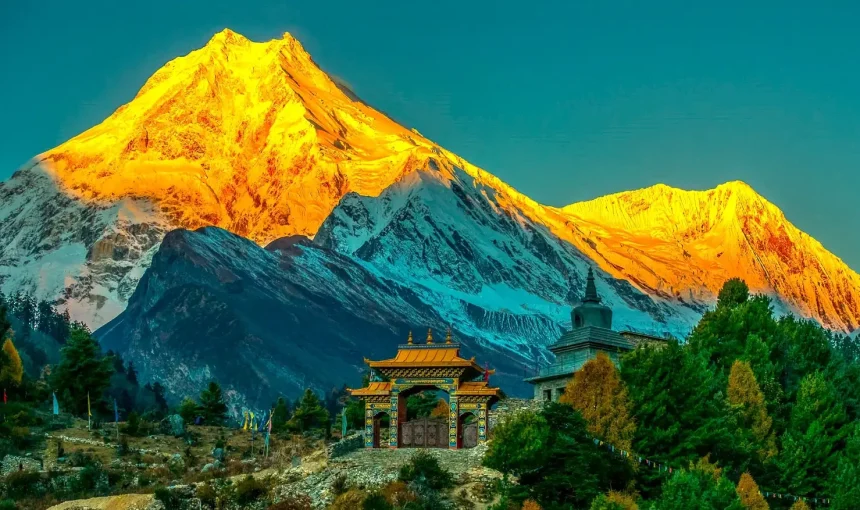
A private Manaslu Circuit Trek means the route around Mount Manaslu (8,163 m) is booked as your own trip — your own licensed guide, your own start date, and an itinerary planned around your group instead of a fixed departure calendar. You are not slotted into a bus full of strangers on a scheduled trip. You, your partner, your family, or a small group of friends can walk the Budhi Gandaki Valley and cross Larkya La Pass on your own terms, while a registered trekking agency handles the permits and guide arrangements that Nepal’s restricted-area regulations require either way.
Manaslu Treks & Expedition organizes private Manaslu Circuit Trek departures year-round for couples, families, friends travelling together, and small groups of two to eight people, alongside our regular group departures. This page explains what a private trek actually involves, what determines the cost, how the standard 13-day itinerary works, what permits are required, how transportation is arranged, who it suits best, and how it compares with joining a fixed group — using real figures from our current operations rather than generic marketing claims.
We’ve written this specifically for people who are past the “is Manaslu worth doing” stage and are now trying to work out the practical side of a private booking — the actual cost by group size, the permit fees, the realistic itinerary, and what genuinely changes when you book privately instead of joining a group. If you’re still deciding between Manaslu and another region entirely, most of what’s here will still be useful background, but the focus throughout is on private trek booking rather than a general destination overview.
About the Manaslu Region
Mount Manaslu is the eighth-highest mountain in the world, sitting in northern Gorkha District between the Budhi Gandaki and Marsyangdi valleys. The name comes from the Sanskrit “Manasa,” generally interpreted as spirit or intellect. The mountain was first climbed on 9 May 1956 by Toshio Imanishi and Sherpa Gyalzen Norbu, part of a Japanese expedition led by Yuko Maki; Reinhold Messner later climbed it without supplementary oxygen in 1972. None of that history is required knowledge for the trek, but it explains why the mountain carries the significance it does among Himalayan climbers and why walking beneath its northwest face at Samagaon feels different from a typical trekking viewpoint.
Planning the Manaslu Circuit Tsum Trek and need help with permits, route, or itinerary?
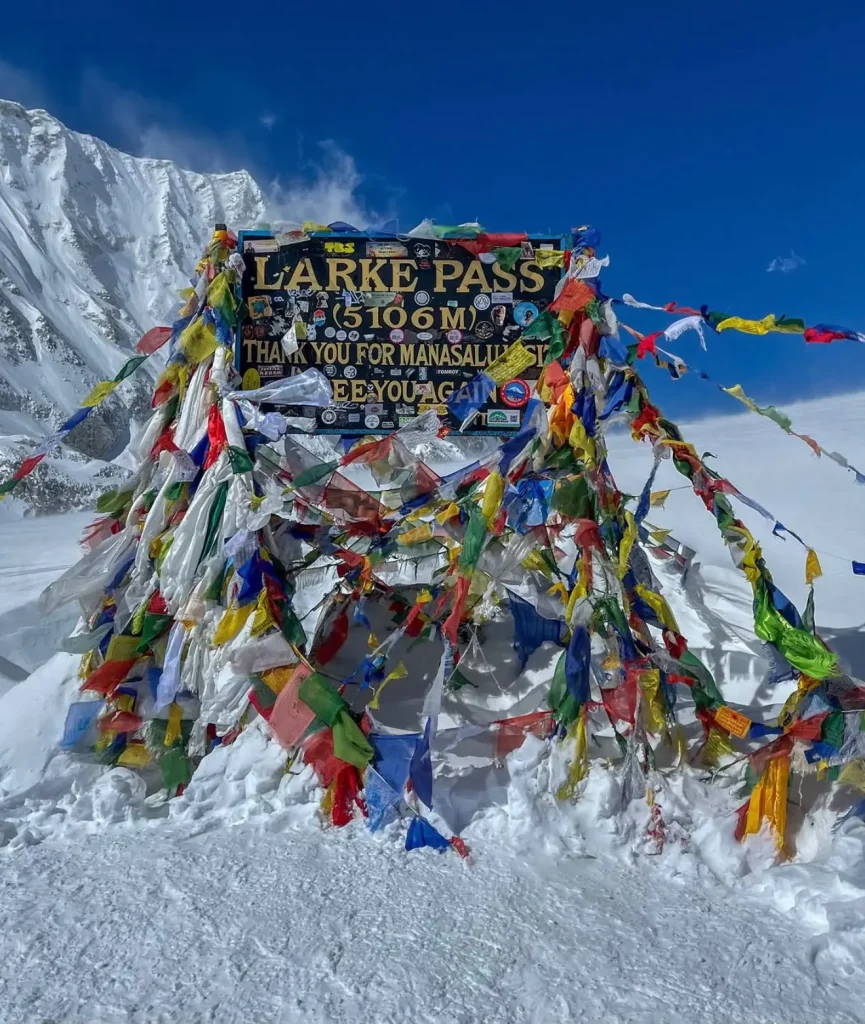
WhatsApp us Email usThe trekking route follows the Budhi Gandaki River through forested lower valleys, climbs through Gurung and then increasingly Tibetan-influenced Nubri villages such as Namrung, Lho, and Samagaon, and finishes with the crossing of Larkya La Pass at 5,106 m before descending into the Annapurna region near Bimthang. The Manaslu Conservation Area, established in 1998 and covering roughly 1,663 square kilometers, protects this corridor — the National Trust for Nature Conservation has recorded more than 2,000 plant species, 39 mammal species (including snow leopard, musk deer and Himalayan tahr) and over 200 bird species within it. None of this changes whether you trek privately or in a group, but it’s worth understanding the landscape and regulatory environment you’re booking into before we get to the practical details of a private trip.
The Manaslu Circuit Trek is a spectacular journey around Mount Manaslu (8,163 m), the eighth-highest mountain in the world. Located…
Manaslu Circuit Trek at a Glance
| Detail | Information |
|---|---|
| Duration | 13 days, Kathmandu to Kathmandu |
| Trip style | Private trip or group departure |
| Max altitude | 5,106 m / 16,752 ft (Larkya La Pass) |
| Difficulty | Challenging |
| Total distance | Approx. 160–180 km |
| Accommodation | Teahouse / lodge throughout |
| Meals | Breakfast, lunch and dinner included during the trek |
| Best season | March–May and September–November |
| Required permits | RAP, MCAP, ACAP, local government fee, TIMS |
| Guide requirement | Licensed guide mandatory (restricted area) |
| Start / end point | Kathmandu |
How the Manaslu Circuit Compares to Other Nepal Treks
If you’ve researched trekking in Nepal, you’ve probably come across the Everest and Annapurna regions first — they’re better known and see far more trekkers each year. Manaslu is different in a few concrete ways that matter when you’re deciding where to trek and how to book it. First, it’s a restricted area, not an open trekking region: you cannot walk it independently without a licensed guide and government-issued permits, unlike most standard Annapurna or Everest trails. Second, permit costs and paperwork are genuinely more involved here, as the tables above show, which is part of why working with an agency that specializes specifically in this region — rather than treating it as one more route on a long list — makes a practical difference. Third, infrastructure is real but noticeably less developed than on the busiest Everest and Annapurna trails: teahouses are comfortable and improving every year, but Dharmasala, in particular, remains basic, and the trail sees only a fraction of the trekker traffic of the Everest Base Camp or Annapurna Circuit routes. For travelers who’ve done those more established treks and want something quieter and less commercialized without giving up teahouse comfort, that combination is a large part of Manaslu’s appeal — and it’s also exactly why a private trek here, with a guide who knows the region specifically, carries more practical weight than it might on a more heavily trodden trail.
Planning the Manaslu Circuit Tsum Trek and need help with permits, route, or itinerary?
WhatsApp us Email usWhy Choose a Private Manaslu Circuit Trek?
Not every trekker needs a private trip, and we won’t pretend otherwise. But for certain travelers, booking privately solves real problems that a fixed group departure cannot.
Choose Your Own Departure Date
Group departures run on a schedule that must accommodate a full group, which usually means specific dates clustered in the main spring and autumn seasons. A private trek is planned around your travel dates instead of a public departure calendar. If you can only travel in the second week of April, or if you need to start on a particular day due to a connecting flight, we plan the trek around that rather than asking you to wait for the next scheduled departure. Our booking system already treats “Private Trip” as a separate option from “Group Departure,” precisely because the two work on different scheduling logic.
This matters more than it might sound. Annual leave, school holidays, connecting international flights and other commitments rarely line up neatly with a handful of published departure dates. A private booking removes that constraint entirely — the constraint that remains is the trekking season itself, since we won’t schedule a private departure into conditions we know are genuinely unsuitable, such as the height of monsoon or deep winter, regardless of how much you’d prefer those dates.
A Guide Dedicated to Your Group
On a private trek, your guide’s attention is on your group for the entire trip, not divided across ten or twelve people from different backgrounds and fitness levels. That matters on a restricted-area route where trail conditions, permit checkpoints and teahouse space change from village to village. A guide managing a smaller, known group can answer questions in more depth, explain the culture and monasteries you’re passing without rushing, and respond faster if someone is struggling with the altitude.
It also changes the working relationship over thirteen days. A guide who spends the whole trek with the same two, four or six people gets to know how each person walks, eats and sleeps at altitude, which means small warning signs — someone eating less than usual, walking more slowly than the day before — are easier to notice early, before they become a bigger problem on a demanding day like the Larkya La crossing.
The Manaslu Circuit Trek is a spectacular journey around Mount Manaslu (8,163 m), the eighth-highest mountain in the world. Located…
A Walking Pace That Matches Your Group
The Manaslu Circuit gains significant elevation over short distances, particularly between Namrung and Samagaon (2,900 m to 3,500 m) and again between Samdo and the Larkya La crossing (3,860 m to 5,106 m). Fitness and altitude response vary a lot between individuals, even among experienced trekkers. In a private trek, the daily pace is set by your group, not averaged across a dozen strangers with different capabilities. If your group wants to start earlier to beat the afternoon heat in the lower valley, or walk more slowly on the Deng-to-Namrung stage, that’s simply how the day gets planned.
Reasonable Itinerary Adjustments
We want to be direct: a private trek gives you more room to make sensible adjustments, not unlimited flexibility. Larkya La Pass still has to be crossed in a single long day, and the route still depends on trail and weather conditions on the day itself. What a private booking genuinely allows is discussion in advance — for example, adding a second night in Samagaon if your group wants extra acclimatization time before Samdo, or shifting a start time based on how people are feeling that morning. Decisions that affect safety, permits or the route itself are made by your guide based on actual conditions, not on request.
We’d rather set this expectation clearly than let you assume a private booking means the itinerary bends to any preference. What it actually means is that reasonable, safety-conscious changes are easier to discuss and act on when there’s no wider group schedule to protect. If you tell us in advance that your group wants a slower build to Larkya La, we can plan for that from day one instead of trying to retrofit it once you’re already on the trail.
Suitable for Couples, Families, Friends and Small Groups
A private Manaslu Circuit Trek works whether it’s two people, a family with older children or teenagers, or four to eight friends travelling together. The arrangement is the same principle in every case: your own guide, your own itinerary, and a trip that isn’t shared with trekkers you’ve never met. It also means evenings in the teahouse are spent with people you already know, which matters more than it might sound after a long day of walking — you’re not making conversation with strangers when you’re tired; you’re relaxing with your own group.
Planning the Manaslu Circuit Tsum Trek and need help with permits, route, or itinerary?
WhatsApp us Email usMore Say Over Transportation
On the road sections — Kathmandu to Machha Khola, and the return from Tilije — a private group can choose a reserved private vehicle instead of the shared public bus used on some standard packages. We cover exactly what that costs and how it compares further down this page, because it’s one of the more concrete, practical differences between a private and a group booking.
Room for Photography and Personal Interests
If you want to stop for ten minutes at a viewpoint of Manaslu, spend longer at a monastery in Lho, or wait for better light before photographing a suspension bridge crossing, a private trek gives your guide the room to allow that without holding up other trekkers who didn’t sign up for the same interests. This isn’t unlimited — the day’s walking time and altitude schedule still need to be respected — but within that structure, a private itinerary has noticeably more room for the things you specifically came to see.
Private Manaslu Circuit Trek Cost
Private Manaslu Circuit Trek cost depends on several factors, and any company that quotes you a single fixed number without asking about your group size and dates isn’t giving you an accurate figure. Here is what actually determines the price.
What Determines the Price
- Number of trekkers. This is the single biggest factor. Fixed costs — guide fees, ground transportation and some logistics — are spread across the group, so per-person cost is highest for a solo traveler and drops as group size increases.
- Guide and porter arrangement. A licensed English-speaking guide is required for the entire trek by current Nepal Tourism Board regulation. Porter support is typically one porter for every two trekkers, carrying up to 20 kg combined, though this can be adjusted for smaller or larger private groups.
- Manaslu Restricted Area Permit (RAP). Priced by season and number of days inside the restricted section — more on the actual fee structure below.
- Manaslu Conservation Area Permit (MCAP) and Annapurna Conservation Area Permit (ACAP). Both are required because the standard route passes through both protected areas.
- Transportation. Standard packages use local/public transport between Kathmandu and Machha Khola, and between Tilije and Kathmandu. A private jeep for these legs is available and priced separately.
- Accommodation. Two nights in a Kathmandu hotel (one before and one after the trek) plus teahouse accommodation throughout the trekking days.
- Meals. Three meals a day during the trekking days, plus morning tea or coffee.
- Trek duration. The standard itinerary is 13 days Kathmandu to Kathmandu. An extra acclimatization day, a Tsum Valley extension, or a different day count changes the total cost.
The Manaslu Circuit Trek is a spectacular journey around Mount Manaslu (8,163 m), the eighth-highest mountain in the world. Located…
Current Reference Pricing
Based on our current group-size pricing structure, per-person cost for the Manaslu Circuit Trek is as follows:
| Number of Trekkers | Price per Person (USD) |
|---|---|
| 1 traveler (private/solo) | USD 1,350 |
| 2 – 5 travelers | USD 1,250 |
| 6 – 8 travelers | USD 1,200 |
| 9 – 10 travelers | USD 1,150 |
These figures are a useful reference point for budgeting a Private Manaslu Circuit Trek cost in 2026 and 2027, whether you’re travelling alone, as a couple, or as a small private group. Permit fees and operating costs can change, and we occasionally run limited-time promotional rates on specific departure dates, so we recommend confirming the current rate for your exact dates and group size directly with our team on WhatsApp or by email before booking, rather than relying on any number published online, including this one.
What’s Included and What Isn’t
Our standard package includes airport pickup and drop-off, two nights of Kathmandu hotel accommodation with breakfast, transportation between Kathmandu and Machha Khola and between Tilije and Kathmandu, all required permits (RAP, MCAP, ACAP), your licensed trekking guide and porter service, teahouse accommodation and three meals a day during the trek, a sleeping bag and down jacket (provided for the trek and returned afterward), a trekking map, a completion certificate, a first-aid kit carried by the guide, government taxes, and a farewell dinner in Kathmandu.
It does not include international airfare, the Nepal entry visa fee, travel insurance with emergency medical and helicopter evacuation coverage, personal expenses such as laundry, phone calls, Wi-Fi and device charging, bottled water and other drinks, and snacks or personal food during the trek. Travel insurance is not optional in practice — the altitude and remoteness of the route mean it should specifically cover high-altitude trekking and emergency evacuation, not just standard travel mishaps.
Choosing Your Private Group Size
The cost table above makes the trade-off visible, but it’s worth walking through what it actually means in practice. A solo private trekker pays the most per person because the guide’s fee, ground transportation and other fixed costs aren’t shared with anyone. That’s a fair price for genuine one-on-one guiding and complete schedule control, and it’s the right choice if you’re travelling alone and value privacy and flexibility over saving money.
A private group of two to five people brings the per-person cost down meaningfully while keeping almost all of the flexibility of a solo private trek — you still get a dedicated guide and a itinerary built around your group, just with the fixed costs spread across more people. This is why we describe two-to-five as the most balanced private group size for most couples, families and friend groups: you’re not paying the solo premium, but you’re also not dealing with the scheduling compromises of a large fixed departure. Groups of six to ten bring costs down further and start to resemble our standard group pricing, while still being fully private if you book together as a self-contained group rather than joining strangers on a scheduled departure.
Permits and Fees for a Private Manaslu Trek
Manaslu is a government-designated restricted trekking area, so the permit process is more involved than for an ordinary Nepal trekking route — and it applies exactly the same way whether you trek privately or in a group. Four separate permits and registrations apply:
| Permit | Fee |
|---|---|
| Manaslu Restricted Area Permit (RAP) — Sept to Nov | USD 100/person for the first 7 days, then USD 15/person/day |
| Manaslu Restricted Area Permit (RAP) — Dec to Aug | USD 75/person for the first 7 days, then USD 10/person/day |
| Manaslu Conservation Area Permit (MCAP) | NPR 3,000 per person |
| Annapurna Conservation Area Permit (ACAP) | NPR 3,000 per person |
| Local Government / Municipality Fee | NPR 100 per person |
| TIMS / Trekking Registration | NPR 1,000 (SAARC nationals) / NPR 2,000 (other foreign nationals) |
If you combine your private trek with Tsum Valley, an additional Tsum Valley Restricted Area Permit applies separately: USD 40/person for the first week (September–November) or USD 30/person (December–August), plus USD 7/person/day after the first week.
The Restricted Area Permit can only be processed through a registered trekking agency — you cannot arrive at the trailhead and buy it yourself. All of the permit fees above are included in what you pay us — we’re listing the breakdown here so you understand where the cost comes from, not because you need to arrange any of it separately.
What We Need From You Before the Trek
To prepare your Manaslu Restricted Area Permit and trekking registration, we’ll ask you for: a clear copy of your valid passport, your Nepal visa information (visa number or submission details), a current travel insurance document showing appropriate coverage, a recent passport-style photograph, and your confirmed trekking dates, since the RAP fee depends directly on season and duration. We handle insurance documentation for the guide and porters accompanying your trek ourselves. Once we have these details, our team submits the application and prepares your documentation — you won’t need to visit the Department of Immigration or conservation-area offices yourself, and your permits are checked, as required, at official checkpoints along the route, so keep them accessible rather than packed away deep in your bag.
Planning the Manaslu Circuit Tsum Trek and need help with permits, route, or itinerary?
WhatsApp us Email usPrivate Manaslu Circuit Trek Itinerary
Our standard Private Manaslu Circuit Trek itinerary runs 13 days from Kathmandu back to Kathmandu, covering roughly 160–180 km depending on the exact trail and road access at the time. This is the same route used for our group departures, and it’s the itinerary we recommend as a starting point for private bookings because it builds in a sensible acclimatization schedule before Larkya La Pass. From here, private groups can discuss reasonable adjustments — an additional rest day, a slower pace on a specific stage, or a Tsum Valley extension — based on your fitness, available time and the actual conditions closer to departure.
Day-by-Day Outline
Day 1: Arrival in Kathmandu (1,300 m). Our team meets you at Tribhuvan International Airport and transfers you to your hotel, followed by a trek briefing covering the route, permits, gear and what to expect. For a private booking, this is also when we confirm any last details about your itinerary — pace preferences, transportation choice, or any adjustments discussed during planning — before you set out the next morning.
Day 2: Drive from Kathmandu to Machha Khola (930 m). Roughly 160–170 km, 8–10 hours by road, following the hills and the Budhi Gandaki River out of the Kathmandu Valley. Whether this leg is by public bus or private jeep depends on what you’ve arranged — see the transportation section further down this page for the practical difference between the two.
Day 3: Trek from Machha Khola to Jagat (1,410 m). Approximately 16–17 km, 6–7 hours walking. The first trekking day follows the Budhi Gandaki through forest, past waterfalls and over the first suspension bridges, giving your group a chance to settle into a walking rhythm together before the terrain gets more demanding.
Day 4: Trek from Jagat to Deng (1,860 m). Approximately 18–20 km, 6–7 hours walking, through the narrower part of the Budhi Gandaki gorge with more suspension bridge crossings. This is one of the longer walking days on the itinerary, and a private group can set out earlier if that suits your pace better than a fixed departure time.
Day 5: Trek from Deng to Namrung (2,900 m). Approximately 17–19 km, 6–7 hours walking, through pine and fir forest with the first clear signs of Tibetan Buddhist influence in the villages. You’ll notice the architecture and the prevalence of mani walls and prayer flags shifting noticeably by the time you reach Namrung.
Planning the Manaslu Circuit Tsum Trek and need help with permits, route, or itinerary?
WhatsApp us Email usDay 6: Trek from Namrung to Samagaon (3,500 m). Approximately 17–18 km, 6–7 hours walking, passing through Lho, where Manaslu itself starts to dominate the skyline. Many private groups slow down here deliberately — the views toward the Manaslu massif from Lho and the approach to Samagaon are some of the best on the entire circuit.
Day 7: Acclimatization day in Samagaon (3,500 m). A 6–10 km, 3–5 hour hike toward Birendra Lake and Pungyen Gompa, reaching 3,800–4,000+ m before returning to sleep at Samagaon’s altitude. This is a genuine rest-and-adjust day before continuing higher, not just a scenic add-on — the “climb high, sleep low” pattern is exactly why this stop is built into the itinerary before Samdo and Larkya La.
Day 8: Trek from Samagaon to Samdo (3,860 m). Approximately 8–9 km, 3–4 hours walking through open, high-altitude terrain and yak pastures. It’s a comparatively short day by distance, giving your body more time to adjust before the altitude increases further.
Day 9: Trek from Samdo to Dharmasala / Larkya Phedi (4,450 m). Approximately 6–7 km, 4–5 hours walking. Dharmasala is the highest and most basic overnight stop on the route — electricity here runs mainly on solar power and Wi-Fi is very limited, unlike most other villages on the circuit — so the afternoon is kept short and focused on rest before the pass.
Day 10: Cross Larkya La Pass (5,106 m) and trek to Bimthang (3,720 m). Approximately 17–20 km, 8–10 hours walking. This is the longest and hardest day of the trek by a clear margin — an early, cold start well before sunrise, a steady climb to the highest point of the route, and a long, knee-testing descent on the other side toward Bimthang.
Day 11: Trek from Bimthang to Tilije (2,300 m). Approximately 15–18 km, 5–7 hours walking, descending through forest as the vegetation turns green again and you re-enter the Marsyangdi valley. After the exposed, rocky terrain of the previous days, this stage feels noticeably different — warmer, greener and gentler underfoot.
Day 12: Drive from Tilije to Kathmandu. Roughly 220+ km, 8–10+ hours by road, back to Kathmandu for a farewell dinner. For private groups using our own jeep, this leg starts with direct pickup from Tilije rather than a walk on to Dharapani first.
Day 13: Final departure. Airport transfer arranged according to your international flight schedule.
Distance alone doesn’t tell the full difficulty story on this route — a shorter day at high altitude, like Samdo to Dharmasala, can feel harder than a longer day lower down. The Dharmasala–Larkya La–Bimthang stage is consistently the hardest single day, combining the longest walking time with the highest elevation of the trek.
The Manaslu Circuit Trek is a spectacular journey around Mount Manaslu (8,163 m), the eighth-highest mountain in the world. Located…
What Can Actually Be Adjusted on a Private Trip
We won’t claim any request can be accommodated, because that isn’t true on a restricted-area route with a fixed high pass. What we can genuinely offer on a private booking includes: starting on a date that works for you rather than a published departure; adding an extra acclimatization day if your group wants more buffer before Samdo or Larkya La; combining the circuit with Tsum Valley for a longer, more culturally focused trip; and adjusting daily start times and pace within each stage. Larkya La Pass still has to be crossed in one push, and if weather or trail conditions on the day require a change of plan, that decision is made by your guide for safety reasons, not by preference.
Transportation for Your Private Trek
Transportation is one of the most concrete practical differences between a private and a group booking, so it’s worth explaining properly rather than glossing over it. The road journey between Kathmandu and Machha Khola can be done by public bus or by reserved private jeep, and the two options differ meaningfully in cost, comfort and flexibility.
| Transportation | Approx. Cost | Approx. Time | Flexibility |
|---|---|---|---|
| Public bus | USD 10–12 per person | 7–8 hours | Fixed schedule, limited stops |
| Reserved private jeep | Approx. USD 150 per jeep | 5–6 hours | Flexible departure and rest stops, can travel farther when road conditions permit |
The road journey itself is a long mountain drive regardless of which option you choose, so we build in reasonable breaks along the way — breakfast and lunch stops timed to the journey, bathroom breaks, and photo stops where traffic and road conditions allow. For private treks, we generally use our own Land Cruiser, Bolero or Scorpio vehicles, selected according to group size and current road conditions. This matters most on the return leg: a public bus from Tilije generally requires trekkers to walk on to Dharapani to connect with transportation, while our private jeep can pick up directly from Tilije, subject to road conditions at the time. Road access itself is not fixed — depending on the season, a jeep may be able to travel beyond Chisapani toward Machha Khola and sometimes farther, while during heavy monsoon rainfall vehicles may not reach past Machha Khola at all. We check current road conditions before your departure and plan transportation accordingly rather than promising a fixed road endpoint regardless of what’s actually happening on the ground that season.
People and Culture Along the Route
A private trek gives you more room to slow down and actually take in the cultural side of the Manaslu Circuit, which changes noticeably as you gain altitude. The Manaslu Conservation Area covers three broad cultural areas — Nubri, Kutang and Tsum. Villages such as Samagaon, Lho and Prok belong to Nubri, while Chumchet and Chhekampar form part of Tsum Valley, each with its own dialect, customs and community identity shaped by geography and long historical ties to Tibet.
In the lower and middle sections of the route, Gurung communities are the dominant presence, and you’ll see this in the architecture, food and daily rhythms of villages like Jagat and Deng. Climbing higher, the upper Nubri settlements around Lho and Samagaon show a much stronger Tibetan Buddhist character — mani walls, chortens, prayer wheels and prayer flags become a constant presence along the trail, and monasteries such as Pungyen Gompa near Samagaon are active religious sites, not museum pieces.
Daily life away from the trekking trail still runs largely on farming and livestock — barley, buckwheat and potatoes are the staple crops that suit the altitude and climate, and yaks remain important for transport and food at the higher elevations. Tourism has become a significant part of the local economy over the past decade, but it sits alongside, not in place of, these older patterns of village life. It’s worth remembering, particularly if you’re trekking with a small private group and have more time to look around, that not every household along the route runs a teahouse — many families are simply going about ordinary agricultural life that predates trekking tourism by generations.
Because a private itinerary isn’t locked to a group’s collective pace, your guide has more room to stop at a monastery, explain a festival if your dates happen to overlap with one — communities in the region observe Lhosar and Tamu Lhosar as New Year celebrations, along with Buddhist observances such as Saga Dawa and Dumji, though exact dates shift with the lunar calendar — or simply let a village go by at walking pace instead of rushing to keep a schedule. A few practical etiquette points are worth knowing before you go: ask before photographing people, especially monks and children; walk clockwise around chortens and mani walls, as is local custom; dress modestly and behave quietly around monasteries, particularly during ceremonies; and don’t remove stones or religious objects as souvenirs.
Planning the Manaslu Circuit Tsum Trek and need help with permits, route, or itinerary?
WhatsApp us Email usFlora and Fauna You Might See
The Manaslu Conservation Area’s biodiversity comes from the sheer elevation range the trek covers — from warm forested valleys around 900 m to bare alpine terrain above 5,000 m at Larkya La. Lower and middle sections between Jagat and Namrung run through pine, fir and rhododendron forest, with rhododendron flowering seasonally depending on elevation and the year’s weather. Above Samagaon, Himalayan birch and juniper appear before the tree line gives way to open alpine meadows, and by Dharmasala and the approach to Larkya La, vegetation is sparse to nonexistent.
Wildlife recorded in the conservation area includes snow leopard, musk deer, Himalayan tahr, Himalayan serow, blue sheep, red fox and Himalayan marmot, along with more than 200 recorded bird species including Himalayan griffon and golden eagle. We’ll be straightforward about this: the Manaslu Circuit is not a wildlife safari, and most of these animals are shy and stay well away from the main trail. Seeing a snow leopard on a standard trek would be exceptionally rare. What trekkers more realistically notice is the changing forest cover, rhododendron in season, mountain birds overhead, and the occasional marmot near the higher pastures — a guide who knows the route can often point out signs of wildlife that would otherwise go unnoticed.
Teahouses and Daily Comforts on the Route
The Manaslu Circuit is a teahouse trek — you won’t need to carry a tent or camping equipment on the standard route, since guesthouses operate in the villages from the lower Budhi Gandaki valley all the way to Bimthang. Facilities have improved substantially in recent years: most teahouses now have electricity, phone and camera charging (often free, though some lodges still charge a small fee), and Wi-Fi of varying speed and reliability. Rooms are simple and functional, usually twin-sharing, with beds, mattresses and blankets provided.
Dharmasala is the one clear exception. As the highest and most remote overnight stop before Larkya La, its electricity depends mainly on solar power, Wi-Fi and mobile signal are very limited, and accommodation is more basic than anywhere else on the route. This is expected and normal for a stop at 4,450 m — it’s simply worth knowing in advance rather than being surprised by it. Hot showers are available at many teahouses in the lower and middle sections, though availability becomes less reliable the higher you go. Meals throughout the trek typically include dal bhat, noodles, pasta, soups, potatoes, momos and other simple teahouse fare, with vegetarian options widely available. A private group has a bit more flexibility here too — since you’re not coordinating a large party’s dietary preferences and room assignments, meal and room logistics at each stop tend to be simpler.
Guides and Porters on Your Private Trek
It’s worth understanding what your guide and porter actually do, since they’re the two people your private trek depends on most directly. Your guide is responsible for route-finding, daily planning, coordinating with teahouses, monitoring how the group is handling the altitude, and making the real-time judgment calls that keep a mountain trek safe — recommending rest, adjusting the pace, or changing plans if weather or trail conditions demand it. On a restricted-area route like Manaslu, a licensed guide isn’t a luxury add-on; current Nepal Tourism Board regulations require one, along with a trekking-agency-issued TIMS registration.
A porter’s role is different: carrying the group’s main trekking bags so you walk with only a light daypack, typically at a ratio of one porter per two trekkers carrying up to 20 kg combined. Trekkers generally keep water, documents, valuables, medication and other essentials in their own daypack. Many experienced porters in Nepal’s trekking industry eventually train and certify as guides themselves, which is part of why we take porter welfare seriously — fair loads, proper equipment and reasonable working conditions aren’t just an ethical position, they reflect how much of our own guiding team started out. On a private trek, both roles are dedicated to your group specifically for the full trip, rather than being shared informally across a larger party.
What to Pack for a Private Manaslu Trek
Packing for Manaslu means preparing for both warm lower-valley days and genuinely cold, high-altitude conditions around Larkya La — the same list applies whether you’re trekking privately or in a group. At minimum you’ll want: sturdy, broken-in trekking boots, a warm down jacket, a good sleeping bag rated for sub-zero temperatures (we provide one as part of your package, along with a down jacket, and both are returned at the end of the trek), layered clothing including a base layer, fleece or midlayer, and a windproof/waterproof outer shell, warm gloves and a hat, sunglasses and high-SPF sunscreen for the intense high-altitude sun, trekking poles, a headlamp, a basic personal first-aid kit and any personal medication, water purification tablets or a filter, and a daypack to carry the essentials you want with you rather than with your porter.
Trekking boots and a sleeping bag are worth getting right before you arrive, since fit and personal comfort matter most for these two items. Other technical gear, such as microspikes for icy sections or additional cold-weather layers, can usually be rented in Kathmandu if needed, which is worth asking us about rather than over-packing for conditions that may not apply to your specific dates. Keep in mind that porter capacity is generally around 20 kg shared between two trekkers, so packing efficiently — rather than bringing everything you own “just in case” — makes the trek more comfortable for everyone, porters included.
The Manaslu Circuit Trek is a spectacular journey around Mount Manaslu (8,163 m), the eighth-highest mountain in the world. Located…
Fitness and Preparation for a Private Trek
The Manaslu Circuit is rated challenging, and the honest reason is the altitude gain rather than technical difficulty — no ropes, crampons, or climbing skills are needed on the standard route. What matters is being able to walk five to ten hours a day, several days in a row, on an uneven mountain trail, while your body adjusts to progressively thinner air. The itinerary is built to manage that: you gain altitude gradually from Machha Khola upward, with a dedicated acclimatization day at Samagaon before the push through Samdo, Dharmasala and over Larkya La.
A private trek doesn’t lower the physical demand of the route, but it does let the pace and rest schedule reflect your group’s actual fitness rather than an average across strangers. If you’re preparing in advance, general cardiovascular fitness and experience walking on consecutive long days — hiking, hill walking, or simply extended time on your feet with a daypack — will serve you better than anything specific to altitude, since altitude response varies by individual regardless of fitness level. If you’ve trekked above 3,000 m before, that experience is useful for knowing how your own body tends to respond, but it isn’t a prerequisite; plenty of first-time high-altitude trekkers complete the Manaslu Circuit successfully with sensible pacing and a guide who takes acclimatization seriously.
Planning the Manaslu Circuit Tsum Trek and need help with permits, route, or itinerary?
WhatsApp us Email usWho Is a Private Manaslu Trek Best For?
Couples
A Manaslu Circuit Trek for couples booked privately means you’re not sharing your daily rhythm, meals, or teahouse evenings with a group of strangers. You set the pace together, and your guide adjusts to how the two of you are managing the altitude and terrain.
Families
Manaslu Circuit Trek for families works as a private booking when children are old enough to manage the walking days and altitude gain, since the terrain is genuinely demanding, particularly around Larkya La. A private arrangement lets the itinerary reflect the family’s actual walking speed rather than assuming everyone matches a fixed group’s pace, and gives parents room to make a judgment call about rest days without checking it against other trekkers’ plans. We’ll say plainly that this isn’t a trek for young children — the altitude, distance and the Larkya La crossing are demanding even for fit adults — but for families with teenagers or older children with genuine trekking experience, a private booking is the more sensible way to attempt it.
Friends Travelling Together
A group of friends booking a Custom Manaslu Circuit Trek gets the benefit of shared costs across the group while still keeping the guide, schedule and itinerary private to just your group. It also avoids one of the more common frustrations of joining a fixed departure with strangers: mismatched fitness levels dictating the pace for everyone. When your whole group already knows and trusts each other, decisions about rest days, start times and side trips like the Birendra Lake hike at Samagaon tend to happen faster and more comfortably.
Small Groups
Manaslu Circuit Trek for small groups of four to eight people is often the most balanced private option — you get meaningfully lower per-person cost than a solo private trek while still avoiding a large fixed departure with people you don’t know. It also tends to be a comfortable size for porter logistics, since one porter per two trekkers scales cleanly at this group size without needing a large support team.
Experienced Trekkers
Trekkers who already know their own walking rhythm, have done high-altitude treks before, and want a Manaslu trek private guide who can move at their pace rather than a group average, tend to get the most out of a private booking. If you’ve already trekked to Everest Base Camp or around the Annapurna Circuit and know how your body handles altitude above 4,000 m, a private Manaslu trek lets you apply that self-knowledge directly, rather than defaulting to a conservative group pace built for trekkers of unknown fitness.
First-Timers at High Altitude, With the Right Preparation
You don’t need years of Himalayan trekking experience to attempt the Manaslu Circuit. The route starts at a relatively low elevation around Machha Khola (roughly 900–930 m) and climbs progressively, which gives your body time to adapt. Good general fitness — being comfortable walking several hours a day on consecutive days over uneven terrain — matters more than prior high-altitude experience. That said, Larkya La still reaches 5,106 m, so this should never be treated as an easy trek regardless of the pacing.
Travelers Who Need Their Own Dates
If your available travel window doesn’t match a published group departure, a private trek is really the only practical route to doing the Manaslu Circuit on the dates you actually have.
Private vs Group Joining Manaslu Circuit Trek
The Manaslu Circuit is a restricted-area route, so “solo trekking” here doesn’t mean independent trekking without a guide — a licensed guide and the required permits are mandatory either way, whether you travel alone or as part of a large group. The real choice for most travelers is between a private trek with a dedicated guide and itinerary, or joining a group departure alongside other trekkers.
| Feature | Private / Solo Traveler | Group Trek |
|---|---|---|
| Trip style | Private | Shared |
| Guide | Dedicated to your trip | Shared with the group |
| Departure date | Flexible | Usually fixed |
| Walking pace | More flexible | Group pace |
| Itinerary changes | Easier | More limited |
| Privacy | High | Moderate |
| Social experience | More private | More social |
| Cost per person | Higher | Usually lower |
| Best for | Privacy and flexibility | Value and companionship |
Group joining generally suits travelers who are comfortable with fixed departure dates, want to meet other trekkers, and prefer a lower per-person cost. Private trekking suits travelers who want their own schedule, a dedicated guide, and more room to adjust the day-to-day plan. Neither option is objectively better — it depends on what you’re optimizing for. For many trekkers, a small private group of two to five people ends up being the most balanced choice: meaningfully lower cost per person than a fully private solo trek, while keeping the flexibility of a private itinerary.
Why Book Your Private Manaslu Trek With Manaslu Treks & Expedition?
We are a Nepal-based trekking company that focuses specifically on the Manaslu region and Tsum Valley, rather than running trips across every trekking area in the country. That focus is a practical advantage on a restricted-area route like this one, where permit rules, trail conditions and teahouse availability change often enough that generic knowledge isn’t enough.
Our founder, Kiran Basnet, is the Founder and CEO of Manaslu Treks & Expedition Pvt. Ltd. He was born and raised in the Himalayas and began his career in these mountains as a porter, building years of hands-on experience on the trails before founding the company. That background shapes how we plan private treks — our itineraries come from actually having walked this specific route in different seasons, not from a template copied across trekking regions.
Planning the Manaslu Circuit Tsum Trek and need help with permits, route, or itinerary?
WhatsApp us Email usWhat Working With Us Involves
- A licensed, English-speaking guide assigned specifically to your group for the full trek, supported by porters trained in first aid and altitude awareness.
- Full permit handling for the Manaslu Restricted Area Permit, MCAP, ACAP and TIMS registration, arranged through our registered agency before departure.
- Direct communication with our team before you book and throughout planning, so you can ask specific questions about dates, pace or itinerary changes before committing.
- No advance payment required for eligible bookings — we keep the initial step simple so you can plan with us without financial pressure up front.
- Transparent pricing that clearly separates what is included and excluded, so there are no surprise costs once you’re on the trail.
- Practical support during the trek, including a first-aid kit carried by your guide and coordination support if a weather delay or medical situation requires a change of plan.
- Vehicles we operate ourselves — Land Cruiser, Bolero and Scorpio — for private road transportation, rather than outsourcing to whoever is available on the day.
We are a registered and licensed trekking company (Company Reg. No: 390960/82/83, PAN: 623602724, Local Business Reg. No: 21260), a TAAN member and NMA affiliated, operating from our office in Thamel, Kathmandu. Our guiding team includes trek leader Amar Khand and trekking guides Sudip Gurung, Rupak Kadel, Dipak Dhakal, Arjun Adhikari, Susam Suyal, Keshav Khadka and Aayush Basnet, all of whom work specifically on Manaslu and Tsum Valley routes. As of this writing, our Manaslu Circuit Trek carries 26 verified trip reviews with a 4.8 out of 5 average rating on our own booking platform.
A few other things worth knowing before you book: we give a proper pre-trek briefing covering the route, altitude, accommodation, meals and gear before you set out, so you’re not figuring things out on day one. We can also advise honestly on what gear you actually need for this specific route rather than a generic Nepal trekking list, and what can be rented in Kathmandu instead of carried from home. Because our operations are concentrated on Manaslu and Tsum Valley rather than spread across every trekking region in Nepal, our team can give more attention to the details specific to this route — permit timing, current road conditions, which teahouses are open in a given season — than a company running treks everywhere from Everest to the Annapurnas to Mustang at the same time.
The Manaslu Circuit Trek is a spectacular journey around Mount Manaslu (8,163 m), the eighth-highest mountain in the world. Located…
Staying in Touch During Your Private Trek
Connectivity along the Manaslu Circuit has improved a lot in recent years, though it’s still worth setting expectations correctly. Most teahouses from Machha Khola up through Samagaon now offer Wi-Fi of varying speed, and a local Namaste SIM card can provide mobile data in areas with network coverage, which is most of the lower and middle sections of the route. Dharmasala remains the clear exception — internet and mobile signal are very limited there, consistent with it being the most remote and basic stop on the circuit. Once you descend past Larkya La toward Bimthang, connectivity picks back up again. None of this is unique to private trekking, but it’s genuinely useful to know in advance: don’t plan on being reachable in real time on days nine and ten of the standard itinerary, and let people at home know that in advance rather than leaving them wondering why you’ve gone quiet.
Altitude Awareness on a Private Trek
Larkya La Pass sits at 5,106 m, and the standard itinerary is built specifically around managing that altitude gain sensibly rather than rushing toward it. The route follows the widely accepted principle of gradual ascent with a dedicated acclimatization day — the Samagaon rest day, with its hike up toward Birendra Lake and Pungyen Gompa, exists specifically so your body can adjust to roughly 3,500 m before continuing toward Samdo, Dharmasala and the pass itself. This is not a formality; skipping or rushing that adjustment period is one of the more common and avoidable causes of altitude problems on high routes like this one.
On a private trek, your guide watches for the usual early signs — headache, unusual fatigue, loss of appetite, difficulty sleeping — throughout the trek, and has the flexibility to slow the pace, extend a rest period, or in a serious case, descend, without needing to coordinate that decision around a larger group’s plans. Staying well hydrated, eating enough despite reduced appetite at altitude, and being honest with your guide about how you’re actually feeling all matter more than any piece of gear you can buy. If you have specific health conditions relevant to high-altitude travel, it’s worth discussing them with your own doctor before booking, and mentioning them to us directly so we can plan accordingly.
Safety and Emergency Support
High-altitude trekking carries real risk, and a private booking doesn’t remove that — it changes how quickly and specifically your team can respond to it. Every guide on our team is trained in altitude awareness, basic first aid and emergency response, and carries a first-aid kit throughout the trek. On a private trip, your guide’s judgment calls about pace, rest and route are made entirely around your group’s condition, without needing to weigh the needs of other trekkers who aren’t part of your booking.
If a serious situation does arise — a medical issue, a bad reaction to altitude, a weather-related delay — our team coordinates from Kathmandu to help arrange the appropriate response, which for a genuinely serious case at these altitudes usually means helicopter evacuation. This is exactly why travel insurance with high-altitude and evacuation coverage isn’t optional, whatever package you book. We’d rather you understand this clearly before you go than discover it as a surprise on the trail.
None of this is meant to alarm you out of booking — thousands of trekkers complete the Manaslu Circuit safely every season, and the itinerary, permit system and guide requirement all exist specifically to manage the route’s risks properly. The point is simply that “private” doesn’t mean “less structured.” If anything, a well-run private trek should feel more attentive to safety, not less, because your guide’s full focus is on your specific group throughout.
How Booking a Private Trek Works
The process is straightforward. You contact us with your rough plans — dates, group size, and duration — and we respond honestly about what’s realistic for that window, including if your dates fall in a season we wouldn’t normally recommend. From there we go back and forth on the itinerary details: standard 13 days, an added acclimatization day, or a Tsum Valley extension, along with transportation preferences for the road sections. Once the plan and cost for your specific group are confirmed, we begin the permit paperwork, which requires your passport copy, Nepal visa information, travel insurance details and a passport photo. No advance payment is required for eligible bookings to get this process moving — we’d rather earn your commitment through clear communication than lock you in with an upfront charge. Final arrangements, including your Kathmandu hotel and airport pickup, are confirmed as your departure date approaches.
Responsible Private Trekking
A private trek doesn’t have to mean a lighter footprint in the region — if anything, it’s an opportunity to be more deliberate about it. We work with local guides and porters from Manaslu and Tsum Valley communities, stay in locally owned teahouses along the route, and try to keep porter loads reasonable and fair rather than treating load limits as something to push. The Manaslu Conservation Area protects forest, wildlife and community land that local households still depend on for farming and livestock alongside tourism income, so we ask trekkers to stay on marked trails, avoid taking plants, stones or religious items as souvenirs, and pack out what they bring in. None of this changes whether you’re trekking privately or with a group — it’s simply part of trekking responsibly in a restricted, ecologically protected area.
Extending Your Private Trek: The Tsum Valley Combination
Because a private itinerary isn’t locked to a fixed group schedule, combining the Manaslu Circuit with Tsum Valley is a realistic option worth considering if you have the extra time. Tsum Valley branches off the main Budhi Gandaki route near Philim and Lokpa, leading into a side valley with its own strong Buddhist identity — the Tsumba culture — and a slower pace of development than the main circuit. It’s one of our core routes alongside the standard Manaslu Circuit, not an improvised add-on, and we run it regularly for both group and private bookings.
Practically, combining the two treks means: a longer overall itinerary than the standard 13 days, a separate Tsum Valley Restricted Area Permit on top of the standard Manaslu permits (USD 40 per person for the first week in September–November, or USD 30 per person in December–August, plus USD 7 per person per day after that), and more time spent in traditional villages and monasteries before rejoining the main route toward Samagaon and Larkya La. For travelers who want a deeper cultural experience alongside the mountain scenery and have an extra week or so available, it’s worth asking about when you contact us — we’ll give you a realistic combined itinerary and cost rather than just tacking days onto the standard package.
Planning the Manaslu Circuit Tsum Trek and need help with permits, route, or itinerary?
WhatsApp us Email usBest Time for a Private Manaslu Circuit Trek
One advantage of booking privately is that you’re not tied to someone else’s departure calendar, so you can genuinely aim for the strongest trekking window rather than whatever date a group trip happens to run. Based on our experience operating this route, October is generally the strongest month overall — clear post-monsoon skies, dry trails, and generally favorable conditions for the Larkya La crossing. April is a close second, with good spring visibility and greener lower valleys. Early November and late March are solid shoulder-season options, and late September can work well too as the monsoon clears. We generally advise against the monsoon months of June to August, since the lower Budhi Gandaki valley receives heavy rainfall that affects both the trail and road transportation, and against full winter (December to February) for a standard-length private trek, since snow and cold at Samdo, Dharmasala and Larkya La add real difficulty. If your dates fall outside the ideal window, we’ll tell you honestly what to expect rather than just taking the booking.
Month-by-Month Guide for Private Departures
| Month | Typical Conditions | Our Recommendation |
|---|---|---|
| January – February | Very cold, winter conditions at high altitude | Not recommended for most trekkers |
| March | Improving; high areas can still be snowy early in the month | Better from late March |
| April | Spring, good visibility, comfortable temperatures | Excellent |
| May | Good early in the month; increasing pre-monsoon cloud later | Good, especially early May |
| June – August | Monsoon; wet, muddy lower trails, possible road delays | Generally avoid |
| September | Improving after monsoon | Late September is good |
| October | Clear, dry and generally stable | Best overall |
| November | Clear but progressively colder | Excellent, especially early November |
| December | Increasing winter conditions | Possible with careful planning and flexibility |
A private booking is genuinely useful here, because you can pick a departure inside the strongest windows above rather than settling for whatever date a group happens to be running. That said, a good season doesn’t guarantee a clear pass — snowfall and sudden wind can occur at 5,106 m even in October or April, which is exactly why your guide keeps an eye on real conditions rather than just the calendar.
Common Questions About Private Manaslu Trekking
Is solo trekking allowed on the Manaslu Circuit?
“Solo traveler” and “solo trekking” aren’t the same thing here. You can absolutely travel to Nepal alone and book a private Manaslu Circuit Trek, but you cannot enter the restricted area independently without a registered trekking agency, a licensed guide and the required permits. A private trek is exactly how solo travelers legally and practically do the Manaslu Circuit.
Can a beginner really do a private Manaslu Circuit Trek?
Yes, with proper preparation. The route starts around 900–930 m and climbs progressively, which gives your body time to adjust. General fitness for consecutive days of walking on uneven terrain matters more than prior high-altitude experience. That said, Larkya La still reaches 5,106 m, and a private booking doesn’t reduce that difficulty — it just means the pace and acclimatization schedule can be built around your actual ability rather than a group average.
How much does a private guide add to the cost compared to joining a group?
Our reference pricing table above shows the practical difference directly: a solo private trekker currently pays around USD 1,350 per person, compared with USD 1,150–1,250 per person in a group of five to ten. The gap narrows quickly as your private group grows — a private group of two to five people is priced the same as a small standard group booking.
Planning the Manaslu Circuit Tsum Trek and need help with permits, route, or itinerary?
WhatsApp us Email usDo I need travel insurance for a private trek?
Yes. It isn’t included in any Manaslu Circuit package, private or group, and it should specifically cover high-altitude trekking and emergency medical evacuation, since Larkya La sits above 5,000 m and the route is remote enough that a helicopter evacuation is the realistic response to a serious problem.
Can a private trek be combined with Tsum Valley?
Yes — this is one of the more common private-trek requests we get, and it’s genuinely one of our regular routes, not a one-off custom build. It requires a separate Tsum Valley Restricted Area Permit in addition to the standard Manaslu permits, and extends the standard 13-day itinerary.
What happens if someone in a private group struggles with altitude?
Your guide monitors the group throughout the trek and has the authority to slow the pace, add rest time, or adjust the day’s plan in response. This is one of the practical advantages of a private booking — the response is built around your specific group rather than a fixed group schedule that’s harder to change once other trekkers are counting on the plan.
What vehicles do you use for private road transportation?
We operate our own Land Cruiser, Bolero and Scorpio vehicles for private jeep transportation, with the specific vehicle chosen according to your group size and current road conditions between Kathmandu, Machha Khola and the return via Tilije.
Is there a minimum group size for a private trek?
No — we arrange private treks for solo travelers as well as couples, families and small groups. A single traveler simply carries the fixed costs (guide, permits, transportation) alone, which is why solo private pricing sits at the top of our per-person cost table.
Can I add an extra acclimatization day to the standard itinerary?
Yes, this is one of the more common and genuinely reasonable adjustments we make for private groups, typically as an additional night around Samagaon before continuing toward Samdo and Dharmasala. It adds a day to the total trip length and cost, but for groups wanting extra altitude buffer, it’s a sensible option to discuss when you book.
What’s the difference between a “private trip” and a “custom itinerary”?
In practice, we use them together. “Private” refers to who you’re trekking with — your own group, not joined with other trekkers. “Custom” refers to what the itinerary looks like — the standard 13-day route, an extended version with Tsum Valley, or an added rest day. A private booking is what makes meaningful custom adjustments realistic in the first place, since there’s no wider group schedule to protect.
Do I pay in cash, by card, or in advance?
We don’t require advance payment to begin planning your private trek for eligible bookings, and we’ll walk you through the specific payment arrangement — currency, method and timing — directly once your itinerary and cost are confirmed, since this can depend on your group size, dates and any customization involved. If you have a preference, raise it when you first contact us so we can confirm whether it works for your specific booking.
Private Manaslu Circuit Trek Booking
If you’re ready to move forward with a Private Manaslu Circuit Trek booking, contact our team directly with a few details: your preferred dates, the number of trekkers in your group, your preferred trek duration, any transportation preferences for the Kathmandu–Machha Khola and Tilije–Kathmandu legs, and any specific itinerary requirements, such as an extra acclimatization day or a Tsum Valley extension.
We’d rather answer your questions honestly before you book than have you find out mid-trek that something wasn’t explained properly. Reach out on WhatsApp or by email, tell us what you’re planning, and we’ll work through the practical details — permits, guide arrangement, cost for your specific group size, and a realistic itinerary — together before you commit to anything.
A private Manaslu Circuit Trek isn’t the right choice for every traveler, and we’ve tried to be honest throughout this page about where it genuinely helps and where it simply costs more without changing much. If your priority is your own schedule, a dedicated guide, and the flexibility to make sensible adjustments as you go, it’s a solid way to experience one of Nepal’s more demanding and less crowded high-altitude routes. If your priority is keeping costs down and you don’t mind a fixed departure date, our group departures follow the same route and the same standard of guiding. Either way, talk to us before you book — we’ll give you a straight answer about which one actually fits what you’re looking for.
The Manaslu Circuit Trek is a spectacular journey around Mount Manaslu (8,163 m), the eighth-highest mountain in the world. Located…

