A comprehensive pre-booking guide from Nepal’s Manaslu specialists. Covers everything from restricted area permits and Larkya La Pass conditions to package options, acclimatization, packing, and what makes this route unlike anything else in the Himalayas. Our manaslu trek company provides fully customised itineraries with no advance deposit required.
The Manaslu Circuit Trek is Nepal’s most rewarding restricted area trekking route and the Manaslu Treks circles Mount Manaslu at 8,163 m, the world’s eighth-highest peak, crossing the Larkya La Pass at 5,106 m and passing through six distinct ecological zones, from subtropical river gorges at 700 m to high-altitude glacial terrain near the Tibetan border.
What makes this trek genuinely different from Nepal’s famous routes is not any single feature. It is the combination of authentic Tibetan Buddhist culture in the upper villages, a trail that sees roughly 15,000 visitors per year compared to 244,000 in the Annapurna region, no road intrusion inside the restricted zone, and a circuit structure that means you never retrace a single step. Every day of the Manaslu Circuit Trek brings a new landscape, a new village, and a new perspective on the mountains surrounding you.
Manaslu Treks and Expedition, we specialize exclusively in the Manaslu region. Our guides are from the communities the trail passes through. This guide gives you the practical, honest information you need before making a booking decision. There are no inflated claims here. Just the specific details that allow you to prepare correctly and choose the right package for your time, fitness, and goals.
What the Manaslu Circuit Trek Actually Is
The Manaslu Circuit Trek is a complete loop through the Manaslu Conservation Area in western Nepal’s Gorkha District. The route circles Mount Manaslu by following the Budhi Gandaki river gorge northward through increasingly remote terrain, ascending to the Tibetan-influenced upper valley, crossing Larkya La Pass, and descending into the Annapurna Conservation Area at Dharapani where it joins the Annapurna Circuit route.
The circuit covers approximately 177 km over 11 to 18 days of actual trekking. It begins at either Soti Khola (700 m) or Machha Khola (869 m) after a 7 to 9 hour jeep drive from Kathmandu, and it ends at Dharapani (1,860 m) where vehicles can drive you back to Kathmandu. The trail is a genuine loop: not a single section is walked twice. This structure makes it one of the most rewarding trekking circuits in Nepal in terms of variety per day.
The route passes through subtropical forest, terraced farming villages of the Gurung and Brahmin communities, Buddhist monasteries and mani walls in the mid-elevations, the austere Tibetan-influenced upper villages of Samagaun and Samdo, and the glacial high-altitude terrain approaching Larkya La. After the pass, the descent through Bimtang’s rhododendron forests completes the ecological arc before the trail joins the Annapurna network.
Unlike the Everest Base Camp and Annapurna Base Camp routes, which are point-to-point or out-and-back trails, the Manaslu Circuit is a genuine loop that circles one of the world’s great mountains without repeating terrain. This is not a minor distinction. It means 11 to 18 days of new scenery, new villages, and new elevation perspectives every single day.
What Restricted Area Status Means in Practice
The Manaslu region was classified as a restricted trekking area by the Government of Nepal when it first opened to foreign visitors in 1991. This classification remains in force in 2026. Understanding what restricted area status means before you book prevents expensive surprises.
What It Means for You
- A licensed guide is legally mandatory at all times. This is enforced at multiple government checkpoints between Jagat and Dharapani. You cannot legally walk the restricted section of the Manaslu Circuit without a guide, regardless of your experience level or how many other Nepal treks you have completed.
- All trekking must be arranged through a registered Nepal trekking agency. Independent bookings without a registered company are not possible for the permit applications.
- Restricted Area Permits (RAP) must be obtained in Kathmandu. Unlike conservation area permits that can sometimes be purchased at entry points, the Manaslu RAP requires processing at the Department of Immigration in Kathmandu. Allow one to two working days. In October, allow three to four days due to peak-season office volume.
- The restricted zone adds natural visitor control. The permit system creates a structural ceiling on visitor numbers. This is precisely why the trail is so quiet compared to Everest and Annapurna routes.
As of March 22, 2026, Nepal’s Department of Immigration removed the previous requirement of a minimum of two foreign trekkers per permit application. Solo trekkers can now legally obtain Manaslu restricted area permits through a registered agency with a single licensed guide. The guide requirement has not changed. This update makes the trek more accessible for solo travelers without changing the fundamental structure of restricted access.
How the Manaslu Circuit Compares to Everest and Annapurna Routes
The most common question we receive from trekkers who have completed Everest Base Camp or the Annapurna Circuit is: “How does Manaslu compare?” The answer requires an honest look at specific differences rather than generic claims about which route is “better.”
| Factor | Manaslu Circuit | Everest Base Camp | Annapurna Circuit |
|---|---|---|---|
| Annual trekkers | ~14,980 (2025) | ~50,000 (2024) | ~244,045 (2024) |
| Route type | True circuit (no retracing) | Out and back | True circuit |
| Highest point | Larkya La 5,106 m | Kala Patthar 5,545 m | Thorong La 5,416 m |
| Area type | Restricted (guide + agency) | Open national park | Open conservation area |
| Trailhead access | Road only (jeep, 7 to 9 hrs) | Mountain flight to Lukla | Road from Besisahar |
| Road intrusion on trail | None inside restricted zone | Limited in lower sections | Significant below Chame |
| Cultural character | Tibetan Buddhist (upper valley) | Sherpa Buddhist | Gurung, Thakali, Tibetan |
| Teahouse comfort | Basic to moderate | Better developed | Most developed |
| Standard package cost | USD 1,090 to 2,000 | USD 1,400 to 2,200 | USD 700 to 1,200 |
| Flight dependency | None | High (Lukla weather delays) | None |
| Crowd level on trail | Very low | Moderate to high | Very high (Oct) |
Trekkers who have completed both the Annapurna Circuit and Manaslu Circuit consistently observe that the experience of walking them is fundamentally different. Annapurna has better infrastructure and more service variety; Manaslu has deeper wilderness character and significantly fewer people. The absence of road access inside the restricted zone means the Manaslu trail retains a quality that the Annapurna Circuit, where jeeps now bypass large sections, cannot replicate.
Difficulty Level and Physical Demands
The Manaslu Circuit Trek is rated moderate to strenuous. This is an accurate classification that deserves specific explanation rather than reassuring generalities.
The Difficulty Factors That Matter
The trail is not technically difficult in the mountaineering sense. No ropes, ice axes, or climbing skills are required for the standard circuit. The difficulty comes from four compounding factors that interact in ways that flat-land fitness training does not fully replicate.
- Duration and cumulative fatigue. The circuit requires 14 to 18 consecutive days of 6 to 8 hours of daily walking on uneven terrain. By Day 8 or 9 when you are at Samagaun at 3,530 m, you have been accumulating fatigue for over a week. The acclimatization rest day here is physiologically essential, not a comfort option.
- Altitude. The pass crossing at 5,106 m exposes trekkers to air containing roughly 53 percent of the oxygen available at sea level. Every physical task at this elevation feels harder than at normal altitude. Cardiovascular fitness helps but does not eliminate this effect.
- Remoteness and consequence. Above Samagaun, there are no road access points and no shortcut exits. If you need to abandon the trek, you either walk out or arrange a helicopter evacuation. This psychological dimension of commitment is real and should be acknowledged before departure.
- The Larkya La crossing day. The pass crossing is 8 to 10 hours of active walking starting at 4:00 to 4:30 AM. Beginning at 4,460 m in pre-dawn cold and ascending 700 m of elevation gain to 5,106 m before a long descent to Bimtang at 3,590 m — this is the hardest single day of any Nepal trek that does not involve technical climbing.
| Difficulty Factor | Manaslu Circuit | EBC Trek (for comparison) |
|---|---|---|
| Average daily walking hours | 6 to 8 hours | 5 to 7 hours |
| Maximum altitude | 5,106 m (Larkya La) | 5,545 m (Kala Patthar) |
| Technical terrain required | None | None |
| Bail-out options above 3,500 m | Very limited (helicopter or walk) | More options (EBC corridor) |
| Longest single day | 8 to 10 hrs (Larkya La crossing) | 6 to 8 hrs (EBC and Kala Patthar) |
| Road access if needed | None inside restricted zone | Limited below Namche |
| Overall difficulty rating | Moderate to Strenuous | Moderate |
Larkya La Pass: What Every Trekker Should Know Before Departure
The Larkya La Pass crossing at 5,106 m is the defining moment of the Manaslu Circuit Trek. It is the moment most trekkers describe first when they return. Understanding it before you go allows you to prepare correctly and set realistic expectations for the day.
The Crossing Day in Specific Detail
The crossing begins at Dharamsala camp at 4,460 m. Departure is between 4:00 and 4:30 AM to complete the summit and descent before afternoon weather deteriorates. In October, temperatures at Dharamsala pre-dawn are between minus 5 and minus 8 degrees Celsius. Headlamps are necessary for the first hour of walking.
The ascent from Dharamsala to the Larkya La summit gains approximately 700 m of elevation over glacial moraine terrain. In October, the pass is generally snow-free or carries only light dusting. In March and November, consolidated snow may cover the approach. The summit sits at 5,106 m and on a clear day delivers a panorama of Manaslu, Manaslu North, Cheo Himal, Himlung Himal, Larkya Peak, Samdo Peak, and the distant Annapurna range to the south. Prayer flags mark the highest point.
The descent to Bimtang at 3,590 m takes another three to four hours. Total active trekking time for the Larkya La day is 8 to 10 hours. This is the longest and most demanding day of the circuit.
| Season | Snow on Pass | Pre-dawn Temperature | Wind | Safety Rating |
|---|---|---|---|---|
| October (best) | None to minimal | -5 to -8°C | Calm until 10 AM | Optimal |
| Early November | Light dusting possible | -7 to -10°C | Increasing; depart by 4:30 AM | Very Good |
| Late November | Light to moderate | -10 to -12°C | Cold and gusty | Good with preparation |
| April | Consolidated; manageable | -3 to -6°C | Moderate; AM cloud builds PM | Very Good |
| March | Significant; crampons needed | -5 to -8°C | Variable | Experienced Only |
| Winter (Dec to Feb) | Heavy; trail buried | -15 to -20°C | Strong | High Risk |
All Larkya La crossings begin before 5 AM and should be completed and descending before noon. This is not a preference. Afternoon weather on the pass deteriorates rapidly in all seasons. Your guide makes the final departure-time decision based on conditions observed from Dharamsala the previous evening. Trust that decision without debate. The pass has claimed lives from parties who departed too late or who ignored deteriorating conditions.
Altitude Sickness and Acclimatization on the Manaslu Circuit
Altitude sickness is the single most significant health risk on the Manaslu Circuit. The route climbs from 700 m at Soti Khola to 5,106 m at Larkya La, a vertical gain of over 4,400 m. At Larkya La, each breath delivers approximately 53 percent of the oxygen available at sea level. No amount of cardiovascular fitness eliminates this effect. Acclimatization is the only variable you can control.
The Manaslu Acclimatization Schedule
A properly structured itinerary builds in two mandatory acclimatization stops. Both are non-negotiable on any itinerary operated by Manaslu Treks and Expedition.
| Stop | Altitude | Recommended Activity | Why It Cannot Be Skipped |
|---|---|---|---|
| Samagaun (Day 1) | 3,530 m | Rest; gentle village walk | First major altitude stop after rapid climb from lower valley |
| Samagaun (Rest Day) | 3,530 m | Hike to Birendra Lake or Manaslu Base Camp (4,800 m) | Climb high, sleep low: the Base Camp hike is the best acclimatization exercise on the circuit |
| Samdo | 3,875 m | Rest or optional day hike toward Tibet border | The most underestimated acclimatization step; budget itineraries cut this day at real safety cost |
| Dharamsala | 4,460 m | Rest only; no exertion | Pre-pass sleep altitude; full energy reserves required for 4 AM start |
AMS Symptoms and the Rule That Saves Lives
Acute Mountain Sickness (AMS) symptoms include persistent headache, nausea, loss of appetite, fatigue, and disrupted sleep. They typically appear 6 to 12 hours after reaching a new altitude. Mild symptoms affect 40 to 60 percent of trekkers above 3,500 m. They are manageable if caught early.
The critical rule: never ascend when you have AMS symptoms. A descent of just 300 to 500 m stops AMS progression in most cases within a few hours. Trekkers who push through worsening symptoms create emergencies. Trekkers who descend promptly almost always recover quickly and complete the trek successfully after a rest day.
Carry and understand Diamox (acetazolamide), a prescription medication that aids acclimatization. Consult your doctor before departure about dosage. Standard recommendation is 125 mg twice daily starting 24 hours before ascending to significant altitude. It aids acclimatization but does not replace rest days.
Permits Required for Manaslu Circuit Trek in 2026
The Manaslu Circuit requires multiple permits from different issuing bodies. All must be arranged in Kathmandu before the trek begins, through your registered trekking agency. Your agency handles all applications; you provide your passport, copies, passport photos, and travel insurance documentation.
| Permit | Issuing Body | Autumn Cost (Sept to Nov) | Spring Cost (Dec to Aug) | Notes |
|---|---|---|---|---|
| Manaslu Restricted Area Permit (RAP) | Dept. of Immigration, Kathmandu | USD 100 first 7 days; USD 15/extra day | USD 75 first 7 days; USD 10/extra day | Core restricted area permit; mandatory; processed only in Kathmandu |
| Manaslu Conservation Area Permit (MCAP) | MCAP Office / NTB | NPR 3,000 (~USD 23) | Same rate year-round | Conservation area entry; required for all trekkers |
| Annapurna Conservation Area Permit (ACAP) | ACAP Office / NTB | NPR 3,000 (~USD 23) | Same rate year-round | Required for the post-pass descent section into Annapurna area |
| Chumnubri Rural Municipality Permit | Local government | ~USD 10 | ~USD 10 | Local development levy |
| Total estimated permits (14-day autumn) | USD 160 to 200 per person | USD 130 to 165 per person | Exact total depends on trek duration |
Note: TIMS cards are not required for the Manaslu Circuit as of 2024 through 2026. If an agency includes a TIMS card charge, ask them to clarify the current regulation. Plan at least one full working day in Kathmandu for permit processing. Government offices are closed on Saturdays and Nepali public holidays. Your agency will handle the queue and processing on your behalf.
Package Options: Choosing the Right Manaslu Circuit Itinerary
Manaslu Treks and Expedition offers multiple itinerary lengths for the Manaslu Circuit Trek. The right choice depends on your available time, fitness level, and specific goals. Here is an honest assessment of what each itinerary length delivers.
Do not choose the shortest available itinerary based on cost alone. The acclimatization days at Samagaun and Samdo are not rest days that can be traded for cost savings. They are the physiological mechanism by which your body prepares for the Larkya La crossing. Our 14-day Manaslu Circuit Trek is the standard recommendation for first-time high-altitude trekkers. The 13-day Best Manaslu Circuit Trek is our most popular choice for trekkers with prior Himalayan experience.
For trekkers who want to combine the Manaslu Circuit with the Tsum Valley extension, the combined route requires 18 to 24 days and an additional restricted area permit. Our Manaslu Tsum Valley Trek section covers the combined itinerary in full detail.
Photography enthusiasts should also consider the Manaslu Photography Trek package, which includes specialized timing for optimal light conditions and extended stops at key viewpoints throughout the circuit.
Full Cost Breakdown for the Manaslu Circuit Trek in 2026
The total cost of the Manaslu Circuit Trek is one of the first questions every trekker asks and one of the easiest to misrepresent through incomplete cost disclosure. This breakdown covers everything, including what packages typically exclude.
| Cost Category | Estimated Amount (2026) | Notes |
|---|---|---|
| Restricted Area Permit (autumn) | USD 100 for first 7 days; USD 15/day after | Largest individual permit cost; lower in non-autumn seasons |
| MCAP and ACAP permits | ~USD 46 combined | Fixed conservation fees; included in most packages |
| Trekking package (all-inclusive) | USD 1,090 to 2,000 per person | Covers guide, porter, transport, accommodation, meals, permits |
| Licensed guide (if hiring separately) | USD 25 to 35 per day | NTB-licensed; legally mandatory |
| Porter (per day) | USD 20 to 30 per day | Optional but strongly recommended; carries main bag |
| Teahouse accommodation | USD 5 to 15 per night | Price increases with altitude; Dharamsala is most basic |
| Meals (3 per day) | USD 20 to 40 per day | Increases with altitude; dal bhat most economical |
| Hot shower | USD 2.50 to 5 per use | Available in lower and mid sections; not at Dharamsala |
| Device charging | USD 2 to 5 per device | Increases above 3,500 m due to solar power only |
| Wi-Fi | USD 2 to 8 per session | Unreliable above Samagaun; unavailable at Dharamsala |
| Personal daily expenses | USD 15 to 30 per day | Hot drinks, snacks, personal items; carry Nepalese Rupees |
| Travel insurance | USD 80 to 200 | Must cover helicopter evacuation to 6,000 m; mandatory |
| Jeep transport (Kathmandu to trailhead) | USD 50 to 100 per person | Included in most packages |
At Manaslu Treks and Expedition, we operate on a pay-after-arrival basis. No deposit is required before you land in Kathmandu. This removes booking risk for trekkers and reflects our confidence in the service we deliver. All prices are transparent with no hidden fees. The price you see on our package pages is the price you pay.
Best Time for the Manaslu Circuit Trek: Month by Month
Timing the Manaslu Circuit Trek correctly is one of the most impactful planning decisions you will make. The trek passes through six climatic zones, and conditions at the lower trail sections differ substantially from those at Larkya La. The summary below reflects conditions across the full circuit.
| Month | Day Temp (Low Alt) | Night Temp (High Alt) | Larkya La | Trail | Permit Cost |
|---|---|---|---|---|---|
| January | 8 to 14°C | -15 to -20°C | Heavy snow; high risk | Frozen above 4,000 m | USD 75/7 days |
| February | 10 to 16°C | -12 to -18°C | Heavy snow | Cold; some closures | USD 75/7 days |
| March | 15 to 18°C | -6 to -10°C | Residual snow; manageable | Lower trail clearing | USD 75/7 days |
| April | 18 to 22°C | -2 to -5°C | Good conditions | Rhododendrons blooming | USD 75/7 days |
| May | 20 to 24°C | 0 to -3°C | Clear; pre-monsoon cloud PM | Good; late May wetter | USD 75/7 days |
| June to August | 22 to 28°C | 5 to 12°C | Poor; landslide risk | Leeches; mud; road risk | USD 75/7 days |
| September | 18 to 24°C | 2 to 5°C | Clearing from Week 3 | Dries quickly post-monsoon | USD 100/7 days |
| October | 15 to 20°C | -5 to -8°C | Best of year; dry and clear | Excellent throughout | USD 100/7 days |
| November | 10 to 16°C | -8 to -12°C | Good; colder nights | Dry; fewer trekkers | USD 100/7 days |
| December | 8 to 14°C | -10 to -15°C | Snow building above 4,500 m | Upper section challenging | USD 75/7 days |
Best overall: October. Post-monsoon visibility, dry trails, fully open tea houses, safest Larkya La conditions of the year, and the autumn clarity that makes Manaslu’s south face from Samagaun one of the most powerful mountain views in Nepal.
Best for budget and spring culture: April. Lower permit costs (USD 75 versus USD 100), rhododendron forests in full bloom, monastery festivals in the upper valley. Slightly fewer trekkers than October.
Culture and What to Expect in the Upper Manaslu Villages
The cultural experience on the Manaslu Circuit is one of its most distinctive qualities and one of the least adequately described in most trekking guides. The transition from Hindu lowland Nepal to Tibetan highland culture as you gain altitude is sudden and striking.
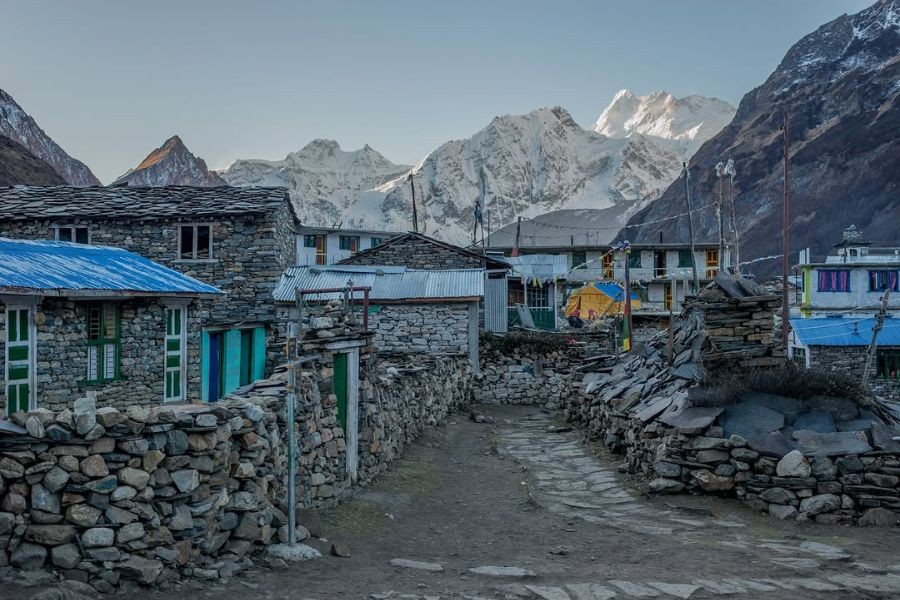
The lower trail villages of Soti Khola, Machha Khola, and Jagat are predominantly Gurung and Brahmin communities. Hindu temples mark the roadside. The food is dal bhat and rice. As you climb above 2,500 m, that cultural landscape transforms. Prayer flags appear on every ridge. Mani walls carved with Tibetan Buddhist scripture line the approach to every upper valley village. By the time you reach Namrung, Lho, and Samagaun, you are in a world with Tibetan Buddhist cultural roots that stretch back centuries.
Key Cultural Elements
- The Nubri community of Samagaun and Samdo are descendants of Tibetan settlers whose ancestors arrived in the upper Budhi Gandaki valley hundreds of years ago. Their language, dress, and religious practice are distinctly Tibetan, not blended with lowland Nepal culture.
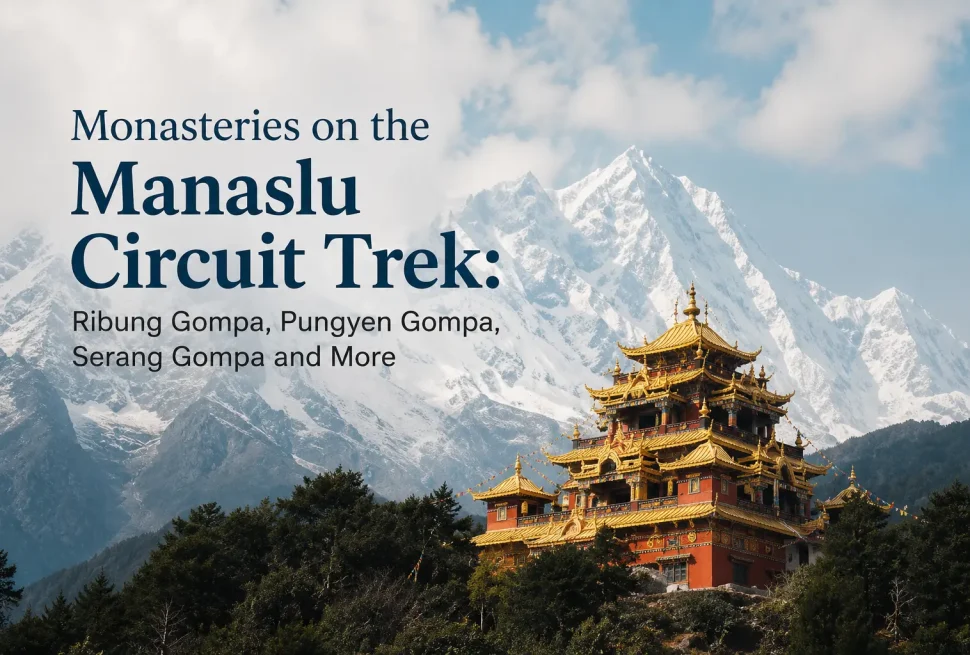
- Pungyen Gompa monastery sits above Lho village with a direct view of Manaslu’s south face. Active monks conduct daily practice. Trekkers who arrive respectfully are generally welcome to observe. Remove footwear before entering.
- The Shyagya nonviolence code observed by the Nubri community prohibits hunting within traditional territory. This centuries-old Buddhist ethic means wildlife in the upper valley behaves differently than in heavily visited regions. Blue sheep graze close to the trail without alarm.
- Festival timing in the upper valley varies by the Tibetan lunar calendar. April sees monastery puja ceremonies and community events in the Tsum Valley extension communities. October sees Dashain and Tihar celebrated with local variation in the villages.
Dress modestly in all upper valley villages. Cover shoulders and knees when walking through village streets and when visiting monasteries. Learn a few words of Nepali before departure: Namaste (greetings), Dhanyabad (thank you), and Dal bhat dinus (please serve dal bhat) go a long way toward building genuine rapport with the tea house families who host you.
Fitness and Training for the Manaslu Circuit
The Manaslu Circuit Trek does not require mountaineering experience or specialist technical skills. It does require genuine cardiovascular fitness and the muscular endurance for sustained daily walking over 14 to 18 days. This distinction matters: trekking fitness and gym fitness are not the same thing.
Start 8 to 12 Weeks Before Departure
Begin structured cardiovascular training at least 8 weeks before your trek. Three to five sessions per week of sustained aerobic exercise: running, cycling, swimming, or stair climbing. The goal is to comfortably maintain 65 to 75 percent maximum heart rate for 45 to 90 continuous minutes.
Train Specifically with Long Hikes
From six weeks out, replace at least one weekly training session with a long hike of 4 to 6 hours carrying a 7 to 10 kg daypack. Include elevation gain wherever your local terrain allows. This replicates the joint load, footwear demands, and sustained output that the circuit requires. It is also when you identify and correct footwear problems before Nepal.
Build Leg and Knee Strength
The long descents on the Manaslu Circuit, particularly the 1,500 m descent from Larkya La to Bimtang, load the quadriceps and knees heavily. Squats, lunges, step-downs, and calf raises directly address these demands. Strong quads reduce descent pain and knee injury risk significantly.
Break In Your Boots Completely
Begin wearing your trekking boots on every training hike from eight weeks before departure. Blisters from unbroken boots at altitude are a genuine trek-threatening problem. By the time you board the plane to Kathmandu, your boots should feel as natural as everyday shoes.
Practice with Your Pack Weight
On the Manaslu Circuit, you carry a daypack of 6 to 10 kg while a porter carries your main bag. Every training hike from six weeks out should involve your daypack loaded to the weight you will carry on the trail. The pack changes your posture, balance, and energy expenditure in ways that walking without one does not prepare you for.
Complete Packing List for the Manaslu Circuit Trek
The packing list for the Manaslu Circuit spans subtropical heat at 700 m and arctic conditions at 5,106 m. Every item below is field-tested on this specific route.
Clothing and Footwear
- Waterproof high-ankle trekking boots (well broken-in)
- Camp sandals for tea houses
- 5 to 7 pairs merino wool trekking socks
- Thermal base layers top and bottom (2 sets)
- 2 to 3 moisture-wicking long-sleeve shirts
- Fleece mid-layer jacket
- Down jacket rated to minus 15°C minimum
- Waterproof shell jacket (Gore-Tex recommended)
- Waterproof trekking trousers
- Warm beanie and sun hat
- Balaclava (essential for pre-dawn Larkya La start)
- Liner gloves plus warm outer gloves
- Gaiters (mud lower trail; November snow high trail)
Sleeping and Shelter
- Sleeping bag rated to -10 to -15°C
- Sleeping bag liner (adds warmth; improves hygiene)
- Microfiber travel towel (small and large)
- Earplugs (shared tea house common rooms)
- Eye mask (early sleep before 4 AM Larkya La start)
Gear and Navigation
- 50 to 70L duffle bag (porter carries this)
- 30 to 40L daypack with rain cover
- Trekking poles (collapsible; essential for descents)
- Headlamp plus spare lithium batteries
- Power bank minimum 20,000 mAh
- NTC SIM card (purchased in Kathmandu; best coverage)
- Offline maps downloaded before departure
- Reusable water bottle 1.5 to 2 liters
- Water purification tablets or filter bottle
- Sunscreen SPF 50+ and lip balm with SPF
- Sunglasses with UV protection
Health, Safety and Documents
- First aid kit: bandages, antiseptic, pain relief, anti-diarrhea, blister treatment
- Pulse oximeter (monitor blood oxygen daily above 3,500 m)
- Diamox (acetazolamide) — prescription; consult doctor
- Personal medications plus generous extra supply
- Rehydration salts or electrolyte powder
- Original passport and copies in waterproof pouch
- All permit copies (agency provides)
- Travel insurance with helicopter evacuation coverage
- Cash: NPR 20,000 to 30,000 minimum (no ATMs on trail)
- Passport photos 4 to 6 copies
Sleeping bags, down jackets, trekking poles, and gaiters can all be rented at quality shops in Thamel, Kathmandu for USD 1 to 3 per day per item. If you do not own quality cold-weather gear, renting in Kathmandu is more practical and affordable than purchasing at home. Our team at Manaslu Treks and Expedition verifies gear the day before departure to ensure you have everything required for the conditions at altitude.
Solo Trekking on the Manaslu Circuit: The 2026 Update
Until March 2026, the Manaslu restricted area permit required a minimum of two foreign trekkers per application. Solo travelers had to find a trekking partner or could not legally obtain permits.
On March 22, 2026, Nepal’s Department of Immigration revised this policy. Individual foreign trekkers can now apply for Manaslu restricted area permits through a registered agency with a single licensed guide. The minimum group size requirement has been removed. The guide requirement has not changed.
What This Means Practically
- Solo travelers can now book and complete the Manaslu Circuit with just themselves and a licensed guide, without finding a second trekker.
- The mandatory licensed guide remains in force under all circumstances. No form of independent guideless trekking is permitted in the restricted area.
- Permits must still be processed in Kathmandu through a registered trekking agency. The solo trekker rule change does not create any self-service permit option.
- Solo bookings are available on all our Manaslu Circuit Trek packages for 2026. Contact our team to discuss private departure options with a dedicated guide.
The practical safety benefit of the mandatory guide is particularly significant for solo trekkers. Having a licensed professional who monitors your altitude symptoms, knows the trail conditions, communicates with other guides about pass conditions, and has emergency evacuation protocols is not a bureaucratic imposition. It is the single most important safety mechanism on a remote restricted-area route.
What to Confirm Before You Book
Before confirming a booking for the Manaslu Circuit Trek with any agency, these are the specific questions to ask. The answers reveal both the quality of the operator and whether the itinerary is structured safely.
| Question | Why It Matters |
|---|---|
| How many full acclimatization days are in the itinerary? | A minimum of one rest day at Samagaun and one night at Samdo is required for safe acclimatization before Larkya La. Any itinerary that omits Samdo is compressing at genuine safety cost. |
| What is the permit processing timeline in Kathmandu? | Allow one to two working days minimum. In October, allow three to four days. Government offices are closed Saturdays and public holidays. If an agency says “same day,” ask how. |
| Does the guide carry a pulse oximeter? | Daily blood oxygen saturation monitoring above 3,500 m is standard on professionally operated high-altitude treks. If the answer is uncertain, probe further. |
| What is the exact protocol if a trekker develops severe AMS above Samagaun? | The protocol should be specific: oxygen saturation thresholds for mandatory descent, helicopter contact procedures, and insurance verification steps. A vague answer is a concern. |
| Is travel insurance verified before departure, and does it cover helicopter evacuation to 6,000 m? | Any reputable agency requires and verifies this documentation before confirming departure. A helicopter evacuation from Samagaun costs USD 3,000 to 5,000 without coverage. |
| What is the cancellation and rescheduling policy? | Understand exactly what happens if you need to cancel due to illness, weather, or personal emergency before and during the trek. |
| Is advance payment required? | At Manaslu Treks and Expedition, no advance payment is required. You settle on arrival in Nepal. Ask any agency requiring large pre-arrival deposits to explain what protections are in place. |
| How many times has the guide personally completed the Larkya La crossing? | A guide who has crossed the pass dozens of times reads weather from Dharamsala camp and navigates morning conditions differently from a guide on their second or third crossing. |
Why the Manaslu Circuit Trek in 2026 Is Worth Booking Now
The Manaslu Circuit Trek sits at a specific moment in its trajectory as a trekking destination. Visitor numbers grew 40 percent year-on-year in 2025. The March 2026 solo permit change will increase bookings further. The trail infrastructure has improved significantly over the past five years. The experience the trail delivers, however, is still largely unchanged from a decade ago: genuine solitude, intact Tibetan Buddhist culture, a mountain that fills the sky, and a pass crossing that demands everything you have and gives back a panorama that few people in the world will ever see.
That balance will shift. Growth that continues at 40 percent annually does not take long to change the character of a trail. Trekkers who are drawn to what makes the Manaslu Circuit special — the quiet, the culture, the wilderness — have a finite window to experience it in its current form.
Our team at Manaslu Treks and Expedition has been operating exclusively in this region for over a decade. Our guides come from the communities you will pass through. Our operations support the families who run the tea houses, the porters who carry the loads, and the conservation programs that protect the wildlife and habitats of the Manaslu Conservation Area. When you trek with us, the investment of your time and resources reaches the people and places that make the experience worth making.
To see all current departures, detailed day-by-day itineraries, and package inclusions, visit our Manaslu Circuit Trek destination or contact our team directly. We offer 24/7 support via WhatsApp and email before, during, and after your trek.
Ready to Book Your Manaslu Circuit Trek?
No advance payment required. Pay after arrival in Nepal. Our local experts handle every detail from permits to Larkya La and back.
View 14-Day Package Explore All PackagesManaslu Treks and Expedition | Registered Nepal Trekking Operator | Kathmandu
Do you need a guide for the Manaslu Circuit Trek?
Yes. Hiring a licensed guide is mandatory because the Manaslu region is a restricted area in Nepal.
Can you do the Manaslu Circuit Trek alone?
u003cstrongu003eYes, but not independently.u003c/strongu003e Since Nepal updated restricted area rules in 2026, solo trekkers can now apply without needing a second foreign trekker. However, you still must book through a registered trekking agency and trek with a licensed guide. Independent unguided trekking is still not permitted in the Manaslu region.
Do beginners need previous trekking experience for Manaslu?
No. Previous trekking experience is not mandatory, but good fitness and preparation are important.
Is altitude sickness a risk on the Manaslu Circuit Trek?
Yes. The trail reaches high elevations, including Larkya La Pass at 5,106 m, so proper acclimatization is important.
Are permits more expensive than regular trekking permits in Nepal?
Yes. Restricted area permits and additional conservation fees make Manaslu permits cost more than many other treks.
Is internet available throughout the Manaslu Circuit Trek?
u003cstrongu003eYes, but service varies by location.u003c/strongu003e NTC (Nepal Telecom) generally provides better coverage than Ncell on much of the Manaslu route, and many tea houses also offer paid WiFi. However, connections can become slower or less reliable at higher villages and during bad weather.
Is the Manaslu Circuit Trek crowded like Annapurna or Everest?
No. Manaslu usually receives fewer trekkers and offers a quieter trekking experience.
Can you trek the Manaslu Circuit in winter?
Yes. Winter trekking is possible, but snow around Larkya La Pass can create difficult conditions.
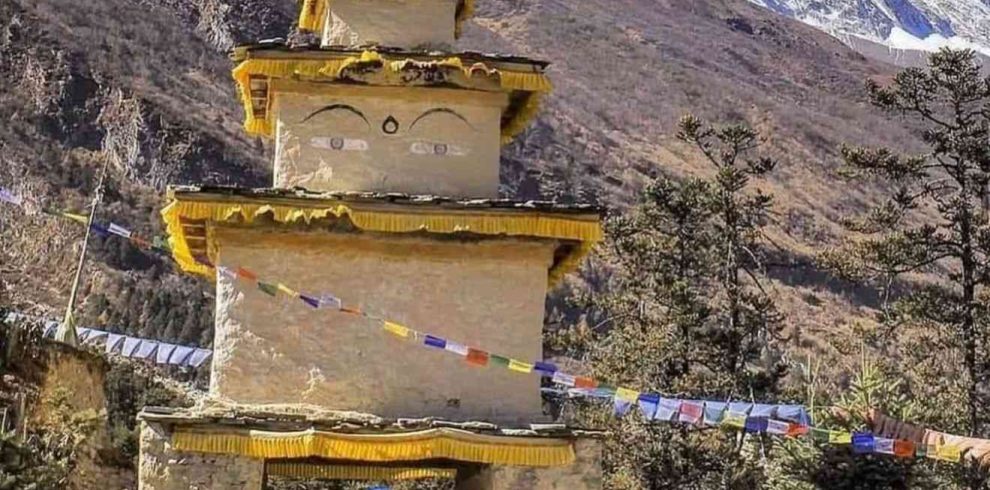
The 14-Day Manaslu Circuit Trek takes you around Mount Manaslu at 8,163 meters, the eighth-highest mountain on earth, through one of…