A complete, season-by-season planning guide from the team who operates this trek year-round. Covers weather, trail conditions, permits, accommodation, Larkya La Pass conditions, and more. Our manaslu trek company provides fully customised itineraries with no advance deposit required.
The Manaslu Tsum Valley Trek combines two of Nepal’s most remote restricted trekking areas into one extended Himalayan journey. The circuit wraps around Mount Manaslu at 8,163 m, the world’s eighth-highest peak, and the Tsum Valley branches off the main circuit at Lokpa into a high-altitude Buddhist sanctuary that stayed closed to outside visitors until 2008.
Together, these two regions cover an elevation range from around 700 m at Soti Khola to 5,160 m at Larkya La Pass, passing through subtropical river gorges, terraced farmland, rhododendron forests, and eventually the bare high-altitude landscapes near the Tibetan border. A combined itinerary typically takes between 18 and 24 days of actual trekking, depending on the pace and how far into Tsum Valley you go.
Timing this trek correctly matters more than on most other Himalayan routes. The reasons are straightforward. The trail passes through six distinct climatic zones. The Larkya La crossing becomes genuinely dangerous in certain weather conditions. Tsum Valley sits in a slightly drier rain shadow, but the access trails to it involve river crossings and steep sections that deteriorate badly in monsoon conditions. Tea houses in the upper reaches close entirely in winter. And the restricted area transport logistics, specifically the rough jeep road from Kathmandu to the trailhead at Machha Khola, become unreliable and sometimes impassable in heavy rain.
This guide is written from the experience of operating Manaslu Tsum Valley treks across all seasons. We have guided groups through the spring rhododendron bloom, the clear October skies, the post-monsoon mud of September, and the frost of late November. What follows is not a seasonal overview built from general Himalayan knowledge. It is the specific, practical guide that we use to brief our own clients before departure.
Quick Facts: Manaslu Tsum Valley Trek 2026
| Detail | Information |
|---|---|
| Trek Duration | 18 to 24 days (including Tsum Valley extension; standard Manaslu circuit alone is 14 to 16 days) |
| Maximum Altitude | Larkya La Pass at 5,160 m (Mu Gompa in Tsum Valley at 3,700 m) |
| Trek Region | Manaslu Conservation Area and Tsum Valley, Gorkha District, Nepal |
| Difficulty Level | Moderate to strenuous; no technical climbing required |
| Accommodation Type | Tea house lodges; basic in upper sections |
| Required Permits | Manaslu RAP, Tsum Valley RAP, MCAP, ACAP, Chumnubri local permit |
| Best Months | October and November (autumn); April and May (spring) |
| Transportation | Private jeep or public bus from Kathmandu to Machha Khola (7 to 9 hours) |
| Average Daily Walking | 6 to 8 hours per day |
| Starting Point | Machha Khola (869 m) or Soti Khola (700 m), Gorkha District |
| Ending Point | Dharapani (1,860 m), connecting to Annapurna Circuit; drive back to Kathmandu |
| Trek Style | Restricted area; licensed guide mandatory; minimum two trekkers required |
| Guide Requirement | Licensed guide legally required at all times in restricted zone |
| Solo Trekking | Not permitted under any circumstances in the Manaslu restricted zone |
Why Timing Matters for the Manaslu Tsum Valley Trek
Unlike the Everest Base Camp trek or the lower sections of the Annapurna Circuit, the Manaslu Tsum Valley Trek has very little infrastructure to cushion a poor seasonal choice. There are no road shortcuts that bypass a closed pass. No helicopter-accessible villages every few hours. The trail through the Budhi Gandaki gorge has sections where a landslide can block the route for days. Above Samagaun, the tea houses are small, family-run, and seasonal.
The Larkya La Pass crossing at 5,160 m is the pivot around which all timing decisions should be made. In heavy snowfall, the trail across the pass disappears. In clear autumn conditions, you can see the full panorama of Manaslu, Himlung Himal, Cheo Himal, and the Annapurna range from the summit. That difference is not just aesthetic. It is also a safety difference. Parties who attempt the pass in poor conditions face real risk.
In Tsum Valley, the timing issue is different but equally important. The valley is at higher cultural engagement in spring, when monastery festivals and community events coincide with the trekking season. The village of Chhekampar and the Mu Gompa monastery above it are more accessible and more alive as a cultural experience in spring and autumn than at any other time of year.
Transportation also factors in heavily. The road from Kathmandu to Machha Khola deteriorates badly after Arughat during the monsoon. Landslides between Soti Khola and Machha Khola are a documented seasonal risk. In spring and autumn, private jeeps complete the journey in seven to nine hours. In monsoon season, the same journey can take significantly longer, or fail to reach the trailhead at all without detours and delays.
Overview of Trekking Seasons in Nepal
Nepal’s trekking calendar divides into four seasons. Two of them work well for the Manaslu Tsum Valley Trek. Two of them present challenges significant enough that most experienced guides recommend against attempting this particular route during those windows.
The two best seasons align with Nepal’s broader trekking calendar but have their own specific characteristics in the Manaslu region that are worth understanding in detail. The Manaslu region sits slightly further west than the Everest zone, and the Tsum Valley’s position near the Tibetan border gives it a drier microclimate in its upper reaches. This matters when planning around monsoon margins in both June and September.
Best Time to Go Manaslu Tsum Valley Trek in 2026
After operating this trek across all four seasons, the answer is consistent: October and early November are the best overall months for the Manaslu Tsum Valley Trek in 2026. October in particular gives you the clearest skies of the year, dry trails, fully open tea houses, and the best possible conditions for the Larkya La crossing. The mountain visibility on a clear October morning from Samagaun, looking up at the south face of Manaslu, is something that photographs cannot adequately represent.
April and May are a close second, especially for trekkers who want to see the rhododendron forests in bloom and experience Tsum Valley’s monastery culture in the festival season. Spring also offers the financial benefit of off-peak permit pricing (USD 75 per week for the Manaslu RAP versus USD 100 in autumn).
For most trekkers planning the Manaslu Tsum Valley Trek in 2026, book for October. If your schedule does not allow October, target mid-April to early May. Both windows give you stable weather, open tea houses, and safe conditions for Larkya La. Early November is also excellent but requires warmer sleeping gear as night temperatures above 3,500 m approach minus 10 degrees Celsius by mid-month.
Spring Season for Manaslu Tsum Valley Trek
Spring on the Manaslu Tsum Valley trek runs from March through May. This is the second most popular window for this route and offers its own distinct character. The lower trail sections between Soti Khola and Jagat transform into a vivid landscape of red and pink rhododendron forests from late March onward. Temperatures are warmer than autumn at lower elevations, and the overall atmosphere of the trek feels greener and more alive.
March
March is a transitional month. The lower sections of the trail are warming up and the rhododendrons begin to open around 2,000 m. However, the upper elevations, specifically the area around Dharamsala and Larkya La, still carry significant residual snow from winter. A March crossing of Larkya La is manageable with the right equipment and guide experience, but expect icy conditions on the pass and the approach moraine. Day temperatures in lower villages like Jagat reach 15 to 18 degrees Celsius. At Samdo (3,875 m), nights can still drop to minus 8 degrees. Tea houses in the upper sections reopen progressively through March, and not all of them are operational in the first two weeks of the month. Confirm with your agency which specific lodges are open before departing Kathmandu.
April
April is the premium spring month. The rhododendron forests below 3,000 m are fully in bloom, creating the most visually striking lower-trail conditions of the year. The Larkya La snow has consolidated enough to be manageable but not so much that it creates dangerous icy buildup. Day temperatures across the circuit are comfortable: 18 to 22 degrees Celsius in the lower valleys, 5 to 12 degrees at Samagaun, and around minus 2 to plus 5 at Dharamsala. Mountain visibility is excellent on clear days, and while April sees some afternoon cloud buildup, mornings are typically crisp and clear. In Tsum Valley, April is the best time to encounter local festivals at Mu Gompa and Rachen Gompa. The monastery communities in Chhekampar and Nile are fully active. This is the month we most often recommend to clients who have a strong interest in the cultural side of this trek.
May
May is still good but requires awareness of the approaching monsoon. The first two weeks of May are generally excellent: warm, clear, and with the added benefit of fewer trekkers than April. By the third week of May, pre-monsoon humidity begins building from the south, and cloud cover becomes less predictable. Mountain views can be obstructed by afternoon haze. The Larkya La crossing is straightforward in May, as the snow has largely melted from the pass itself. Tea houses are fully operational throughout. If your trip spans into late May, plan the Larkya La crossing for early morning and be prepared for afternoon rain at lower elevations on the descent toward Bimtang.
Spring Pros
- Rhododendron forests in full bloom (March to April)
- Lower permit costs (USD 75 per week for RAP)
- Monastery festivals in Tsum Valley (April)
- Warmer daytime temperatures in lower sections
- Fewer trekkers than peak autumn season
- Excellent mountain views in early morning
- All tea houses open from mid-March
Spring Cons
- Residual snow at Larkya La in March
- Pre-monsoon cloud buildup from mid-May
- Some upper tea houses still closed in early March
- Trail can be muddy after afternoon rain (May)
- Afternoon visibility declines by late May
- Leeches begin to appear on lower trails from late May
Autumn Season for Manaslu Tsum Valley Trek
Autumn is the most reliable season for the Manaslu Tsum Valley Trek and the one that most experienced Nepal trekking guides recommend as the first choice for first-time visitors to this region. The monsoon typically clears from the Manaslu region by mid to late September, leaving behind skies that have been washed clear by months of rain. The resulting mountain visibility in October is exceptional.
September
September is a transitional month that becomes progressively better as the weeks pass. In the first two weeks, residual monsoon rainfall is still possible, particularly below 2,500 m. The lower trail sections between Soti Khola and Jagat can be muddy and leech-infested. By the third and fourth weeks of September, conditions improve significantly. The trails dry out, cloud cover reduces, and mountain views become clear on most mornings. September is underrated by many trekkers. If you can be flexible and target the last ten days of September, you get better conditions than July and August with significantly fewer trekkers than October. Tea houses are fully operational, and guides have more time for each group because the rush has not yet begun.
October
October is the single best month for the Manaslu Tsum Valley Trek. The monsoon is completely gone. The trails are dry and well-maintained. Visibility on clear days exceeds 90 percent of daylight hours. Day temperatures at lower elevations range from 15 to 20 degrees Celsius; at Samagaun they range from 5 to 12 degrees. Dharamsala (the pre-pass camp at 4,460 m) sees daytime highs of around 3 to 7 degrees and night temperatures that drop to minus 5 to minus 8. The Larkya La crossing in October is at its most straightforward: no snow on the pass itself in early to mid-October, clear visibility, and stable winds in the early morning hours when most parties begin the ascent (typically between 4:00 AM and 5:00 AM). Tea houses across the circuit are at their busiest but rarely fill to capacity. The Manaslu region simply does not see enough trekkers for accommodation to be a serious problem even in peak season.
November
November offers excellent conditions in the first three weeks, with the added benefit that trekker numbers drop noticeably compared to October. The air becomes increasingly cold as the month progresses. By late November, night temperatures at Samagaun drop toward minus 10 degrees Celsius, and the pre-dawn walk to Larkya La requires full winter layers including insulated down jacket, balaclava, and gloves. Some upper-section tea houses begin their seasonal closure in the last week of November. November is the best month for photographers who want dramatic light and low crowds, but it demands more serious cold-weather preparation than October.
Autumn Pros
- Clearest mountain visibility of the year
- Dry, stable trail conditions throughout
- Safe Larkya La conditions (October especially)
- All tea houses fully operational
- Nepal’s major festivals: Dashain and Tihar in October
- September is uncrowded and increasingly good
- Best mountain photography conditions
Autumn Cons
- Higher permit costs (USD 100 per week for Manaslu RAP)
- October is the busiest month, though still quiet versus other Nepal treks
- November requires serious cold-weather gear
- Early September still has monsoon residue
- Some upper tea houses close by late November
- Festival season in Kathmandu (October) means busy city days pre-trek
Manaslu Tsum Valley Trek During Monsoon Season
The monsoon in Nepal typically runs from June through August, with July and August being the heaviest months in the Manaslu region. Trekking the Manaslu circuit and Tsum Valley during this period is not recommended for most visitors, and we are direct about that with our clients.
What the Monsoon Actually Means on This Trail
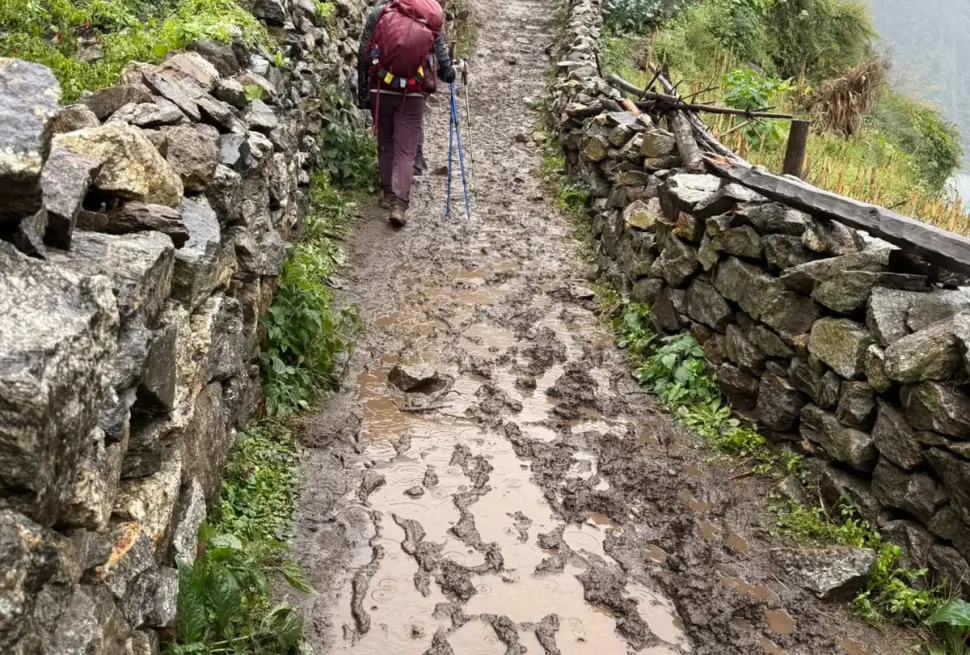
The road from Kathmandu to Machha Khola passes through Arughat and along the Budhi Gandaki valley. This road deteriorates during the monsoon, with sections becoming rough tracks of loose mud after rainfall. Landslide zones between Soti Khola and Jagat are active during heavy rain. In previous seasons, parties have been delayed at this section by trail blockages for two or more days. This is not a theoretical risk.
On the lower trail sections, leeches appear in large numbers from June onward in the forested sections below 2,000 m. The trail surface between Machha Khola and Namrung becomes slippery and eroded. River crossings on suspension bridges are generally safe as long as the bridges themselves are maintained, but approach trails to bridges can wash out.
Cloud cover during the monsoon means mountain views are largely absent. On most monsoon days, Manaslu itself is hidden by cloud from mid-morning onward. This is not the weather for seeing the south face of the world’s eighth-highest peak. Visibility at Larkya La is frequently zero during monsoon rain and cloud events.
Why Some Trekkers Still Attempt Monsoon Season
A small number of trekkers do attempt the Manaslu circuit in monsoon conditions, and some complete it successfully. The reasons are usually: extreme availability of dates, lower costs during off-season, and the genuine visual appeal of the lower valleys when they are green, waterfull, and vibrant with plant life. Tsum Valley’s upper sections are in a rain shadow and receive less monsoon rainfall than the lower circuit sections, which makes Tsum Valley slightly more manageable in monsoon than the Larkya La crossing itself. However, reaching Tsum Valley requires transiting the lower circuit, which is the problem. We assist clients who specifically request monsoon treks but we are clear about the risks and limitations before any departure.
Winter Season in Manaslu and Tsum Valley
Winter in the Manaslu region spans December through February. Temperatures above 4,000 m can drop to minus 15 to minus 20 degrees Celsius at night. Larkya La Pass accumulates deep snow from December onward, and by January, crossing the pass requires crampons, ice axes in severe conditions, and a guide with specific winter-pass experience.
Practical Conditions
Many tea houses above 3,500 m close for the winter season, typically from late November or early December until March. This means trekkers attempting a winter circuit must carry camping equipment or have confirmed information from their agency about which specific lodges remain open. Dharamsala, the standard pre-pass camp, is often unstaffed in deep winter. Water sources freeze at night at high altitude, and in extremely cold conditions, tea house pipe systems at Samdo and Dharamsala can freeze during the night, causing morning water supply issues.
The lower sections of the trail (below 2,000 m) are manageable in winter and actually pleasant on clear days. The problem is exclusively in the upper section from Samdo upward. December, particularly the first two to three weeks, is actually one of the better times to attempt the lower portions of the Manaslu circuit if combined with a retreat before Larkya La.
Who Winter Trekking Suits
Winter trekking in the Manaslu region is appropriate for very experienced high-altitude trekkers who have previous winter Himalayan experience, carry full winter camping equipment as a contingency, are traveling with a guide who has completed the Larkya La crossing in winter conditions before, and have full evacuation insurance including helicopter rescue up to 6,000 m. It is not appropriate for first-time high-altitude trekkers or those without extensive cold-weather camping experience.
Month by Month Weather Guide for Manaslu Tsum Valley Trek
The table below summarizes average conditions across the full circuit, from the lower valley sections around 700 to 1,400 m up to the high-altitude sections above 4,000 m. All temperatures are in degrees Celsius. For a deeper month specific breakdown, see our full Manaslu Circuit Trek in August guide.
| Month | Day Temp (Lower) | Night Temp (High Alt) | Visibility | Trail Condition | Crowd Level | Recommended |
|---|---|---|---|---|---|---|
| January | 8 to 14°C | -15 to -20°C | Clear but hazy | Snow above 4,000 m; frozen at pass | Very low | Experts Only |
| February | 10 to 16°C | -12 to -18°C | Moderate | Heavy snow at Larkya La; icy | Very low | Experts Only |
| March | 15 to 18°C | -6 to -10°C | Good; improving | Residual snow at pass; lower trails clear | Low | With Preparation |
| April | 18 to 22°C | -2 to -5°C | Excellent | Good; rhododendrons in bloom below 3,000 m | Moderate | Highly Recommended |
| May | 20 to 24°C | 0 to -3°C | Good (morning); cloudy PM | Good; pre-monsoon cloud from late May | Moderate | Recommended |
| June | 22 to 26°C | 5 to 8°C | Poor (monsoon cloud) | Wet; leeches; landslide risk | Very low | Not Recommended |
| July | 24 to 28°C | 8 to 12°C | Very poor | Muddy; active landslides; road issues | Very low | Avoid |
| August | 23 to 27°C | 7 to 10°C | Very poor | Heaviest monsoon; most dangerous month | Very low | Avoid |
| September | 18 to 24°C | 2 to 5°C | Improving; clear from 3rd week | Damp early; dries quickly from week 3 | Low to moderate | Good from Late Sept |
| October | 15 to 20°C | -5 to -8°C | Excellent (90%+ clear days) | Dry, well-maintained throughout | Moderate (peak season) | Best Month Overall |
| November | 10 to 16°C | -8 to -12°C | Excellent (early); very good (late) | Dry; cold at high altitude | Low to moderate | Recommended |
| December | 8 to 14°C | -10 to -15°C | Clear and crisp | Snow building above 4,500 m; lower trail fine | Very low | Experts Only |
Best Season for Mountain Views
Mountain visibility on this trek depends on two factors: the absence of monsoon cloud, and the absence of winter haze from high-altitude cold air inversions. The clearest window for mountain views on the Manaslu Tsum Valley Trek is October through mid-November. In October, the post-monsoon air has been scoured clean by months of rain, and there is no dust haze yet from the coming dry season. The south face of Manaslu seen from Samagaun at dawn in October is one of the most powerful mountain views in Nepal.
April offers the second-best visibility. Clear mornings are the norm, though afternoon cloud buildup from the south is common from late April onward. For views of the Ganesh Himal range from within Tsum Valley, April gives excellent morning conditions from Mu Gompa (3,700 m) and the ridge hikes above Nile. The panoramic views of Manaslu range visible from Larkya La itself are best in October and November.
Best Time for Photography
For photographers, the answer depends on what you are trying to capture. The recommendations break down clearly:
- Mountain and landscape photography: October and early November. The light at dawn and dusk at high altitude in October is exceptional. The dry air creates contrast and depth that simply does not exist in other seasons.
- Rhododendron and flora photography: Late March through April. The lower trail sections between 1,500 m and 2,800 m are covered in blooming rhododendrons, with a progression of color as you gain altitude.
- Cultural and monastery photography: April for Tsum Valley monastery festivals. October for the active village life during Dashain season.
- Dramatic weather photography: Late September for post-storm clearing light, which can produce extraordinary conditions when clouds part to reveal snow-dusted peaks against blue sky.
Best Time for Fewer Crowds
The Manaslu Tsum Valley Trek is never truly crowded by Nepal trekking standards. Even at peak season, the number of trekking groups on the trail at any given time is a fraction of what you encounter on the Annapurna or Everest routes. That said, within this trek there are relative busy periods.
For the fewest other groups on the trail, late September to early October is the sweet spot. The monsoon has cleared, conditions are increasingly good, but the main October rush has not fully arrived. November is also notably quieter than October while still offering excellent weather. April is quieter than May in terms of overall numbers. March is the quietest good-conditions month of the year, though it comes with the Larkya La snow caveat mentioned above.
Best Time for Comfortable Temperatures
For comfortable temperatures at all elevations simultaneously, April is the most balanced month. Lower sections are warm without being hot. Upper sections are cold at night but manageable with standard three-season equipment. Larkya La crossing temperatures in April are around minus 5 to minus 8 at 4:00 AM, which is cold but not extreme for a properly equipped trekker.
Trekkers who prefer warmer lower-trail conditions will find May slightly more comfortable below 2,500 m, but the trade-off is more cloud and humidity. Those who can tolerate a colder night in the upper sections will find October more rewarding for overall quality of experience, even though nights at Dharamsala drop to minus 5 to minus 8.
Best Time for Cultural Experience in Tsum Valley
The Tsum Valley is one of the most culturally intact Himalayan trekking destinations in Nepal. The residents are descendants of Tibetan settlers who arrived as early as the 16th century, and their language, dress, customs, and religious practice remain distinctly Tibetan Buddhist rather than blended with the lowland Nepali culture that characterizes most of the country.
The villages of Chumling, Chhekampar, Nile, and Chule are inhabited year-round by communities who live largely from farming, livestock, and trade. The monasteries of Mu Gompa (built around 1895 AD) and Rachen Gompa, one of the largest nunneries in the Manaslu region, are active centers of religious practice. The cave of Milarepa, the famous Tibetan saint, is visited by both trekkers and local pilgrims.
Key Cultural Timing
- April: Spring monastery festivals in Tsum Valley, including puja ceremonies and community gatherings. The valley community is fully active after the winter. This is the recommended month for deep cultural engagement.
- October: Active village life during the Dashain and Tihar festival season in Nepal. The communities in Tsum Valley observe their own versions of these festivals. Interaction with families in tea houses is warm and genuine.
- Losar (Tibetan New Year): Typically falls in February or early March depending on the lunar calendar. In 2026, Losar falls in February. Experiencing Losar in Tsum Valley is an exceptional cultural event, but it requires winter-season trekking commitment.
- Mani Rimdu: The Buddhist festival celebrated with traditional monastery dances. Timing varies by monastery. Ask your agency to confirm dates for 2026 before booking.
How Weather Affects Larkya La Pass Crossing
The Larkya La crossing at 5,160 m is the highest point of the Manaslu Tsum Valley Trek and the section most directly affected by seasonal weather. Understanding the pass conditions in each season is essential for safety planning.
| Season | Snow at Pass | Wind Conditions | Visibility | Safety Assessment |
|---|---|---|---|---|
| October | None to minimal | Calm mornings; winds possible by 10 AM | Exceptional; 360° panorama | Optimal |
| Early November | Light dusting possible | Increasing; start by 4:30 AM | Excellent | Very Good |
| Late November | Light to moderate | Cold and gusty; critical to start early | Good to excellent | Good with Preparation |
| April | Consolidated; manageable | Moderate; start by 5:00 AM | Excellent morning; PM cloud builds | Very Good |
| March | Significant; crampons needed | Variable | Good on clear days | Experienced Only |
| December to February | Heavy; trail buried | Strong and cold | Can be zero in storms | High Risk |
| June to September | None | Unpredictable; pre-storm gusts | Poor to very poor | Not Recommended |
All Larkya La crossings begin before dawn, typically at 4:00 to 4:30 AM from Dharamsala. This is not optional: the pass is exposed, and afternoon weather deteriorates regardless of the season. The ascent takes three to four hours in good conditions. The descent to Bimtang takes another three to four hours. Total pass-crossing day walking time is typically eight to ten hours. Your guide will make the final call on departure time based on conditions observed the previous evening and the night sky visibility.
Never attempt to cross Larkya La without a licensed guide. This is a legal requirement on the Manaslu circuit, but it is also the single most important practical safety decision you can make. Our guides carry weather data from trail checkpoints and have experience reading cloud behavior above the pass from the Dharamsala camp below. The pass has claimed lives from parties who were inadequately prepared or who departed too late in the day.
Accommodation and Tea House Conditions by Season
Tea house trekking in the Manaslu region is the standard approach for this circuit. The quality and availability of lodges varies considerably by altitude and by season.
| Section | Spring (April to May) | Autumn (Oct to Nov) | Winter (Dec to Feb) | Monsoon (Jun to Aug) |
|---|---|---|---|---|
| Lower trail (Jagat to Namrung) | All open; warm rooms | All open; busy | Most open but cold | Open but wet |
| Mid-section (Lho to Samagaun) | All open | All open; peak occupancy | Some closed | Open; limited |
| Upper section (Samdo to Dharamsala) | Open from mid-March | All open October | Mostly closed | Open but rarely visited |
| Tsum Valley (Chumling to Mu Gompa) | Fully open; best season | Fully open | Limited; cold | Limited access |
| Post-pass (Bimtang to Tilije) | All open | All open | Some closed | Open |
Tea houses in the Manaslu region are family-run lodges that range from adequate at lower altitudes to very basic above Samagaun. Rooms are typically twin-sharing with simple bedding. Blankets are provided but are often thin at high altitude: bring or rent a sleeping bag rated to at least minus 10 to minus 15 degrees Celsius. Hot showers are available in some lower-section lodges (solar heated) but not reliably above 3,500 m. Charging for electronic devices is available for a fee at most lodges where solar power is installed. Wi-Fi, where advertised, is unreliable above 3,000 m and should not be counted on for communication.
Transportation and Road Conditions in 2026
The drive from Kathmandu to the trailhead at Machha Khola or Soti Khola is one of the most significant logistics factors for this trek. The road distance is approximately 140 to 160 km from Kathmandu, but the journey takes seven to nine hours by private jeep in good conditions due to road quality.
The route passes through Malekhu, Arughat, and Soti Khola before reaching Machha Khola. From Arughat onward, the road is an unpaved jeep track that follows the Budhi Gandaki gorge. In dry conditions, this section is rough but navigable in a well-maintained 4WD vehicle. In wet conditions, sections of this road become deeply rutted, and certain corners above river banks require careful driving. Landslides are a documented risk on the stretch between Soti Khola and Machha Khola in monsoon season.
| Season | Road Condition | Typical Drive Time | Vehicle Recommendation | Risk Level |
|---|---|---|---|---|
| October to November | Dry; manageable | 7 to 9 hours | Private jeep (4WD) | Low |
| March to May | Good; occasional rain patches | 7 to 9 hours | Private jeep (4WD) | Low |
| Late September | Damp; mostly cleared | 8 to 10 hours | Private jeep (4WD) | Low to Moderate |
| June to August | Wet; landslide risk active | 10 to 14+ hours or blocked | Private jeep essential; may fail | High |
| December to February | Dry but cold; river mist | 8 to 10 hours | Private jeep (4WD) | Moderate |
Public buses from Kathmandu’s Gongabu Bus Park depart for Arughat and Soti Khola at 6:00 AM to 8:00 AM daily, with one evening service. The road is asphalted to Arughat, after which the public bus route becomes significantly slower. Public buses are a cheaper option (approximately USD 8 to 12 per person versus USD 50 to 100 per person for a private jeep) but significantly less comfortable and slower. For the Manaslu Tsum Valley Trek, we recommend private jeep transport for the sake of rest before a demanding first walking day.
Permits Required for Manaslu Tsum Valley Trek in 2026
The Manaslu Tsum Valley Trek requires multiple permits from different government bodies. All restricted area permits must be obtained in Kathmandu before departure. They cannot be issued on the trail. Your trekking agency handles this process, which requires your original passport, a copy of your Nepal tourist visa, passport-sized photographs, and travel insurance documentation including helicopter evacuation coverage.
Solo trekking is not permitted in the Manaslu restricted area. A minimum of two foreign trekkers and a licensed guide are required for all permit applications. This rule is strictly enforced at the Jagat checkpoint and subsequent checkpoints along the trail. Book your trek through a registered Nepal trekking agency that can handle all permit logistics.
| Permit | Issuing Body | Autumn Cost (Sep to Nov) | Off-Peak Cost (Dec to Aug) | Notes |
|---|---|---|---|---|
| Manaslu Restricted Area Permit (RAP) | Dept. of Immigration, Kathmandu | USD 100 for first 7 days; USD 15/extra day | USD 75 for first 7 days; USD 10/extra day | Mandatory; covers Jagat to Samagaun zone |
| Tsum Valley Restricted Area Permit | Dept. of Immigration, Kathmandu | USD 40 for 7 days (approx.) | USD 30 for 7 days (approx.) | Required only if entering Tsum Valley; additional to Manaslu RAP |
| Manaslu Conservation Area Permit (MCAP) | MCAP Office / NTB | NPR 3,000 (~USD 23) | Same; fixed year-round | Required for all; covers conservation area entry |
| Annapurna Conservation Area Permit (ACAP) | ACAP Office / NTB | NPR 3,000 (~USD 23) | Same; fixed year-round | Required for descent section after Larkya La |
| Chumnubri Rural Municipality Permit | Local govt. / via agency | Approx. USD 10 | Approx. USD 10 | Local development levy; covers Manaslu and Tsum Valley areas |
| Estimated Total (14-day autumn circuit + Tsum) | USD 200 to 250 per person | USD 145 to 180 per person | Exact total depends on trek duration |
Plan at least one full working day in Kathmandu before the trek begins for permit processing. The Department of Immigration is closed on Saturdays and public holidays. Your agency will collect your original passport on Day 1 and can typically have permits ready by Day 2 afternoon. Allow for this in your overall trip schedule. For more details on trekking permits in Nepal, consult your agency before departure.
Trekking Difficulty by Season
The physical difficulty of the Manaslu Tsum Valley Trek changes meaningfully between seasons. The core difficulty is always present: 6 to 8 hours of daily walking, cumulative elevation gain of around 11,000 m over the full circuit, and the demanding Larkya La crossing day of 8 to 10 hours. But seasonal factors add layers of challenge or ease on top of the baseline.
| Season | Physical Difficulty | Trail Hazards | Altitude Risk | Overall Rating |
|---|---|---|---|---|
| October | Moderate to strenuous | Low (dry, clear) | Standard AMS risk above 2,500 m | Best Conditions |
| April | Moderate to strenuous | Low to moderate (April rain) | Standard AMS risk | Very Good |
| November (early) | Moderate to strenuous | Low; cold adds gear weight | Standard AMS risk; cold amplifies symptoms | Good |
| March | Strenuous | Snow and ice at high altitude | Higher risk (cold stress + AMS) | Experienced Only |
| Monsoon (Jun to Aug) | Very strenuous | Mud, leeches, landslides | AMS risk plus weather emergency risk | High Risk |
| Winter (Dec to Feb) | Extreme | Ice, deep snow, closed tea houses | Cold dramatically increases AMS severity | Expert Only |
What to Pack for Different Seasons
Spring Packing (March to May)
- Down jacket (rated to -15°C minimum)
- Thermal base layers (top and bottom)
- Waterproof shell jacket
- Waterproof trekking pants
- Warm fleece mid-layer
- Lightweight gloves plus warm inner gloves
- Wool hat and sun hat
- Sunscreen SPF 50+ (high UV at altitude)
- Trekking poles (essential for descents)
- Sleeping bag rated to -10 to -15°C
- Waterproof trekking boots (broken in)
- Leech socks or long gaiters for May
- Headlamp and spare batteries (Larkya La start)
- Water purification tablets or filter
Autumn Packing (September to November)
- Down jacket (rated to -15°C minimum)
- Thermal base layers (top and bottom)
- Lightweight shell jacket (September rain possible)
- Warm fleece mid-layer
- Insulated trousers for Dharamsala and pass
- Heavy gloves and liner gloves
- Balaclava (essential for Larkya La in November)
- Trekking poles
- Sleeping bag rated to -10 to -15°C
- Waterproof trekking boots
- Gaiters (useful for early snow in November)
- Sunscreen SPF 50+
- Headlamp with lithium batteries
- Lip balm and hand cream (dry autumn air)
All Seasons: Essentials
- First aid kit including diamox (altitude sickness medication)
- Pulse oximeter (monitor blood oxygen saturation)
- Rehydration salts
- Personal medications plus extras
- Travel insurance documents (helicopter evacuation cover)
- Copies of all permits and passport
- Cash in Nepalese Rupees (ATMs not available on trail)
- Portable battery bank for devices
- Offline map app loaded with Manaslu circuit route
- Snacks (energy bars, nuts, chocolate)
For Monsoon or Winter (if applicable)
- Waterproof everything: pack liner, dry bags
- Leech socks and insect repellent (monsoon)
- Trekking umbrella (monsoon lower trail)
- Crampons (winter, for Larkya La)
- Ice axe (winter, experienced users only)
- Expedition-weight sleeping bag (-20 to -25°C rated)
- Emergency bivouac shelter
- Extra stove fuel (tea houses may be closed)
- Satellite communicator (Garmin inReach recommended)
Important Safety Tips for 2026 Trekkers
Acclimatize Properly and Do Not Rush
Acute Mountain Sickness (AMS) can occur above 2,500 m and becomes life-threatening if HACE (High Altitude Cerebral Edema) or HAPE (High Altitude Pulmonary Edema) develops. The standard acclimatization day at Samagaun (3,530 m) is not optional. Do not attempt to compress the itinerary above 3,500 m to save time. Descend immediately if symptoms of severe AMS develop.
Take Out Full Trekking Insurance Before You Leave Home
Your insurance must specifically cover helicopter evacuation up to 6,000 m and emergency medical treatment in Nepal. Without this coverage, a helicopter rescue from Samagaun can cost USD 3,000 to 5,000 out of pocket. This is a non-negotiable requirement, not a recommendation. Your agency will ask for insurance documentation during the permit process.
Trek with a Licensed Guide at All Times
This is a legal requirement in the Manaslu restricted area. It is also the most important practical safety decision you can make. A guide who knows the Larkya La approach can read developing weather from the camp below. They know which tea houses are open in each season. They communicate with other guides on the trail about conditions ahead. Your guide is your most important safety asset on this trek.
Monitor the Weather Actively from Dharamsala
The evening before the Larkya La crossing, observe the sky at sunset from Dharamsala camp at 4,460 m. Clear stars mean a good crossing day. Heavy cloud from the south or strong wind from the northwest are warning signs. Your guide will make the final decision on the departure time and whether to delay. Trust that decision.
Carry Diamox if Prone to Altitude Issues
Diamox (acetazolamide) is a prescription medication that aids acclimatization. Consult your doctor before the trip about whether it is appropriate for you and the correct dosage. Many of our clients carry it as a precaution and start taking it one day before ascending to Samagaun. It does not eliminate AMS risk but can reduce the severity of mild symptoms.
Tell Your Guide if You Feel Unwell Immediately
Altitude sickness symptoms include headache, nausea, dizziness, loss of appetite, and fatigue. These are normal in mild form during the first day or two at a new altitude. They become serious if they worsen after a rest day, if you develop shortness of breath at rest, or if you experience confusion or loss of coordination. Do not hide symptoms from your guide. Early descent is always the right decision.
Recommended Itinerary for the Best Season (October)
The following is a 20-day combined itinerary covering both the Manaslu Circuit and the Tsum Valley extension, designed for an October start. This is the structure we use for our Manaslu Tsum Valley Trek departures. Days can be adjusted based on fitness and acclimatization.
1 to 2
Kathmandu: Permits and Preparation
Permit processing, gear checks, equipment rental if needed. Pre-trek briefing with your guide. Transfer permits require original passport from Day 1.
3
Drive Kathmandu to Soti Khola or Machha Khola (700 to 869 m)
7 to 9 hour jeep drive. Arrive and rest. First checkpoint at Jagat ahead.
4
Trek to Jagat (1,340 m) — 6 hours
First full walking day through subtropical forest and river gorge. Permit check at Jagat.
5
Jagat to Deng (1,860 m) — 6 to 7 hours
The route branches here for the Tsum Valley side trip (begin Tsum section now or complete circuit first).
6 to 8
Tsum Valley Extension: Deng to Chhekampar to Mu Gompa (3,700 m)
Branch toward Lokpa; trek to Chumling, Chhekampar, and ascend to Mu Gompa. Cultural immersion in Tibetan villages and monasteries.
9
Mu Gompa to Nile (3,050 m) and return toward main circuit
Descend through Nile and Chumling; rejoin the main Manaslu circuit trail.
10 to 11
Namrung (2,630 m) and Lho (3,180 m)
First clear views of Manaslu appear above Lho. Pungyen Gompa monastery optional side trip.
12 to 13
Samagaun (3,530 m): Acclimatization
Two nights. Side trip to Birendra Lake or Manaslu Base Camp (4,800 m) for acclimatization. Critical rest period before upper circuit.
14
Samagaun to Samdo (3,875 m) — 3 to 4 hours
Short acclimatization day. Optional hike toward Tibetan border for views.
15
Samdo to Dharamsala (4,460 m) — 4 to 5 hours
Pre-pass camp. Very basic lodge. Rest and preparation for early start. Sleep by 8 PM.
16
Larkya La Pass (5,160 m) to Bimtang (3,590 m) — 8 to 10 hours
Earliest start of the entire trek (4:00 to 4:30 AM). The defining day. Panoramic views from the summit. Long descent to Bimtang.
17 to 18
Bimtang to Dharapani (1,860 m) — two days descent
Through Tilije and Goa village. Rhododendron forests on descent. Connects to Annapurna Circuit at Dharapani.
19 to 20
Dharapani to Kathmandu (drive) and departure day
Jeep back to Kathmandu via Besisahar (approximately 7 hours). Rest night in Kathmandu before international flight.
Who Should Avoid Certain Seasons
The following practical guidance is based on what we observe each year from clients who come to us after failed attempts elsewhere or who contact us for honest advice before booking.
- Avoid monsoon (June to August) if: This is your first high-altitude trek, you have a fixed schedule that cannot accommodate weather delays, you are uncomfortable with leeches, slippery trails, and reduced mountain visibility, or you need a reliable transport window for your return.
- Avoid winter (December to February) if: You have not previously completed a winter high-altitude trek in Nepal or similar range, you do not have full winter camping equipment as a contingency, or you cannot confirm which upper-section tea houses are open in your specific travel window.
- Avoid March if: The Larkya La crossing is a primary goal and you have not previously used crampons and ice axes at altitude. March is manageable for experienced trekkers with the right gear, but it is not appropriate for first-time high-altitude visitors.
- Avoid late May if: Mountain photography is your primary motivation. The pre-monsoon cloud that builds from mid-May onward significantly reduces visibility above 4,000 m in afternoon hours.
- Best advice for first-time Manaslu trekkers: Book for October. Do not try to save money on the permit cost by shifting to an off-season window unless you have the experience and equipment to manage what that window requires.
Final Conclusion
The best time to go on the Manaslu Tsum Valley Trek in 2026 is October for most trekkers, and April for those who want rhododendron blooms, monastery festivals in Tsum Valley, and lower permit costs. Both windows give you dry trails, safe Larkya La conditions, open tea houses, and the kind of mountain visibility that makes this one of the most rewarding restricted area treks in Nepal.
Best Overall Season
October. Clearest skies, dry trails, open tea houses, safest Larkya La conditions. Suitable for most fitness levels.
Best for Budget Trekkers
April. Same good conditions as October but with lower permit costs (USD 75 versus USD 100 per week for the Manaslu RAP).
Best for Experienced Trekkers
November (first half). Excellent conditions, dramatically fewer crowds, and a more raw mountain environment as winter approaches.
Best for Photographers
October for mountain and landscape work. April for rhododendron and cultural photography in Tsum Valley.
For 2026 specifically, we recommend booking your October departure at least four to five months in advance. Permits require at least one full working day in Kathmandu. Your guide, porter, and transport should be confirmed well before departure. This trek is not one to leave to last-minute arrangements: the logistics require preparation, and the experience rewards it fully.
If you are planning the Manaslu Tsum Valley Trek for 2026 and have specific questions about seasonal conditions, permit logistics, or itinerary planning, contact our team directly. We operate this trek year-round and can give you the current trail conditions from our guides on the ground.
For more information on Nepal trekking seasons, best treks in Nepal, and how to plan a restricted area trek in Nepal, explore our full trekking resource guide. You can also compare this route with the Annapurna Circuit Trek, the Langtang Valley Trek, or the Everest Base Camp Trek to understand how the Manaslu region fits within Nepal’s broader trekking landscape.