My Recommendation: The Manaslu Circuit Trek
I am Kiran Basnet. I grew up in Tripura Sundari Municipality in Dhading district, which sits at the entrance of the Manaslu Circuit. The mountains I am recommending to you are not mountains I read about. They are the mountains I grew up looking at.
I started in trekking the way many people from this part of Nepal do — as a helper on the trail. My first trek was the Ghorepani Poon Hill route in the Annapurna region. I was young, I did not have a formal guide certificate, and I was learning what it meant to be responsible for people in the mountains. That experience made it clear to me that this work mattered and that I wanted to do it properly.
I In 2018 I became a licensed trekking guide. Since then I have completed the Manaslu Circuit more than 20 times. I have also guided the Everest Base Camp trek, the Annapurna Circuit, Annapurna Base Camp, and the Langtang Valley trek. I know the teahouses on every one of these routes, who runs them, and what to expect at each one. Before founding Manaslu Treks and Expedition, I worked as a local operator guide for Trip a Deal, an Australian travel company that sent international guests to Nepal and ran their ground operations through local agencies. That experience showed me how trekking companies work from both sides.
I founded Manaslu Treks and Expedition because I wanted to run the kind of operation that I would trust with my own family. Local knowledge, honest information, and guides who know this specific region rather than generalists who cover every route in Nepal the same way.
Of all the routes I have guided, the Manaslu Circuit is the one I recommend most often when someone asks me which trek in Nepal is worth their time. Not because it is the most famous. Because it is the most honest. The trail is real, the villages are real, the mountains are real, and the experience you take home is real. I have watched it change people over 13 days in a way that the busier routes no longer can.
I come from Dhading, the gateway district of this trek. These are not mountains I discovered as a guide. They are the mountains I grew up with.
Why I Recommend the Manaslu Circuit Over Other Nepal Treks
I have guided Everest Base Camp, Annapurna, and Langtang. I know what each route feels like on the ground, not from a brochure. When people ask me which trek to choose, I ask them one question: do you want to feel like you are on a trail, or do you want to feel like you are in the mountains?
The Annapurna Circuit recorded roughly 250,000 trekkers in 2024. Everest Base Camp saw around 50,000. The Manaslu Circuit had about 12,500. That difference is felt on every day of the walk. You will pass other trekkers on the Manaslu Circuit but you will also walk full morning hours where the only people you see are the families who live there.
The villages between Deng and Samagaun are Tibetan Buddhist communities that have been living the same way for centuries. The Nubri people in the upper valley have a culture and a relationship to the land that tourism has not yet flattened into something performed for visitors. When you sit in a teahouse in Samagaun, the family running it is not doing it for you. They are doing it because it is how they live. That difference comes through in every interaction.
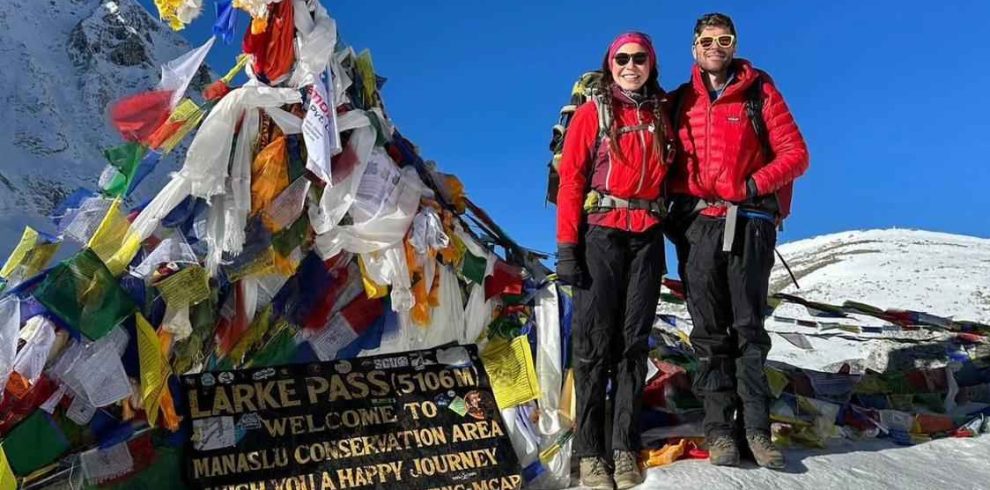
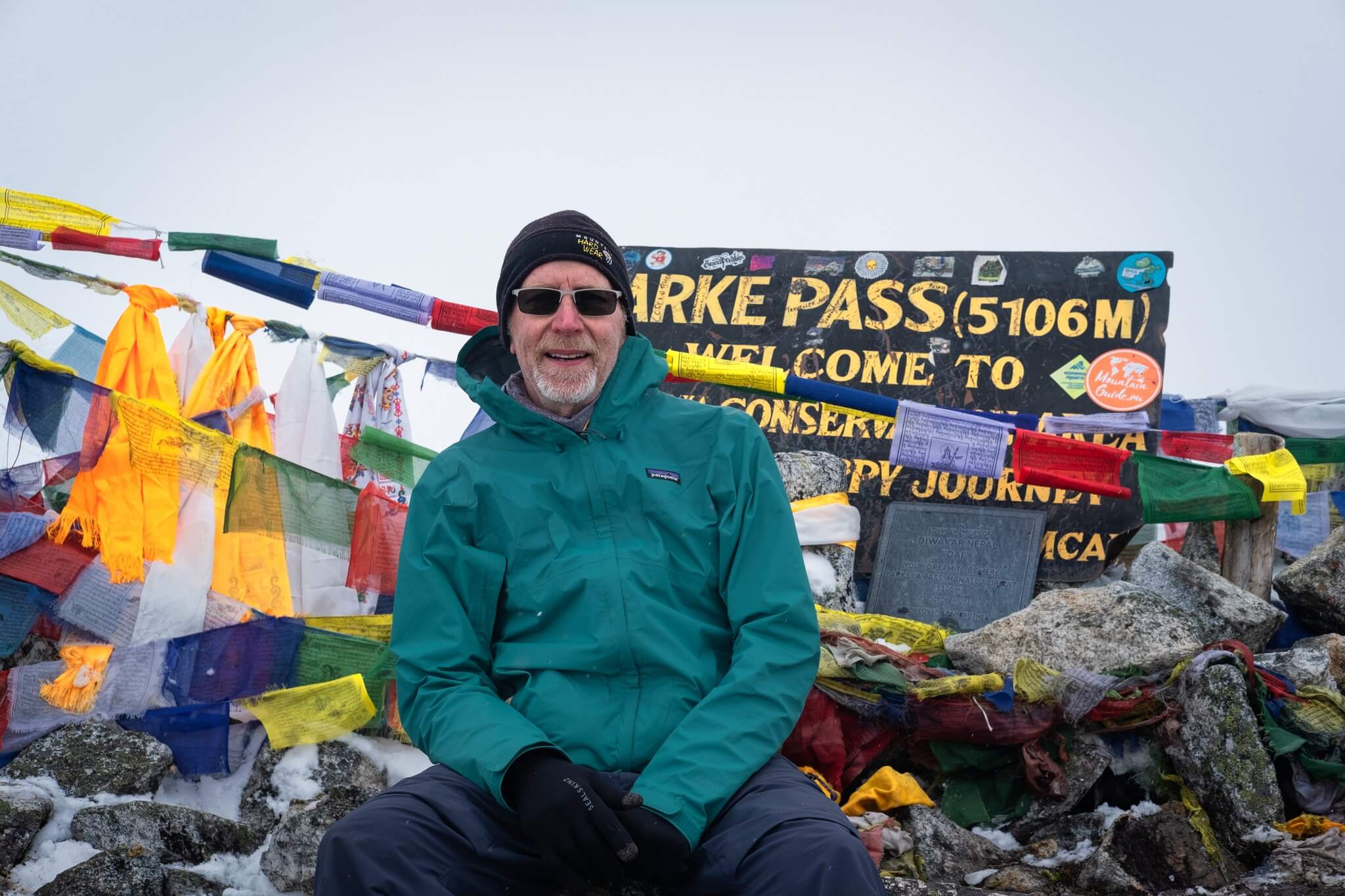
The Larkya La Pass at 5,106 metres is the hardest day of the trek. I have crossed it more than 20 times and it is still the day I look forward to most when I am planning a group trip. From the top, Himlung Himal, Cheo Himal, Kang Guru, and Manaslu are all visible in one frame with nothing in between. There is no other point on the circuit that gives you that view. Trekkers who reach it after 10 days on the trail are not just seeing four peaks. They have earned that view with their legs and their lungs and the nights they spent at altitude preparing for it.
I also know something that does not make it into most trek descriptions: the people who run the teahouses along the Manaslu Circuit are people I have known for years. Some of them were helpers on the trail when I was starting out. Some have become teahouse owners. I know their names, their families, and which teahouses to recommend for which groups. That kind of connection is something no booking platform can give you and it makes a real difference to how your trip runs day to day.
Acclimatisation on the Manaslu Circuit: What I Tell Every Group
After more than 20 trips on this route, the single biggest factor that determines whether someone has a strong crossing of the Larkya La or a difficult one is not their fitness. It is how well they have acclimatised in the days before the pass. I have seen very fit trekkers struggle above 4,500 metres because they moved too fast in the lower sections. I have seen trekkers who were nervous about their fitness cross the pass comfortably because they respected the altitude schedule.
The Manaslu Circuit itinerary I recommend is built around two principles that most 13-day plans get right but that many shorter plans get wrong. First, the rest day at Samagaun at 3,530 metres is not optional. It is the most important day of the trek. The body needs time to adjust at that altitude before moving to Samdo at 3,860 metres and then to Dharamsala at 4,460 metres. Cutting the Samagaun rest day to save one day is the single most common mistake I see on other agencies’ itineraries.
Second, the night at Dharamsala before the Larkya La is a short night. You leave at 4am. Most trekkers sleep 4 to 5 hours at most because of the altitude and the anticipation. This means you are crossing the most demanding section of the trek on partial sleep after 10 days of accumulated fatigue. The solution is to arrive at Dharamsala with as much acclimatisation base as possible. The days at Samagaun and Samdo are what build that base.
The acclimatisation schedule I use
The route itself is designed well for altitude gain. The problem is that some agencies compress the lower days to save cost. On my itinerary, we do not rush the section between Deng and Namrung. The altitude gain from Machha Khola at 870 metres to Samagaun at 3,530 metres happens over seven walking days. That is the right pace. Faster than that and you are asking trekkers to acclimatise on the move rather than giving them the rest days to do it properly.
What I tell every group the night before Larkya La: drink water before you sleep even if you are not thirsty, put your batteries inside your sleeping bag, set your alarm for 3:30am and be ready to walk by 4:00am. The groups that leave early have the best conditions on the pass. The groups that leave late walk into the wind that comes up after 9:00am on most days. That wind at 5,000 metres in the cold is the thing that makes a hard day into a very hard day.
I have guided trekkers from their 20s to their early 60s across this pass. Age matters less than preparation and pace. Go slow. Drink water. Trust the schedule.
The Teahouses on the Manaslu Circuit: What I Know From 20 Trips
I know every teahouse on the Manaslu Circuit by name and by owner. Some of the people running teahouses on this route today were helpers and porters when I first started guiding here. A few were working the same trail I was working when I was learning the route. Watching them build their own businesses over the years is one of the most satisfying things about doing this work in a region I come from.
The teahouses on the Manaslu Circuit are not luxury accommodation and they are not trying to be. From Machha Khola to Jagat the rooms are simple but warm. As you move higher into the Nubri valley the rooms get smaller and the nights get colder. At Dharamsala the accommodation is the most basic on the entire route because the teahouse there exists for one reason: to shelter trekkers the night before the Larkya La. Nobody stays there for comfort. They stay there because the pass is four hours away in the morning dark.
What the teahouses do consistently well is the food. The dal bhat on this route is cooked by people who have been making it their whole lives. It is not trekker food in the way that some Kathmandu restaurants interpret it. At Samagaun especially, the families cooking are using what they have grown and what they have raised. I recommend dal bhat over pasta or pizza at every teahouse above Deng, not because I am being traditional, but because it is genuinely better and because the carbohydrate load is exactly what your body needs at altitude.
Electricity above Samagaun is solar dependent. It is not reliable enough to plan your charging schedule around. Bring a full power bank and keep it warm at night alongside your camera batteries. This is not a problem I tell people about to manage expectations. It is just the reality of being in a remote valley at 3,500 metres where the solar panels on the teahouse roof are doing their best.
One thing I tell every group before we leave Kathmandu: the teahouses on this route are family businesses run by people who have chosen to stay in their community and build something there. Treat their homes with respect. Leave the rooms as you found them. The Manaslu Circuit is still a quiet route in part because the communities along it have had a better experience with trekkers than the communities on the busier routes. That is worth protecting.
Manaslu Circuit Permits in 2026: What Changed and What You Need to Know
Something significant changed on March 22, 2026. Nepal’s Department of Immigration officially updated the Manaslu Restricted Area Permit rules. The requirement that forced solo trekkers to find a second foreign trekker before a permit would be issued has been removed. Solo trekkers can now apply for the Manaslu Restricted Area Permit individually.
I want to be clear about what this does and does not change. The guide requirement has not changed. A licensed guide from a registered agency is still mandatory on the Manaslu Circuit and independent trekking without a guide is still prohibited. What changed is that you no longer need to find another trekker to share a permit application with. If you want to do this trek alone, you can now book it as a solo trekker and we arrange the permit for you individually.
The permits required for the Manaslu Circuit in 2026 are three: the Manaslu Restricted Area Permit, the Manaslu Conservation Area Permit, and the Annapurna Conservation Area Permit. You also pay a Chumnubri Rural Municipality entry fee at the Jagat checkpoint. TIMS cards are not required for this route. If any agency tells you otherwise, they are either not up to date or adding cost that does not belong.
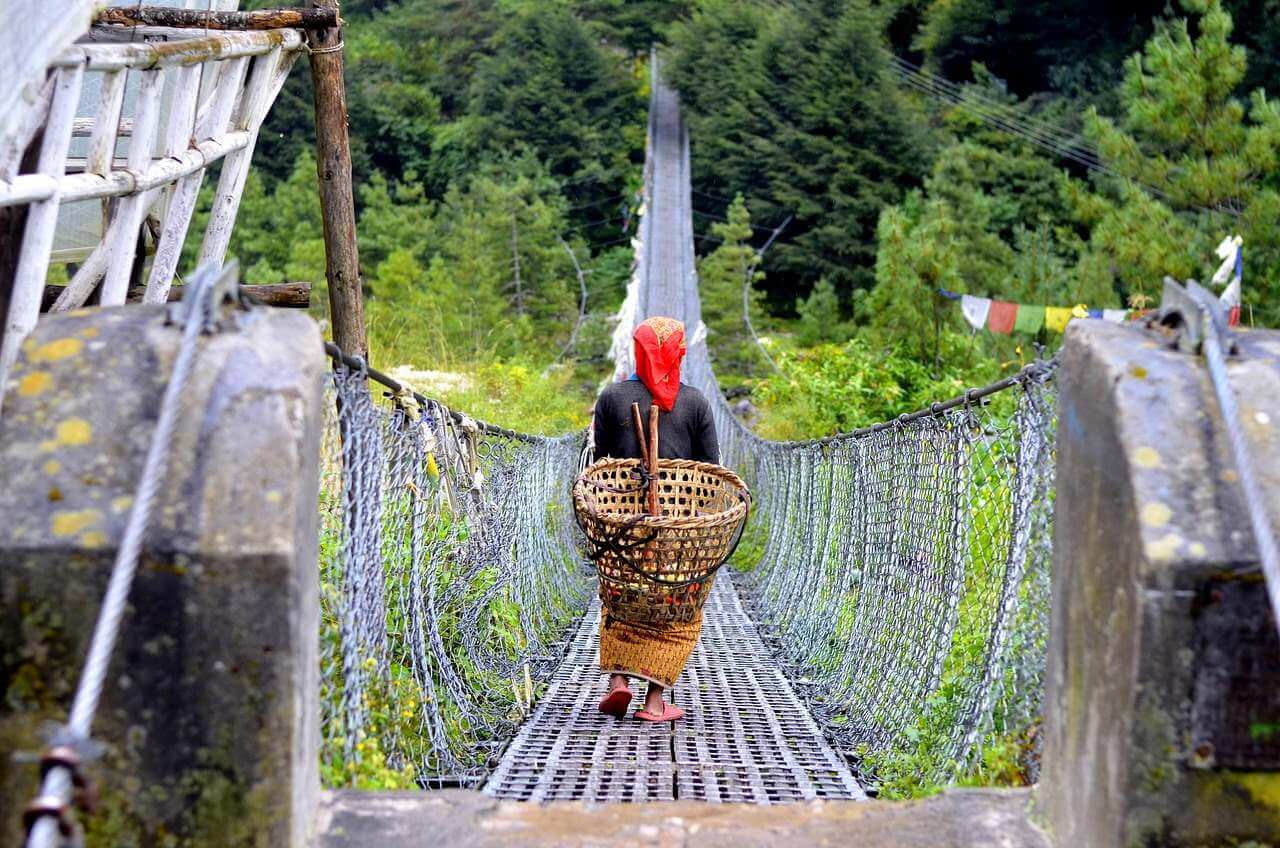
One practical note about the checkpoints: as of 2026, the main checkpoints at Jagat and Namrung use digital tracking systems for permit verification. Your guide handles the scanning at each post. Keep a digital copy of your permits on your phone as a backup. The river crossings on the lower Budhi Gandaki sections have a way of getting into bags and paper permits do not survive that well.
We process all permits here in Kathmandu. We need your original passport and it takes one to two business days. During October when the immigration office is at its busiest, allow three to four days. We collect your passport on arrival day and have everything ready before you leave the city. All permit costs are included in the trek price. There is nothing to arrange or pay separately.
If you’re looking for a trek that combines untouched nature, authentic villages, and jaw-dropping Himalayan views, the Manaslu Circuit is one of Nepal’s best kept secrets.
Best Manaslu Circuit Trek Cost 2026 and 2027
The Best Manaslu Circuit Trek cost for 2026 and 2027 starts from USD$ 1,240 per person and goes up to USD $1,490 per person.
This price is 100 percent all inclusive, which means there are no hidden costs, no surprise fees, and nothing extra to pay once you arrive in Nepal. Everything needed for the trek such as permits, accommodation, meals, guide, and logistics is included based on the itinerary.
| No. of Pax | Starting Price (per person) | Inquiry |
|---|---|---|
| 1 Pax | USD $1,490 | |
| 2–3 Pax | USD $1,400 | |
| 3–4 Pax | USD $1,340 | |
| 4–10 Pax | USD $1,240 |
Best Manaslu Circuit Trek Itinerary Recommended by Manaslu Trekking Guide
This Manaslu Circuit Trek itinerary follows a comfortable pace recommended by experienced Manaslu trekking guides. It includes proper acclimatization, balanced walking hours, and a safer ascent toward Larkya La Pass.
- Day 01: Drive from Kathmandu to Machha Khola (930m)
Duration: 8–10 Hours Drive - Day 02: Trek from Machha Khola to Jagat (1,340m)
Duration: 6–7 Hours Trek - Day 03: Trek from Jagat to Deng (1,860m)
Duration: 6–7 Hours Trek - Day 04: Trek from Deng to Namrung (2,630m)
Duration: 6–7 Hours Trek - Day 05: Trek from Namrung to Samagaon (3,530m)
Duration: 6–7 Hours Trek - Day 06: Acclimatization Day in Samagaon
Optional Side Trip: Manaslu Base Camp or Pungyen Gompa (4–7 Hours) - Day 07: Trek from Samagaon to Samdo (3,875m)
Duration: 3–4 Hours Trek - Day 08: Trek from Samdo to Dharamsala / Larkya Phedi (4,460m)
Duration: 4–5 Hours Trek - Day 09: Cross Larkya La Pass (5,106m) and Trek to Bimthang (3,720m)
Duration: 8–10 Hours Trek - Day 10: Trek from Bimthang to Gho / Goa (2,300m)
Duration: 5–6 Hours Trek - Day 11: Trek from Gho to Dharapani (1,860m)
Duration: 4–5 Hours Trek - Day 12: Drive from Dharapani to Kathmandu or Pokhara
Duration: 8–10 Hours to Kathmandu | 6–7 Hours to Pokhara - Day 13: Final Departure from Kathmandu
Best Manalsu Circuit Trek Overview
What is the Manaslu Circuit Trek in Nepal?
The Manaslu Circuit Trek is one of Nepal’s most scenic and culturally rich high-altitude trekking routes. Located in the Gorkha district, the trail circles the entire Mount Manaslu massif, the world’s eighth-highest mountain at 8,163 meters (26,781 ft). The route follows the Budhi Gandaki River through deep gorges, traditional villages, and remote Himalayan landscapes before crossing the dramatic Larkya La Pass at 5,106 meters.
Unlike the busier Everest and Annapurna regions, the Manaslu Circuit remains a restricted trekking area. Trekkers are required to travel with a licensed guide and obtain special permits. These regulations help preserve the region’s culture and reduce overcrowding, creating a quieter and more authentic trekking experience.
The route passes through diverse landscapes and cultures. Lower sections feature subtropical forests, waterfalls, and river valleys, while higher sections enter Tibetan Buddhist communities such as Namrung, Samagaun, and Samdo. Along the trail, trekkers experience monasteries, prayer flags, yak caravans, ancient traditions, and spectacular mountain scenery.
Most standard itineraries take around 13–16 days, including acclimatization days. The trek usually begins with a drive from Kathmandu to Machha Khola and ends in Dharapani after crossing Larkya La Pass. Throughout the journey, trekkers see stunning views of Manaslu, Himlung Himal, Cheo Himal, Kang Guru, and nearby peaks.
For many trekkers, the Manaslu Circuit offers a balance that is increasingly difficult to find elsewhere in Nepal: fewer crowds, genuine local culture, challenging terrain, and a true sense of Himalayan adventure.
What You Will Find on the Manaslu Circuit Trek: Culture, Food, Wildlife, Mountains and How the Trail Has Changed
I started guiding the Manaslu Circuit from Arughat Bazaar. That is where the road from Dhading ends and the trail begins in its older form, before the road construction that now pushes the starting point further into the valley. I know this route from that original starting point, and I have watched it change season by season over more than 20 trips. What I can tell you about the culture, the food, the wildlife, and the mountains is not from a guidebook. It is from being here, repeatedly, over years.
The Culture of the Manaslu Circuit
The Manaslu Circuit passes through two distinct cultural zones that most trekkers do not fully appreciate until they are standing inside them.
The lower Budhi Gandaki valley from Arughat Bazaar and Machha Khola through to Deng is predominantly Hindu and animist, culturally closer to the hill communities of Dhading and Gorkha. The terraced fields, the roadside shrines, the market towns, the language spoken in the tea shops — this is Nepal that most foreigners recognise from Kathmandu and the Terai. It is familiar, warm, and already beautiful.
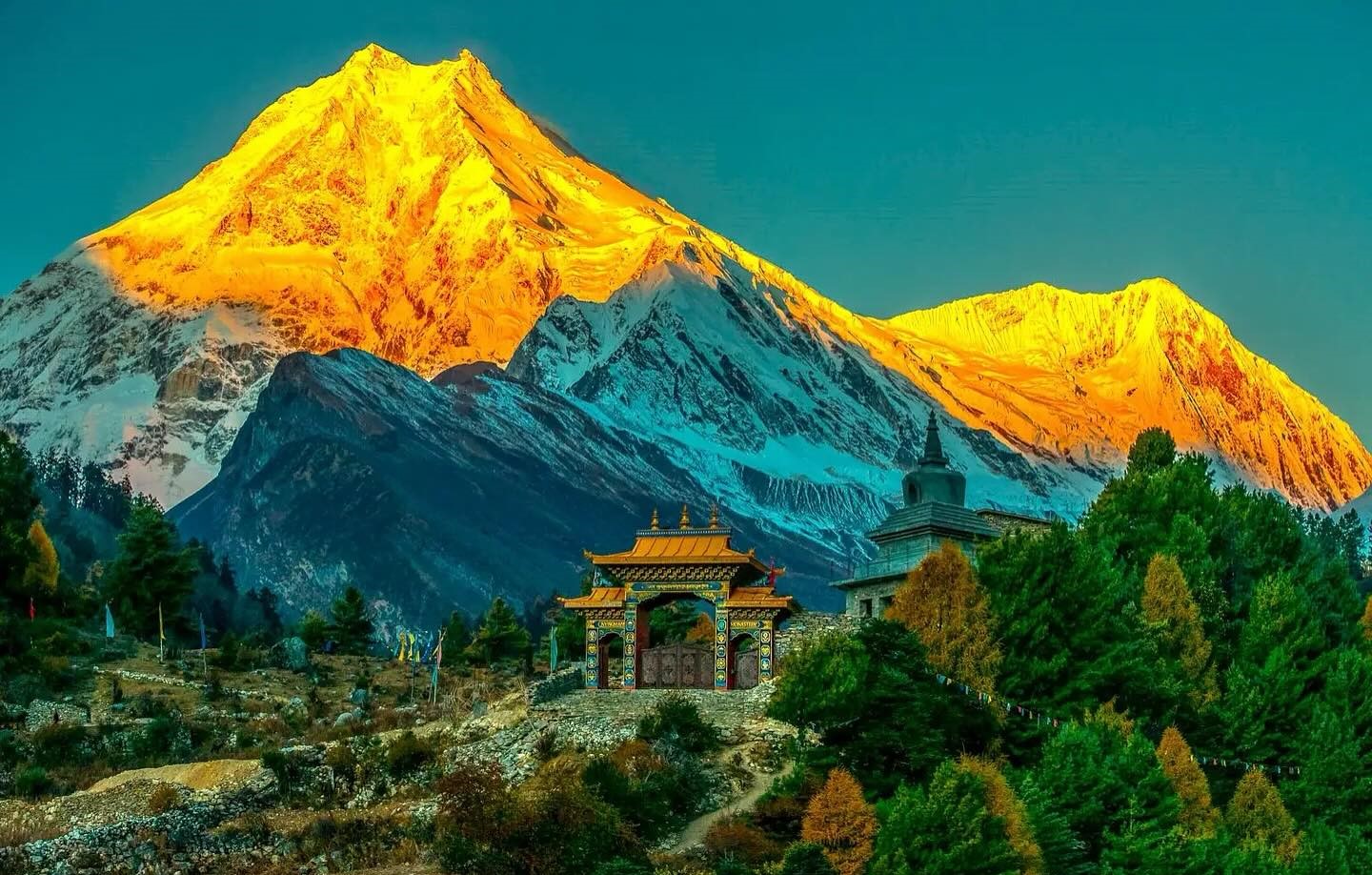
Everything changes at Deng. From Deng onward into the Nubri valley, you are entering a Tibetan Buddhist world. The architecture changes. The prayer flags appear on every ridge and rooftop. The mani walls along the trail become longer and more elaborate. The faces of the people in the villages are different, the food is different, the monasteries are active rather than preserved. The Nubri people have maintained this way of life for centuries in a valley that was almost entirely closed to the outside world until 1991.
Samagaun, which sits at 3,530 metres and is one of the main stops on the upper circuit, has a gompa at its centre that has been standing and practicing for generations. When I am there with a group, I always spend time at the gompa in the morning when the monks are doing their prayers. The sound carries across the village. The smell of juniper incense comes through the door. This is not a cultural performance put together for trekkers. It is Tuesday morning in Samagaun.
At Samdo, which sits even closer to the Tibetan border, the Tibetan influence is stronger still. The stone houses are built into the hillside, the livestock enclosures are immediately below the living quarters for warmth in winter, and the community has a quiet, self-contained quality that comes from centuries of living at altitude with limited contact with the outside world.
From Deng onward, you are not visiting a Tibetan Buddhist culture. You are walking through it. That is a different thing entirely.
Monasteries Worth Visiting
The gompa at Samagaun is the most accessible and the most visited. Pungen Gompa, which sits above Samagaun on the way to the glacier viewpoint, is smaller and older and sees fewer visitors. Rachen Gompa in the Tsum Valley, if you take the extension, is a functioning nunnery carved into a cliff face that is one of the most striking religious sites I have seen anywhere in Nepal. For trekkers who are genuinely interested in Buddhist practice rather than just the aesthetic of monastery buildings, the upper Manaslu circuit rewards that interest more than almost any other route in Nepal.
Food on the Manaslu Circuit
The food on this trek changes with the altitude and with the culture of the valley you are passing through.
In the lower sections from Machha Khola to Jagat and Philim, the teahouse menus are close to what you find anywhere in the Nepal hills. Dal bhat, noodle soup, fried rice, eggs in various forms, chapati with vegetables. The ingredients are fresh because the villages here are connected to local markets and the climate allows for a wider range of produce.
As you move higher into the Nubri valley from Namrung onward, the menus simplify. The altitude and the remoteness mean that supplies have to be carried in or grown locally. Dal bhat remains the most reliable and the most nutritious choice. Tsampa, which is roasted barley flour mixed with butter tea, is a staple of the Tibetan communities and you will find it in various forms in the upper valley teahouses. It is worth trying. It is an acquired taste. It is also exactly what the body needs at altitude.
Butter tea is served in every teahouse from Deng onward. It is made from strong tea, yak butter, and salt. First-time trekkers almost universally find it unusual. I recommend drinking it anyway. It keeps you warm, the fat content is genuinely useful at altitude, and drinking what the local families drink is part of being on this trail rather than just passing through it.
What I Tell Every Group About Food
Eat dal bhat above Deng. Not because pasta and pizza are not available — they are on most menus — but because dal bhat is cooked from what the families here have available and it is consistently better than the international menu items that the teahouses stock for trekkers who will not try the local food. The rice is filling, the lentils have protein, the vegetable curry changes every day, and the meal is refillable without extra charge at most teahouses. At 4,000 metres when your appetite is reduced and your body is working harder than usual, a full dal bhat is the most useful thing you can eat.
Above Samagaun, eat more than you feel like eating. Altitude suppresses appetite but the body is burning more calories than usual. Trekkers who under-eat in the two days before the Larkya La crossing feel the deficit on the pass. The teahouses at Samdo and Dharamsala are simple but they will feed you well if you ask for enough.
| Location | What to eat | What to expect |
|---|---|---|
| Machha Khola to Jagat | Dal bhat, egg dishes, fresh vegetables | Widest variety on the route, fresh produce available |
| Deng to Namrung | Dal bhat, noodle soup, chapati | Menus simplify, quality still good, locally grown where possible |
| Lho to Samagaun | Dal bhat, tsampa, butter tea, potato dishes | Tibetan food begins to dominate, yak dairy products available |
| Samdo and Dharamsala | Dal bhat, hot soup, garlic soup for altitude | Basic menus, focus on warmth and calories rather than variety |
| Bimthang descent | Dal bhat, hot noodles, any warm meal | After the pass, appetite returns sharply, eat what is available |
Wildlife on the Manaslu Circuit
The Manaslu Conservation Area covers 1,663 square kilometres and contains one of the most complete high-altitude ecosystems remaining in Nepal. The wildlife here is not guaranteed on any given day but the chances of meaningful sightings are genuine, particularly above 3,500 metres.
Himalayan Blue Sheep
Blue sheep, known locally as bharal, are the most commonly seen large mammals on the upper circuit. They live on the rocky slopes above the treeline and are most concentrated above Samdo and on the terrain approaching Larkya La. The herds I have seen above Samdo can be large, sometimes thirty to fifty animals on a single slope. They are not tame but they are accustomed to some human presence and if you move quietly and keep the group together you can get close enough for clear photographs without a telephoto lens. With a telephoto lens the shots are excellent.
Snow Leopard
The Manaslu Conservation Area has an estimated population of around 50 snow leopards. I want to be honest: in more than 20 trips on this route I have seen fresh tracks twice and seen an actual animal once, at a significant distance, above Samdo in the early morning. The chance of seeing a snow leopard is real but it is not something to expect or to plan around. What I tell trekkers is this: the fact that they are here, that the habitat is intact enough to support them, is something worth knowing as you walk through this terrain. The mountain you are walking under is large enough and wild enough to hide a snow leopard from a guide who has walked it for years.
Himalayan Tahr and Musk Deer
Himalayan tahr are seen regularly on the forested slopes between Jagat and Deng, particularly in the early morning. Musk deer are present in the forest sections of the lower valley and are most often seen at dawn or dusk near water. They are shy and quick. The best strategy is to move quietly in the early morning rather than rushing through the lower sections to cover distance.
Birds
The bird life on the Manaslu Circuit is one of the most underappreciated aspects of the trek. The Himalayan Monal, which is Nepal’s national bird, is seen regularly in the forest sections between 2,500 and 4,000 metres. Lammergeier vultures circle the high ridges above the upper valley with a wingspan that makes everything else in the sky look small. Blood pheasants are found near the treeline. Grandala, a brilliant blue bird, appears on the open slopes above 4,000 metres. For trekkers who are interested in birds, the Manaslu Circuit is a serious destination on its own terms.
The Mountains You See on the Manaslu Circuit
The Manaslu Circuit circles Mount Manaslu, the eighth highest mountain in the world at 8,163 metres. But the trek does not give you one mountain. It gives you a changing relationship with a range of peaks over 13 days as you move through different valleys and different elevations.
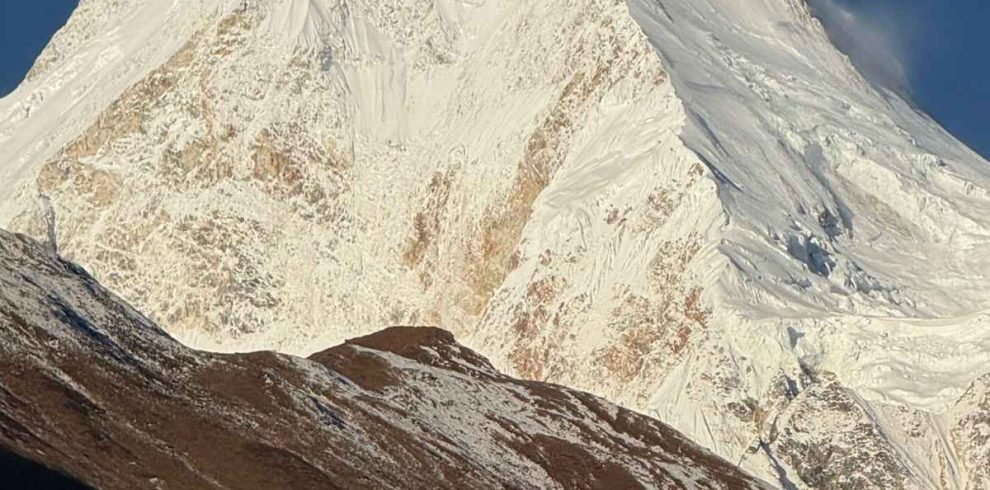
The first clear view of Manaslu’s north face appears above the village of Lho at around 3,180 metres. Most trekkers stop walking when they see it. Until that point the mountain has been hidden by ridges and forest. When it appears it is closer and larger than expected and the glacier on the face is visible in detail. This is one of the moments I look forward to most on every trip, watching someone see it for the first time.
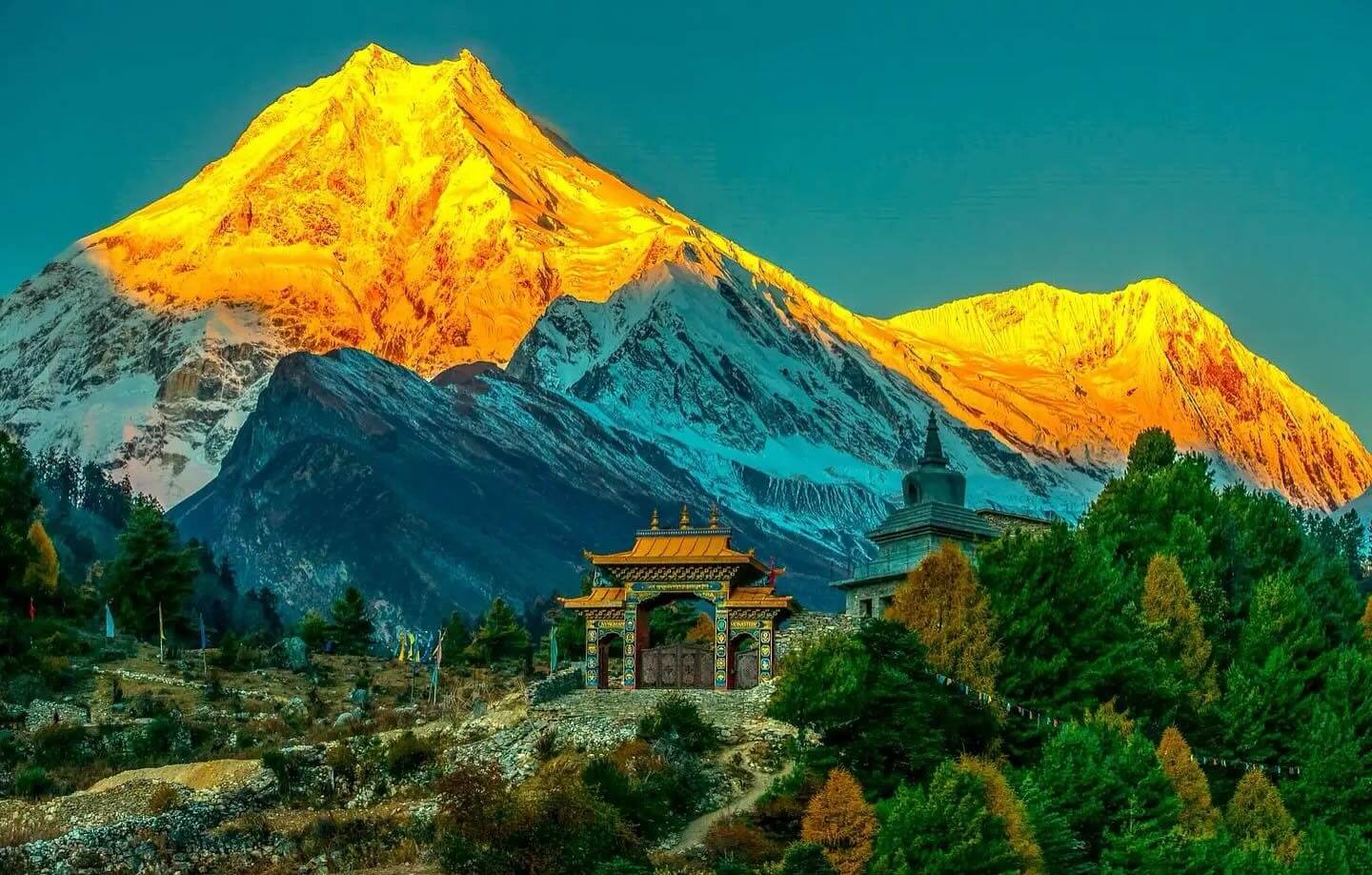
From Samagaun, Manaslu fills the eastern sky. At sunrise the summit catches the first light while the valley floor is still in shadow. The contrast lasts about 25 minutes before the light spreads down the face and the full mountain is lit. Birendra Lake at Samagaun, a 45-minute walk from the village, reflects the peaks on calm mornings before the wind comes up around 07:30.
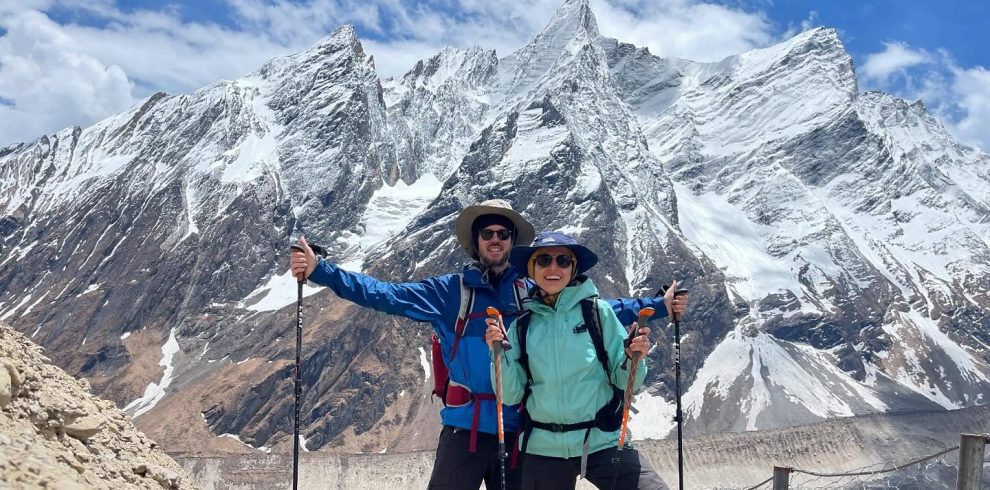
From Pungen Gompa above Samagaun, the view looks directly across at the Manaslu glacier. The ice is close enough to show crevassing and movement. This is a different kind of mountain view from the long-distance panoramas you get on the Annapurna Circuit. It is intimate in a way that surprises people who have not been this close to an 8,000 metre peak before.
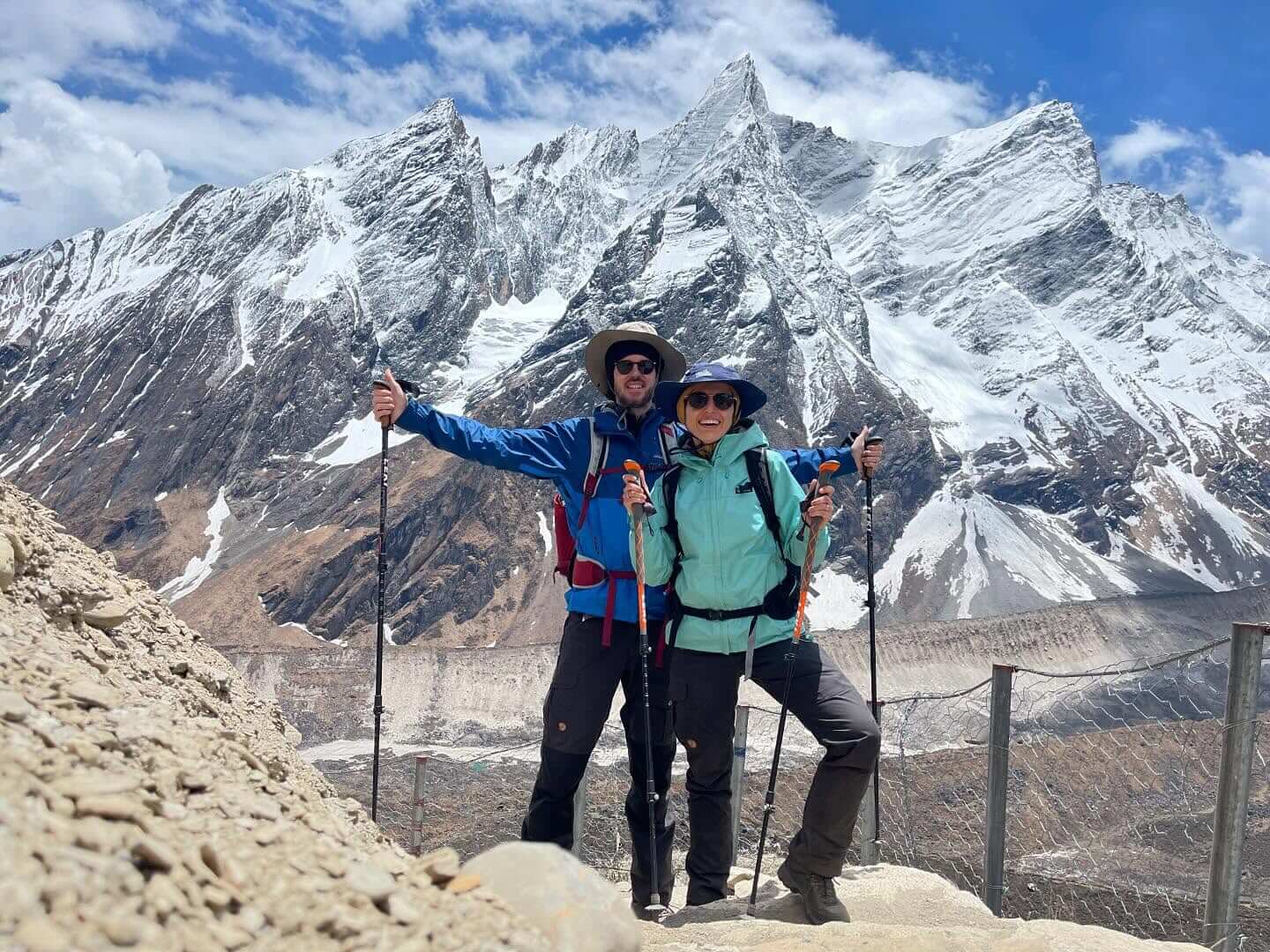
At the Larkya La, the view opens to the west and north. Himlung Himal at 7,126 metres, Cheo Himal at 6,820 metres, Kang Guru at 6,981 metres, and Manaslu itself are all visible from the pass summit. There is no other point on the circuit where all four are in the same frame with open sky between them.
| Peak | Height | Best viewed from |
|---|---|---|
| Mount Manaslu | 8,163m | Lho, Samagaun, Pungen Gompa, Larkya La |
| Himlung Himal | 7,126m | Larkya La summit |
| Kang Guru | 6,981m | Larkya La summit and descent toward Bimthang |
| Cheo Himal | 6,820m | Larkya La summit |
| Ngadi Chuli | 7,871m | Upper Budhi Gandaki valley sections |
| Himalchuli | 7,893m | Lower and mid valley sections looking north |
| Ganesh Himal | 5,203m | Lower valley sections approaching from Arughat Bazaar |
How the Trail Has Changed: 2026 Update
I started walking this route from Arughat Bazaar. That is the market town in Gorkha district where the road from Dhading reaches the Budhi Gandaki valley and the trekking trail originally began. Most trekkers in those earlier years started from Arughat and walked the full lower gorge section to Machha Khola as their first day or first two days on the route.
The road has now been extended further up the valley. Machha Khola, which used to be a rest stop on a walking day, is now the point where most jeeps drop trekkers and the trail officially begins for most agencies. The road work that has changed the lower section of the Annapurna Circuit is happening in this valley too, and the trail between Arughat Bazaar and Machha Khola that I walked as a young guide is now partly a construction road.
Further up, road construction is ongoing in sections between Machha Khola and Jagat. The trail in this area diverts around the construction in some sections and the walking surface is less clean than it was three or four years ago. This is not a reason to avoid the trek. The upper valley above Deng is essentially unchanged. But trekkers who read old trip reports from five or six years ago should know that the lower sections look and feel different now.
What Has Improved: Teahouses with Attached Bathrooms
The most significant positive change I have seen in the last few years is the teahouse infrastructure. When I first guided this route, most teahouses had shared bathrooms, usually a squat toilet in a separate block and no hot water except from a bucket heated on the stove. This is still the reality at some of the smaller stops and at Dharamsala just before the pass. But at the main stops — Machha Khola, Jagat, Deng, Namrung, Lho, Shyala, Samagaun, and Samdo — there are now teahouses with attached bathrooms, hot showers, and in the lower and mid sections, reliable wifi.
This is a genuine improvement for trekkers who found the older shared facilities difficult. The teahouses with attached bathrooms cost slightly more per night but the difference is modest. For couples or solo trekkers who value privacy and comfort at the end of a long walking day, these rooms are worth asking for specifically when you arrive.
The teahouse owners who have built these upgrades are people who have invested their own savings into improving their businesses. Some of them have been on this trail as long as I have, starting as helpers and porters and building toward owning and running their own places. Choosing to stay at their upgraded teahouses supports exactly the kind of local economic development that keeps this trail in good hands.
Internet Connectivity
Ncell coverage has improved significantly on the lower and mid sections of the route. From Machha Khola to Samagaun, data connectivity is available at most teahouses, though the speed varies and it becomes unreliable above Samagaun. Some teahouses now offer wifi through satellite connections. At Samdo and Dharamsala above 3,800 metres, do not plan on reliable internet. This is not a problem. It is part of being on a mountain route that is still genuinely remote in its upper sections.
For trekkers who need to stay reachable for work or family, the practical approach is to check in from Samagaun before moving up to Samdo and Dharamsala. Tell people at home that you will be out of contact for two to three days around the pass crossing and that no news is good news during that window.
For full details on the 13-day Manaslu Circuit Trek itinerary and cost, or to ask specific questions about the route, teahouses, or permit requirements for 2026, visit manaslutreks.com or reach us directly on WhatsApp. I answer questions about this route personally.
Manaslu Circuit Trek Highlights
- Scenic circuit around Mount Manaslu (8,163m) – the world’s 8th highest peak
- Cross the iconic Larkya La Pass (5,106m) – one of the most beautiful high passes in Nepal
- Less crowded trail – a peaceful alternative to Everest and Annapurna routes
- Deep Tibetan Buddhist culture – explore ancient monasteries, chortens, and prayer flags
- Visit remote villages like Samagaon, Lho, and Samdo with stunning mountain backdrops
- Trek through the Manaslu Conservation Area – home to snow leopards, blue sheep, and Himalayan wildlife
- Support local communities through responsible tourism in a restricted region
- Fully guided adventure with a licensed local expert, permits, and all logistics handled
After more than 20 trips on this route I have watched trekkers make the same mistakes and ask the same questions at the same points on the trail. Most of the problems people encounter on the Manaslu Circuit are avoidable. Not all of them, because this is a remote high-altitude route and the mountains do not negotiate. But the majority of difficult experiences come from preparation gaps that could have been closed before leaving Kathmandu.
This is the advice I give every group before we start. Not the version in the official pre-trek briefing. The version I give when someone asks me directly what they actually need to know.
Before You Leave Kathmandu
Do not rush the permit process
Permit processing at the Department of Immigration takes one to two business days under normal conditions. In October, when the office is handling the highest volume of applications of the year, allow three to four days. The office is closed on Saturdays and public holidays. If your itinerary has you arriving on a Thursday and leaving on a Saturday, your permits will not be ready in time. We handle this for every group we guide but if you are planning independently you need to build this buffer into your Kathmandu days.
From March 2026, solo trekkers can apply for the Manaslu Restricted Area Permit individually. The guide requirement has not changed. You still need a licensed guide and you still need to book through a registered agency. What changed is that you no longer need a second trekker on the same application.
Get your gear sorted in Kathmandu, not on the trail
Thamel in Kathmandu has everything you need for this trek. Good quality gear is available at reasonable prices. Broken zips, worn boot soles, and thin sleeping bags are problems that are easy to fix in Kathmandu and impossible to fix above Deng. Check your boots are properly broken in before you arrive. If they are new, wear them for at least four to six weeks of regular walking before the trek. Blisters on day two of the Budhi Gandaki gorge section are a miserable way to start 11 more days of walking.
Buy travel insurance that covers helicopter evacuation
This is not optional on the Manaslu Circuit. The nearest hospital capable of treating serious altitude illness or injury is in Kathmandu. The only realistic evacuation from the upper valley in an emergency is by helicopter. Helicopter evacuation costs USD 3,000 to 5,000 or more depending on the pickup location and conditions. Your insurance must specifically cover helicopter rescue and evacuation to at least 6,000 metres. Check the policy wording, not just the headline coverage amount. Some policies exclude high-altitude trekking or have altitude limits that do not cover the Larkya La crossing.
On the Trail: What I Tell Every Group
Walk slower than you think you need to
This is the single piece of advice that makes the biggest difference to how people feel at altitude and almost nobody follows it well in the first three days. The Budhi Gandaki gorge section in the lower valley does not feel like altitude walking. The air is warm, the scenery is new and interesting, and the natural instinct is to walk at your normal pace. The problem is that your body is already beginning to adapt to the gradually increasing elevation and the effort you spend in the lower sections accumulates by the time you reach 4,000 metres.
The Nepali trekking pace, which guides use on every serious route, is a rhythm where you could hold a conversation without breathing hard. If you cannot talk comfortably while walking, you are going too fast. This feels uncomfortably slow to most trekkers from cities for the first two days. By day five it feels natural and by day ten it is the only way you would choose to move.
The rest day at Samagaun is not optional
Some agencies sell 11-day versions of the Manaslu Circuit that cut the acclimatisation day at Samagaun. I will not run this itinerary and I would not recommend booking it with anyone who does. The rest day at Samagaun at 3,530 metres is the foundation for everything that happens above it. Your body needs that day to adjust before you move to Samdo at 3,860 metres and then to Dharamsala at 4,460 metres. Trekkers who skip it arrive at Dharamsala with less acclimatisation base and cross the Larkya La on a body that has not been given the time it needed. I have seen the difference many times. The rest day is there for a reason.
Drink water consistently, not just when you are thirsty
Thirst is a lagging indicator of dehydration. By the time you feel thirsty at altitude you are already mildly dehydrated, and mild dehydration at altitude amplifies every other symptom of altitude stress including headache, fatigue, and poor sleep. Drink one litre of water before you start walking each morning. Drink steadily throughout the day. Drink again in the evening even if you are not thirsty. The rule I give every group is simple: your urine should be pale yellow or clear. If it is dark, drink more immediately regardless of how you feel otherwise.
Know the symptoms of altitude sickness and tell your guide immediately
Headache, nausea, dizziness, and loss of appetite at altitude are common and do not always mean something serious. They are your body telling you it is working hard. What you need to watch for is when these symptoms are severe, when they are getting worse rather than better with rest and hydration, or when they are accompanied by confusion, loss of coordination, or a wet cough. These are signs of High Altitude Cerebral Edema or High Altitude Pulmonary Edema and they are medical emergencies that require immediate descent.
Tell your guide at the first sign of anything unusual. Do not manage symptoms privately and hope they pass. Guides are trained to assess altitude illness and we would always rather know early. The most dangerous trekkers on this route are not the unfit ones. They are the ones who do not tell their guide how they are actually feeling because they do not want to slow the group down or appear weak. There is no version of this situation where staying quiet is the right choice.
For a full breakdown of the sections on the Manaslu Circuit where the trail presents the most serious physical risk, including the gorge landslide zones, the rockfall areas, and the specific demands of the Larkya La crossing, read our detailed guide on the risky parts of the Manaslu Circuit Trek before you go.
The night before Larkya La
You will not sleep well at Dharamsala. The altitude is 4,460 metres, the room is cold, and most trekkers lie awake thinking about the 4am start. This is normal. Do not worry about the sleep. What matters is what you do with the hours before you try to sleep.
Eat a full meal at dinner even if your appetite is reduced. Drink a full litre of water before you sleep. Put your camera batteries, your phone, and your power bank inside your sleeping bag or under your pillow. Cover them with a cloth if you have one. Cold overnight temperatures at this altitude drain batteries to the point of uselessness by morning and you want everything working on the pass. Set two alarms. Lay your trekking clothes where you can put them on in the dark without searching. Put your headlamp where your hand can reach it without sitting up.
When you wake at 3:30am the temperature inside the room will be close to zero. Get dressed quickly, drink something warm if the teahouse can provide it, and be ready at the door by 4am. The groups that leave early have the best conditions on the pass. Wind builds on the Larkya La after 9am on most days. Starting early is not about being fast. It is about being on the descent before the weather on the pass changes.
Physical Preparation Before You Come
The Manaslu Circuit is graded as a challenging trek. This is accurate. The daily walking times range from 5 to 8 hours on most days, the terrain is uneven throughout, and the altitude accumulates steadily from 870 metres at Machha Khola to 5,106 metres at the Larkya La. You do not need to be an athlete to complete this trek. I have guided trekkers in their 50s and early 60s who completed it comfortably. But you need to have done the preparation work before you arrive.
What to train for specifically
The most useful training for this trek is sustained uphill walking with a loaded pack. Running and gym fitness help but they do not prepare your legs and joints for 6 to 7 hours of continuous descent on rocky terrain the way that actually walking hills does. If you live near hills or mountains, get on them with a 6 to 8 kilogram pack on your back for at least two months before the trek. If you live in a flat city, use stairs with a pack, combine this with regular long walks of 3 to 4 hours, and add lower body strength work for the knee stability that the descents require.
The descent from Larkya La to Bimthang is long and steep on rocky ground. It is the section where trekkers with weak knees or unprepared legs feel the consequences of inadequate preparation most clearly. Trekking poles are useful here and I recommend bringing them for the whole trip. They reduce the load on your knees on every descent and improve balance on the narrow gorge sections in the lower valley.
Age and fitness: what I have actually seen work
The oldest trekker I have guided on this route was 64 years old. She completed the full circuit including the Larkya La crossing and said afterwards it was the most physically demanding thing she had done in twenty years and the most satisfying. The youngest solo trekker I have guided was 22 and struggled significantly above 4,000 metres because she had underestimated the altitude component and had trained only for distance rather than for sustained elevation gain.
Age matters less than preparation and honesty with yourself about your current fitness. Do the training. Come prepared. Tell your guide the truth about how you are feeling every day on the trail.
Things Most Trekkers Do Not Think About
Your passport stays with the agency in Kathmandu for one to two days
We need your original passport to process the Restricted Area Permit. The Department of Immigration requires it for verification. This means you will be in Kathmandu for at least one full day without your passport before the trek starts. Keep digital copies of all your documents on your phone and in email before you hand the passport over. This is standard practice and every registered agency does it this way. It is not a reason for concern but it is something to know in advance so it does not catch you off guard on arrival day.
Cash above Samagaun
There are no ATMs on the Manaslu Circuit. The last reliable ATM is in Gorkha or Arughat Bazaar before the trail starts. Some teahouses accept card payment in the lower sections but this becomes less reliable as you go higher. Above Samagaun, assume cash only. Bring enough Nepali rupees to cover your teahouse bills, tips for your guide and porter, any personal items you want to buy in the villages, and an emergency buffer. Discuss the daily cost breakdown with your agency before departure so you know exactly what is included in your package and what you will need cash for separately.
Tipping your guide and porter
Guides and porters on the Manaslu Circuit work in genuinely demanding conditions. A standard tip at the end of the trek is USD 10 to 15 per day for a guide and USD 5 to 8 per day for a porter. This is not mandatory but it is the normal practice and it is a meaningful contribution to the income of people who spend their working lives carrying weight and managing safety on a remote mountain route. Prepare the tip money in cash in Kathmandu before you leave.
Read about the risky sections before you go
The Manaslu Circuit has sections that present genuine physical risk that is different from standard trekking difficulty. The gorge between Jagat and Deng has rockfall zones and narrow trail sections above fast water. There are landslide areas in the lower valley that require moving quickly and not stopping. The Larkya La in bad weather or late in the season can have ice on the descent that changes the crossing from demanding to genuinely dangerous. Knowing where these sections are and what they require does not make the trek harder. It makes you better prepared for what the trail actually is. Read our full guide on the risky parts of the Manaslu Circuit Trek so you arrive with an honest picture of the route.
For the full itinerary, permit details, and departure dates for the 13-day Manaslu Circuit Trek, visit manaslutreks.com. Questions about preparation, fitness, or what to expect on specific sections of the route can be sent directly via WhatsApp and I will answer personally.