By Peteris Latvia
Introduction to My Nepal Adventure
It is me, Peteris. I am from Latvia and I work as a pilot at Cathay Pacific based in Hong Kong. Nepal had been on my list for a long time but my schedule as a pilot makes taking long holidays genuinely difficult. Layovers and days off come irregularly and planning a multi week adventure requires a specific kind of window that does not arrive often. Book with the best manaslu trek company for competitive pricing and guaranteed departures.
That window opened in late November 2025. I had several days available starting from December and I knew I had to use them. I had been researching the Manaslu Circuit Trek for about a year, reading everything I could find about it between flights from Hong Kong. The restricted area, the high mountain pass, the Tibetan Buddhist villages, the fact that it receives a fraction of the visitors that Everest and Annapurna get every season. Everything about it appealed to me.
Because I am based in Hong Kong, the logistics were simple on the flight side. Kathmandu is well connected from Hong Kong and I knew I could be there in under four hours. The bigger question was finding the right trekking company to trust with a trip I had been planning for so long.
I found Manaslu Treks and Expeditionwhile searching online for companies specialising in the Manaslu region specifically. Most big agencies in Nepal offer Manaslu as one option among dozens. Manaslu Treks and Expedition was different because the Manaslu region is clearly their area of deepest knowledge. I sent an enquiry and a guide named Kiran replied the same day. The conversation moved to WhatsApp and within a couple of days of texting back and forth, going through the itinerary, the permits, the costs, and what to expect in December conditions on the route, I felt confident enough to confirm the booking.
That is genuinely how it happened. A few text messages with a guide who clearly knew what he was talking about, and a short Manaslu Circuit trek was locked in for the first week of December 2025.
Planning the Manaslu Circuit Trek and need help with permits, route, or itinerary?
WhatsApp us Email us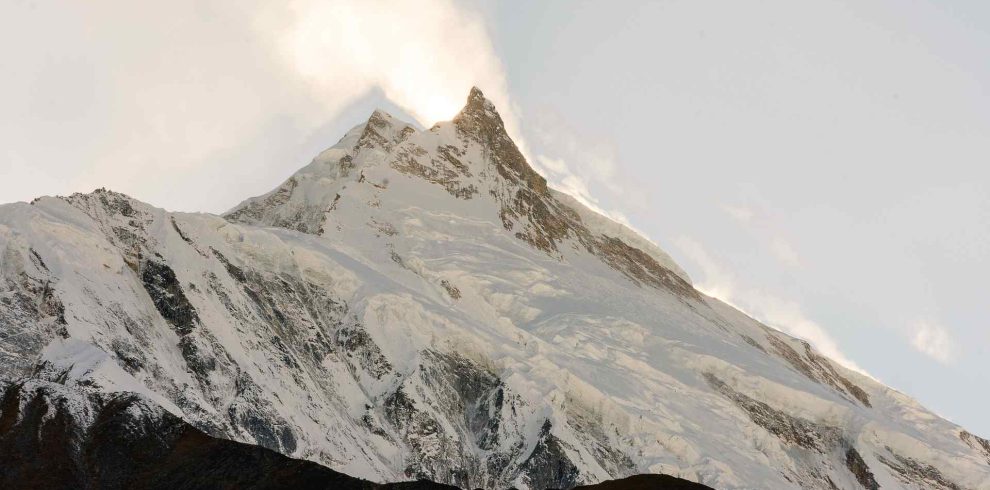
What This Trek Is and Who It Is Built For Most trekking companies sell the 9 day Manaslu Circuit as…
The Flight from Hong Kong to Kathmandu
I was working a flight on the evening of November 28 and came off duty in the early hours of November 29. I had a few hours at home in Hong Kong before heading back to the airport, this time as a passenger rather than as crew, which is always a slightly strange feeling when flying is your profession.
The Cathay Pacific flight from Hong Kong to Kathmandu takes around three hours and fifty minutes. I have flown this sector operationally before so I know it well from the flight deck side. Sitting in the cabin as a passenger and looking out the window on approach into Kathmandu is a completely different experience from the cockpit. The Himalayan range appears to the north as the aircraft descends into the valley and even on a hazy late November afternoon the scale of what you are looking at is immediately obvious from the air. Pilots develop a particular relationship with terrain. Looking at those ridges and peaks from the cabin window, I was already thinking about walking through them in a few days.
The aircraft landed at Tribhuvan International Airport on the afternoon of November 29.
Kiran at the Airport — First Meeting
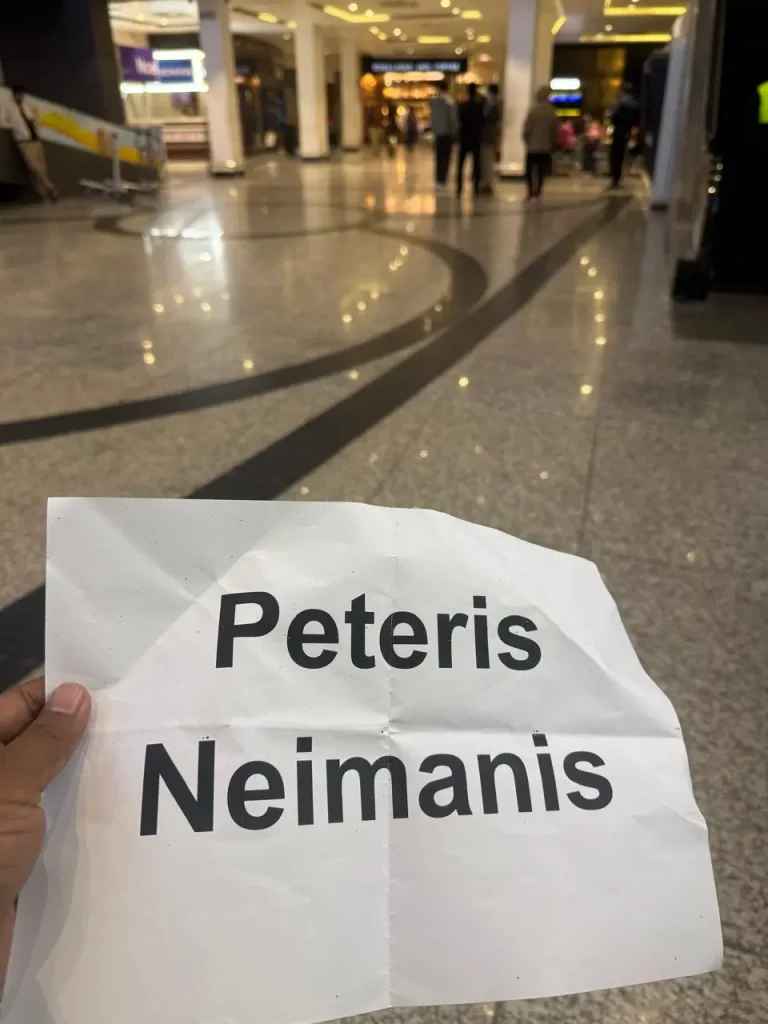
The arrivals process at Tribhuvan International took about forty five minutes including the visa on arrival. I collected my bag and walked through the arrivals gate into the usual Kathmandu airport crowd. There were drivers holding printed signs in every direction and a wall of people pressed up against the barrier watching the arrivals door.
I spotted my name almost immediately. But what I did not expect was that Kiran had come to the airport himself rather than sending a driver. He was standing near the front of the crowd holding a sign with my name on it, dressed casually and completely calm in the noise and the crowd around him. He had also written the names of several other guests he was meeting that same afternoon on separate cards tucked under his arm, which told me something immediately about how organised he was and how many people trusted him with their Nepal experience.
He saw me before I reached him, stepped forward, and greeted me with a warm handshake and a Namaste. After weeks of WhatsApp messages and one video call it was a genuinely good feeling to put a real person to those conversations. He took my larger bag without being asked and walked me out to the vehicle.
On the drive from the airport to Thamel he pointed out landmarks as the city moved past the windows. He named the temples, explained a little about the neighbourhoods we passed through, and answered the questions I asked without over explaining anything. By the time the car pulled up outside my hotel in Thamel I already felt that the trek was in good hands.
First Evening in Kathmandu — November 29
Kiran helped carry my bag into the hotel lobby and waited while I checked in. Once I had the room key he suggested we sit for a few minutes in the small hotel restaurant to go through the plan for the following morning. Over two cups of tea he walked me through the departure time, what to pack in my daypack for the long drive, and what to expect from the first two days on the road toward the Manaslu region.
He was thorough without being overwhelming. He answered everything I asked and when I had no more questions he stood up, said he would be outside the hotel at 5:30am the following morning, and left.
I went upstairs, showered, and walked a short distance to a local restaurant on the main street. Dal bhat arrived in a large metal tray with several small bowls of lentils, vegetables, pickle, and rice. I had no idea what I was doing but the owner of the restaurant showed me how to mix everything together. I ate two full plates. I was in bed by 9pm and asleep within minutes. The trek to Machhikhola started the next morning.
The Short Manaslu Circuit Trek Itinerary
Day 1: November 29 — Arrive Kathmandu
Day 2: November 30 — Drive Kathmandu to Machhikhola
Day 3: December 1 — Trek Machhikhola to Jagat
Day 4: December 2 — Trek Jagat to Deng
Day 5: December 3 — Trek Deng to Namrung
Day 6: December 4 — Trek Namrung to Shyala
Day 7: December 5 — Trek Shyala to Samagaun, Lunch, Visit Manaslu Base Camp, Return to Samagaun

Day 8: December 6 — Samagaun to Dharamsala (Larkya La Base Camp)
Day 9: December 7 — Cross Larkya La Pass (5,160m) to Bimthang
Day 10: December 8 — Bimthang to Tilije
Day 11: December 9 — Tilije to Dharapani, Drive to Kathmandu
Day 2: Drive Kathmandu to Machhikhola — November 30
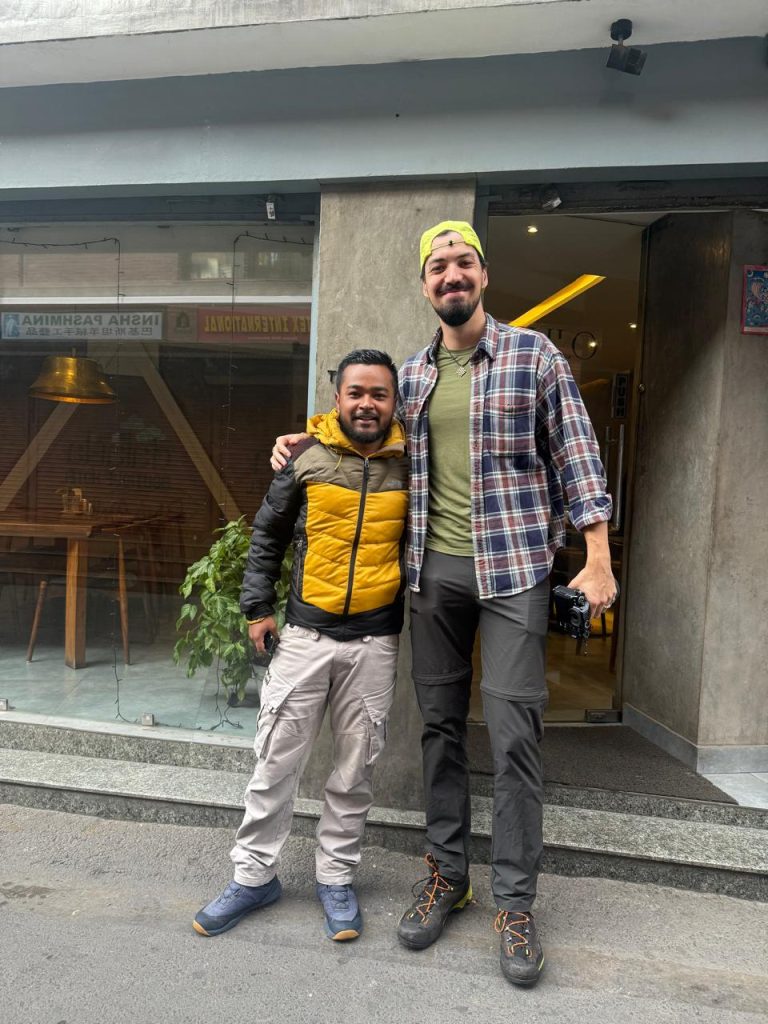
Kiran was outside the hotel at 5:30am exactly. The jeep was already running and the morning air in Kathmandu was cold and very still. The city at that hour is a different place entirely from the afternoon version I had arrived into the day before. The streets were almost empty and the temples and buildings along the road had a quiet presence in the early darkness that felt completely different from the noise and traffic of daytime Kathmandu.
The drive from Kathmandu to Machhikhola is long. It follows the Prithvi Highway west out of the Kathmandu Valley before turning north and following the Budhi Gandaki river gorge toward the Manaslu region. The road conditions on the highway are fine for the first few hours. Once the jeep turned off toward the Manaslu region the tarmac gave way to gravel and stone with river crossings in between.
Kiran sat beside me through most of the drive and talked about the route ahead. He described the character of each day, the altitude gains, the villages, and what to expect from the communities in the restricted area above Jagat. He talked about the Nubri people of the upper valley, their Tibetan Buddhist traditions, and why December was actually one of his preferred months to guide on this route. The cold keeps the trail clear of the heavy foot traffic that comes with October and the sky above 4,000 metres in December is often the sharpest and clearest of the year.
The drive took most of the day. By the time the jeep reached Machhikhola the light was already fading and the temperature had dropped considerably. Kiran had pre arranged the teahouse so the room was ready and food was being prepared when I arrived. I ate, looked at the map Kiran had given me showing the first few days of the route, and was in bed well before 9pm.
The first real trekking day started at dawn the next morning.
Day 3: Machhikhola to Jagat — December 1
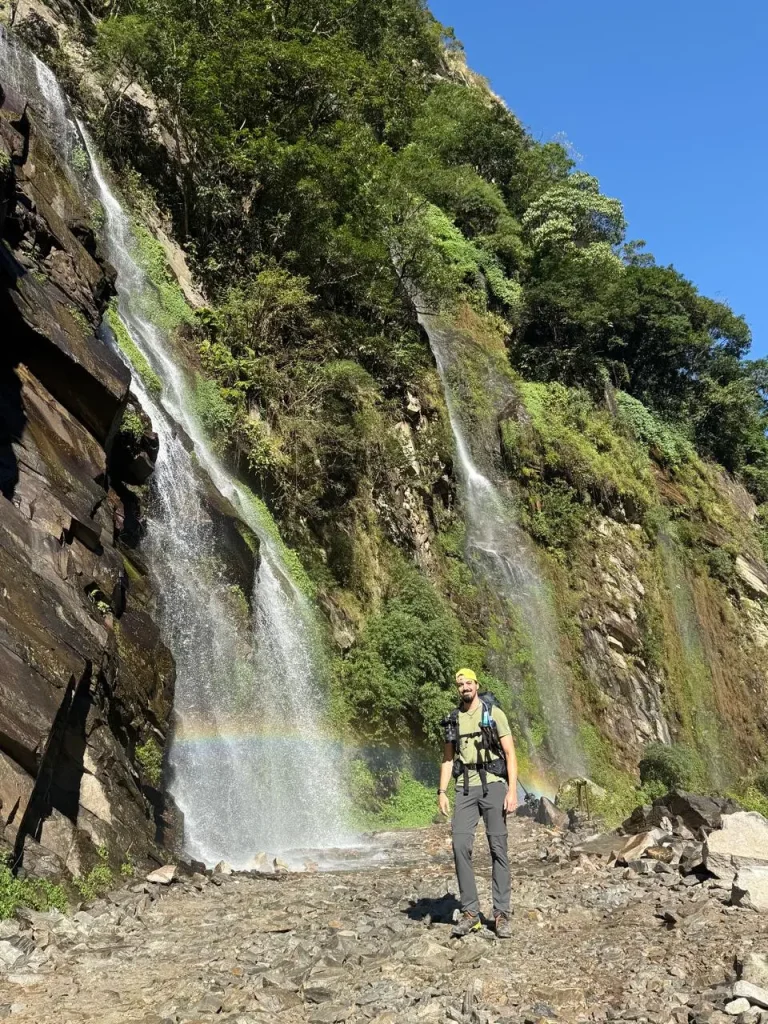
The first morning of walking on the Manaslu Circuit began with cold air and a clear sky. The trail leaves Machhikhola heading north along the Budhi Gandaki river and immediately enters the kind of terrain that makes this route different from anything I had experienced before.
The lower sections of the Manaslu Circuit are subtropical and dense. The trail passes through thick forest with the river running loud and fast below the path and the walls of the gorge rising steeply on both sides. It is not what most people imagine when they picture a Himalayan trek. There are no snow peaks visible here and no open mountain views. The world is green and enclosed and the trail demands complete attention on the footing.
The route crosses the river repeatedly on suspension bridges throughout the morning. The bridges vary considerably. Some are wide and stable. Others are narrow and move noticeably underfoot. As a pilot I am not someone who has much relationship with the fear of heights in the conventional sense. But standing on a narrow suspension bridge above fast moving river water in the early morning cold with a full pack is a different experience from the flight deck. The bridges move. The water below is loud and close. You learn to find your footing quickly and to trust the structure.
Kiran walked ahead on the bridge crossings each time and waited at the other side. He never made anything of the crossings but he positioned himself where he could see every step. That quiet watchfulness was something I noticed throughout the trek without him ever drawing attention to it.
Jagat is the main checkpoint for the Manaslu Restricted Area and the point where the permit system becomes real. Kiran handled all the documentation at the checkpoint. The army personnel on duty checked everything carefully and recorded the details. Beyond Jagat the number of other trekkers dropped immediately and the trail took on the genuinely remote character that I had been hoping for since I first started researching this route.
I stayed overnight in Jagat at a clean teahouse run by a local family. The owner spoke a little English and was curious about where I was from. When I told him Latvia he thought for a moment and then said he had never had a guest from Latvia before. That felt exactly right for this kind of trek.
Planning the Manaslu Circuit Trek and need help with permits, route, or itinerary?
WhatsApp us Email usDay 4: Jagat to Deng — December 2
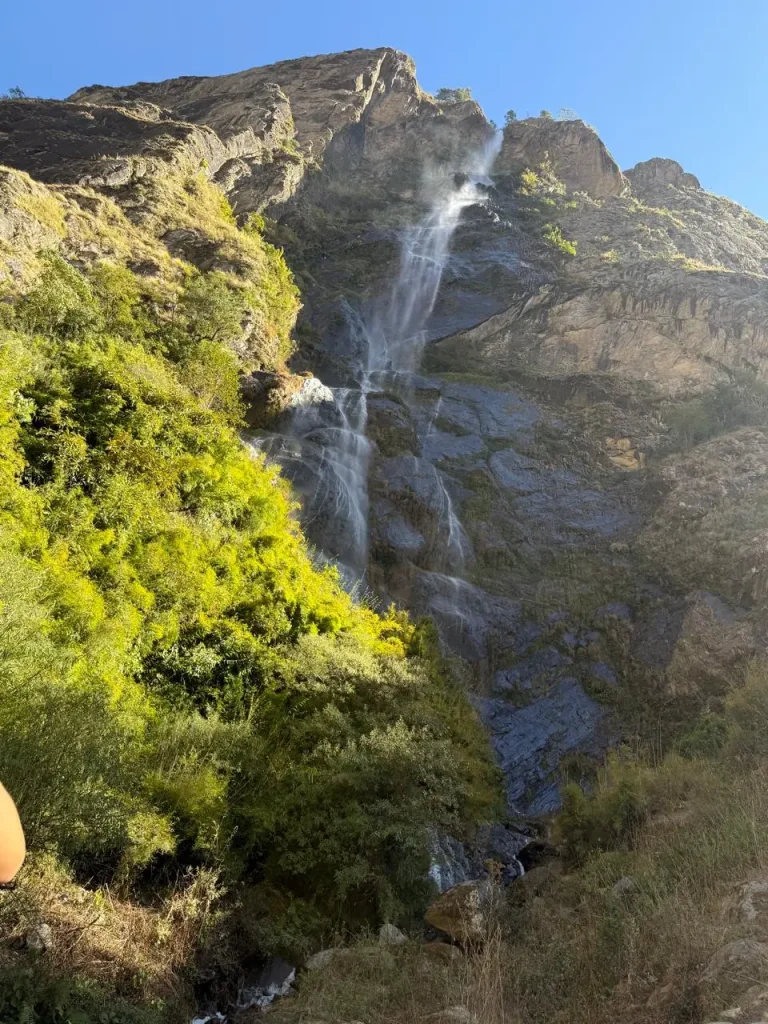
Above Jagat the valley begins to transform. The subtropical jungle of the lower sections starts to thin and the trail opens out onto wider views of the gorge and the ridgelines above. The river runs faster and the sound of it changes character. The mountain walls on either side grow taller with each kilometre and the sense of being deep inside something enormous grows steadily through the morning.
Kiran talked more on this day about the cultural landscape of the upper valley. He explained the significance of the mani walls that appear regularly along the trail and why they should always be passed on the left side. He showed me how to read the carved stone tablets stacked along the walls, many of them worn smooth by decades of wind and water, and described what the most common mantras carved into them mean. He pointed to prayer flags stretched across the trail between poles and explained what each colour represents and why they are placed at exposed and elevated points where the wind will carry the prayers outward.
I started paying close attention to all of these things after that conversation and the trek deepened considerably as a result. What had looked like decoration before Kiran explained it became something entirely different once I understood what I was looking at.
One section of the trail on this day had the path carved directly into the face of a cliff above the river with the rock wall on one side and a significant drop on the other. It was about 200 metres of narrow ledge walking that required full concentration. Kiran went first and I followed his line exactly. When the ledge section ended and the trail widened again he turned around with a completely calm expression and said something like that particular section always gets the attention. He was entirely unbothered and that helped me be unbothered too.
Deng is a quiet settlement with a small gompa that Kiran said dates back several centuries. After dinner I walked up to it in the fading light. A young monk was lighting butter lamps inside. The smell of the burning butter mixed with the cold air coming down from the mountains above was something that I could not have anticipated or described before experiencing it.
Day 5: Deng to Namrung — December 3
The fifth day of the trek marked a clear shift in the landscape and the culture of the communities along the route.
The trail above Deng climbs steadily and the subtropical character of the lower valley disappears completely. The vegetation becomes sparser, the air noticeably cooler, and the villages more clearly Tibetan in their architecture and atmosphere. Stone buildings with carved wooden window frames and prayer flags flying from every rooftop replaced the lower valley style of construction. Chortens appeared at the entrances and exits of every village.
The Nubri region that the route enters above Jagat is one of the most culturally isolated Tibetan Buddhist communities in Nepal. Kiran explained that many of the older generation in these villages speak Tibetan as their primary language and that the religious calendar governs the rhythm of daily life in ways that the outside world has very little influence over. In December, with almost no other trekkers on the trail, that isolation felt completely real. Several times through the morning I walked for an hour or more without seeing another foreign visitor.
The views of the surrounding peaks grew dramatically through the afternoon as the trail climbed. Snow covered ridges appeared above the valley walls and the scale of the Manaslu massif to the north became increasingly apparent even though the summit itself was not yet fully visible.
Namrung sits at around 2,660 metres and in December had the quiet feel of a village settling into its winter rhythm. A large white chorten stood at the entrance with prayer flags moving in the cold wind. Kiran stopped at it for a personal prayer before moving into the village. He did this at every major religious landmark throughout the trek and I always waited quietly. I respected that he did not separate his personal practice from his professional one.
Day 6: Namrung to Shyala — December 4
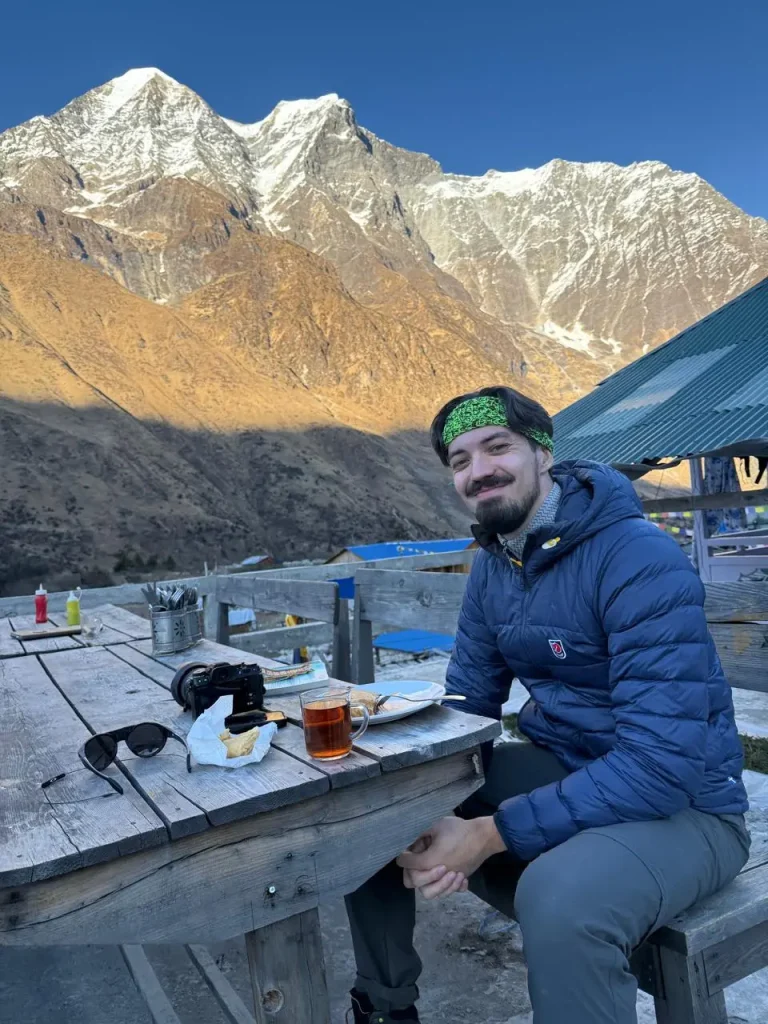
The trail between Namrung and Shyala was one of the finest mornings of walking on the entire trek.
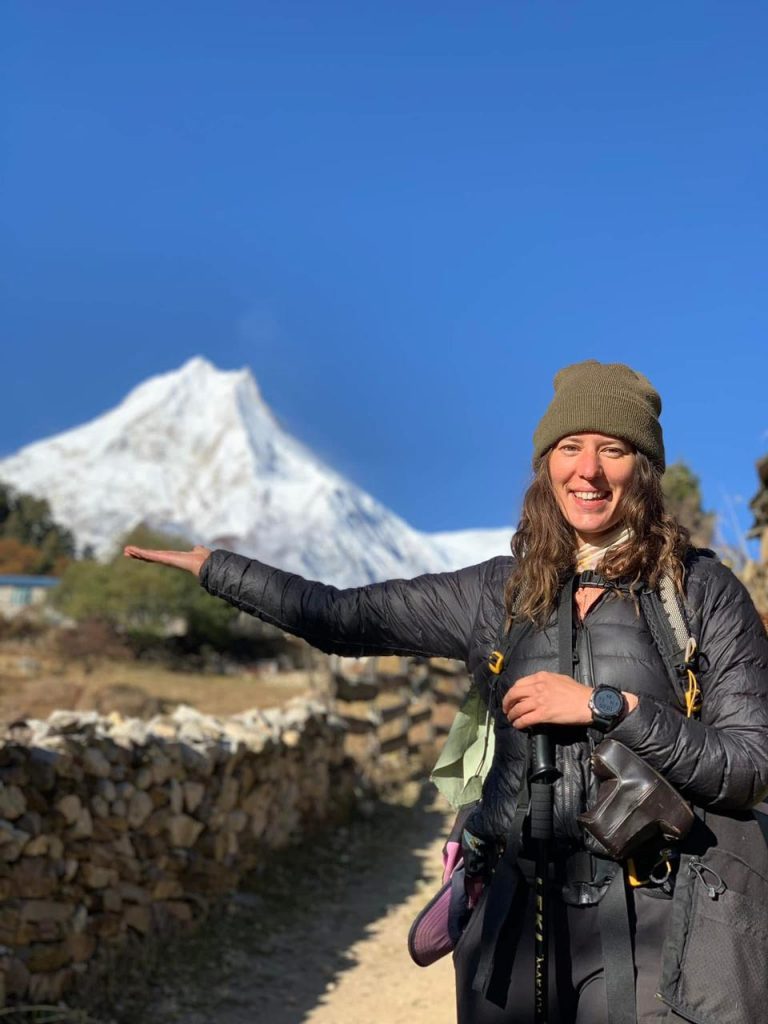
The route climbs through high yak pastures and wide open ridgelines with increasingly unobstructed views of the peaks surrounding the upper valley. Mount Manaslu began to reveal itself properly on this section. I had seen photographs of it during my research in Hong Kong but standing at a point where the summit is directly in front of you at a distance that makes its scale completely legible is something that photographs cannot prepare you for adequately.
At Lho village there is a monastery with what I can only describe as one of the finest views I have ever seen from any single spot. The monastery sits on a promontory above the valley and from its courtyard Manaslu fills almost the entire northern horizon. The glaciers on its upper flanks were catching the morning light and the summit was completely clear above the surrounding ridges. I stood in that courtyard for a long time. Kiran sat on a low stone wall nearby and said nothing. He only spoke when I turned away from the mountain, which was exactly the right instinct.
Shyala is a small settlement that in December was very quiet. There were one or two teahouses open and a handful of local families going about their daily work. Yaks were moving through the village in the late afternoon carrying loads between houses. The temperature dropped quickly once the sun moved behind the ridge to the west and the cold that settled into the valley by evening was a different quality of cold from anything I had experienced in the lower sections of the trek.
I put on every layer I had for dinner that evening and was still glad of the sleeping bag liner Kiran had recommended I bring from Kathmandu.
Day 7: Shyala to Samagaun, Manaslu Base Camp Visit and Return — December 5
This was the longest and most physically varied day of the short Manaslu Circuit and in many ways the most memorable.
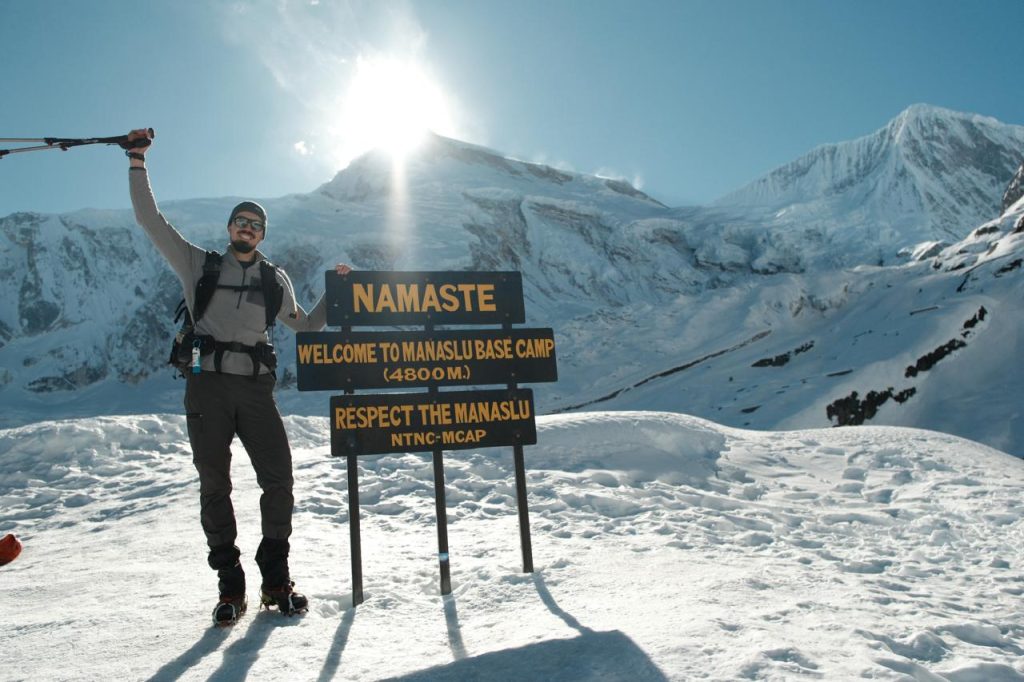
The morning trek from Shyala to Samagaun follows the upper valley through open terrain above the tree line. The trail is wide and the views of the surrounding peaks are completely unrestricted. Walking through that landscape in December with clear skies and almost no other trekkers on the route felt genuinely extraordinary. The silence at that altitude and in that season is very deep. The only sounds were the wind, the crunch of the trail underfoot, and occasionally the distant sound of a yak bell from somewhere out of sight.
Samagaun is the largest settlement in the upper Budhi Gandaki valley and sits at around 3,520 metres. The village has several teahouses and a well known monastery called Pungyen Gompa on the hillside above. I arrived by mid morning and ate lunch at the teahouse Kiran had pre arranged.
After lunch Kiran suggested visiting Manaslu Base Camp while the afternoon light was good. The trail from Samagaun toward the base camp area climbs through boulder fields and glacial moraine and the landscape becomes increasingly dramatic the higher the route goes. The Manaslu Glacier fills a massive bowl above and the sounds of ice shifting and occasional small rockfall echo down the valley in a way that has no equivalent I can think of from my ordinary life.
I did not go all the way to the base camp itself but climbed high enough to see the expedition tents clearly in the distance against the grey and white of the moraine. There was a small expedition on the mountain that December and Kiran pointed out where the fixed ropes would be on the upper face. Standing at that point and looking up at the route that serious mountaineers climb to reach the summit of the eighth highest mountain in the world gave the entire trek a different kind of scale.
The descent back to Samagaun took about an hour and a half. I was tired in a satisfying way by the time I sat down at the teahouse for dinner. That evening was cold and clear and the stars above Samagaun at that altitude were extraordinary. I sat outside for about fifteen minutes before the cold became too much and went inside to sleep.
Planning the Manaslu Circuit Trek and need help with permits, route, or itinerary?
WhatsApp us Email usDay 8: Samagaun to Dharamsala — December 6
Dharamsala in this context is not the Indian city but a small cluster of very basic teahouses at 4,460 metres that exist only as a staging point for the Larkya La pass crossing the following morning. It is not a village in any real sense. It is a place to sleep before the pass.
The trail from Samagaun to Dharamsala follows the valley upward through completely barren glacial terrain. No trees, no grass, only rock, moraine, wind, and the extraordinary presence of the mountains above. The cold at this altitude in December is physical and constant. Even walking steadily the wind on exposed sections cut through clothing that had felt perfectly adequate an hour earlier at lower elevation.
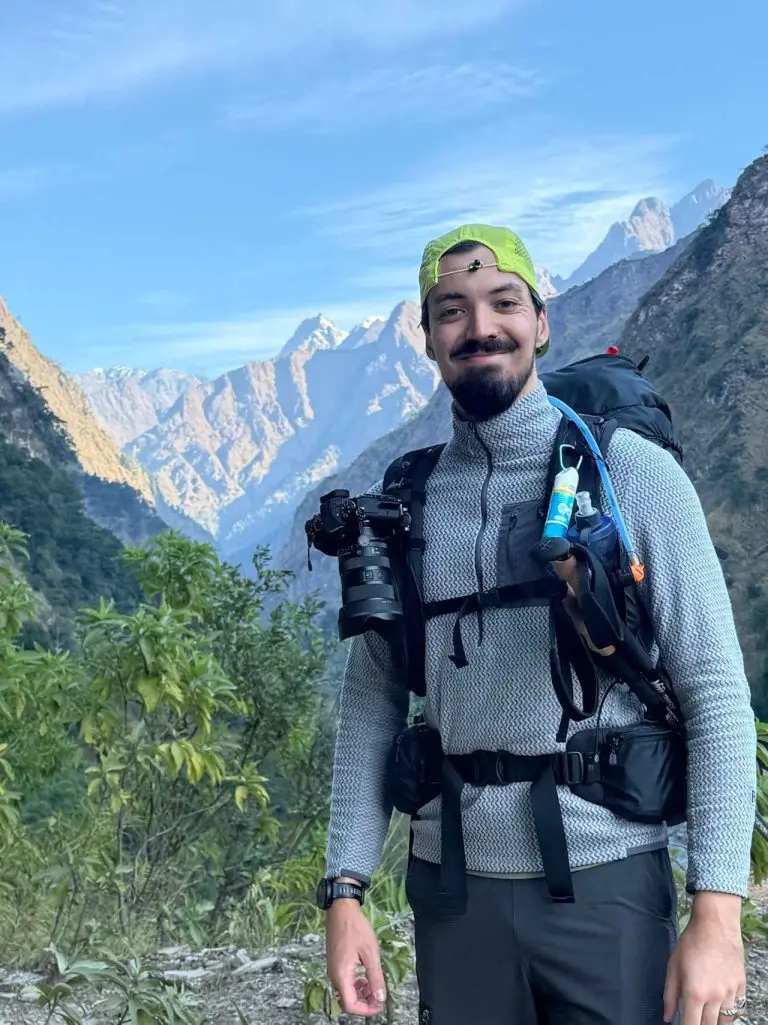
Kiran set a very deliberate and slow pace through the entire day. He explained that arriving at Dharamsala tired was a serious problem because the body needs energy reserves to stay warm overnight at that altitude and the pass crossing would begin at 3am. Every step conserved was worth saving.
The teahouses at Dharamsala are the most basic of the entire route. The rooms are cold and the blankets are thin. I put on my full sleeping kit immediately after dinner and added the liner. Kiran told me to eat a full meal even if I did not feel very hungry, which I did.
The sky above Dharamsala that night was the clearest I have ever seen anywhere. At 4,460 metres with no light pollution and completely dry December air, the stars were dense and sharp in a way that is genuinely unlike anything visible from lower elevations. I stood outside for a few minutes before the cold drove me back inside. The alarm was set for 2:30am.
Day 9: Larkya La Pass (5,160 metres) to Bimthang — December 7
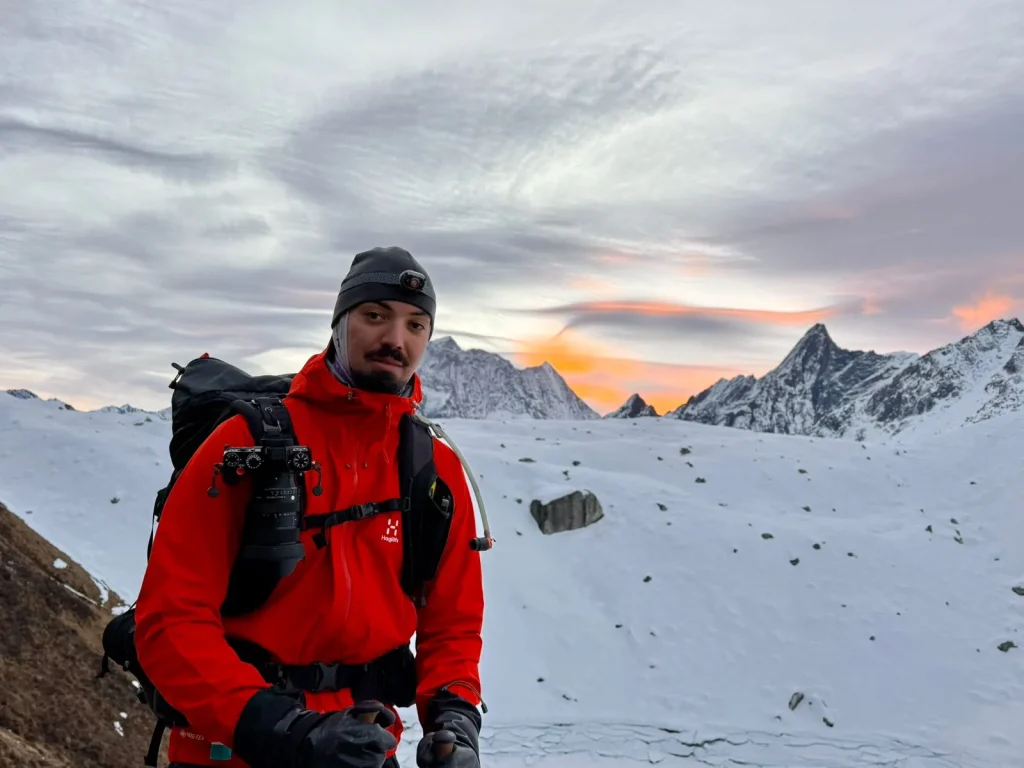
This was the day the entire trek had been building toward.
I was awake before the alarm. The teahouse was completely dark and the temperature inside had dropped considerably through the night. I dressed in every layer available, ate a small breakfast that the teahouse owner had prepared, and stepped outside into the darkness at 3am.
The temperature at that hour was somewhere around minus twelve degrees Celsius. The headlamp beam lit the trail ahead and the stars above were still fully visible. The silence was absolute except for the wind and the sound of boots on frozen ground.
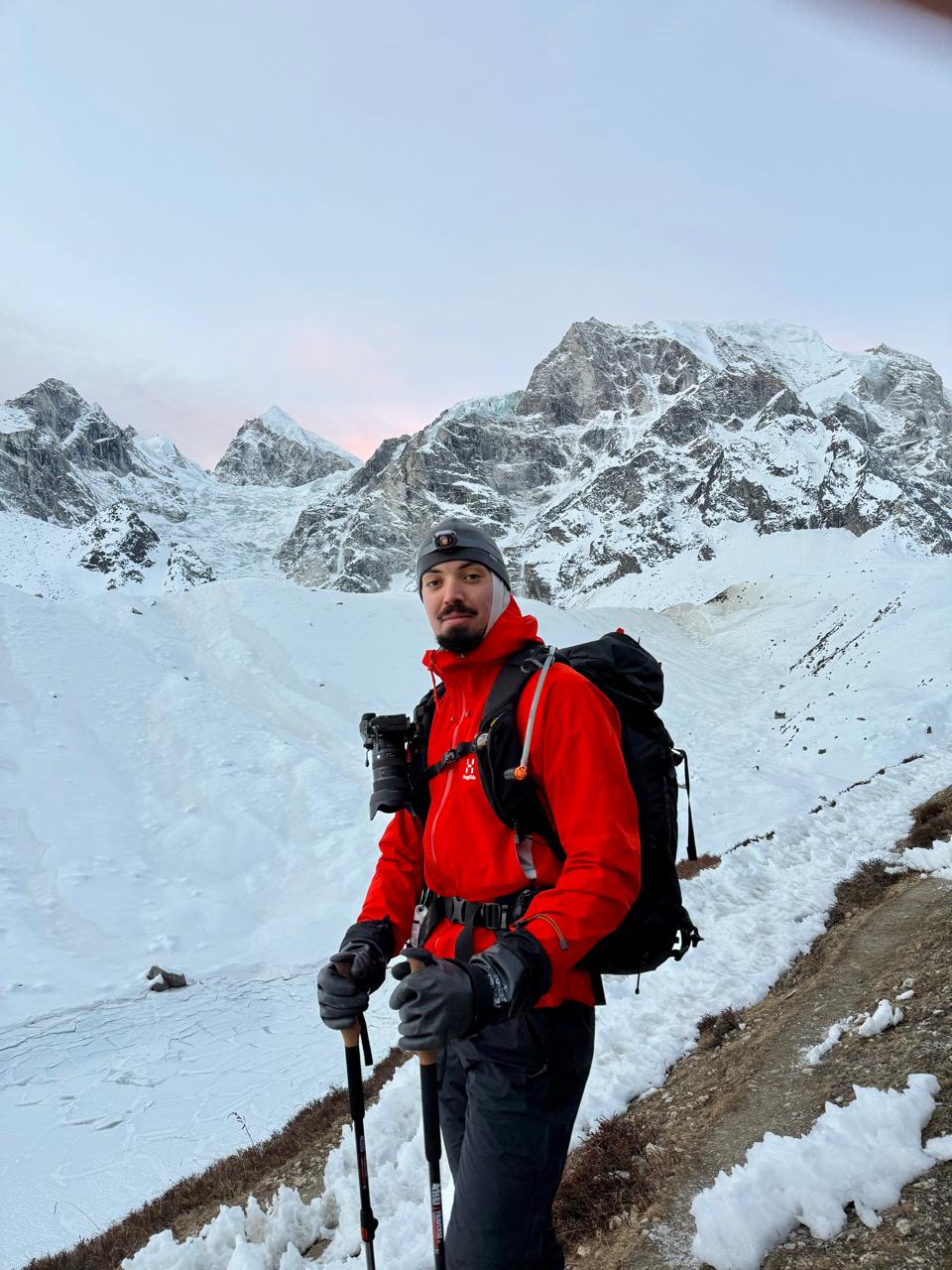
The approach to Larkya La climbs gradually at first through open moraine and then steepens significantly in the final section before the col. The trail in December had sections of hard ice and compacted snow from earlier in the season. The microspikes that Kiran had recommended in Kathmandu were essential on those sections. Without them the footing would have been genuinely dangerous.
The ascent took about three hours. I focused on breathing steadily and keeping the pace absolutely consistent. At around 4,800 metres the altitude became properly noticeable for the first time on the trek. Each step required more conscious effort and breathing needed to be deliberate rather than automatic. The body was working harder than the pace suggested.
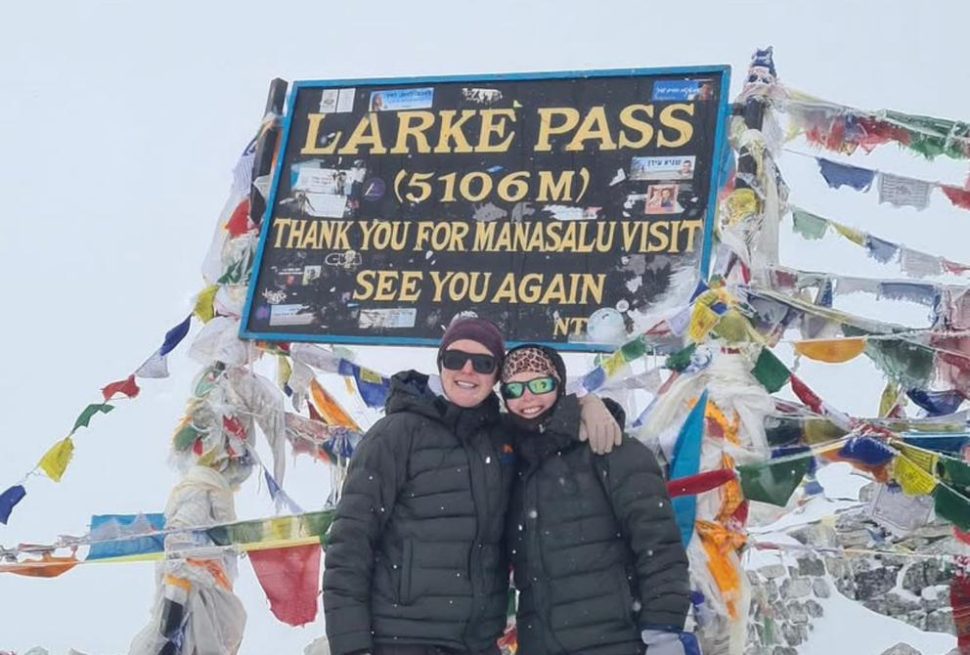
At 6:15am I reached Larkya La at 5,160 metres.
The sky to the east was beginning to lighten. The mountains around the pass were appearing slowly out of the darkness as enormous dark shapes against a sky shifting from black to deep blue to a thin orange line along the horizon. Prayer flags were strung across the pass and they moved in the wind with a sound that seemed completely appropriate for that place and that moment.
I stood at the top of Larkya La for several minutes without moving. The highest point I had ever stood on the surface of the earth. The light was growing every minute and the peaks around the pass were becoming clearer and more defined as the dawn came. Looking north I could see the Tibetan plateau beyond the ridgeline. Looking south the valley I had walked up through over the previous eight days was hidden somewhere below the moraine and the clouds that were beginning to form in the lower elevations.
The descent from Larkya La to Bimthang is long and steep and physically demanding in a different way from the ascent. Descending on loose rock and frozen ground at that altitude with tired legs after a very early start is where the body discovers reserves it did not know it had. Kiran reminded me to use trekking poles actively, to keep steps short, and not to allow the gradient to push the pace faster than my legs could control safely.
I reached Bimthang at around 11am. The valley below the pass opens into a wide green meadow at 3,590 metres with Manaslu visible at its head and the surrounding slopes heavily forested compared to the barren terrain above the pass. After nine days of walking through subtropical gorges, remote Tibetan villages, high glacial terrain, and finally over a 5,160 metre pass in December darkness, sitting on the grass outside the Bimthang teahouse in the late morning sun and looking back up at the mountain felt like the most complete kind of tiredness I have ever experienced.
Day 10: Bimthang to Tilije — December 8
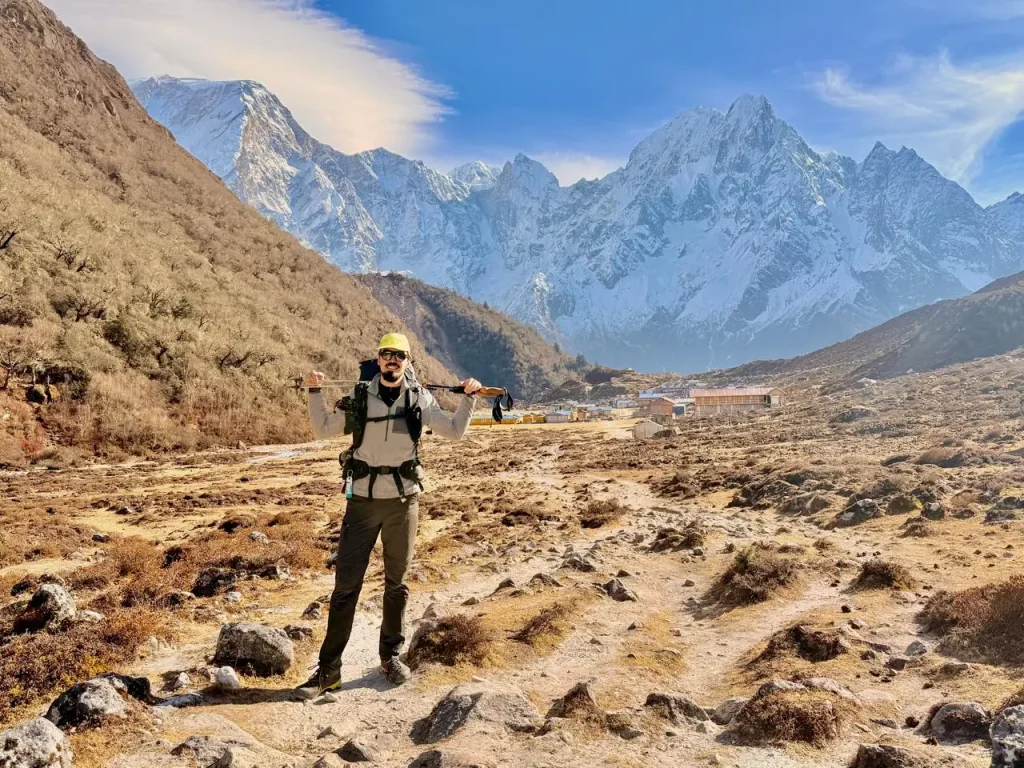
The day after crossing Larkya La was spent descending through forest and following the Dudh Khola river south through the Marsyangdi valley. After the high altitude barren landscape of the previous three days the forest felt extraordinarily lush and alive. The sound of birds returned. The air smelled of pine and damp earth. The temperature was genuinely warm by midday for the first time since leaving the lower sections of the route.
My legs were tired from the pass crossing and the descent to Bimthang the previous day. The trail demanded less technical attention than the previous days but the sustained downhill on tired muscles was its own kind of work. I stopped more frequently on this section than at any other point on the trek, not from altitude or difficulty but simply from the accumulated fatigue of nine consecutive days of mountain walking.
The views through the forest and across open sections of the trail were beautiful in a completely different way from the dramatic high mountain scenery above the pass. The Marsyangdi river was audible long before it came into view and the sound of it below the trail was a consistent companion through most of the afternoon.
Tilije is a larger and more developed village than the settlements of the upper valley. There was a small shop selling cold drinks and snacks, which felt surprisingly civilised after a week above 3,000 metres. I bought a bottle of water and sat on a wall above the river for a while before continuing to the teahouse.
That evening was the most relaxed of the entire trek. The physical hardest days were behind me and the end of the route was close enough to feel real.
Day 11: Tilije to Dharapani and Drive to Kathmandu — December 9
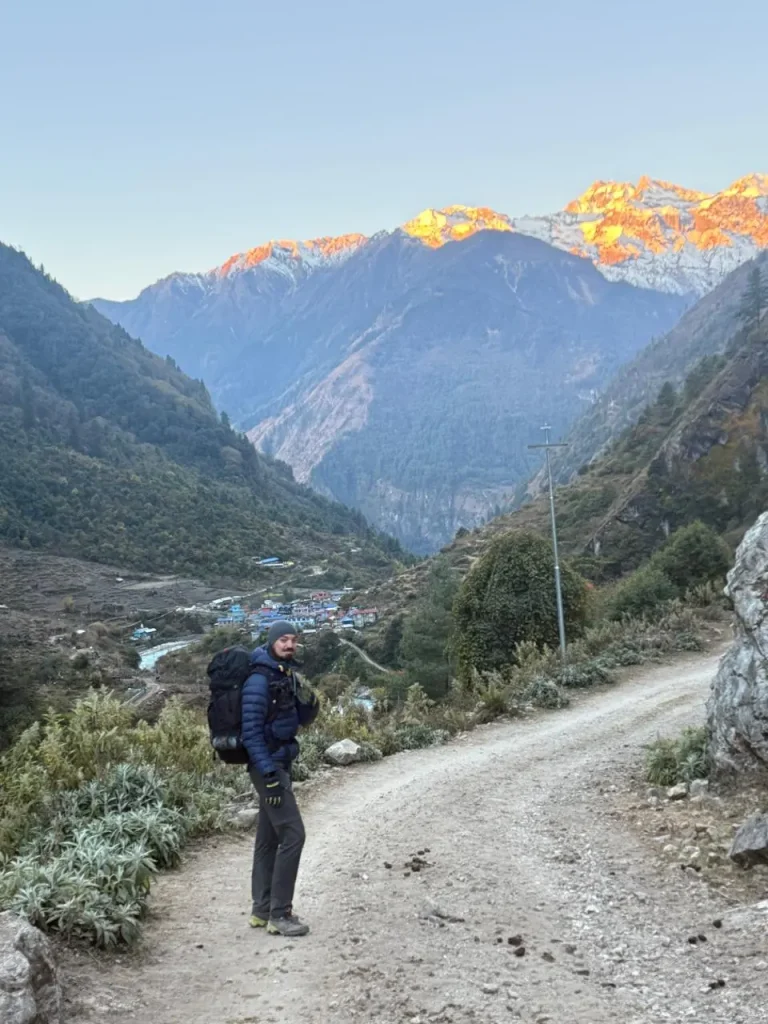
The final trekking day of the short Manaslu Circuit followed the Marsyangdi river south to Dharapani where the Manaslu route meets the Annapurna Circuit trail.
At Dharapani the character of the trail changed immediately. The Annapurna Circuit is one of Nepal’s most popular trekking routes and even in December there were other groups moving through in both directions. After nine days on a trail where I often walked for hours without seeing another foreign visitor, encountering groups and teahouses clearly oriented toward higher tourist volume felt noticeably different.
But by Dharapani the Manaslu Circuit was effectively complete and what I carried away from it was already fully formed. The restricted area above Jagat, the Nubri communities of the upper valley, the silence of the high terrain in December, the dawn crossing of Larkya La, and the long descent to Bimthang in the morning light. Those days are among the clearest and most complete memories I have from any experience outside of my professional life.
The jeep that Manaslu Treks and Expedition had arranged was waiting at Dharapani. The drive back to Kathmandu took most of the rest of the day along roads that seemed smooth and fast compared to the approach route. I looked out the window through most of the journey and thought about what the trek had actually been.
I arrived back in Kathmandu on the evening of December 9, which was also the night of my return flight from Kathmandu to Hong Kong. Kiran had factored this into the planning from the beginning, making sure the final day left enough time for the drive, a meal, and the journey to the airport without rushing. The timing worked exactly as he had planned it.
At the airport that evening I checked in for the Cathay Pacific flight back to Hong Kong. Walking through the departures hall with my trekking bag I felt the particular kind of tiredness that comes only from having done something physically genuine over an extended period. Every muscle in my legs had a specific and honest kind of fatigue. I was deeply ready to sleep on the aircraft.
The flight took off northward before turning east toward Hong Kong. For a few minutes after takeoff the Himalayan range was visible to the north in the darkness, white and enormous against the night sky. Looking at those mountains from the aircraft knowing that I had been walking among them ten days earlier, having crossed one of their high passes in the December darkness before dawn, was a feeling I could not easily put into words at the time and still find difficult to describe accurately now.
Planning the Manaslu Circuit Trek and need help with permits, route, or itinerary?
WhatsApp us Email usMy Honest Thoughts on the Short Manaslu Circuit Trek
Writing this in 2026, several months after the trek, what stays with me most clearly is not the summit of the pass or any single dramatic moment but the cumulative experience of the entire route.
The short Manaslu Circuit in December gave me something that I had not expected to find so completely: genuine remoteness. The restricted area permit system that some travelers find inconvenient is exactly what keeps this route special. Above Jagat in December the trail belongs to the mountains and the communities that live there. Foreign visitors are present but secondary. That feeling of being genuinely inside something rather than observing it from a comfortable distance is rare and worth considerable effort to find.
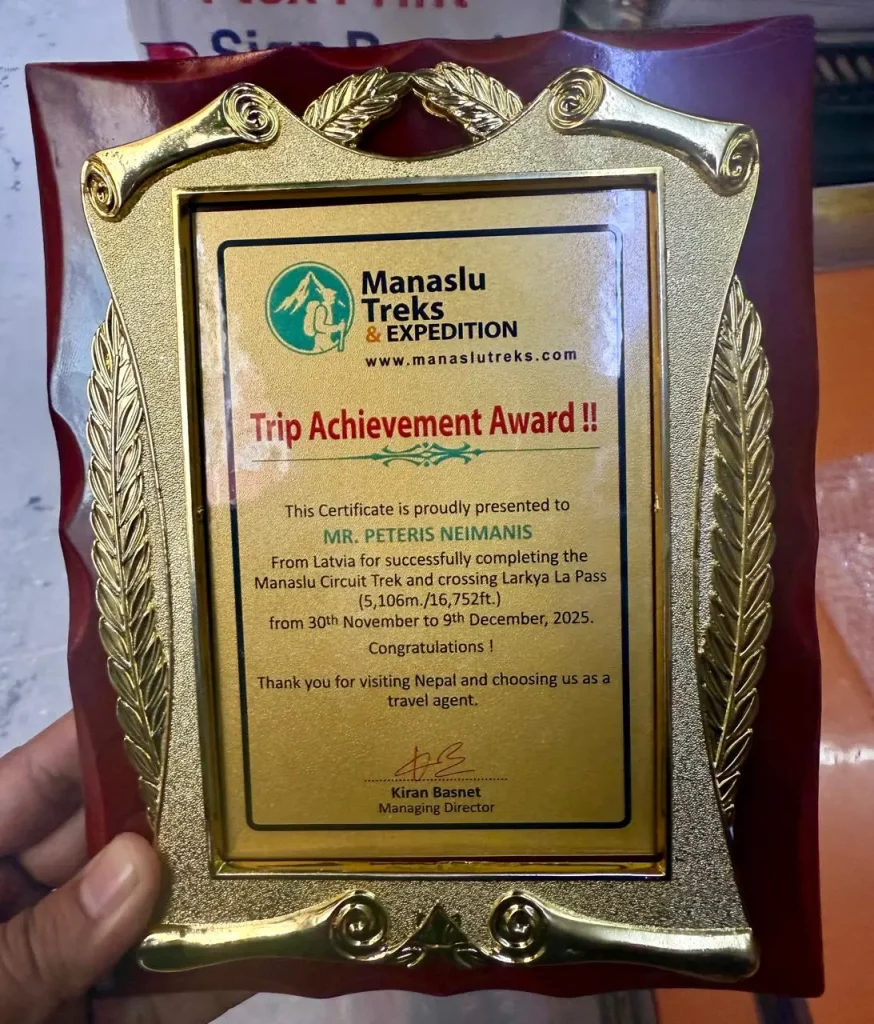
Kiran made the trek what it was. His knowledge of the route is deep and practical. His reading of my physical condition through each day was accurate and quietly managed without ever making me feel like a patient or a liability. His cultural knowledge of the Nubri region turned what could have been a physical journey through beautiful terrain into something with real depth and meaning. And his logistical management of permits, teahouses, timing, and the final airport connection was completely seamless throughout.
I came to Nepal with eleven days and a specific ambition. I left with a memory that will stay with me for the rest of my life.
If you are a traveler with limited time who wants a Himalayan experience that goes well beyond the mainstream routes, the short Manaslu Circuit in the hands of a specialist company and the right guide is exactly what you are looking for.
Peteris Neimanis, Pilot, Cathay Pacific, Hong Kong
Latvia, writing in 2026
🏔 Recommended Manaslu Trips for 2026 / 2027
9 Day short Manaslu Circuit Trek
Peteris Neimanis from Latvia shares his honest 9 day short Manaslu Circuit Trek experience in December 2025 with guide Kiran from Manaslu Treks and...
Product Currency: USD
Product Price: 750
Product In-Stock: InStock
5