A detailed, honest look at the 12 reasons trekkers from around the world are choosing the Manaslu Circuit over Nepal’s more famous routes in 2026 and why that choice makes complete sense. Book with the best manaslu trek company for competitive pricing and guaranteed departures.
The Manaslu Circuit Trek was not always the name on every serious trekker’s shortlist. The region only opened to foreign visitors in 1991. For years after that, it remained a route known primarily to expedition mountaineers and a small number of Himalayan trekking specialists who had looked beyond the well-worn Everest and Annapurna corridors.
That has changed decisively. Trekker numbers in the Manaslu region reached approximately 14,980 in 2025, representing a 40 percent increase from the previous year. The trail is now referenced in nearly every comparative guide to Nepal trekking. Experienced trekkers who have completed Everest Base Camp and the Annapurna Circuit consistently name Manaslu as the next route on their list.
The question worth answering properly is not simply whether Manaslu is popular. That is already established. The more useful question is why it is popular, and what that means for a trekker deciding whether to go in 2026. This guide breaks down the 12 substantive reasons that have driven the growth of the Manaslu Circuit Trek from a specialist route to one of Nepal’s most sought-after Himalayan experiences.
Every reason in this article is grounded in what our guides observe year after year: what clients report when they return, what draws new trekkers to ask about this route, and what distinguishes the experience from other treks in Nepal. We have operated the Manaslu Circuit and the Manaslu Tsum Valley Trek for over a decade, and what follows reflects that field experience directly.
How Popular Is the Manaslu Circuit Compared to Other Nepal Treks?
Before examining the reasons for its popularity, it helps to see the Manaslu Circuit in the context of Nepal’s broader trekking landscape. The numbers below make the crowd situation immediately clear.
| Trek | Annual Trekkers | Area Type | Pass Altitude | Duration |
|---|---|---|---|---|
| Annapurna Region (all routes) | 244,045 (2024) | Open conservation area | Thorong La 5,416 m | Variable |
| Everest Base Camp Trek | ~50,000 (2024) | Open national park | Kala Patthar 5,545 m | 14 to 16 days |
| Langtang Valley Trek | ~15,000 (2024) | Open national park | Tserko Ri 4,984 m | 7 to 10 days |
| Manaslu Circuit Trek | ~14,980 (2025) | Restricted area (permit required) | Larkya La 5,160 m | 14 to 18 days |
| Upper Mustang Trek | ~3,000 to 4,000 | Restricted area | Various ~4,000 m | 12 to 16 days |
The Manaslu Circuit sits in an interesting position: growing fast enough that trail infrastructure has improved substantially, but still quiet enough that solitude remains the daily norm on the trail. That combination will not last indefinitely, which is one of the practical arguments for going in 2026 rather than waiting further.
The Trail Is Genuinely Uncrowded
This is the reason cited most consistently by trekkers who have completed both the Manaslu Circuit and Nepal’s more famous routes. On the Annapurna Circuit, tea houses in Manang and Thorong Phedi fill to capacity in October. Queues form at viewpoints. The trail near Chame on busy days resembles a walking commute rather than a wilderness experience.
On the Manaslu Circuit Trek, even at the height of the October peak season, you can walk for hours without encountering another trekking group. The gap in numbers is not marginal. The Annapurna region receives roughly 16 times more visitors than Manaslu each year. The Everest Base Camp route still sees three to four times more trekkers than Manaslu annually.
The experience this creates on the ground is qualitatively different, not just quantitatively. Tea house owners have time to cook properly. Conversations with villagers feel genuine rather than transactional. The trail is quiet in a way that allows you to actually hear the river, the wind, and the mountains around you. The restricted area permit and mandatory guide requirement act as a natural ceiling on visitor numbers, and that ceiling is the single most important structural difference between this route and every major open-area trek in Nepal.
You Circle an Eight Thousander at Close Range
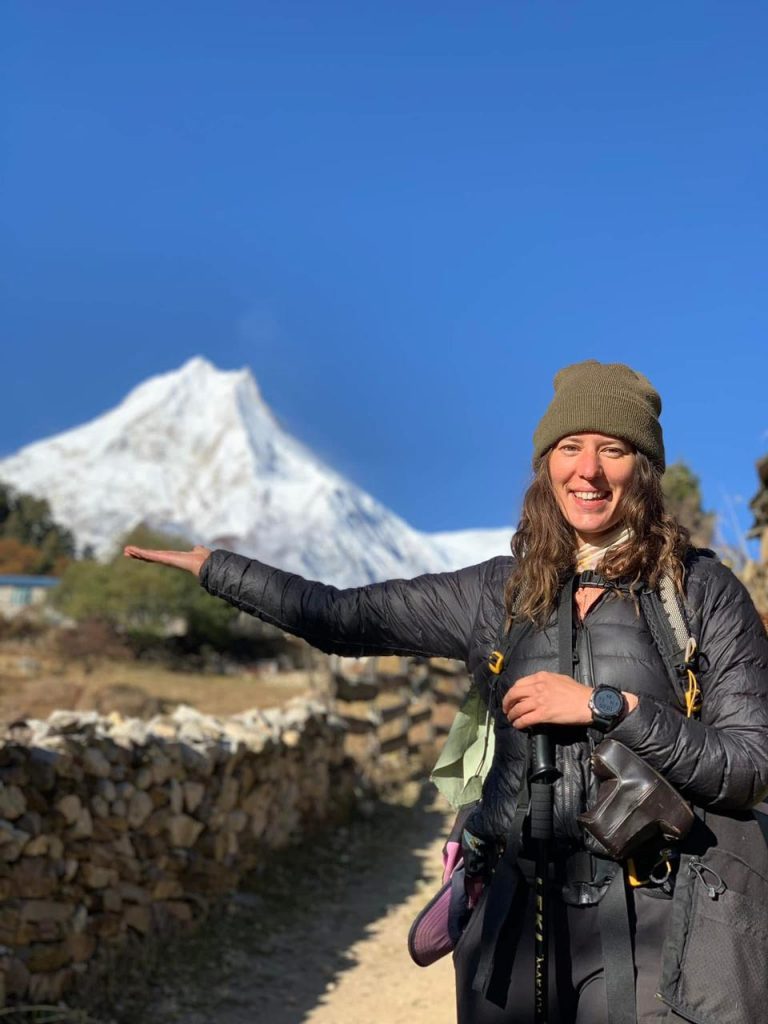
Mount Manaslu stands at 8,163 m. It is the world’s eighth-highest peak. Its Sanskrit name means “Mountain of the Spirit,” and the way it dominates the skyline throughout the northern arc of the circuit is unlike anything on the Everest Base Camp or Annapurna trails.
On the Everest Base Camp route, the summit of Everest is partially obscured from the base camp itself. The most dramatic view comes from Kala Patthar, a spur above Gorak Shep. On the Annapurna Circuit, the mountain panorama is broad but diffuse. On the Manaslu Circuit, the mountain is present from the moment you enter the upper valley. From Lho village at 3,180 m, Manaslu fills the northern skyline. From Samagaun at 3,530 m, the south face looks almost vertical at dawn, catching the first light while the valley below is still in deep shadow.
The optional side trek to Manaslu Base Camp at 4,800 m brings you within a few kilometers of a mountain that most trekkers in the world never see at close range. Spending ten days walking in a full circle around the same eight-thousander, watching it reveal different faces as you gain height and descend into new valleys, is an experience that the out-and-back routes to Everest and Annapurna base camps simply cannot replicate.
The Landscape Changes Every Single Day
The Manaslu Conservation Area spans six distinct climatic zones within a single trekking route. The elevation range from the trailhead at Soti Khola (700 m) to Larkya La Pass (5,160 m) covers nearly 4,500 m of vertical gain, and each zone presents a completely different visual and ecological environment.
This progression means that no two days feel the same. The first days through the Budhi Gandaki gorge involve dense subtropical forest, suspension bridges, and roaring river crossings. The middle days climb through terraced farmland and traditional stone villages. The upper section transforms into the austere high-altitude landscape of Tibetan-influenced terrain. The descent after the pass moves through pine forests and rhododendron groves into a completely different valley system. Trekkers who have done the Everest Base Camp route often observe that the Khumbu valley, while dramatic, presents a relatively consistent high-altitude landscape for much of the trek. Manaslu’s six-zone ecological shift keeps the experience genuinely engaging throughout.
Tibetan Buddhist Culture That Remains Intact
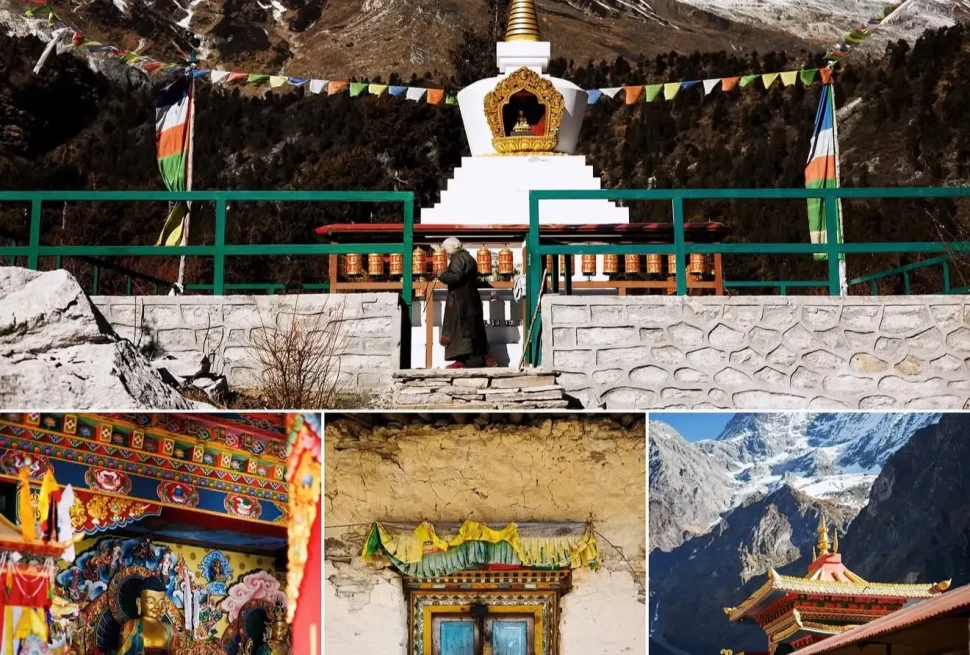
The upper Manaslu valley, particularly the Nubri communities of Lho, Samagaun, and Samdo, has been culturally connected to Tibet for centuries. These communities share language, religious practice, architecture, food traditions, and dress with Tibetan culture in a way that has been remarkably preserved by the region’s relative isolation and controlled access.
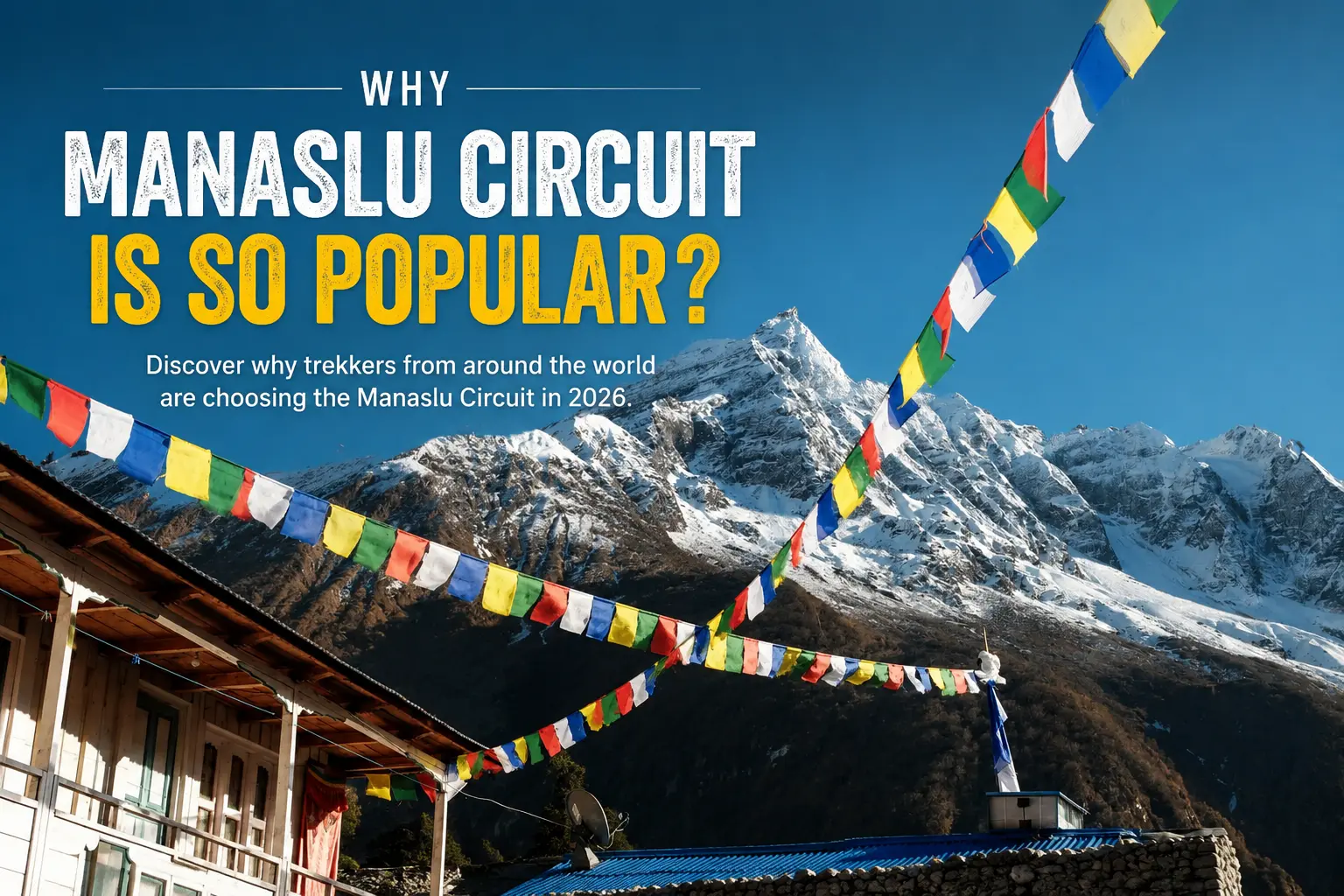
Walking into Samagaun from the south, the change from Hindu lowland Nepal to Tibetan highland culture is sudden and striking. Flat-roofed stone houses replace the sloped-tile construction of lower villages. Prayer flags on every ridge line catch the wind in constant motion. Mani walls carved with Buddhist scripture line the trail approach. Pungyen Gompa monastery sits on a hillside above the village with Manaslu’s south face directly behind it.
The Nubri and Tsumba communities observe Shyagya, an ancient nonviolence code that prohibits hunting within their traditional territory. This centuries-old Buddhist practice means wildlife in this area behaves differently from regions where animals have learned to fear humans. Blue sheep graze near the trail above Samagaun. Eagles circle without alarm. This is not incidental. It reflects the depth of the living culture that trekkers encounter in the upper valley.
The contrast with more commercial trekking regions is significant. In the Khumbu valley, the Sherpa culture is present but layered with decades of international trekking economy. In the upper Manaslu valley, that commercial layer has not yet formed. The villagers you meet are farmers and herders whose daily life does not revolve around serving trekkers, and that difference defines the quality of every interaction you have.
Larkya La Pass: A Real Mountain Challenge That Delivers
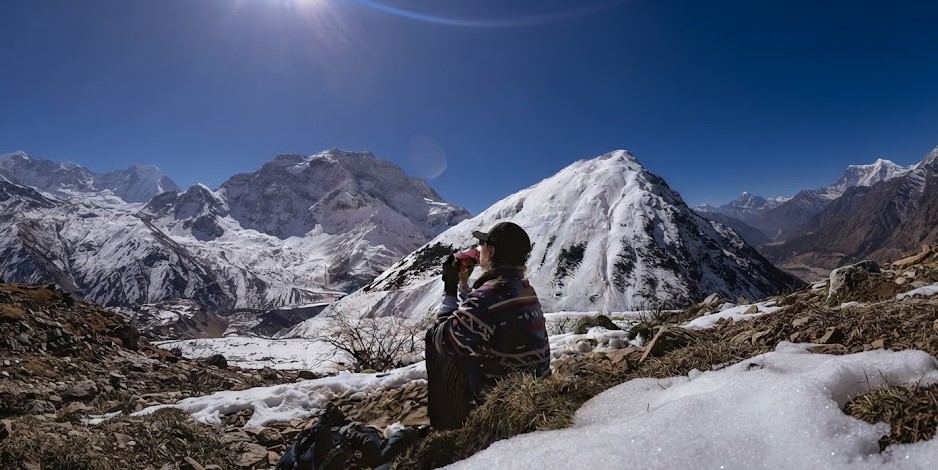
The crossing of Larkya La Pass at 5,160 m is the climax of the Manaslu Circuit and the moment most trekkers describe first when they return. It demands everything a trekker has after ten days of progressive altitude gain, and it rewards that effort with a panorama that photographs cannot adequately represent.
The crossing day begins in darkness, typically departing Dharamsala camp at 4:00 to 4:30 AM. The ascent follows a path across glacial moraine, gaining approximately 700 m of altitude before the pass summit. In October, the approach is dry and stable. The temperature at the top on a clear morning sits around minus 5 to minus 8 degrees Celsius. Most trekkers reach the summit between 7:30 and 9:00 AM.
What meets them at the top is a 360-degree panorama including Manaslu, Manaslu North, Samdo Peak, Larkya Peak, Cheo Himal, Himlung Himal, and the distant Annapurna range. The descent to Bimtang at 3,590 m takes another three to four hours. For trekkers at an intermediate level of experience, Larkya La represents exactly the right level of challenge: demanding but achievable with proper preparation, and delivering a sense of accomplishment that matches the physical and mental investment of the preceding days.
| Pass | Trek | Altitude | Typical Departure | Total Pass Day Walking |
|---|---|---|---|---|
| Larkya La | Manaslu Circuit | 5,160 m | 4:00 to 4:30 AM | 8 to 10 hours |
| Thorong La | Annapurna Circuit | 5,416 m | 4:00 to 5:00 AM | 7 to 9 hours |
| Kongma La | Everest Three Passes | 5,535 m | Dawn start | 4 to 5 hours |
No Flights Required to Reach the Trailhead
This practical advantage is underestimated by trekkers who have not yet experienced the Lukla flight situation. The Everest Base Camp trek begins with a flight to Tenzing-Hillary Airport, one of the most weather-affected mountain airports in the world. In peak season, multi-day cancellations and delays at Lukla are not exceptional events. They happen regularly and can consume a significant fraction of a fourteen-day itinerary.
The Manaslu Circuit begins with a road journey from Kathmandu to the trailhead at Machha Khola or Soti Khola. The drive takes seven to nine hours by private jeep. It is long and the road past Arughat is rough. But it is reliable. There is no weather window to miss, no airport queue, and no standby situation. Your itinerary starts exactly when planned.
For trekkers with limited holiday time, this reliability matters enormously. A four-day weather delay at Lukla can erase a disproportionate fraction of a two-week trip. On the Manaslu Circuit, that risk simply does not exist. The only transport variable is road condition between Arughat and the trailhead, which is relevant during monsoon season but not a serious concern in spring or autumn when the majority of trekkers travel.
A True Circuit, Not an Out-and-Back Route
The Everest Base Camp trek is an out-and-back route. You walk up the Khumbu valley to the base camp and walk back down the same valley. The views differ because you are facing a different direction on the return, but the trail sections, villages, and tea houses are identical in both directions.
The Manaslu Circuit is a genuine loop. You begin in the subtropical lowlands of the Budhi Gandaki river system, climb through the deep gorge, ascend into the high Tibetan-influenced valley, cross Larkya La, and descend into a completely separate river system on the far side before exiting to the road at Dharapani. You never retrace your steps. Every day brings new terrain, new villages, and new elevation perspective.
This structure delivers more variety per trekking day and creates a more satisfying narrative arc for the journey. You begin in heat and humidity, cross a high mountain pass, and finish in a completely different valley. The Gurung communities of the lower valley contrast sharply with the Tibetan Buddhist communities of the upper valley, and the Annapurna-influenced villages on the descent section add a third distinct cultural texture. The circuit format also connects naturally to the Annapurna Circuit Trek at Dharapani, making a combined Great Himalayan Trail traverse possible for trekkers with the time and ambition.
The Restricted Area Status Protects the Experience
The Manaslu region is classified as a restricted area trek in Nepal by the Government. This requires trekkers to obtain a Manaslu Restricted Area Permit (RAP), travel with a licensed guide through a registered agency, and maintain permit compliance at checkpoints throughout the circuit. The permit costs USD 100 per person per week in autumn and USD 75 during other seasons.
As of March 22, 2026, the Nepal government updated the Manaslu restricted area permit rules. The previous requirement of a minimum of two foreign trekkers per permit application has been removed. Individual trekkers can now apply through a registered agency provided they are accompanied by a licensed guide. This change makes the trek more accessible to solo travelers without compromising the guide requirement or the permit structure that limits overall visitor numbers.
Many trekkers who have visited both Manaslu and the Annapurna region specifically mention the restricted area status as something they appreciate rather than resent. The higher permit cost is understood as a mechanism that keeps the trail from reaching Annapurna-level footfall. The knowledge that the area will remain relatively uncrowded because of structural regulation is part of why experienced trekkers are willing to pay the premium. The permit fees also channel directly into conservation programs through the Manaslu Conservation Area Project.
Exceptional Wildlife in a Protected Conservation Area
The Manaslu Conservation Area was established in 1998 and covers 1,663 square kilometers spanning six climatic zones from subtropical forest to arctic alpine. It supports 33 species of mammals, over 110 species of birds, approximately 2,000 plant species, and 11 forest types, making it one of the most biodiverse protected regions in Nepal.
Snow Leopard
Approximately 15 individuals estimated in the MCA. Most elusive predator; rocky terrain above 3,000 m. Sightings rare but documented by guides.
Red Panda
Found in bamboo and rhododendron forest between 1,500 m and 3,000 m. Most visible in forested lower circuit sections near Philim.
Blue Sheep
Commonly seen in herds above 3,500 m around Samagaun and on the Larkya La approach. Graze surprisingly close to the trail.
Himalayan Tahr
Wild mountain goat found on steep cliffs throughout the upper circuit. Remarkably sure-footed on terrain that looks impassable from below.
Himalayan Monal
Nepal’s national bird. Iridescent plumage makes it unmistakable. Common in forest sections between 2,000 m and 4,000 m.
Musk Deer
Inhabits temperate forests in mid-elevation sections. The Nubri community’s nonviolence code has protected this species here for centuries.
The Shyagya nonviolence code observed by the Nubri and Tsumba communities creates a situation where wildlife does not flee at the sound of human footsteps in the way it does in heavily visited regions. Blue sheep grazing above Samagaun will continue feeding as a trekking group passes below. Marmots at the Dharamsala camp scatter only reluctantly. The relationship between wildlife and the human communities of the upper valley is different from what most trekkers experience anywhere else in the Nepal Himalayas.
Natural Gateway to Tsum Valley
One of the structural advantages of the Manaslu Circuit as a trekking route is its position as a gateway to the Tsum Valley. The Tsum Valley branches off the main circuit at Lokpa and leads into a high-altitude Buddhist sanctuary that remained closed to foreign visitors until 2008. Adding the extension requires five to seven additional days and a separate restricted area permit.
The Tsum Valley represents a deepening of everything that makes the Manaslu region appealing. The monastery of Mu Gompa, built in approximately 1895 AD at 3,700 m, is one of the most architecturally remarkable religious buildings in the entire Nepal Himalayan region. The villages of Chumling, Chhekampar, Nile, and Chule are smaller and more isolated than their counterparts on the main circuit. The cave of Milarepa, the revered Tibetan saint, draws Buddhist pilgrims from across the Himalayan region.
The combination of the Manaslu Circuit and Tsum Valley in a single 18 to 24 day journey is considered by many experienced guides to be the single most complete Himalayan trekking experience available in Nepal. It covers the full range of terrain, culture, altitude, and challenge that Nepal’s mountains can offer, with the added benefit of touching two distinct restricted-area zones that most trekkers never visit at all. For anyone looking at best treks in Nepal, the combined Manaslu and Tsum Valley route is the most comprehensive answer available.
Responsible Tourism With Direct Community Benefit
The Manaslu Circuit’s mandatory licensed guide requirement is sometimes viewed as an added cost. In practice, it is one of the most direct mechanisms for ensuring that trekking expenditure reaches the communities through which the trail passes.
A licensed Manaslu guide earns USD 25 to 40 per day. A porter earns USD 20 to 30 per day. Those incomes support families in the Gorkha district. The permit fees paid to the Manaslu Conservation Area Project fund anti-poaching patrols, habitat restoration programs, and livestock insurance schemes that compensate herders when snow leopards kill their animals, reducing retaliatory killings of a globally endangered predator. The tea house operators in the upper valley are local families whose investment in lodge infrastructure depends directly on visitor numbers remaining sustainable rather than overwhelming.
A portion of every Manaslu Conservation Area Permit (MCAP) fee goes directly toward the Manaslu Conservation Area Project, which manages wildlife protection, community conservation training, eco-tourism development, and alternative energy projects across the 1,663 km² protected zone. When you pay the trekking permits for the Manaslu Circuit Trek, that money does measurable conservation work in the region you are walking through.
In 2026, a growing proportion of international trekkers make deliberate decisions about the tourism economy they want to support. The Manaslu Circuit’s structure, with mandatory local guides, restricted access that limits mass tourism, and permit fees channeled into conservation, aligns with those values in a way that more developed trekking routes cannot easily replicate. This alignment is increasingly a reason for choosing the trek, not just a byproduct of it.
The Himalayas as They Used to Feel
This final reason is the hardest to quantify but the most consistently cited by trekkers returning from the Manaslu Circuit. It appears in different language from different people, but the core observation is always the same: the Manaslu region feels like what Nepal’s mountains must have felt like before trekking became a global industry.
The villages in the upper circuit are not organized around your visit. Samagaun and Samdo are farming and herding communities whose daily rhythm continues with or without trekkers passing through. The yaks being driven to higher pastures in the morning are not a tourist attraction. The monks at Pungyen Gompa are not performing their practice for an audience. The family at the tea house in Namrung is hosting you in the same building where they sleep, eat, and raise their children.
The trail between Jagat and Lho has not been widened for vehicle access. There are no coffee shops mid-route with laminated menus in five languages. The suspension bridges have the characteristic movement that has not been engineered out in favor of tourist-grade infrastructure. The path sometimes disappears for a moment and requires your guide to confirm the correct line across a moraine slope. These qualities are not romanticized shortcomings. They are evidence that the region has not yet been reshaped to smooth the edges of the wilderness experience it delivers.
Trekkers who experienced Nepal twenty or thirty years ago, before roads were built through formerly remote valleys and tea houses became lodges with satellite Wi-Fi, consistently say the Manaslu Circuit is the closest thing left in Nepal to what drew them to the Himalayas in the first place. That quality, the sense of genuinely being somewhere that has not been packaged for consumption, is the underlying reason all twelve of the points in this guide cohere into something exceptional.
Who Is the Manaslu Circuit Trek Best Suited For?
The Manaslu Circuit Trek is not the right choice for every trekker, and it is important to be clear about this. The reasons for its popularity are genuine and well-founded, but they exist within a framework of physical demands and logistical requirements that not every visitor to Nepal is ready to meet in 2026.
| Trekker Profile | Suitability | Notes |
|---|---|---|
| Experienced multi-day trekkers (5+ day treks completed) | Ideal | The primary audience for this trek. Prior experience significantly improves both safety and enjoyment at altitude. |
| First-time Nepal trekkers with solid fitness base | Good with preparation | Manageable with a licensed guide and proper pre-trek cardiovascular training. Not the easiest Nepal start, but achievable. |
| Everest or Annapurna alumni wanting something deeper | Highly recommended | The most common trekker profile choosing Manaslu. The comparison to previous Nepal treks is almost universally favorable. |
| Photographers seeking wilderness conditions | Excellent choice | October for mountain photography. April for flora and cultural imagery. Low crowds mean unobstructed compositions at every viewpoint. |
| Budget-first trekkers with no cost flexibility | With careful planning | The mandatory guide and restricted area permits add cost above other Nepal routes. Spring permits are cheaper than autumn. |
| Trekkers wanting consistent lodge comfort throughout | Not the right route | Tea houses in the upper sections are basic. The Annapurna Circuit Trek better suits this preference. |
Manaslu Circuit vs Other Classic Nepal Treks
| Category | Manaslu Circuit | Everest Base Camp | Annapurna Circuit |
|---|---|---|---|
| Annual trekkers | ~14,980 (2025) | ~50,000 (2024) | ~244,045 (2024) |
| Crowd experience | Very quiet; solitude normal | Busy in peak season | Very busy; advance booking essential |
| Peak altitude | Larkya La 5,160 m | Kala Patthar 5,545 m | Thorong La 5,416 m |
| Route type | True circuit (no retracing) | Out and back | True circuit |
| Permit type | Restricted area (RAP + MCAP + ACAP) | National park permit | ACAP only (open area) |
| Trailhead access | Road only (jeep, 7 to 9 hours) | Mountain flight to Lukla | Road (6 to 7 hours) |
| Flight dependency | None | High (weather delays common) | None |
| Cultural character | Tibetan Buddhist (upper valley) | Sherpa Buddhist | Gurung, Thakali, Tibetan mix |
| Tea house quality | Basic to moderate | Better developed | Well developed; most comfortable |
| Package cost (guided 14 days) | USD 1,600 to 2,000 | USD 1,400 to 2,200 | USD 699 to 1,200 |
| Best for | Solitude, culture, wilderness | Iconic mountain, Sherpa culture | Diversity, beginners, flexibility |
Why the Manaslu Circuit Trek Continues to Grow
The growth trajectory of the Manaslu Circuit Trek is not a temporary trend. It reflects a structural shift in how experienced trekkers think about what constitutes a meaningful Himalayan journey. The mainstream routes that defined Nepal trekking for thirty years are extraordinary in their own right, but they carry the weight of their own fame. The Annapurna and Everest regions are now deeply commercial trekking corridors. Their popularity has not diminished the mountains, but it has changed what it feels like to walk through them.
The Manaslu Circuit offers the Himalayas on different terms. The mountains are larger, the trail is quieter, the culture is more intact, and the experience of standing at Larkya La at 5,160 m with a 360-degree panorama and no queue has an impact that the most famous routes in Nepal cannot replicate. The trek is harder to organize, more expensive in permits, and demands more preparation than most accessible alternatives. That is not a deterrent for the trekkers who are drawn to it. It is part of what makes the experience worth the investment.
The Core Appeal
Solitude on a trail circling the world’s eighth-highest peak, with Tibetan Buddhist culture intact and a high mountain pass that delivers exactly what it promises.
The Structural Advantage
Restricted permits keep crowds low permanently. No flight dependency. A true circuit. Direct road access from Kathmandu with no aviation uncertainty.
The Conservation Value
1,663 km² protected area. Over 110 bird species. Snow leopards, red pandas, blue sheep. Permit fees fund active conservation programs year-round.
The 2026 Opportunity
Growing at 40% per year but still a fraction of mainstream trek levels. The window to experience this trail in its current state is open, but it will not remain this quiet indefinitely.
For trekkers planning their next significant Himalayan journey, the Manaslu Circuit Trek in 2026 represents one of the clearest cases in Nepal trekking where the popular choice and the right choice happen to be the same destination. If you want to understand why this trek has grown from 12,000 trekkers in 2023 to nearly 15,000 in 2025 and will continue growing, the twelve reasons in this article are the complete answer.
To learn more about planning this trek in detail, read our guides on the Manaslu Tsum Valley Trek, best time to go, permit requirements, and itinerary options. For broader Nepal trekking context including the Everest Base Camp Trek, Annapurna Circuit Trek, and Langtang Valley Trek, our Nepal trekking guide covers each route in comparable depth.
Ready to Trek the Manaslu Circuit in 2026?
Our team handles every detail: permits, licensed guides, transport, tea house bookings, and acclimatization planning. You focus entirely on the mountains.
Plan Your Trek With UsManaslu Treks and Expedition | Registered Nepal Trekking Operator | Kathmandu, Nepal