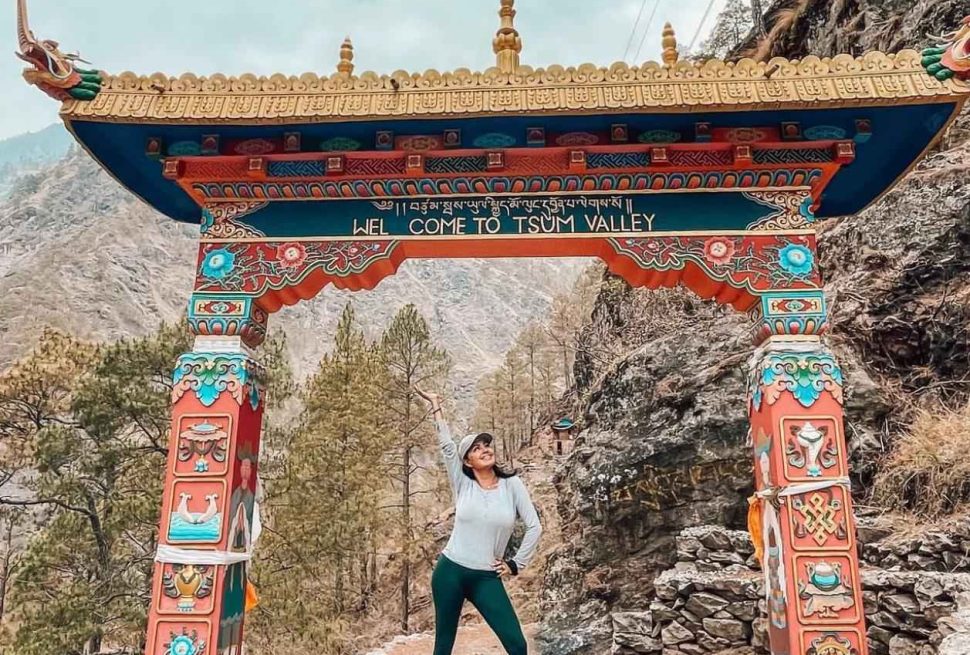
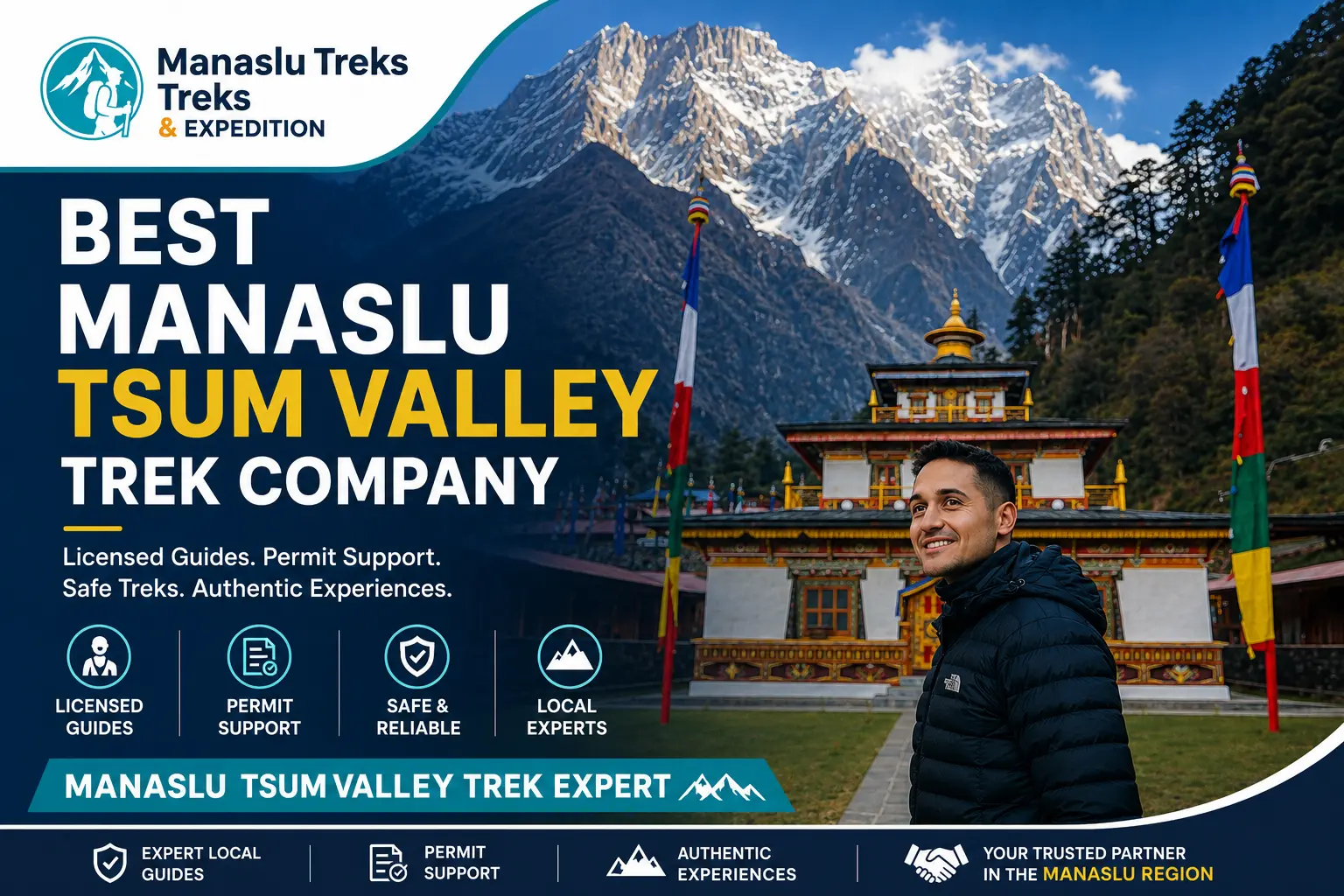
Finding the best Tsum Valley trek company in Nepal is important for permits, licensed guides, safety, and a successful trekking experience in this restricted Himalayan region. The Tsum Valley Trek is one of Nepal’s most culturally preserved and spiritually significant trekking routes, located in the northern Gorkha district near the Tibetan border. Unlike crowded trekking areas, Tsum Valley offers quieter trails, ancient monasteries, Tibetan Buddhist culture, and authentic mountain village life. Trust our manaslu trekking company for expert guidance on every Manaslu adventure.
In the local Tibetan dialect, the word Tsombo, from which Tsum is derived, means vivid. That is the most accurate word for this place. The glacial rivers are sharp and blue. The peaks rise without warning above the forests. The butter tea is strong and served without ceremony. The monks at Mu Gompa go about their morning prayers as they have for generations, and a trekker arriving from Kathmandu feels the distance from ordinary life within the first two days on the trail.
The Tsum Valley Trek is also a restricted area trek, which means it requires specific permits, a licensed guide, and the support of a government-registered trekking agency. You cannot walk into Tsum Valley independently. The regulation exists to protect the valley’s cultural integrity and manage the volume of visitors entering this sensitive border region. That same regulation is also one of the reasons the valley remains worth visiting.
Manaslu Treks and Expedition, we have worked in the Manaslu and Tsum Valley region for years. This is not one itinerary among many for us. The Tsum Valley and the communities within it are at the centre of what we do, and that focus makes a real difference to the quality of experience we can provide.
Planning the Manaslu Circuit Trek and need help with permits, route, or itinerary?
WhatsApp us Email usWhy Choosing the Right Tsum Valley Trek Company Matters
The Tsum Valley is not a trail where things can be figured out as you go. It is a restricted area with multiple checkpoints, strict permit verification, and genuinely remote terrain where the nearest road is many hours of walking away. The teahouses in the upper valley are simple and sometimes fully booked during peak season. The trail junctions in the lower gorge section are not always clearly marked. Mobile network coverage in the valley is either very limited or absent entirely.
The company you choose to organize your Tsum Valley Trek determines how smoothly all of this is managed before you ever arrive at the trailhead. It determines whether your permits are correct, complete, and ready on time. It determines whether your guide has real experience in the valley or is learning the route alongside you. It determines how your accommodation is arranged in a place where there are no online booking options. And in the event something goes wrong on the trail, whether through weather, illness, or injury, it determines whether the response is competent and fast.
Choosing based on the lowest price alone is a genuine risk in a place like Tsum Valley. Agencies that cut costs often do so by using inexperienced guides, skipping proper permit documentation, or simply not understanding the logistical demands of this particular route. The cost of a permit error, a guide who does not speak Tibetan or know the local checkpoints, or an itinerary that does not build in adequate acclimatisation time is paid on the trail, not at the booking stage.
What Makes the Best Tsum Valley Trek Company
When trekkers search for the best Tsum Valley trekking company in Nepal, the characteristics they should actually be evaluating go beyond star ratings and website photos. Here is what matters in practice for a restricted area trek of this nature.
Government registration and legal standing. Any agency processing your Tsum Valley Restricted Area Permit must be registered with Nepal’s Department of Tourism and affiliated with the Trekking Agencies Association of Nepal (TAAN). Permits from the Department of Immigration are only issued to registered agencies. An unregistered operator cannot legally obtain your restricted area permit, and any permit obtained through unofficial channels will be rejected at checkpoints.
Licensed guides with local knowledge. The Government of Nepal requires a licensed guide for all trekkers in the Tsum Valley restricted area. But there is a significant difference between a guide who holds a Nepal Tourism Board licence and a guide who has actually spent time in the valley, knows the Tsumba community, understands the trail conditions through all seasons, and speaks enough Tibetan to communicate with local families and monastery caretakers. The best Tsum Valley trekking agencies employ guides from the region itself.
Permit knowledge and accuracy. The Tsum Valley Trek requires multiple permits. Getting any one of them wrong, or missing one entirely, results in being turned back at a checkpoint. A reliable company knows exactly which permits are needed for which itinerary, handles all the documentation, and double checks everything before your departure from Kathmandu.
Honest itinerary planning. The Tsum Valley is moderately challenging, with some demanding days on rough trails at altitude. A good company gives you an itinerary that actually works for your fitness level, includes adequate rest and acclimatisation, and does not push you through the valley faster than is safe or enjoyable.
Transparency on costs. The Tsum Valley Trek has a clear set of costs: permits, guide fees, porter fees, transport, and accommodation. A trustworthy agency lists these clearly and does not add surprise charges midway through the planning process or on the trail.
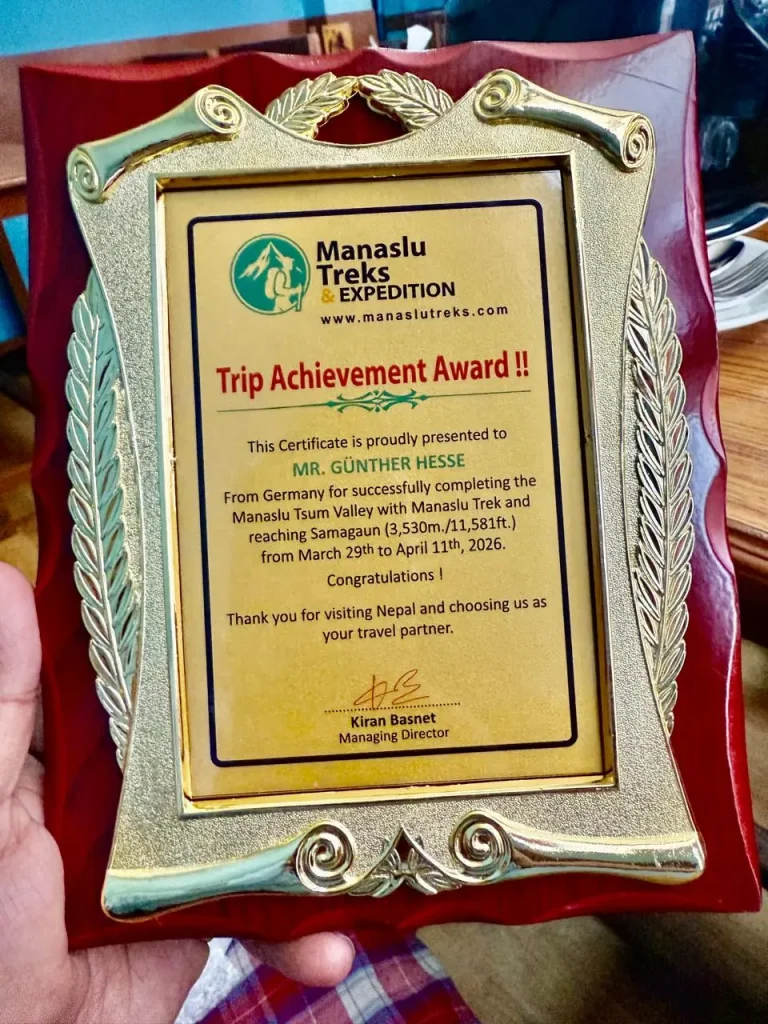
Why Trekkers Trust Manaslu Treks and Expedition
Planning the Manaslu Circuit Trek and need help with permits, route, or itinerary?
WhatsApp us Email usWhy Manaslu Treks and Expedition Is One of the Best Tsum Valley Trek Companies
Manaslu Treks and Expedition operates specifically in the Manaslu and Tsum Valley region. This is not a general Nepal trekking agency that offers Tsum Valley alongside Everest, Annapurna, Langtang, and a dozen other routes. Our work is focused on this particular part of Nepal, which means our guides, our logistics, our local contacts, and our itinerary knowledge are built around the Tsum Valley and Manaslu Circuit rather than spread thin across the country.
Our team knows the teahouse owners in Chumling and Chhokangparo by name. Our guides have visited Mu Gompa and Rachen Gompa dozens of times and can tell you the history of both monasteries in detail. We know which sections of the lower gorge trail require extra care in wet conditions, which villages have the best facilities for overnight stops, and where mobile signal cuts out entirely so trekkers can prepare accordingly.
For trekkers considering either the standalone Tsum Valley Trek or the combined route with the Manaslu Circuit, we offer itineraries across both formats. Our most popular combined options are the 23 day Tsum Valley and Manaslu Circuit Trek and the 19 day Manaslu Circuit with Tsum Valley Trek, both of which are designed around actual walking pace, realistic acclimatisation needs, and the realities of teahouse availability in this region.
Government License and Legal Requirements
Manaslu Treks and Expedition holds a valid government licence issued by Nepal’s Ministry of Culture, Tourism and Civil Aviation. We are registered with TAAN (Trekking Agencies Association of Nepal) and operate in full compliance with all Department of Immigration regulations for restricted area trekking.
This matters practically because only registered agencies can apply for the Restricted Area Permits required for Tsum Valley. The application for the Tsum Valley RAP is submitted to the Department of Immigration in Kathmandu on your behalf, along with your passport copy, visa details, passport photographs, and trekking itinerary. Since March 2026, permit applications must also be accompanied by proof of travel insurance that explicitly covers helicopter evacuation up to 6,000 metres. We advise all our clients of this requirement during the booking process, long before departure.
Freelance guides and unregistered agencies cannot process these permits. If you book through an operator who cannot show a valid registration certificate and process permits through official channels, you are at risk of arriving at the Jagat or Philim checkpoint and being turned back.
Licensed Guides and Local Experience
Every guide we assign to a Tsum Valley Trek holds a Nepal Tourism Board trekking guide licence. Beyond the licence, what we look for in a guide for this particular route is actual familiarity with the valley: knowledge of the checkpoints, the monasteries, the local customs around visiting sacred sites, and the Tsumba people’s traditions and language.
In the upper Tsum Valley, particularly in villages like Chhokangparo, Nile, and around Mu Gompa, most local people speak a Tibetan dialect rather than Nepali. A guide who understands this and can communicate directly with local families and monastery monks gives you access to a level of cultural experience that is simply not available with a guide who is unfamiliar with the region.
Our guides are also trained in first aid, altitude sickness recognition, and emergency procedures. They carry pulse oximeters on high altitude days and know the descent protocol if a trekker shows signs of acute mountain sickness. In a region where the nearest hospital is a full day’s travel away, this preparation is not optional.
Tsum Valley Trek Permit Support
The Tsum Valley Trek requires the following permits for all foreign trekkers:
Tsum Valley Restricted Area Permit (RAP): This is the most specific permit for the Tsum Valley itself. It is issued by the Department of Immigration in Kathmandu and can only be processed through a registered trekking agency. The cost varies by season.
For peak season (September to November): USD 40 for the first week, then USD 7 per additional day. For off season (December to August): USD 30 for the first week, then USD 7 per additional day.
Manaslu Restricted Area Permit (MRAP): Required for trekkers also doing the Manaslu Circuit section of the route, covering the area between Jagat and Dharapani.
For peak season: USD 100 for the first 7 days, then USD 15 per additional day. For off season: USD 75 for the first 7 days, then USD 10 per additional day.
Manaslu Conservation Area Permit (MCAP): Required from Philim village onward. Cost is approximately NPR 3,000 (around USD 23) for non SAARC nationals.
Annapurna Conservation Area Permit (ACAP): Required if the route exits through the Annapurna Conservation Area toward Dharapani on the Manaslu Circuit route. Cost is approximately NPR 3,000 (around USD 23) for non SAARC nationals.
Chumnubri Rural Municipality Permit: A local permit collected along the trail. This is a small fee that goes directly to local community infrastructure.
A minimum of two trekkers is required to obtain the Tsum Valley RAP. Solo trekkers must join another trekker through the agency to meet this requirement. TIMS cards are no longer required for the Tsum Valley or Manaslu Circuit route. The permit system now uses digital QR coded permits that are scanned at checkpoints including Jagat, Philim, Lokpa, and at the entry to the upper Tsum Valley.
Manaslu Treks and Expedition handles all permit processing on your behalf. We confirm which permits apply to your specific itinerary, collect your documents in advance of departure, and process everything through the correct government offices so that your permits are complete and ready before you leave Kathmandu.
Updated Tsum Valley Trek Route and Trail Conditions
The Tsum Valley Trek typically begins with the drive from Kathmandu to Machha Khola, a journey of approximately 9 to 10 hours. The road follows the Prithvi Highway along the Trishuli River before turning north into the Gorkha district. Road conditions are reasonable until Arughat, after which the road narrows and becomes rough and bumpy along the Budhi Gandaki River. In recent years the road has been extended, and Machha Khola is now the recommended trailhead where walking begins.
From Machha Khola, the trail follows the Budhi Gandaki River north through a series of gorges, crossing suspension bridges and climbing through forests of rhododendron and pine. The route passes through Jagat (the first permit checkpoint), Salleri, Phillim, and eventually reaches Lokpa, where the trail diverts from the main Manaslu Circuit route and turns northeast into the Tsum Valley.
The lower valley section between Lokpa and Chumling follows the Shyar Khola river. The trail passes through mixed forest with views of Ganesh Himal appearing as you gain altitude. Chumling at 2,386 metres is the first significant Tsum Valley village and sits directly across the river from Ripchet. The stone houses, slate roofs, and small monasteries here, including Panago Gompa and Gurwa Gompa, give you the first real sense of what the valley holds.
From Chumling, the trail continues through Chhulung to Chhokangparo, the entry to upper Tsum Valley, at 3,031 metres. Chhokangparo is actually two settlements, Chhekam and Paro, situated on flat land with open views of the Ganesh Himal range to the south. The wide, flat valley floor here is a sharp contrast to the gorge sections lower down.
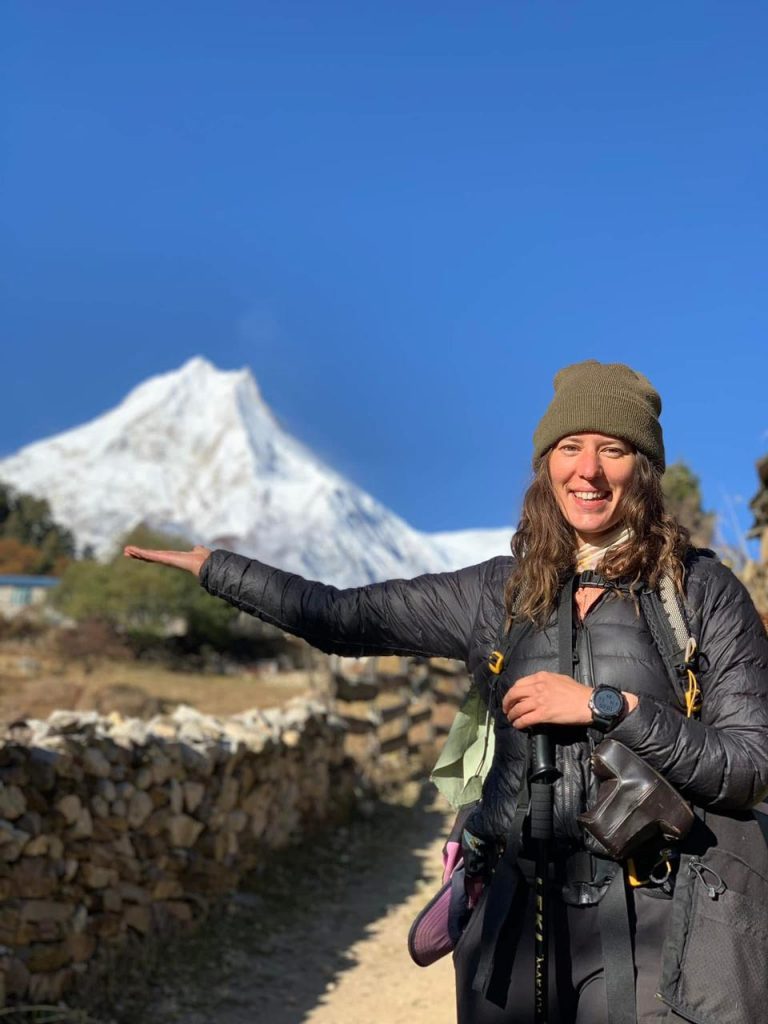
The village of Nile sits at around 3,361 metres on the western side of the Shyar Khola, approximately 45 minutes from Chhule. From Nile, the trail continues to Mu Gompa at 3,700 metres, the largest and most important monastery in the valley. Built in 1895, Mu Gompa houses monks, young novice students, ancient religious texts, and sacred artifacts. The surrounding views of the high Himalayan peaks are dramatic and clear on most autumn and spring mornings.
Some sections near Lokpa in the lower gorge area remain prone to rockfall after heavy rainfall. The trail in this section is narrow and requires attention. An experienced guide is particularly valuable through this part of the route.
Tea House and Accommodation Experience
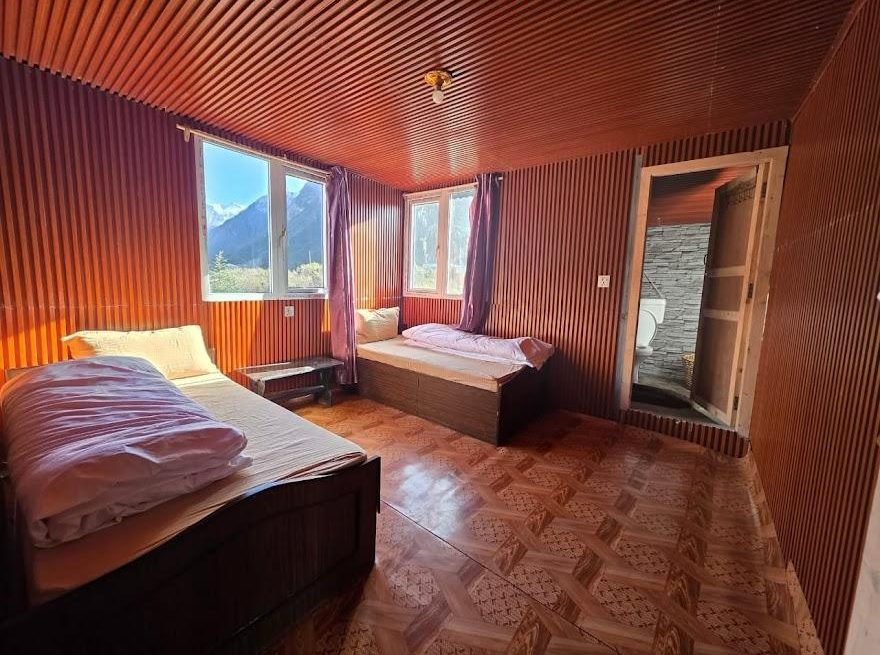
The Tsum Valley is a teahouse trek throughout. You do not need camping equipment, and accommodation is available in villages along the route. The standard of teahouses is basic, particularly in the upper valley, and trekkers should go in with realistic expectations.
Machha Khola: Several guesthouses with simple rooms, shared bathrooms, and basic meals. Some WiFi availability.
Jagat: Guesthouses with similar facilities. This is the permit checkpoint, so the village sees regular trekker traffic.
Chumling: Small, family run teahouses with wooden beds, thin mattresses, and shared facilities. The warmth of the welcome here more than compensates for the basic rooms. Meals focus on dal bhat, noodles, eggs, and potatoes.
Chhokangparo: Simple teahouses with limited but adequate facilities. The flat, open location of the village means wind can make evenings cold even in October.
Nile: Basic lodges, simpler still than Chhokangparo. Charging devices costs a small fee as electricity relies on solar power. Hot showers are not reliably available here.
Mu Gompa area: The simplest accommodation on the route. Rooms are very basic and food options are limited. Trekkers who reach this far are rewarded by the setting rather than the comfort.
In the upper Tsum Valley, the Shyagya tradition is observed. The local community practices a custom of not slaughtering animals, which means meat is generally not available in the upper valley villages. Dal bhat, tsampa (roasted barley flour), Tibetan bread, and butter tea are the staples at altitude. Trekkers who want meat dishes should be aware that the menu becomes vegetarian focused from Chhokangparo upward.
Mobile network coverage is very limited to absent in most of the Tsum Valley. There is some signal in the lower villages but the upper valley, including the area around Mu Gompa and Nile, typically has no reliable network access. Carry cash in Nepali rupees before leaving Arughat, as there are no ATM facilities in the valley.
Planning the Manaslu Circuit Trek and need help with permits, route, or itinerary?
WhatsApp us Email usSafety and Acclimatisation Support
The Tsum Valley Trek reaches its highest point in the area around Mu Gompa and beyond at approximately 3,700 to 3,800 metres. This is considerably lower than the Larkya La Pass on the Manaslu Circuit, but trekkers who combine the two routes will experience both. Even at 3,700 metres, altitude sickness is a real possibility for people who ascend too quickly or do not hydrate properly.
The recommended acclimatisation approach for the Tsum Valley route involves spending at least one rest day in Chhokangparo before ascending to Nile and Mu Gompa. This rest day also allows trekkers to explore the village, visit local monasteries, and adjust to the altitude without physical exertion.
Warning signs of altitude sickness including persistent headache, nausea, loss of appetite, shortness of breath at rest, or confusion must be taken seriously at any altitude. The only reliable treatment is descent. All Manaslu Treks and Expedition guides carry pulse oximeters and are trained to recognise and respond to altitude related symptoms. In a region where evacuation by vehicle is not possible, your guide’s ability to make correct early decisions is the most important safety factor on the trail.
For trekkers doing the combined route with the Manaslu Circuit, the Larkya La crossing at 5,160 metres requires the acclimatisation days built into the itinerary at Samagaon and Samdo. We do not shorten these rest days regardless of time pressure.
Tsum Valley Trek Itinerary Options
Manaslu Treks and Expedition offers the Tsum Valley Trek in several formats depending on your available time and whether you want to combine it with the Manaslu Circuit.
Standalone Tsum Valley Trek (approximately 15 to 18 days including travel): This route goes in and comes back the same way, entering through Lokpa and reaching Mu Gompa before returning. It suits trekkers who want to focus exclusively on the valley’s culture and monasteries without the high altitude demands of the Larkya La Pass.
Combined Tsum Valley and Manaslu Circuit Trek (19 days): This is the 19 day itinerary that moves through the Tsum Valley and then connects back to the main Manaslu Circuit route, crossing the Larkya La Pass and finishing at Dharapani. It suits trekkers with solid fitness and previous high altitude experience.
Extended Tsum Valley and Manaslu Circuit Trek (23 days): The 23 day itinerary allows for additional exploration days in both the Tsum Valley and the upper Manaslu region, including the day hike to Manaslu Base Camp from Samagaon. This format is best for trekkers who want to do the combined route without rushing any section.
All itineraries can be adjusted based on your fitness level, the number of people in your group, and the time of year you are trekking. We do not run rigid group departures that force individual trekkers onto a schedule that does not suit them.
You can find the full route details for the combined trek on the Tsum Valley and Manaslu Circuit.
Transportation and Logistics
The trek begins with the drive from Kathmandu to Machha Khola. This journey takes approximately 9 to 10 hours by private jeep or somewhat longer by public bus. We recommend a private jeep for the comfort and reliability it provides on the rough road section after Arughat.
At the end of the trek, whether you finish at Dharapani on the Manaslu Circuit exit or return to Machha Khola on the standalone Tsum Valley route, a jeep back to Kathmandu or Besisahar is arranged in advance by our team.
Internal logistics along the route, including teahouse reservations during peak season, are managed by us before and during the trek. During October and early November, accommodation at Dharamsala on the Larkya La approach can be scarce. We book ahead wherever this is possible.
Porter support is available for all Tsum Valley packages. A porter carries luggage of up to 20 kg and allows trekkers to move with only a light day pack. We pay our porters fair daily wages, provide them with appropriate insurance, and ensure they have adequate equipment for the altitude. This is a non negotiable part of how we operate.
Cost Transparency and No Hidden Charges
The total cost of a Tsum Valley Trek varies based on the duration of the itinerary, the number of people in your group, whether you hire a porter, and the time of year you travel. We provide a full cost breakdown before you confirm your booking. This includes permit costs, guide and porter fees, transport costs, and teahouse accommodation.
What our packages include: all required permits, licensed guide, porter (if requested), transport from Kathmandu to the trailhead and back, teahouse accommodation along the route, and three meals per day on trekking days.
What trekkers pay for separately: personal travel insurance, Kathmandu hotel accommodation before and after the trek, personal gear and clothing, charging fees, hot shower fees, and personal drinks beyond water and basic beverages.
There are no surprise fees once the trek begins. If a situation arises that requires an unplanned expense, such as a flight or vehicle due to an emergency, we communicate clearly with the trekker about the cost and reason before making the arrangement.
Cultural Experience in Tsum Valley
The Tsum Valley is home to the Tsumba people, a community of Tibetan Buddhist heritage who have lived in this valley for centuries. Their language is a dialect of Tibetan. Their religion, architecture, customs, and farming practices are all shaped by their proximity to Tibet and their centuries of relative isolation from the rest of Nepal.
Visiting the valley as a trekker means encountering this culture in its actual daily form rather than as a performance or a museum exhibit. In Chumling, Chhokangparo, and Nile, locals go about their ordinary lives: herding yaks, farming barley and potatoes at altitude, spinning prayer wheels, and performing religious ceremonies that follow the Buddhist calendar. Trekkers who approach with genuine curiosity and respect are often welcomed into homes and invited to witness ceremonies that would otherwise be closed to outsiders.
The monasteries are the most visible expression of Tsum Valley’s cultural heritage. Mu Gompa at 3,700 metres is the largest monastery in the valley, housing monks and young novice students in a setting of extraordinary mountain scenery. Rachen Gompa is one of the region’s important nunneries and houses nuns of the Ngakpa sect. The Milarepa Piren Phu cave, where the Buddhist yogi Milarepa is believed to have meditated during his journey through the Himalayas, holds deep spiritual significance for both the local community and Buddhist trekkers from other countries.
The Shyagya custom in the upper valley means no animals are slaughtered, giving the upper Tsum Valley a genuinely peaceful quality that is felt in the atmosphere of the villages. This is not a rule imposed for tourism. It is an ancient community practice rooted in Buddhist principles of non harm, and being in a place where it is observed gives the valley a different quality from anywhere else in Nepal.
Our guides from Manaslu Treks and Expedition understand and respect these cultural practices. They brief trekkers before entering the valley on appropriate behaviour in monasteries, correct etiquette when visiting local homes, and the spiritual significance of the sites along the route.
Why the Tsum Valley Trek Is Different from Everest and Annapurna
Trekkers who have done the Everest Base Camp or Annapurna Circuit routes and are looking for something genuinely different often find the answer in the Tsum Valley. The differences are real and substantial.
Crowd levels: The Everest region sees tens of thousands of trekkers each year. The Annapurna region sees similar numbers. The Tsum Valley, by contrast, is visited by a small fraction of that number. The restricted area permit system and the relative difficulty of access limit visitor volumes. Walking through Chumling or Chhokangparo during peak season, you might pass a handful of other trekkers. Walking the same trail in shoulder season, you may see none.
Cultural depth: The Tsum Valley’s cultural identity is distinct from the Sherpa culture of the Everest region or the Gurung and Thakali cultures of the Annapurna area. The Tsumba people, their language, their monasteries, and their customs are found only here. This is not a variation on a familiar Himalayan cultural experience. It is something genuinely separate.
Trail character: The Everest and Annapurna trails are well marked, have lodges with menus printed in multiple languages, and in some sections feel more like walking through a linear hotel than through the mountains. The Tsum Valley trails are narrower, quieter, and in places require more navigation. The teahouses are family run and the menus are short. The food is what the local family cooks, and it is usually excellent.
Altitude demands: The Tsum Valley standalone trek does not cross a major high pass. The highest point on the valley route is around 3,700 to 3,800 metres. This makes it accessible to a wider range of fitness levels than the Larkya La crossing on the Manaslu Circuit, while still providing a full and meaningful Himalayan experience.
Best Time for Tsum Valley Trek
Autumn: September to November
Planning the Manaslu Circuit Tsum Valley Trek and need help with permits, route, or itinerary?
WhatsApp us Email usAutumn is the most popular season for the Tsum Valley Trek, and for good reason. The monsoon ends in September and skies clear quickly. October brings the best combination of clear mountain views, stable weather, and comfortable temperatures. The rhododendron forests in the lower sections are not in bloom, but the overall clarity and colour of the landscape in autumn is outstanding.
Best months: October and early November.
Spring: March to May
Spring is the second most popular season. Rhododendron forests bloom from late March through April, covering the lower trail sections in red and pink. The days are warm and the light is good in the mornings. As May progresses, pre monsoon cloud builds up and afternoon visibility drops, but the mornings remain clear in most years.
Best months: Late March, April, and early May.
Monsoon: June to August
Heavy rainfall from June through August makes the trails slippery and muddy. Leeches are present in the forest sections. Views of the mountains are largely obscured by cloud. Landslides can block sections of the lower trail. Manaslu Treks and Expedition does not recommend the monsoon season for the Tsum Valley Trek.
Winter: December to February
The lower sections of the Tsum Valley can be walked in winter with the right preparation. Temperatures at altitude are severe, particularly at night, and the upper village teahouses sometimes close during the coldest months. For experienced trekkers who are properly equipped and want complete solitude on the trail, a winter Tsum Valley trek is possible. It requires careful planning and flexibility around weather.
Important Questions to Ask Before Booking a Tsum Valley Trek
Before you confirm a booking with any Tsum Valley trekking company in Nepal, asking these questions will help you identify whether the operator is genuinely prepared for this route.
Is your company government registered with Nepal’s Department of Tourism? Any legitimate Tsum Valley trekking agency can provide their registration number immediately.
Can you show me your guide’s Nepal Tourism Board licence? A licensed guide is a legal requirement for the Tsum Valley restricted area. Agencies should be able to confirm this without hesitation.
Which permits does my itinerary require, and how are they processed? A knowledgeable operator will give you a clear answer covering the Tsum Valley RAP, MCAP, ACAP (if applicable), and the Chumnubri Rural Municipality permit. Any confusion or vagueness on this question is a warning sign.
Has my guide trekked the Tsum Valley route before? General Himalayan experience is not the same as knowing this particular valley. Your guide should have walked the Tsum Valley route multiple times.
What is your emergency protocol if a trekker becomes seriously ill or injured on the trail? A reliable company has a clear answer about helicopter evacuation, communication procedures, and their relationship with emergency services in Nepal.
What is included in the package price and what do I pay separately? Any reputable agency provides a clear breakdown. If the answer is vague or keeps changing during the conversation, that tells you something important about how the company operates.
Are your porters properly insured and paid fair wages? This matters both ethically and practically. A company that treats its porters well is one that runs its operations responsibly across the board.
Why Trek with Manaslu Treks and Expedition
The number of trekking agencies in Nepal that advertise the Tsum Valley Trek is large. The number that genuinely specialise in it, know it well, and can deliver a consistently good experience is considerably smaller.
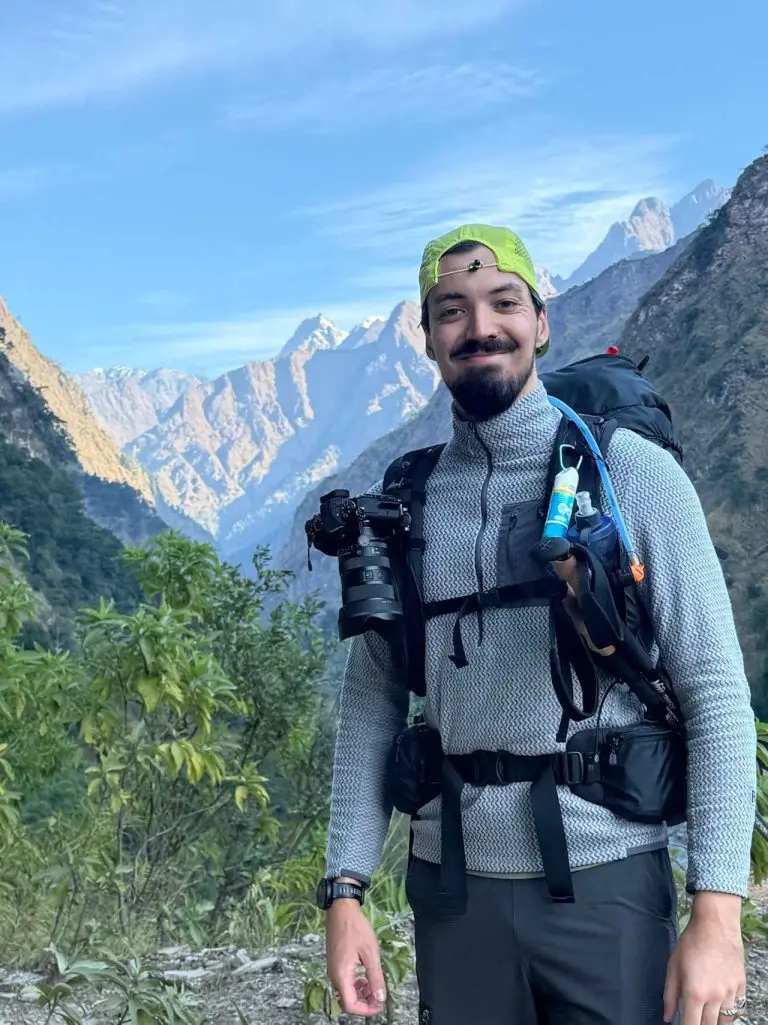
Manaslu Treks and Expedition works exclusively in the Manaslu and Tsum Valley region. Every guide we send to Tsum Valley has walked the route before, knows the communities along the trail, and understands the cultural protocols of the valley. Our permits are processed through the correct government channels and are always complete before departure. Our itineraries are built around real walking conditions, not optimistic estimates, and include the acclimatisation time the route actually requires.
We also handle the logistics that most trekkers do not think about until they are on the trail: advance teahouse arrangements during peak season when beds are limited in Nile and Chhokangparo, pre arranged transport at both ends of the trek, clear guidance on cash requirements since there are no ATMs in the valley, and detailed pre trek briefings that cover everything from the Shyagya custom to the correct behaviour at monastery checkpoints.
Our combined Tsum Valley and Manaslu Circuit itineraries give trekkers the option to see both regions without rushing either. The 23 day combined route and the 19 day version both follow realistic day stages with the acclimatisation built in, not squeezed out for the sake of a shorter package.
If you are looking for a Tsum Valley trekking agency in Nepal that knows the region from the ground up, handles every detail of permits and logistics reliably, and employs guides who genuinely understand the valley they are leading you through, reach out to us at Manaslu Treks and Expedition. We will answer your questions directly, provide a transparent itinerary and cost breakdown, and help you plan a Tsum Valley Trek that reflects the reality of what this extraordinary place has to offer.
Planning the Manaslu Circuit Trek and need help with permits, route, or itinerary?
WhatsApp us Email us